They told you to eat salmon for the omega-3, then they fed the salmon rapeseed.
The whole case for oily fish is the long-chain omega-3, the fat your brain and retina are built from, and the one fat in this whole debate both sides agree you need more of.
Farmed salmon does not make it. Nothing makes it. The fish gets it from eating smaller fish, which got it from algae. Take the smaller fish out of the feed and the salmon is a pink shape.
So the industry took the smaller fish out of the feed.
Fish oil is expensive and rapeseed oil is not. Between 2006 and 2015 the feed in Scottish salmon farms swung from fish oil to vegetable oil, and the omega-3 in the fillet on the shelf halved. Same fish, same price, half the point.
A portion of farmed salmon now carries half the fat you were sent to buy it for, and a load of linoleic acid the wild fish never had, because a salmon has no rumen and its fat is a printout of the feed bag.
The label still says rich in omega-3. Rich against what, it does not say.
The pattern holds across the whole shelf. Name a food for one virtue, industrialise it, quietly swap the virtue out for a cheaper oil, keep the name.
The salmon did nothing wrong. It ate what it was given. So did you.
Carnivore is a rigid, puritanical cult destined to collapse the first time it meets a holiday, so here is the report from Greece, three days in: 90% mutton and beef by choice, 10% baklava, nothing to confess.
Nobody made me order the mutton. Nobody is standing behind me at the grill. I eat this way at home because I like the food and I like how I feel on it, and both of those got on the plane with me.
So the mutton came under a fistful of oregano and I ate it. Something was fried in the wrong oil, twice, and I ate that. There is a pastry near the harbour with my name on it, and before the week is out it will find me.
None of that is a relapse. A relapse is what happens to a man on a diet. I am on a menu, and the menu is beef, and a menu does not mind if you order something else on a Thursday.
The critics have this exactly backwards. The rigid, all-or-nothing eater they keep describing is the one counting almonds and weeping over a slice of cake. That person is white-knuckling a rule. I am eating my favourite food in the sun and occasionally something else, which is what people who are not in a cult do.
Carnivore is my home diet. The baseline, the place I live, the thing I go back to next week because I want to. A baseline you cannot leave for a week is a cage, and a diet that collapses on holiday was never a diet, it was a performance.
This is why I have never tried to convert anybody, and why the purists in my own replies find me such a disappointment.
I want people to see the shape of human food. The ruminant, the fat, the milk, the egg at the top. The seed oil, the refined flour, the thing in a wrapper with a health claim on it at the bottom. Once you can see that, you can build your own way of eating anywhere along it, and you will do it better than any plan of mine, because it will be yours.
Right now the sea is warm, the grill is lit, and somebody's grandmother is making pastry.
Some cult. It let me out for a week and I am still eating the steak.
Fluoride was prescribed to slow an overactive thyroid down in the 1950s, at five to ten milligrams a day, and then it went in the water.
The gland runs on iodine. Fluoride sits in the same column of the periodic table and gets in the way of the iodine being taken up, so the gland slows.
Doctors used that on purpose. A 1958 paper in the endocrinology journal gave patients with overactive thyroids five to ten milligrams a day and watched the metabolism drop.
Fluoridated water runs at about a milligram a litre in Britain, and the toothpaste adds to it. Two litres a day and a brush morning and night gets an adult to getting on for half the low end of the dose that was once a prescription.
In 2015 researchers compared England's fluoridated areas with the rest. Practices in the fluoridated West Midlands were roughly twice as likely to be recording high rates of hypothyroidism as practices in Greater Manchester, which has no fluoride in the water.
The tired, cold, gaining-weight woman on a thyroid tablet for life is the patient the 1950s were trying to create, on purpose, with the same molecule, in a smaller dose, every day, from the tap.
In 2024 the American government's own toxicology programme concluded with moderate confidence that higher fluoride exposure is linked to lower IQ in children.
The dental argument was made in 1945, for teeth.
The thyroid argument was made in 1958, by doctors, and it was that fluoride slows the gland, which is why they gave it to the people whose gland needed slowing.
Nobody has reconciled the two, and both are still true.
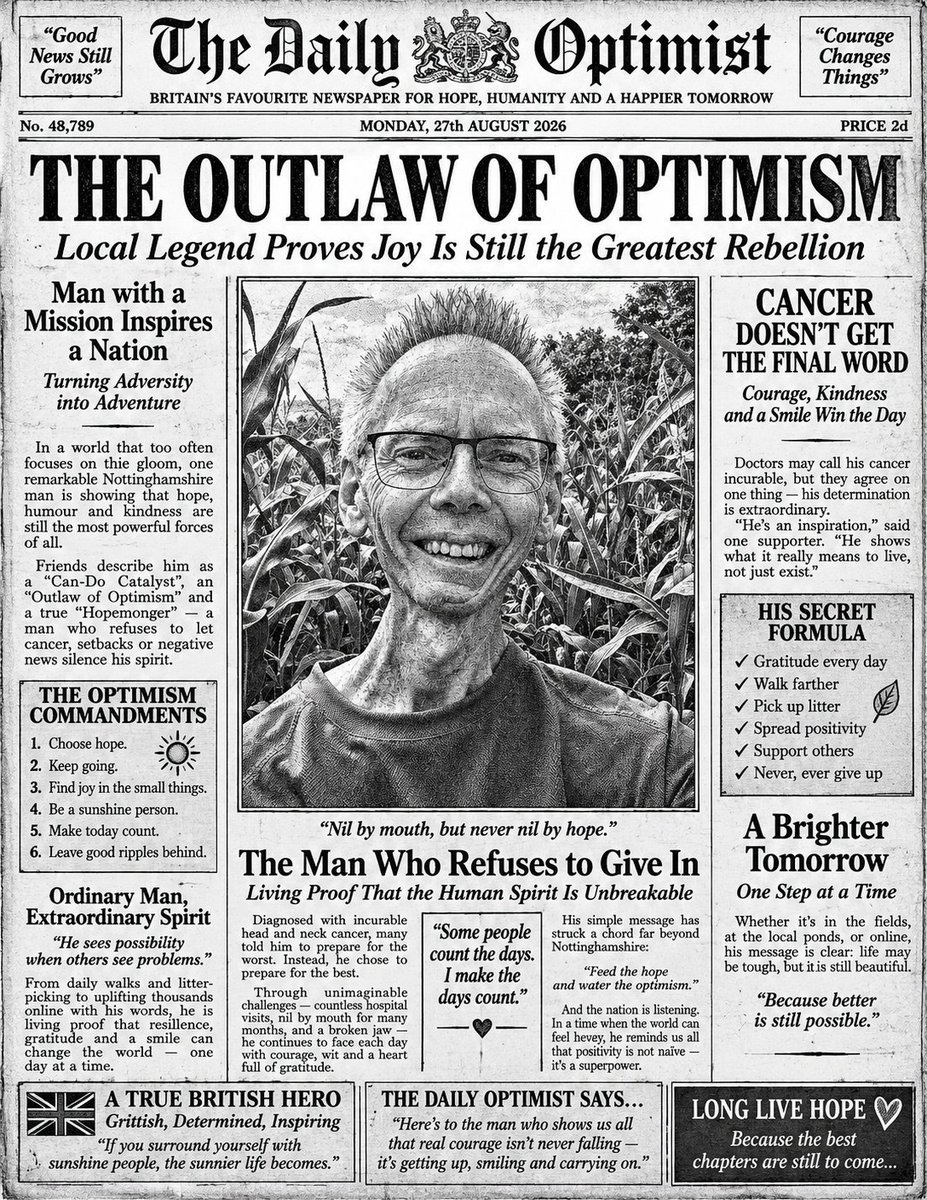
@John_Dabell I have had patients undergo total mandibulectomy (during my residency in ENT) to resect necrosed bone and remove the nidus of infection. It is a new kind of hard to live without a mandible, but I wonder if it would give you some relief. Sending love!!!!
You know what’s cool? The world isn’t as dark as the news consistently makes out. People aren’t as horrible as comments on social media would have you think. And there’s more of us that want to do good for each other than not.
For every awful headline, there are millions of people volunteering, helping children, helping animals, cleaning up the environment, checking in on someone who’s lonely, fighting for something they care about, or choosing to be kind.
Most of that will never make the news. But we can remind each other of how beautiful being alive really is.
To be able to give love and receive love. To watch a sunset. To spend a day with your best friend. To wake up healthy. To call your parents because they’re still around. To read your favourite book. To hug your dog because they’re a legend. The beauty of being human, what a gift!
That’s worth waking up for. Your life is worth waking up for. Don’t give up, you’re more important than you think. 🤍
RFK Jr. is correct. The fact is that there are billions of fragments of human cellular debris and DNA from the cultured cell line of an aborted fetus in every injected dose of MMR, chicken pox, and Hep A vaccines.
Because viruses multiply in cells, living cells are used to grow viruses for vaccine production, including the cultured cell lines of aborted fetuses. Two such cell lines are MRC-5 and WI-38, which are described by a company that sells them as follows: “The MRC-5 cell line was derived from normal lung tissue of a 14-week-old male embryo” and the “WI-38 cell line is the first human diploid cell line to be used in human vaccine preparation … [and] were isolated from the lung tissue of a 3-month-old, female, embryo.” https://t.co/y62xpnD114; https://t.co/MrMp5394fm.
The ingredients of chickenpox, rubella, and hepatitis A vaccines each include cellular and DNA pieces from these fetal cell lines. The ingredient list for Varivax (chickenpox) includes “MRC-5 human diploid cells including DNA & protein,” for MMR-II (which includes rubella) includes “WI-38 human diploid lung fibroblasts,” and for Havrix (hepatitis A) includes “MRC-5 cellular proteins.” https://t.co/HLXdeVjMKZ/pubs/pinkbook/downloads/appendices/b/excipient-table-2.pdf(https://t.co/jJSLoXzWke).
As for the quantity of human DNA in each vial, for Varivax, as the FDA explains: “human MRC-5 cells are the substrate upon which the Oka strain of varicella is grown. In the process of isolating virus from these cells, MRC-5 derived proteins and DNA are also obtained. The nearly 2 ug [2,000 nanograms] of unmodified mammalian DNA present in each dose of VARIVAX…” https://t.co/OU6WGu2nCS.
As for MMR-II, as RFK Jr. pointed out below, during Dr. Plotkin’s deposition, I asked: “Isn't it true that MMR II contains approximately 150 nanograms cells substrate double-strand DNA and single-strand DNA per dose purposefully fragmented to approximately 215 base pairs in length?” Dr. Plotkin answered: “Yeah, that's probably correct, yes.” https://t.co/9js9D2ipLQ p. 328 (https://t.co/yKGUIj9t4Z). See also https://t.co/yDfzW6CAaW; https://t.co/kw1RNTtMuH (See Table 3, reflecting an average of 142 nanograms of single-stranded DNA and 35 nanograms of double-stranded DNA in the rubella vaccine component of each dose of MMR-II; and an average of 276 nanograms of single-stranded DNA and 35.74 nanograms of double-stranded DNA in each dose of Havrix).
For DNA remaining in the final formulation, assuming pharma companies follow FDA’s guidance, they would fragment “the DNA size to below approximately 200 base pairs.” https://t.co/PNRGEYsJLD pp.29-30. Doing the math, supposing only 100 nanograms of double-stranded DNA remain, and are broken down into 200 base pair fragments, this equals approximately 463 billion pieces of human DNA from an aborted fetal cell line in each vaccine dose; double that number for single-stranded DNA. https://t.co/ga1ln5mSBI. See also https://t.co/nwCA2hBond.
Butter did not live in the fridge in this country until the mid eighties.
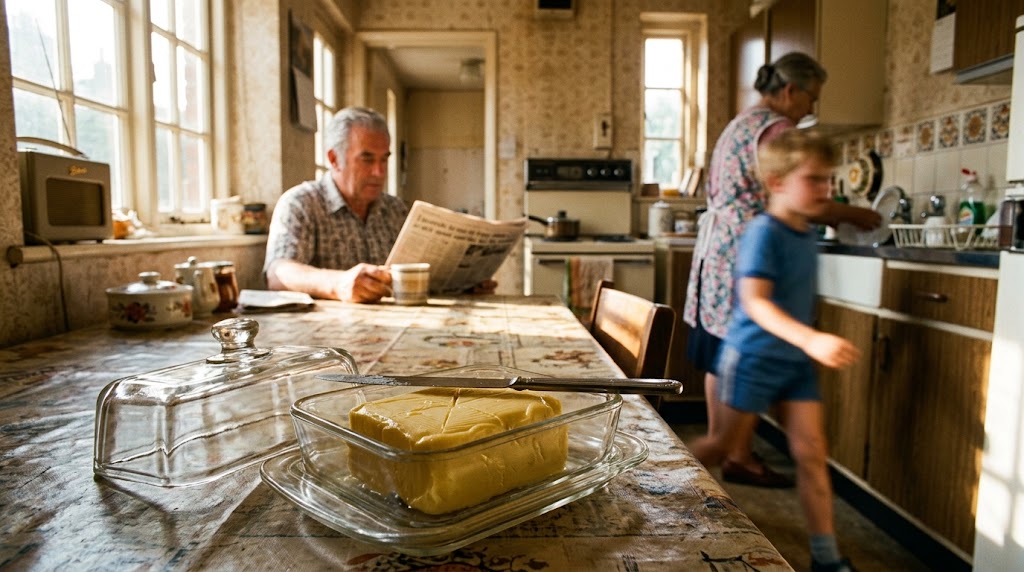
It lived on the table. Under a little lid, or a bell of frosted glass, and it stayed put from breakfast to supper. It got a top-up, never a wash and a fresh pack. When it ran low, more went in. It was there the way the salt was there and the teapot was there, and nobody in that house gave it a second thought.
And it was soft. You pulled it straight across warm toast without tearing a hole in the middle, without the wait, without the cold shrapnel that comes off a fridge-hard block.
It sat out through a July afternoon and nothing happened. It sat out through Christmas week beside the cake and nothing happened. Your grandmother kept butter on the side for fifty years and buried nobody.
Butter is around eighty per cent fat, and the water in it is locked in droplets inside that fat with the salt dissolved in them. Bacteria need free water and there is almost none to be had. The fat is the thing keeping it safe.
The fat. The exact property they spent forty years telling your mother would kill her is the property that lets butter sit on a table all summer and behave itself.
She knew none of that and she was right anyway.
Then the government's committee on nutrition reported in 1984, the country was told to cut the fat out, and inside about three years the dish was in a cupboard and there was a tub in the fridge door with a sunflower on the lid.
Butter out of a fridge cannot be spread. It tears the bread and sits on the knife in a lump. The tub beat butter on exactly one thing, which was that it came out already soft, and it only had that advantage because the competition had just been sent somewhere cold on doctor's orders.
Clover launched in September 1983, made by Dairy Crest, which was the processing arm of the Milk Marketing Board. The dairy industry's own company sold Britain the tub.
Then it sold the fix. Spreadable butter is butter with rapeseed oil blended through it so it comes out of the fridge soft, and the market leader runs at sixty four per cent butter to twenty three per cent oil. It costs more than the block it is diluting.
There is a generation now that flinches at a fat left out at room temperature, and the same people will eat mayonnaise out of a jar that has been sat on a warehouse shelf since March.
Leave a dish of it out tomorrow. Watch it sit there all day doing absolutely nothing, then spread it without a fight.
Your fridge is full of things that would have you on the floor by Thursday. The butter was never one of them.
Nobody in America got sicker on the morning of 4 June 1998. Twenty-nine million of them went to bed a healthy weight and woke up overweight, because the NIH had moved the BMI line from 27.8 to 25 overnight.
That is the whole business model. Here is the headcount.
1994: a WHO panel invents osteopenia. Bone thinner than a young woman's, nowhere near thin enough to break. Half of all postmenopausal women qualify on the spot.
1998: the overweight threshold drops to 25. Twenty-nine million new patients. Not one of them gained a pound.
2001: the cholesterol panel publishes ATP III. Americans recommended a statin go from 13 million to 36 million. Twenty-three million new customers in one afternoon.
2003: the blood pressure committee invents prehypertension. A diagnosis for people whose blood pressure is normal. Forty-five million qualify on day one.
2013: the statin guideline is rewritten. Another 12.8 million eligible, almost all over sixty, none with heart disease. Eight of the nine men who wrote it were on the payroll of statin manufacturers, disclosed only when they were forced to.
2017: hypertension moves from 140 over 90 to 130 over 80. The share of American adults labelled hypertensive jumps from 32 per cent to 46. Thirty-one million people, before lunch.
2026: the new cholesterol guideline lands in March. Another 21.5 million eligible, total now 87.5 million. The people it just added carry an average ten-year risk of 3.1 per cent. Which is to say, almost none.
Not one of those was a discovery about the human body. Every one was a decision about where to draw a line on a chart, taken in a room, by a show of hands.
And note the direction. Thirty years, four organ systems, and the line has never once moved back. No panel has ever sat down, reviewed the last panel's work, and handed several million people their health back.
Over 140 million reclassifications in a single country. A woman of sixty-eight can sit on four of those lines at once and be four kinds of ill without a single symptom, on five tablets, for a body that is doing exactly what a sixty-eight-year-old body does.
A cure is capped by the number of people who have the disease.
A threshold is capped by the population.
Iceland has a breed of sheep that nobody breeds for meat, because for a thousand years it has been bred for one quality only. Judgement.
They are called forystufe. Leader sheep. Taller, longer in the leg, narrower through the body, oddly marked, and always at the front, with their heads up while the rest of the flock has its head down. When they move, the flock moves. Nobody votes.
A proven leader sold for two or three times the price of a good sheep. Bloodlines became famous. When a great one died, the farm kept the head.
And the claim attached to them sounds like folklore until you read the records. They know the weather is coming, sometimes a full day out. If the leader will not leave the barn on a morning that looks perfectly fine, you do not move the flock. Farmers arranged their winters around the opinion of a sheep, and wrote it down as fact.
Autumn round-up, 1884. A large flock is being driven across the interior when a blizzard comes down on open sand and rock. Every landmark goes. You cannot pitch a tent on that ground and turning back is worse than going on.
At the front is a ram called Surtur, from Svinavatn, already known as a superior leader. The fjallkongur, the man running the round-up, makes a decision. He hands the whole thing to the sheep and tells his men to stay together.
A third of the way across, Surtur stops, turns, and walks back down through the flock to find the men. His face is packed solid with ice and he cannot see. They clear it. He returns to the front and walks back into the weather.
He comes back for the same service several more times that night. Nobody has to fetch him.
Then he stops and will not move at all. The men feel about and find grass under their boots, which tells them they are off the desert and nothing else whatsoever.
At dawn the storm eases and they work out where they are.
They are standing on the exact spot the round-up stops every year after crossing the sands. Surtur had halted there since he was a lamb. Afterwards the fjallkongur told his owner that without the ram, men would have died out there as well as sheep.
There are fewer than 1,500 leader sheep left, all of them descended from one district in the north east. Iceland recognised them as a breed of their own in 2017. There is a small museum out there, run by a local teacher, with the heads of the great ones on the wall and a coffee blend named after the animals. The saying on the wall is that if you wear clothes made from their wool, you will always find your way home.
Genetic work has since confirmed they really are distinct from every other Icelandic sheep. The folklore was right. Folklore usually is, out where the weather kills people.
No laboratory. No pedigree software. No genome. Just farmer after farmer, century after century, watching which animal was at the front when the light went, and breeding from that one.
A thousand years of selecting a sheep for its judgement, and at the end of it they built it a museum.
And here we are, in the country that calls them stupid.