👏 Congratulations to Megan and all co-authors on this important contribution to understanding and protecting Red Sea biodiversity!
📖 Read the full paper open-access here: https://t.co/yBEiEp9JqA
🌊 What does the future hold for deep-sea corals in the Red Sea? 🪸
We are excited to share @_Megan_Nolan’s new paper!
In this study, the team investigates how climate change could reshape the distribution of four mesophotic and deep-sea corals across the Red Sea.
These findings underscore that even deep-sea ecosystems are not sheltered from the impacts of climate change and highlight the importance of incorporating future environmental scenarios into marine conservation and spatial planning.
📍 Risk varies widely among reefs and coral taxa
Understanding this variability is key to predicting which reefs are most vulnerable as heatwaves become more frequent.
📖 Read the full paper open access at: https://t.co/i0xUARbXjV
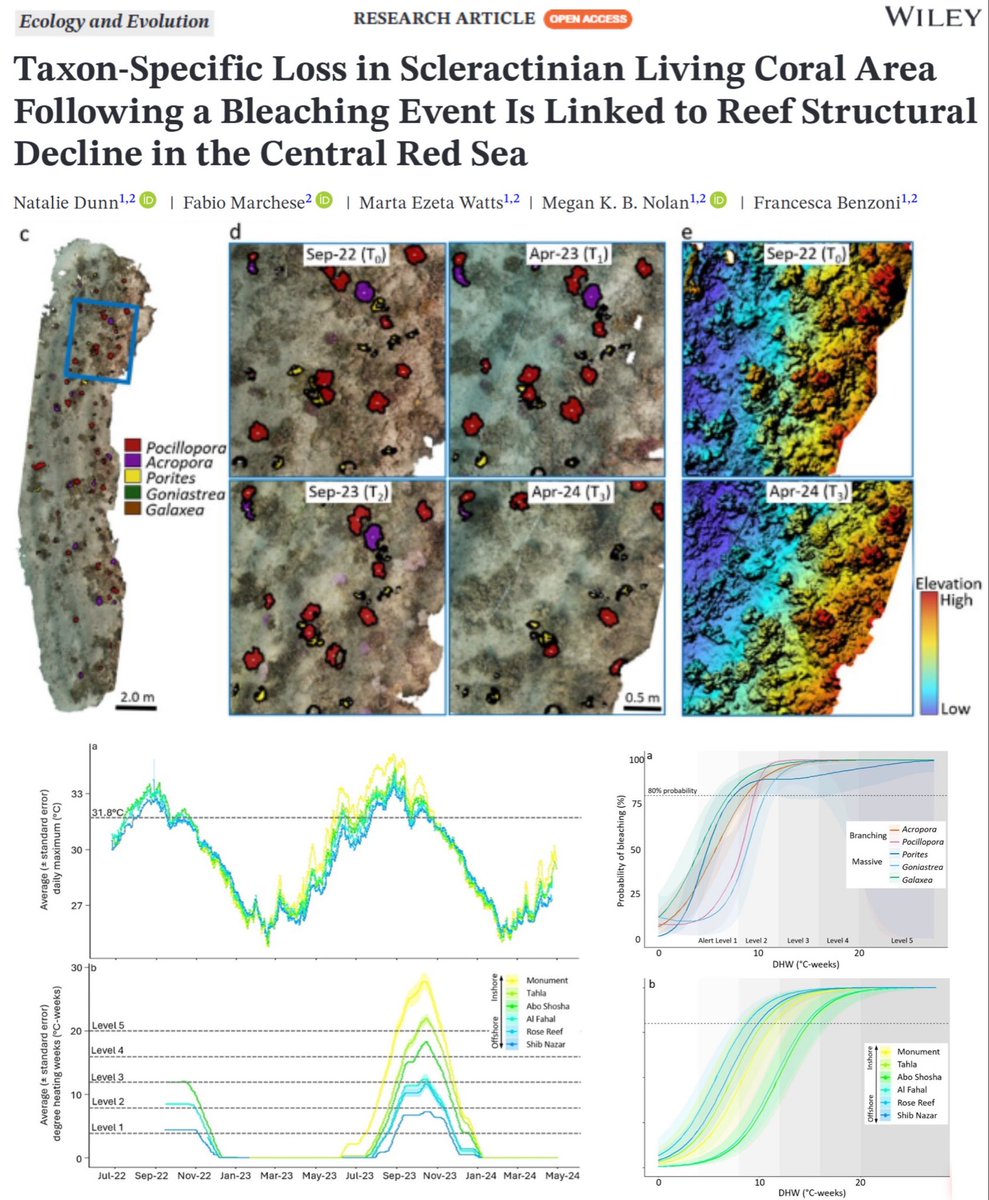
🚨 New publication out in Ecology and Evolution Wiley!
Congratulations to Natalie Dunn and the team on this new study.
Marine heatwaves are reshaping coral reefs, but how do those impacts scale from individual colonies up to the whole reef?
We tracked coral colonies through the 2023 bleaching event in the central Saudi Arabian Red Sea, using Structure-from-Motion photogrammetry to track the changes.
Key findings:
🪸 Bleaching-driven mortality can rapidly erode reef structural complexity
and most severely. Although many colonies died, nearly half recovered, and the temperature data made it possible to define a species-specific bleaching threshold for the Red Sea.
Read the full paper at: https://t.co/uWzq8CaZEA
#CoralBleaching#CoralReefs#RedSea#ClimateChange
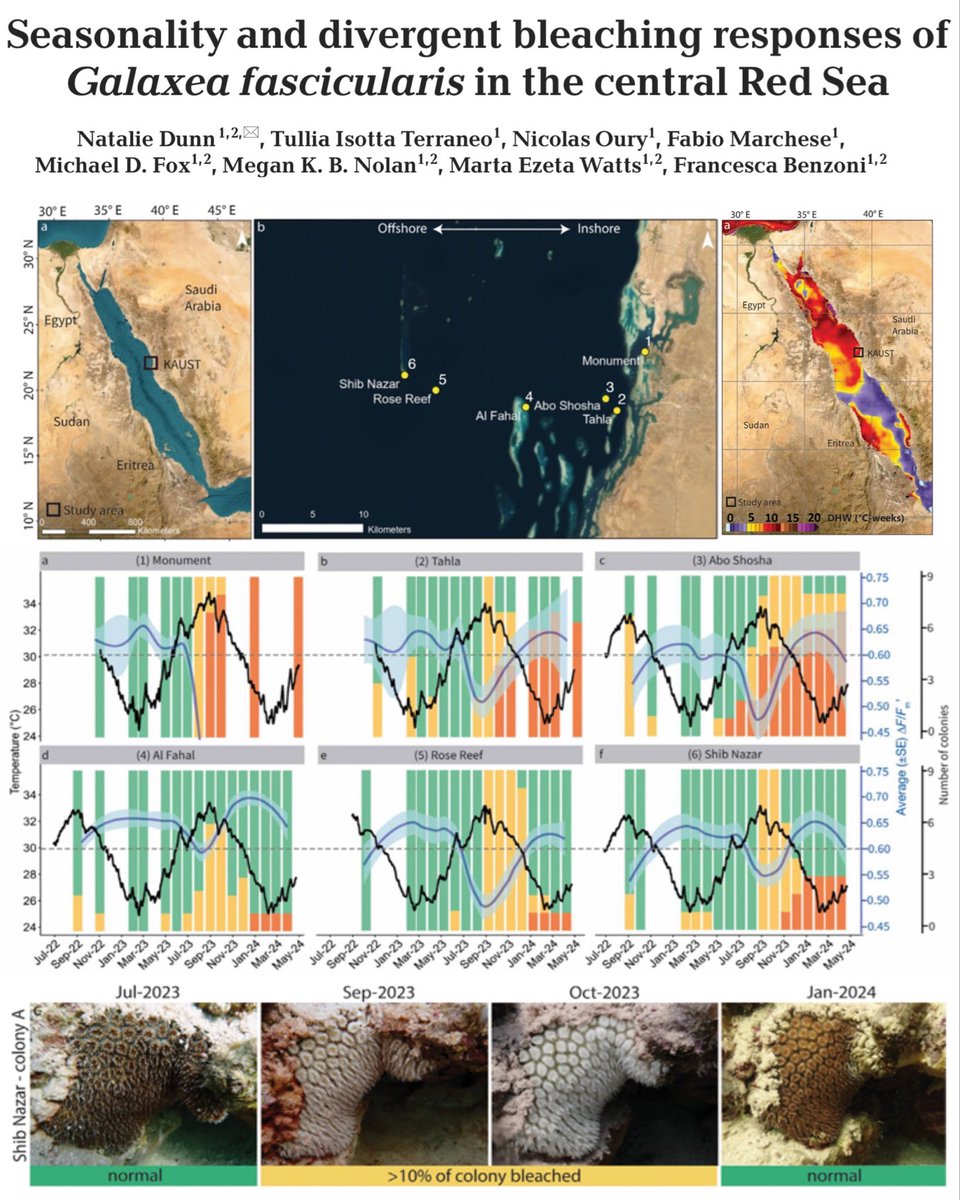
Congratulations to our @nattiedunn and all the team for this new publication!
In this study, she monitored 54 colonies of Galaxea fascicularis across six reefs in the central Saudi Arabian Red Sea, from inshore to offshore, measuring their photophysiology monthly for almost two
years, alongside high-resolution temperature data, to better understand bleaching at the colony level.
The data revealed a clear seasonal signal in photochemical efficiency, which dropped as summer temperatures rose. Bleaching began in August 2023 and affected inshore reefs first
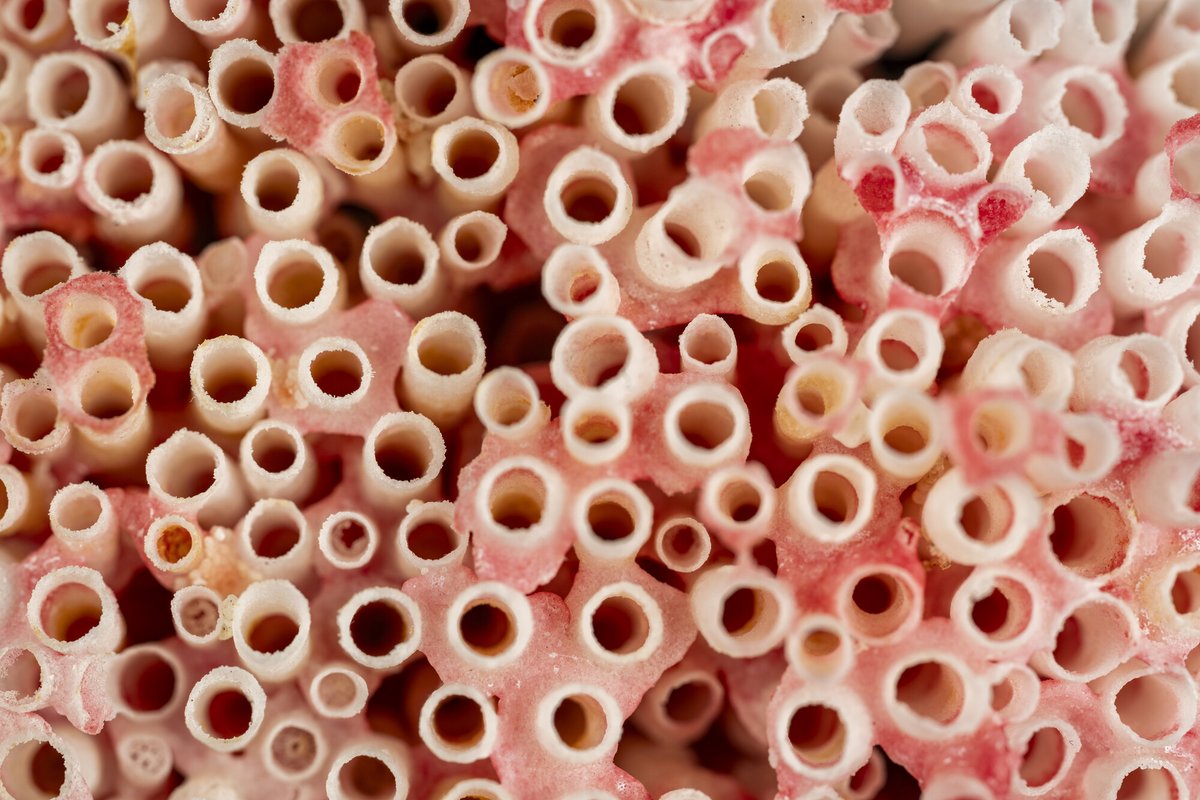
KAUST scientists discover that organ pipe coral is made up of at least 15 genetically distinct lineages, including two that may exist only in the Red Sea.
The study uncovers hidden coral diversity and sheds new light on the evolutionary history and distribution of reef organisms.
Discover more: https://t.co/qKnfAxryar
#ICYMI 🪸 Scientists have discovered that one of the ocean’s most recognizable corals, the iconic “organ pipe coral” — long believed to be a single species — includes at least 15 genetically distinct lineages. Two are known only from the Red SeaStory: https://t.co/i4soZMGoaU
Scientists have discovered that one of the ocean’s most recognizable corals, the iconic “organ pipe coral” — long believed to be a single species — includes at least 15 genetically distinct lineages.
🪸 Story https://t.co/i4soZMGoaU
Study https://t.co/GLMJrCDfyF
@KAUST_News
- A reference collection for octocoral research in the Red Sea
- New insights into mesophotic and deep-sea biodiversity, still largely unexplored, as well as 10 new records for the Red Sea
- A foundation for biodiversity assessments in this rapidly developing region
Here, we present the first comprehensive molecular assessment of octocoral diversity in the Saudi Arabian Red Sea, harnessing sampling efforts spanning the latitudinal extension of the basin and more than 800 m depths.
This study provides:
Our manuscript titled "The hidden diversity of Saudi Arabian Red Sea octocorals revealed through a morpho-molecular assessment across bathymetric and latitudinal gradients", based on the results of my first PhD chapter, is now published open access: https://t.co/0psQhvCaSS
Congrats again to all the HaBBs for another successful conference 🪸🦀 A special mention to our Vicky and @bhr_suzy for winning the best poster and best oral presentation, respectively. We are proud of you girls 💫
@Ecrs2024#ecrs2024