Last Saturday was worth it.
To everyone who showed up, stayed through the conversation, asked questions and shared perspectives — thank you.
To our guest speakers — thank you for showing up with real experience, honest insights and practical breakdowns.
Starting an Android project is easy. Building a foundation that still works when the product, codebase, and team grow is the difficult part.
I built **AndroidProjectTemplate**, a reusable Android foundation designed to remove that repeated setup work.
It includes:
✅ Modular MVVM with clear dependency direction
✅ Jetpack Compose, Material 3, Hilt, Coroutines, and Flow
✅ Gradle convention plugins and a version catalog
✅ JVM, ViewModel, repository, and Compose tests
✅ Detekt, ktlint, Kover reports, and a 70% coverage gate
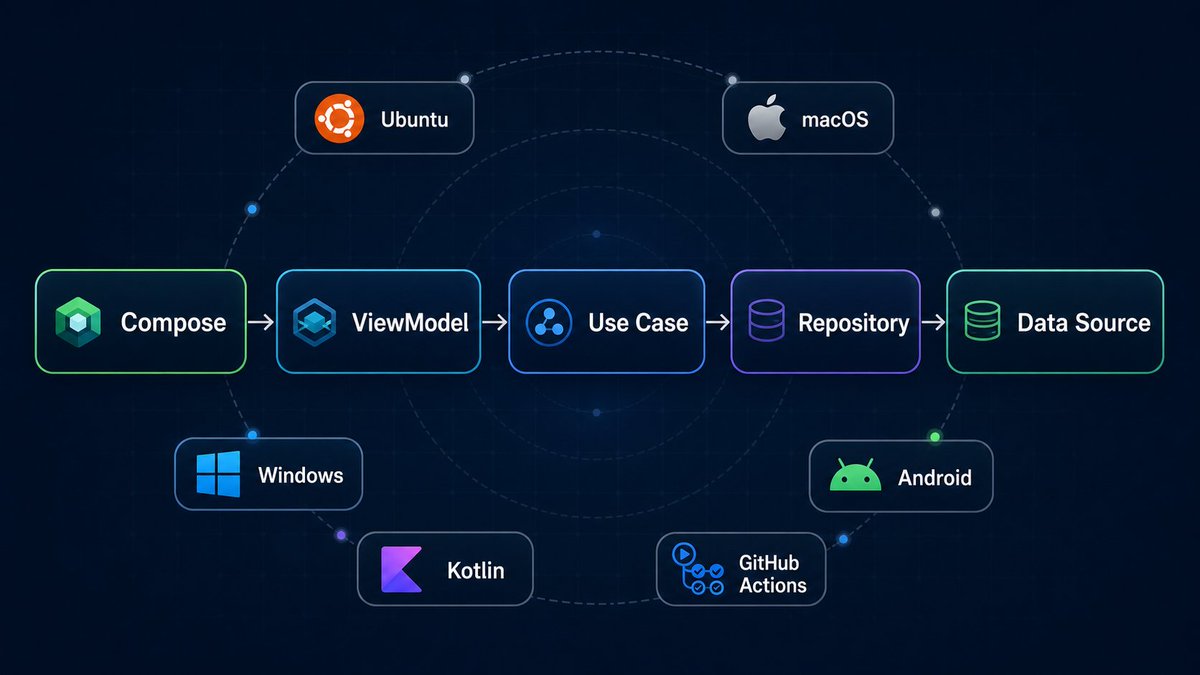
✅ GitHub Actions for Ubuntu, macOS, and Windows
✅ Bash and PowerShell project initializers
✅ A secure signed-AAB workflow with no credentials committed
The important part is not the number of modules or libraries. It is that the starter demonstrates a complete, executable path:
`Compose → ViewModel → Use Case → Repository → Data Source`
Developers can select **Use this template**, create an independent repository, run one initialization command, and start building product features with the architecture, tests, and delivery baseline already in place.
Template: https://t.co/yWYa1JTG7j
I also wrote a detailed walkthrough covering the architecture decisions, testing strategy, convention plugins, cross-platform CI/CD, and trade-offs:
Article: https://t.co/GcRpzUhOuP
I would love feedback from Android engineers: what is the one capability you always add to a new project?
#AndroidDevelopment #Kotlin #JetpackCompose #SoftwareArchitecture #MVVM #Gradle #GitHubActions #OpenSource
Just published:
how I standardized AI-assisted Android development on Ubuntu using android-agent-project-kit 🚀
It installs shared agent rules for Codex, Claude, and Cursor, plus PR templates, so Kotlin/Compose quality stays consistent across projects.
Article: https://t.co/k3hbomuIRq
Repo: https://t.co/b2PNITrhbx
#AndroidDev #Ubuntu #JetpackCompose #Kotlin #AIcoding #OpenSource
Last Saturday was worth it.
To everyone who showed up, stayed through the conversation, asked questions and shared perspectives — thank you.
To our guest speakers — thank you for showing up with real experience, honest insights and practical breakdowns.
Last Saturday was worth it.
To everyone who showed up, stayed through the conversation, asked questions and shared perspectives — thank you.
To our guest speakers — thank you for showing up with real experience, honest insights and practical breakdowns.
Conversations like this are why Hacker’s Code Community exists — a space where learning is practical, perspectives are shared openly and people grow together.
We’re live NOW
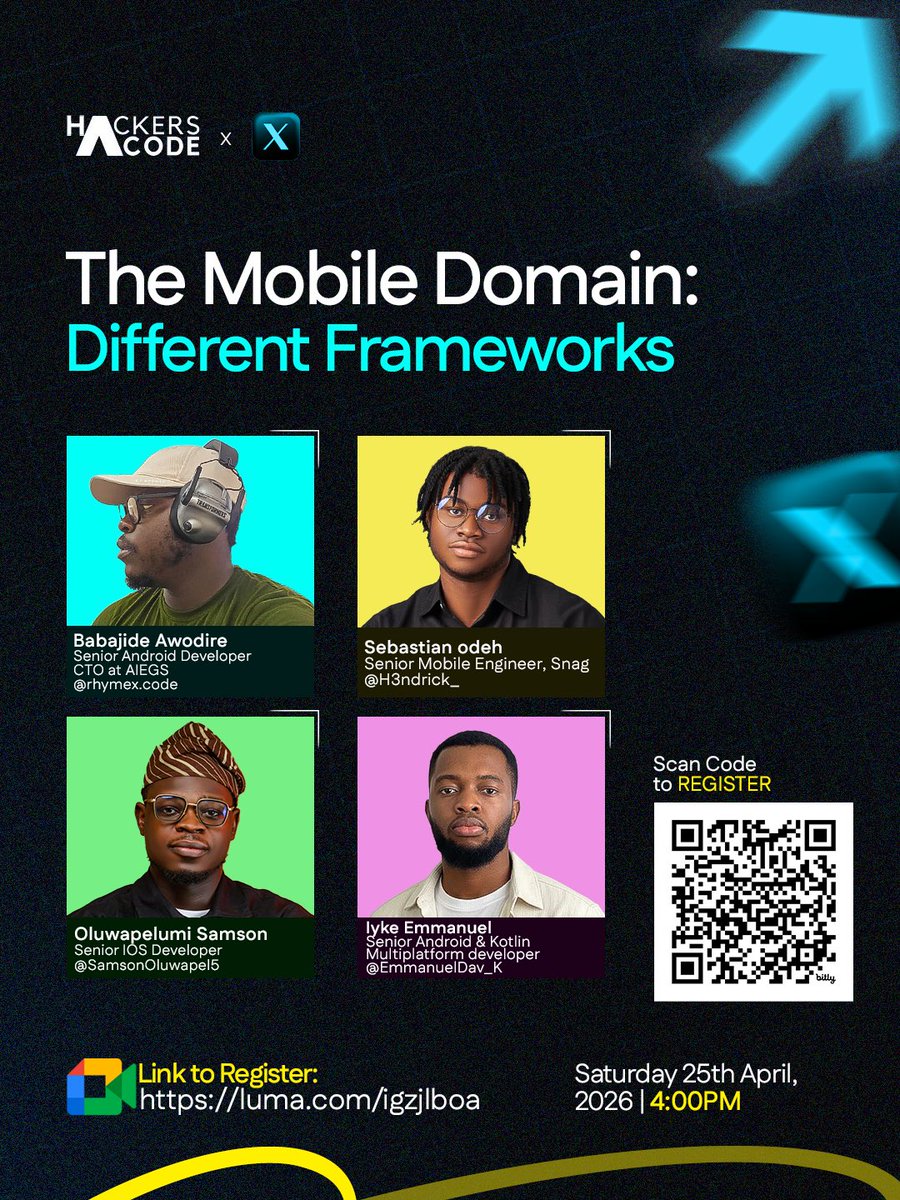
Topic: The Mobile Domain
If you’re building, learning, or stuck on which framework to focus on, pull up.
Join in now: https://t.co/uvB6GDC2yD
See you soon.
#Android#KMP#Flutter
We’ll be unpacking this from real-world perspectives at the upcoming session.
👉 Register to join the conversation: https://t.co/7PWUN34IHd
#Android#KMP#Flutter
Let’s look at this case study:
A developer spent months building with a particular mobile framework.
On paper, it made sense —strong community, fast development, widely recommended. Everything pointed in the right direction.
But as the product grew, things started to shift.
When choosing a mobile framework, what should matter most — speed, performance, flexibility, team structure, or something else?
For those who’ve built before: At what point do you realize a framework is no longer the right fit?
We apologize for the disruption during our last Space 🙏
X had other plans, but we’re back stronger.
📅 April 25
🎙️ The Mobile Domain ( Different Frameworks )
If you missed it or got cut off.
this is your chance 👇
🔗 https://t.co/7PWUN34IHd
Don’t miss it this time 🚀
The session will be rescheduled soon and we’ll share the new details ahead of time so you can plan to join us again—this time, properly.
Thank you for showing up. We don’t take that for granted.
— Hackers Code Community
#TechCommunity#DeveloperCommunity#OpenSource
We owe you an apology.
Earlier today, we experienced repeated network disruptions during our live session and we know how frustrating that was—especially for everyone who showed up, stayed, rejoined and genuinely wanted to be part of the conversation.
We’re already working on making sure future sessions are hosted on a more stable and accessible platform, so conversations can flow the way they’re meant to—without interruptions.