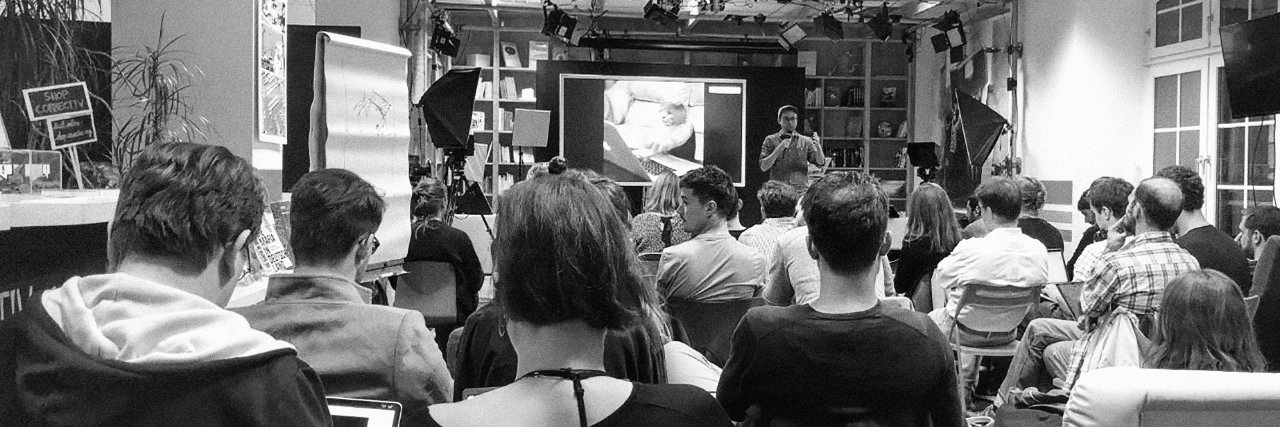
Now Hilde Weeg and Christine Olderdissen of @Journalistinnen, the association of woman journalists in Germany, are presenting their work. They aim to improve how women (and all genders) are represented in the German media, both in terms of employment and language.
@genderleicht is a website that has tricks, hints, and checklists that help you use gender inclusive language. It also provides arguments for using gender inclusive language, which is still controversial in many German newsrooms. They also organize workshops for journalists.
Another link from tonight's Hacks/Hackers Berlin: The ASNE Newsroom Diversity Survey has a lot of insight into diversity situation in US newsrooms. https://t.co/xeeGcBAsRG
If you want to learn more about diversity issues in German media and how to address these issues, check out "Diversity im Medienhaus", the book by @NDMedienmacher. 📘 https://t.co/OY8OiE51Yq
Next up, Rebecca Roth and Natalie Sablowski (@NA7AL13) of @NDMedienmacher present the work their organization is doing in the German media industry. https://t.co/cKsXh8dvgJ
But this kind data is necessary in order to improve their representation in the media. One approach is to collect that data themselves, which is what a group of data journalists with Neue Deutsche Medienmacher*innen is working on.
Simple things people can do, according to Sisi’s experience: Many organisation don’t understand the demographics of their own organization. People from the Hacks/Hackers community can help with collecting that kind of data, e.g. by conducting an (optional) census in their orgs.
Our first speaker is @sisiwei, who is the manager of programs as @opennews and has launched the DEI Coalition for Anti-Racist, Equitable, and Just Newsooms together with 100 members of the journalism industry in the US.
The DEI Coalitions is a virtual space, organized via Slack that organizes journalists, journalism managers, students and others that engage around building more just and anti-racist policies in media organizations. https://t.co/aPNqwptTd1
What does it take to create an anti-racist, equitable, inclusive, and collaborative workplace for journalists? Our speakers @sisiwei@NDMedienmacher@Journalistinnen have an idea or two. Join us for #HHBER 55, all details here: https://t.co/pXRGbbBXtR
#Diversity
📢 TONIGHT, we're live streaming the Berlin Hacks/Hackers meetup! This time, we'll discuss diversity issues in the media and how to tackle them—with talks by @sisiwei, @NDMedienmacher and @Journalistinnen. Everyone can join. See you all there! https://t.co/27kmJmD316
👏👏👏 Thanks so much to our amazing speakers @mialomo, @c_endt, @lus_berlin, and to everyone else who joined us tonight. Watch this space for updates about our next meetup!
@mialomo's key learnings: Tech Handbooks have a short active shelf-life, but are hugely valuable. Handbooks need better platforms and collaboration methods. Also, communities are at the core. If their needs are not met, they leave.
Things that didn't work so well: Google Docs and other collaborative documents are not very usable in the long run. There also wasn't much diversity in terms of users and it was very focused on western countries, even though there were initiatives to translate to other languages.