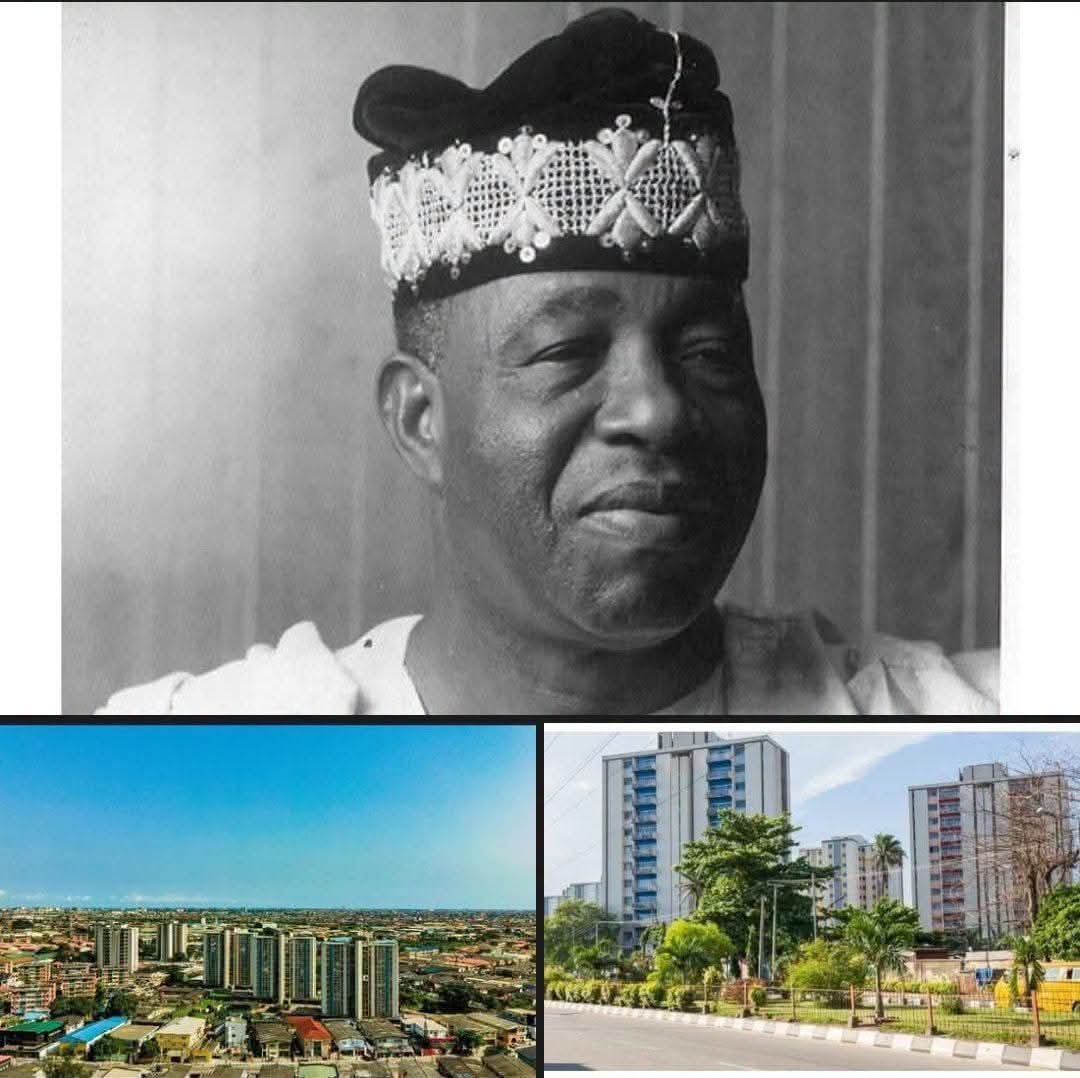
THE MAKING OF SURULERE; THE K.O. MBADIWE CONTRIBUTIONS
FOR THE RECORDS
REMENBERING HON KO MBADIWE. (TIMBER AND CALIBER)
How Kingsley Ozumba Mbadiwe Changed the Face of Surulere
Many people know Surulere today as one of Lagos' most popular and vibrant neighbourhoods. But few know that before the 1950s, the area was largely known for its overcrowded slums and poor living conditions.
The story of its transformation is closely linked to one man—Kingsley Ozumba Mbadiwe.
In January 1954, Mbadiwe was appointed Nigeria's Minister of Lands, Surveys and Natural Resources. At the time, Nigeria was still under British colonial rule, and he was one of the twelve Nigerian ministers serving in the colonial Council of Ministers under the Macpherson Constitution. The Council was made up of representatives from the NCNC, the Action Group (AG), and the Northern People's Congress (NPC), and was chaired by the Governor-General, Sir John Stuart Macpherson.
Shortly after taking office, Mbadiwe presented a bold proposal. He told the Council that he could clear the sprawling slums on the Lagos mainland and replace them with a modern housing estate within just one year.
The proposal reportedly faced strong opposition, particularly from members of the Action Group, who questioned whether such an ambitious project could be completed within that timeframe. Despite the resistance, the Council approved the plan.
Mbadiwe got to work.
Within twelve months, the slums had been cleared, and the Surulere Housing Estate had taken shape. Families were relocated, new homes were built, and what was once considered one of Nigeria's most prominent urban slums gradually became one of Lagos' best-planned residential communities. Over time, Surulere attracted businesses, schools, and other developments, growing into the thriving neighbourhood that many people know today.
For many historians, the Surulere project remains one of the most remarkable examples of urban renewal in Nigeria's history. It stands as a reminder of what visionary leadership and decisive action can accomplish.
Whether viewed from a political, historical, or developmental perspective, Kingsley Ozumba Mbadiwe's contribution to the growth of Lagos remains an important part of the city's history—one that deserves to be remembered.
#NigerianHistory
🚨 URGENT SAHEL UPDATE: A massive military convoy has officially entered the volatile Koalou border zone near Benin 🇧🇯
🇧🇫Burkina Faso is actively asserting absolute border sovereignty and locking down the region against external destabilization. The days of Western-mandated security vacuums are officially over.
The multipolar shift isn't just happening in Europe and Asia—the AES is establishing physical control on the African continent today.
IMF & World Bank Economists Secretly Apologise For Destroying Africa
Economist @ProfSteveKeen says many economists who have worked at the International Monetary Fund and World Bank regret the policies they helped construct that would eventually ruin African countries.
Should your African country continue to take loans from these institutions? Drop us a comment.
For more like this, follow The Spearhead.
Video credit: “Going Underground” hosted by @afshinrattansi
Paramilitary Infected Black South Africans With AIDS
According to Alexander Jones, South African intelligence officers purposely infected Black South Africans with AIDS in the 1980s and 1990s.
Jones is a former member of South African Institute for Maritime Research (SAIMR), an apparent euphemism for a g*nocidal paramilitary. He admitted it in a 2019 documentary, ‘Cold Case Hammarskjöld’ by Danish filmmaker @MBrgger.
Is it no wonder Africans don’t trust European settlers? Drop us a comment.
For more like this, follow The Spearhead.
Video credit: ‘Cold Case Hammarskjöld,' Mads Brügger
🚨 🇧🇫 Burkina Faso is building roads, launching regional development brigades and reclaiming its sovereignty under President Ibrahim Traoré.
For over six decades France kept this nation in an economic chokehold, leaving its infrastructure completely underdeveloped.
Now, through the state led Faso Mêbo Agency, Burkina Faso is utilizing its own national treasury to purchase hundreds of heavy public works vehicles—independently building its own future without begging Paris for aid.
She asked a legitimate question. A South African minister publicly labelled Nigerians as drug dealers, and a Nigerian journalist asked for accountability.
Instead of answering, suddenly the question was “disrespectful” and she was threatened with being kicked out.
At this point, I genuinely believe some South Africans are simply intimidated by Nigerians. The hostility is becoming irrational. You cannot publicly stereotype an entire nationality and then become offended when a Nigerian has the audacity to question you.
She asked a question. If the statement was defensible, defend it. Threats and intimidation are not answers.