On Kurdish urban settlement in Iraq and Syria:
As we have noted before, demographics are one of the key differences between Iraqi and Syrian Kurds and a main reason their models have diverged so sharply.
Urban settlements are one of the clearest examples. Cities shape how wars are fought, drive intellectual production and productivity, and form the foundation of any viable entity.
Syria has only three Kurdish-linked cities with populations over 100,000, and two of them are highly mixed despite their large Kurdish populations. Afrin is the only solidly Kurdish city of that size, while Qamishli and Hasakah are mixed.
Iraq, by contrast, has at least nine solidly Kurdish-majority cities over 100,000, plus two mixed ones.
The gap widens further down the scale. Extending the count to towns of 50,000 to 100,000 adds only six in Syria, while Iraq has more than 26 towns over 50,000, most of them solidly Kurdish.
As we argued in a previous piece, this helps explain why the governing models in Syria and Iraq have diverged so clearly, and not only with regard to the Kurds: https://t.co/FMm2za6eTc
Even the Syrian towns we have classed as Kurdish-majority sit within mixed surroundings. In Derik (al-Malikiyah) and Girkê Legê (al-Muabbada), Kurds likely make up over 70 percent of the population, yet both towns have a sizeable Arab presence, particularly in the surrounding countryside. This pattern holds across most Kurdish-majority areas in Syria. In Iraq, the Kurdish areas are too demographically consolidated for a Syrian-style model to apply.
Urban settlements matter on several levels. Economically, they underpin the viability of any region. Intellectually, larger cities generate more output and perhaps a population more ready to sustain a polity. Militarily, alongside topography, they make war far more difficult and costly, so the larger the cities, the weaker a central government's incentive to launch a military campaign.
This is one reason such a campaign is much harder to contemplate in Iraq. In Syria, the SDF-led administration sought to hold on to Raqqa and Deir ez-Zor partly because it needed a larger population and greater geographic depth to be viable as a region. Once those areas were lost and it was pushed back to a small pocket in Hasakah province, its viability fell sharply, especially as the province's two largest cities, Hasakah and Qamishli, are highly mixed and unlikely to be dominated by any single group.
Kurdish-majority and mixed cities of over 100,000 in Iraq and Syria: https://t.co/c2tSYNZGVi
More on how demographics doomed a Kurdish national project in Syria:
https://t.co/3SyaXA4YNR
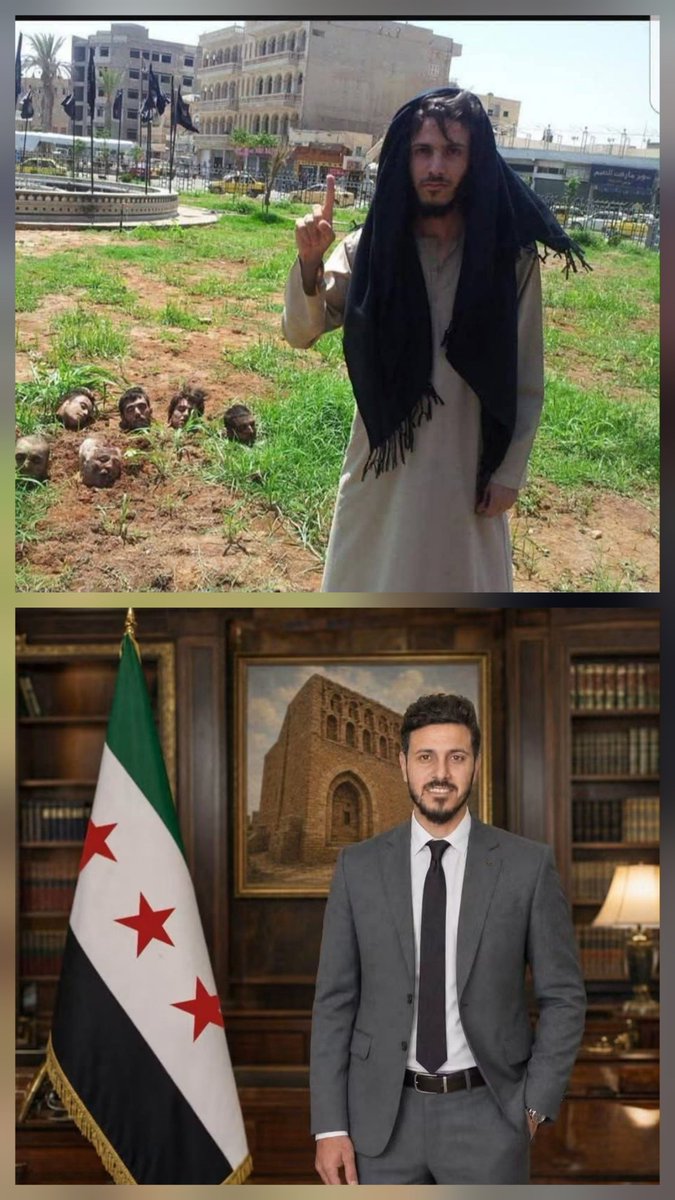
🚨 SYRIA: FORMER ISIS MEDIA FIGURE REPORTEDLY GIVEN GOVERNMENT MEDIA ROLE
Mohammed al-Nashif has reportedly been appointed Director of Digital Media for Raqqa Governorate under Ahmad al-Sharaa’s government.
According to reports about his background, al-Nashif began with the Free Syrian Army before later working for Amaq, ISIS’s principal propaganda outlet.
His family even reportedly announced his death after a U.S.-led Coalition airstrike in 2017 and held a funeral — only for him to reappear roughly a year later.
Now, he is reportedly back in Raqqa — this time with an official government title.
عينت حكومة الشرع "محمد الناشف" مديراً للإعلام الرقمي في الرقة، وهو إعلامي سابق في تنظيم "داعش"، واشتهر بصورة ظهر فيها أمام 7 رؤوس مقطوعة عام 2015..
وين كنتم طوال 14 عاما؟
كنا نقف في مواجهة داعش والنصرة، ونحذر من خطر الفكر الجهادي، بينما كان بعضكم اختار الهروب إلى أوروبا والعيش بنعيم العلمانية.!!
Israel faces a strategic paradox in Syria: the more it escalates to constrain Turkish military influence, the more important Turkey becomes to Damascus. Here is why.
Walla, an Israeli news site with close ties to the security establishment, quoted an Israeli security official this month: "Moderate Sunni states, including Saudi Arabia and the United Arab Emirates, are working around the clock to draw Sharaa closer to them...Al-Sharaa will not be so quick to hand territory over to Erdogan, nor will he necessarily allow him to take control of military bases in Syria. Therefore, to some extent, the recent Israeli strike in Syria helped Ahmed al-Sharaa."
This misreads the position of Ahmed al-Sharaa, the former rebel commander who now leads Syria.
Saudi Arabia is not on a par with Turkey in Syria. Al-Sharaa's central ambition is a strong army, and among the regional powers Damascus can work with, only Turkey has the industrial breadth and military capacity to help build one. Saudi Arabia can bring money and political backing, but its struggle to contain the Houthis in Yemen shows how far it is from matching Turkey's influence and reach.
Israel judges Turkish influence largely by bases and troops on the ground. Ankara is aiming for something more lasting: to become the ecosystem the Syrian army operates within. That starts with officer education and training, which are already under way, and extends to the systems the new army is built around, from software and radars to the architecture linking its forces, followed by ammunition, sustainment and refurbishment. Each layer turns a single sale into a continuing relationship.
Israel's objection goes beyond Turkey. It wants Syria too weak to challenge its uncontested advantage in the air and on the ground, and after Bashar al-Assad fell in December 2024, the Israeli military said its strikes had destroyed up to 80 per cent of the Syrian army's capabilities. Al-Sharaa wants the opposite: a unified state with an army strong enough to make Syria a regional power. Turkey shares that goal for its own reasons. It has a border of roughly 900 kilometres with Syria, it wants a strong neighbour as a buffer against Israel, and it wants a central government able to prevent the Kurdish national project in the north-east from reviving. On Syria's recovery, Damascus and Ankara are on the same side.
Three trends are converging to make Turkey Syria's most practical partner. The first is global rearmament. Only a handful of countries can equip an army across every service, and most are out of reach. Russia's output is absorbed by the war in Ukraine. China is Washington's main rival while Syria is trying to rebuild relations with the West. The United States keeps its arms embargo on Syria and has warned even close allies of delivery delays of up to five years as the Iran war drains its stocks. Europe is rearming for itself, and South Korea's order books are full for years.
The second is Turkey's industrial maturity. Its defence industry now produces most of what Syria would need from rifles and armoured vehicles to drones, radars, air defence, tanks and warships, which is what makes the ecosystem model possible. Syria would be its largest test, and Turkey could come to hold the place in the Syrian military that the Soviet Union once did.
The third is Washington's posture. The United States withdrew its last troops from Syria in April. With rivalries with China and Russia and a war with Iran to manage, it has little appetite for a confrontation with a NATO ally over Syria's army. Washington's latest national security and defence strategies explicitly call for burden-sharing by regional partners, and the security strategy names Turkey among the countries whose support could help stabilise Syria.
The relationship is already visible. Syrian cadets are studying at Turkish military academies, and Syrian units joined Turkey's EFES-2026 exercise in May, their first abroad. BMC Amazon and Otokar Cobra armoured vehicles appear regularly with Syrian defence and interior ministry forces, alongside rifles from Turkish makers such as Sarsilmaz and Kalekalip. No other country is known to have openly supplied significant new equipment since December 2024, apart from possible Russian spare parts for the Soviet-era arsenal.
Tension between Damascus and Ankara remains. Al-Sharaa wants autonomy and has cultivated Saudi Arabia, other Gulf states and Russia to avoid depending on any one patron, which is the instinct the Israeli official is counting on. But Israeli pressure is forcing him to recalibrate. Both governments are Sunni-led with broadly shared regional aspirations, and al-Sharaa knows Syria cannot replace Turkey as the larger power. What Syria can realistically aim for is an important place within a Turkish-centred security system.
The likely result is a cycle. Each Israeli strike reduces Syria's alternatives and strengthens the case for relying on Turkey, and each step towards closer cooperation gives Israel a reason to strike again. Damascus and Ankara may respond by making their cooperation less visible, relying on training, software and supply chains that are harder to target than bases. Israel's pressure would then, ironically, leave Turkish influence more deeply embedded and longer-lasting. The rivalry is therefore likely to intensify, and Turkey's position in Syria is likely to grow with it.
More details:
https://t.co/jc8bK0Hth7
Iranian Kurdish Armed Attacks Decline After May–July Surge, with Pro-PKK Groups Dominating Activity
Attacks by Iranian Kurdish groups inside Iran have declined after a sudden increase that ran from late May, following the Iran war ceasefire, through July. Several attacks were recorded in August and September, but they have been considerably less lethal, with the pattern shifting away from larger armed clashes towards smaller, more targeted attacks.
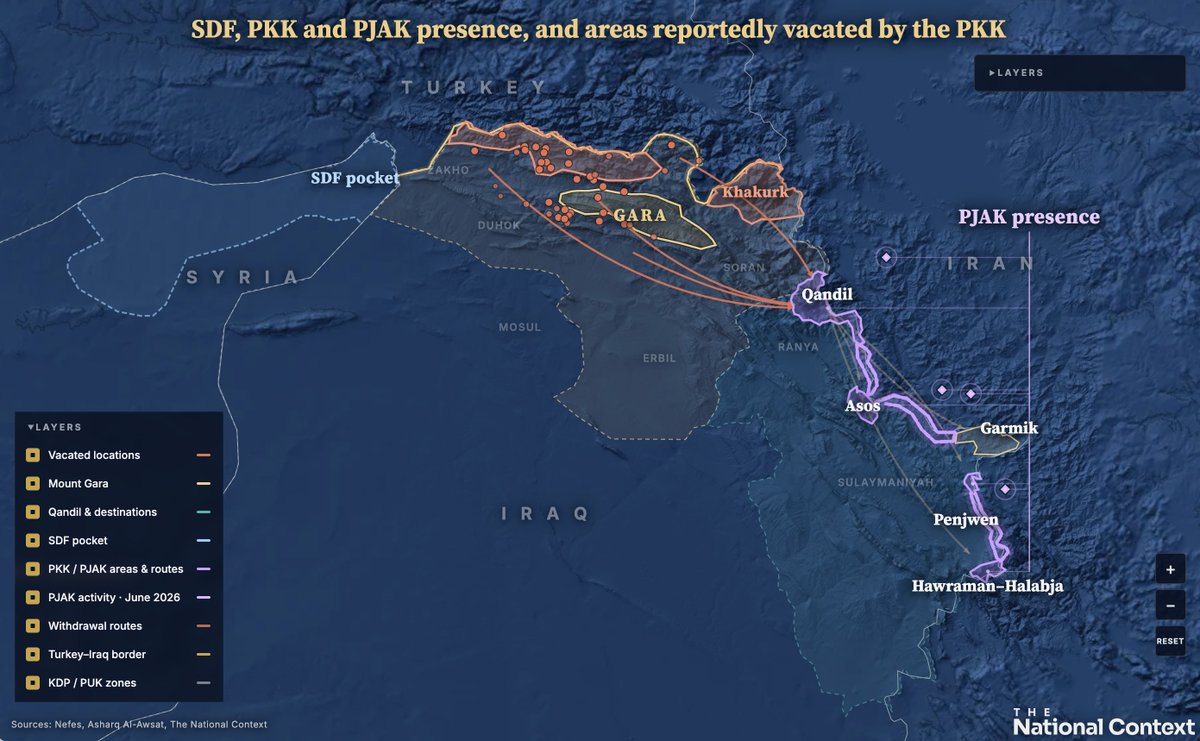
More importantly, of around 27 recorded incidents, pro-PKK/PJAK-linked Iranian Kurdish groups account for at least 63%, compared with just 11% attributed to other Kurdish groups, while around 26% remain disputed or unresolved. Among incidents where the perpetrator can be identified, pro-PKK/PJAK-linked groups account for around 85%.
Their dominance of the armed campaign is therefore clear. The trajectory since July, however, points towards declining intensity and changing tactics: fewer multi-fatality confrontations, more targeted killings, and, particularly in September, a growing share of incidents in which the perpetrator cannot be identified.
The full interactive map here: https://t.co/vYyYo93hOF
Two things are worth noting. First, the attacks have declined since late July as Iran restarted serious diplomatic talks with Iraq and the KRG aimed at having the Iranian Kurdish groups expelled from the Kurdistan Region entirely, to a third, non-neighbouring country, as we have reported here: https://t.co/3sEMM4roWh
Second, PJAK's dominance comes amid the peace process, as it has expanded its presence along the Sulaimani area's borders with Iran and much of the armed activity has concentrated on this geography. More on PJAK's expanded presence: https://t.co/RD1hjlpr8D
@r_rewsen العرب جرب … العني صلاح الدين الكلبي احسن و مع اوجلان العميل هو الي كتب بكتبو من قبل مخابرات التركية انو اكراد جاو من قنديل 🤦🏼🤦🏼و هلا من كتر ما العرب جهل��ء و بغباء عم يحكو كلامو
@MehmudXelilEli شي يوم الما اشوفك يا سيامند لما كنت تصرع راسنا بفكر اوجلان و شقد انت كنت تكره بيت بارازاني و علم كردستان صرعت طيزنا انك بتكره العرب و جولاني شايفك صرت زلمة جولاني من ورا ا��جلان العميل الحقير شو نسيت مكتبك يا واطي يا خاين نسيت قسم الي قسمتو قدامنا تفي على شكلك
Two of the earliest pieces on The National Context, published in February and March 2025, explained why the PKK-Turkey peace process was set in motion by the regional realignment that followed October 7, and set out a broader grand-strategic model around it.
The February piece argued that: "...The timing coincided with the one-year anniversary of the October 7 events and [the beginning of the breakdown of the previous Iran–Israel regional equilibrium]...The region has entered what might be termed a geopolitical "hungry gap" – borrowing from agricultural terminology describing the precarious interval between depleted old harvests and pending new crops. This metaphor aptly captures the current transition, as Iran's decline creates a power vacuum that Turkey, among other regional powers, appears positioned to fill, though the shape of the new regional "harvest" remains uncertain.": https://t.co/iYyBD7LV9O
The March piece went further and built an actual grand-strategic model around the peace process. It situates the process within the transition to a more unstable multipolar order, as the world gradually re-entered an era of "survival of the fittest," identifies October 7 as a marker of that shift, and traces the subsequent weakening of Hezbollah and Iran and the collapse of Assad, and the resulting transformation of the strategic environment surrounding both Turkey and the Kurdish question. The piece argued that the process was about more than ending the PKK’s armed conflict with Turkey. It explored how Kurdish political incorporation could become an asset to Turkish regional power rather than simply a domestic concession, and why the Syrian Kurdish and SDF files were therefore likely to form an integral part of the same process.
In retrospect, the article was particularly prescient both in identifying the broader direction of the process and in treating the SDF-Syria track as structurally connected to the negotiations with Ocalan rather than as a separate issue: https://t.co/rmnEErWSPn
In a more recent article, published in July 2026, another important dimension of this framework in explained greater detail: the Israel layer. The piece examined how the changing Turkey-Israel relationship, the post-October 7 regional order, and the strategic position of Kurdish actors have interacted to shape Ankara’s calculations surrounding the peace process: https://t.co/Gjyc631ISI
@SDF2015SDF بقطع ايدي اذا في زلمة قومي بعفرين ما روهلات القحبة و الهام و سيبان متلهم متل مخابرات التركية اذا 90 بالمية من عفرينية ما يعرفو يحكو كردي اغلب بنات عفرين كل يوم ينتاكو من عرب كس اخت العفرين و اكاذيب عفرين
New on the SDF-Damascus integration agreement:
• Yesterday and today, a sizable number of Damascus-linked Syrian Interior and Defence Ministry personnel entered Hasakah city in preparation for taking over the city's security affairs. We reported five days ago, citing reliable sources, that additional Damascus-appointed security personnel were set to enter Hasakah in the coming days.
• Based on this change on the ground, we are recolouring two areas within Hasakah and the Qamishli countryside to green, denoting Syrian government forces. The entire SDF pocket is now nominally under Damascus control, but outside these areas that control remains nominal, which is why we are keeping the rest yellow, where the SDF holds real power on the ground.
• Two indicators that security control of the city is being taken over: yesterday, a convoy of around 100 military police, a Defence Ministry force, was stationed in the northwest of the city, and today, some 300 to 350 personnel from the Special Tasks Forces were stationed on the eastern and east-northeastern edge of the city.
• Today's deployment is especially large because the role of the Special Tasks Forces is rapid intervention and dealing with exceptional security incidents, including serious disturbances, hostage situations and other sudden security threats. It is a strong sign that they are there in preparation for a further deployment of Syrian government forces into the city. According to a reliable source embedded with the deployed security force, the task forces are one of the first operational components of a phased takeover, providing an early high-readiness security capability while the rest of the state security institutions are deployed sequentially.
• In the coming days, civil police, road security, further military police and other security agencies are set to enter the city to take over their respective functions across it. These forces also include the integrated SDF-linked Asayish personnel, who will form part of the broader security structure under Damascus command. This is important because it shows that while the personnel are being absorbed, as Damascus has previously stated, the command sits with Damascus.
• Two other points are worth noting. The three key security appointments in Hasakah province have now been made, and all three are Damascus-appointed, with none coming from the SDF. This matters because the key goal is command.
• Marwan al-Ali was already appointed head of Internal Security in the province, which oversees and coordinates the Interior Ministry's security presence, including civilian policing, public security, criminal security operations and civilian checkpoints. Imad Fawaz al-Ayash has been appointed head of military police, which enforces military law and discipline, deals with violations by military personnel, carries out military arrests and maintains military order.
• This is significant because while three brigades in Hasakah province are populated by former SDF personnel, the discipline side is handled directly by Damascus, which means they will not function autonomously, and in cases of violation the Damascus-controlled military police structure may intervene.
• The third post went to Thaer Obeid al-Bilal, appointed head of military security, which broadly concerns the security of the military establishment itself: force protection, security oversight, vetting, counter-intelligence functions and the security of installations, although the precise formal remit of the reorganised Military Security structure has not been publicly detailed. Both his appointment and that of al-Ayash were publicly confirmed during the latest integration meetings.
• Today, importantly, the executive office of Hasakah province held its first meeting. We have reported on the appointments to the executive office, which is numerically dominated by SDF-linked figures. As we argued at the time, this executive office is more civilian-facing, and Damascus appears to have compromised by allowing the SDF a stronger civilian-facing role in the province while retaining tighter control over the coercive institutions. That is what is now happening on the ground.
• Aside from that, in the coming weeks more Interior Ministry personnel are expected to enter Qamishli as part of the deployment of Internal Security from Qamishli towards Derik/al-Malkiyah. Damascus-linked Internal Security forces are also expected to be deployed to the Semalka border crossing.
• This is significant because Semalka has already been administratively integrated under the Syrian central government, while the security side has been integrated only on paper, with almost all personnel on the ground being former SDF or Autonomous Administration-linked figures.
• It is now likely that Damascus will deploy its own forces and absorb some of the remaining SDF and Asayish personnel as part of this broader mixed force. The distinction matters, because absorption into a mixed force leaves these personnel without exclusive control of these areas.
• How extensive the deployment will be is unclear. In Qamishli, for instance, no final arrangement appears to have been reached, but the outcome is likely to be a mixed force of integrated SDF Asayish and Damascus-linked security.
• For now, we have changed the colour only of the Hasakah pocket and the triangle towards Qamishli, because the security environment there has already changed to a degree that warrants it. The rest are expected to follow.
More details and a more detailed interactive map: https://t.co/wZri1fGRgC
Why PJAK Remains Armed While the PKK's Other Fronts Close?
Turkey’s new PKK framework law is deliberately broader than the PKK itself. It applies to the PKK/KCK and “every formation connected with it,” meaning that, within Turkey’s own legal framing, regional organisations such as PJAK cannot simply declare themselves unrelated and assume they are outside the process.
• But public statements have limited value in a process that has remained highly opaque. The SDF has likewise repeatedly denied being part of the PKK, yet its dissolution and integration into the Syrian state have proceeded broadly in parallel with the Turkey-PKK process. What the organisations actually do matters more than how they publicly describe their relationships.
• To understand why PJAK, the PKK's Iranian affiliate, appears to have been deferred, we need to go back to why the PKK-Turkey process began in the first place.
• A key trigger was the transformation of the region after October 7, 2023. By autumn 2024, Israel had moved far beyond Gaza, Hezbollah was being systematically dismantled, direct Israel-Iran confrontation had begun, and Ankara increasingly believed the regional order itself could be reshaped. On 1 October 2024, Erdoğan explicitly called for strengthening Turkey’s “internal front” amid the expanding Israeli war. That same day, its nationalist ally Devlet Bahceli made his extraordinary opening towards pro-Kurdish DEM party, which eventually developed into the Ocalan-PKK process.
• From Ankara’s perspective, one of the dangers was fragmentation. This was not simply Turkish rhetoric invented for the peace process. Israel has a longstanding strategic tradition, dating back to the Ben-Gurion-era periphery doctrine, of cultivating relationships with non-Arab states and ethnic or religious minorities. After Assad’s fall, Israeli officials also openly favoured a weak or federalised Syria based on autonomous minority regions.
• For Turkey, the potential geography was particularly threatening. A fragmented Syria, an already weakly integrated Iraq, and a destabilised Iran could leave much of Turkey’s southern and eastern approaches surrounded by Kurdish armed or autonomous political spaces, while Turkey itself still had an unresolved PKK conflict. At the same time, Israel was rapidly deepening hard-security cooperation with Greece and Cyprus. Ankara increasingly saw these developments as parts of a much larger strategic vulnerability.
• The Turkish response therefore appears to be a counter-fragmentation strategy. Inside Turkey, the aim is to convert the PKK conflict into legal political competition and fortify the internal front. In Syria, the SDF’s separate military structure has been dissolved into the Syrian state. In Iraq, the PKK’s autonomous military infrastructure is being dismantled. Kurdish politics can continue, but the separately armed structures capable of becoming instruments of regional geopolitical competition are being removed.
• Iran is different. There is currently no Iranian equivalent of the political landing zones available in Turkey, Iraq or Syria. PJAK cannot simply dissolve and transform into a normal legal Kurdish political party while Iran’s political future remains unresolved and the country is caught in a much larger regional confrontation. The Iranian track therefore appears to have been postponed rather than permanently excluded.
• The Iran war made this distinction even more important. Israel pushed for the mobilisation of Iranian Kurdish armed factions against Tehran, with reporting showing that the initiative was initially driven more aggressively by Israel than by Washington. PJAK, however, conspicuously remained outside the direct Israeli/Mossad channel. At the same time, it retains perhaps the strongest Kurdish military infrastructure along the Iraq-Iran mountain frontier.
• This creates a potential convergence of interests without requiring any formal Turkish-PJAK understanding. For Ankara, an Ocalan-oriented PJAK may be preferable, at least temporarily, to an Iranian Kurdish military vacuum filled by groups more closely aligned with an Israeli-backed fragmentation project. PJAK can therefore function as a buffer against an outcome Turkey considers even more dangerous.
• The arrangement also makes sense from the PKK’s perspective. If it demobilised in Turkey and Iraq, accepted the disappearance of the SDF as an independent military structure, and simultaneously dismantled PJAK, it would surrender almost all of its hard-power leverage before knowing what the final political settlement will deliver. Keeping PJAK intact preserves strategic insurance and ensures that the wider Ocalan movement remains a significant actor in the unresolved Iranian question.
• This may also help explain PJAK’s recent increase in activity inside Iran. Whether or not individual operations were intended as political signalling, the cumulative message is difficult to miss: while the PKK’s western military fronts are being dismantled or integrated, the movement still possesses an operational eastern card.
• However, this does not mean that PJAK has been permanently exempted. The framework law’s deliberately broad language suggests the opposite. But the process increasingly looks country-specific and sequential rather than a simultaneous regional disarmament. Turkey, Syria and Iraq currently have political structures into which armed Kurdish power can be transformed. Iran does not.
• Therefore, if the PJAK question is seen in isolation, it looks like a contradiction in the Turkey-PKK peace process. However, if it is seen within the post-October 7 regional transformation, it may instead be one of the clearest clues to what the process is actually trying to achieve.
The full picture is explained here: https://t.co/XCO03x8rpe




![NatlContext's tweet photo. Two of the earliest pieces on The National Context, published in February and March 2025, explained why the PKK-Turkey peace process was set in motion by the regional realignment that followed October 7, and set out a broader grand-strategic model around it.
The February piece argued that: "...The timing coincided with the one-year anniversary of the October 7 events and [the beginning of the breakdown of the previous Iran–Israel regional equilibrium]...The region has entered what might be termed a geopolitical "hungry gap" – borrowing from agricultural terminology describing the precarious interval between depleted old harvests and pending new crops. This metaphor aptly captures the current transition, as Iran's decline creates a power vacuum that Turkey, among other regional powers, appears positioned to fill, though the shape of the new regional "harvest" remains uncertain.": https://t.co/iYyBD7LV9O
The March piece went further and built an actual grand-strategic model around the peace process. It situates the process within the transition to a more unstable multipolar order, as the world gradually re-entered an era of "survival of the fittest," identifies October 7 as a marker of that shift, and traces the subsequent weakening of Hezbollah and Iran and the collapse of Assad, and the resulting transformation of the strategic environment surrounding both Turkey and the Kurdish question. The piece argued that the process was about more than ending the PKK’s armed conflict with Turkey. It explored how Kurdish political incorporation could become an asset to Turkish regional power rather than simply a domestic concession, and why the Syrian Kurdish and SDF files were therefore likely to form an integral part of the same process.
In retrospect, the article was particularly prescient both in identifying the broader direction of the process and in treating the SDF-Syria track as structurally connected to the negotiations with Ocalan rather than as a separate issue: https://t.co/rmnEErWSPn
In a more recent article, published in July 2026, another important dimension of this framework in explained greater detail: the Israel layer. The piece examined how the changing Turkey-Israel relationship, the post-October 7 regional order, and the strategic position of Kurdish actors have interacted to shape Ankara’s calculations surrounding the peace process: https://t.co/Gjyc631ISI](https://pbs.twimg.com/media/HRXvlfIaEAENo2p.jpg)