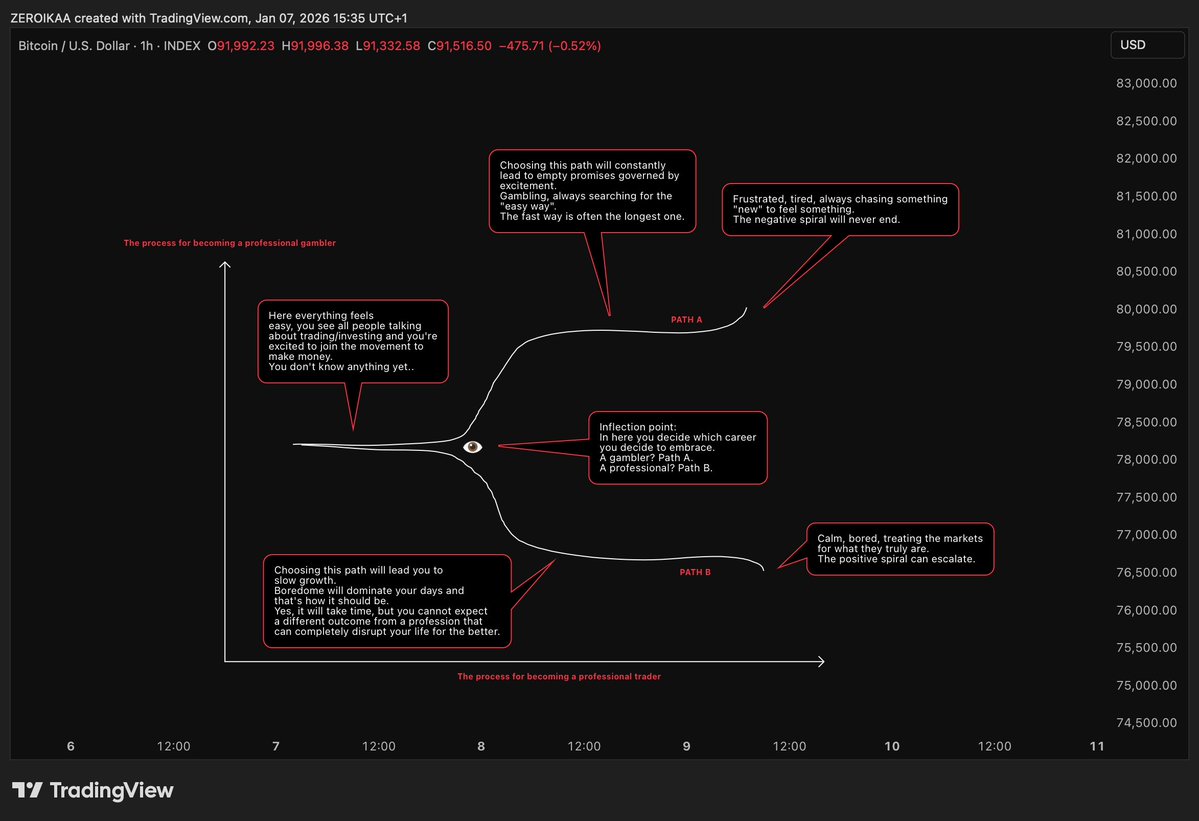
You get stopped out at the exact low.
Then it runs. Without you.
That is not bad luck. You are being hunted.
So I built a free AI mentor that teaches you to see the trap and locks you out the second you try to trade with no stop.
https://t.co/W1CiV9xVEQ
The engineer who built Claude Code just dropped a 28-minute video showing how to actually prompt AI properly.
Not “AI influencer” advice.
Real workflows.
CLAUDE.md files.
Memory shortcuts.
Parallel sessions.
Prompt patterns.
I’ve genuinely seen $300 courses that teach less than what he covered in the first 10 minutes.
That’s the scary thing about AI right now:
Most people still use it like a chatbot…
while others are quietly learning how to turn it into a full operating system for work.
I pulled 18 practical things from the video you can copy into Claude immediately.
Full guide below.
In the process of becoming a trader or a long-term investor (and hopefully a profitable one) losses are inevitable.
There is no single strategy that delivers a 100% win rate.
Every strategy works, and none truly does by the end of the day.
What really makes the difference over the long run is optimal risk management.
Essentially, this means building a system where losses are controlled and profits are allowed to run.
Managing risk doesn’t mean avoiding losses, that’s impossible but controlling their impact.
It means deciding in advance how much you’re willing to lose on any given trade, and sticking to that decision with discipline.
It means avoiding overexposure, not concentrating too much capital on a single idea, and above all, not letting emotions take over.
A good trader isn’t someone who is always right (as you see on social media) but someone who loses little when wrong and gains more when right.
This translates into key concepts like risk/reward ratio, position sizing, and overall capital management.
For example: even with a 40% win rate, you can be profitable if your winning trades generate more than your losing ones cost.
On the other hand, you can have a 70% win rate and still lose money if your losses are larger than your gains.
This is where many fail: they focus on accuracy instead of structure.
Risk management is also about protecting your mental capital.
Because a series of unmanaged losses leads to overtrading, revenge trading, and impulsive decisions that can erase months of progress.
Ultimately, trading is not a game of perfect predictions, but of well-managed probabilities.
It’s not about always being right, but about surviving long enough to let your statistical edge play out.
And it all starts with a simple but fundamental question: “How much am I willing to lose to stay in the game?”
Note it down.
⭕️FULL EDUCATIONAL ARCHIVE⭕️
This is the complete "archive" of all the most important educational post I created during these years.
Hours and hours of intense work condensed into 1 single post, so you'll be able to study this free material that I think will truly take you to the next level.
1. Liquidity related technical concepts:
https://t.co/awvo0Jij2Z
2. Way of charting from scratch:
https://t.co/rZjUQkHmyq
3. The importance of candle closures:
https://t.co/55nKllggiA
4. The importance of candle closures pt.2:
https://t.co/AuVRC2SZR1
5. The truth behind supply & demand levels:
https://t.co/4IvnCjXu8c
6. Fibonacci reverse sequence:
https://t.co/rc3V0SVWNx
7. Fibonacci extensions in play:
https://t.co/VV9SKGY4Rt
8. Setting targets based on data:
https://t.co/Qdv2qRXoSo
9. The truth behind fundamentals: (in crypto)
https://t.co/MHXq4E8b0r
10. How influencers scam you:
https://t.co/fKPvjg5MDY
11. How influencers scam you pt.2:
https://t.co/bxg1Oqj3TP
12. Reprogramming your mind for taking profits:
https://t.co/KPQYryk9uO
13. Order blocks guide:
https://t.co/UG2DW1CCb7
14. HTF distribution in play (no fundamentals):
https://t.co/imXMYSG81Q
15. Fair Value Gaps:
https://t.co/xByxZYQgLS
16. Distribution at Fair Value Gap:
https://t.co/64rUPPvkB9
17. Fibonacci insights:
https://t.co/D5DO1qiosi
18. Fibonacci settings:
https://t.co/74piO8akuX
19. Compound game:
https://t.co/aHc0xSl6fJ
20. Taking profits & strategies:
https://t.co/gQ4lL2oCNI
21. The game of inefficiency, liquidity and orders:
https://t.co/UjA2o3Wqyb
22. Backtesting a strategy:
https://t.co/jTZhPFsQ8t
23. The quintessential mental model of a real trader:
https://t.co/l95ZyGdT4E
24. Using volume areas to form a bias + repricing and migration of value + using defensive levels to place the stop + execution of a MTF long inside an HTF range:
https://t.co/Cqsl1AV5c7
25. Value migration theory + understanding market's behavior and placing trades + protection levels:
https://t.co/QplrrYYJIa
26. AMT full framework:
https://t.co/D9GLAYjotw
27. Understanding capital rotation:
https://t.co/vdVBGJRNFA
28. Intermarket analysis:
https://t.co/6V9m7XxvBK
29. Intermarket cheat sheet:
https://t.co/8i7troUv8O
30. How to form a bias with intermarket analysis + spotting opportunties + capital rotation + alpha & beta plays:
https://t.co/H3XYoyfufC
31. Continuation of the post above:
https://t.co/9SOKmXpV2f
32. Qualifying ranges + VP:
https://t.co/UiBAtEtG03
33. Scalp on NYO to understand liquidity dynamics:
https://t.co/p64f25cV1K
34. Scalp on NYO & explanation:
https://t.co/NN5nij99Ye
35. 9-steps psychological framework to not sabotage yourself:
https://t.co/al5I7prhLw
36. VSA analysis HTF example:
https://t.co/RPIXwszGcy
37. VSA pt. 2:
https://t.co/5Bv0ERtGk8
38. Qualifying supply & demand based on MA:
https://t.co/ssdBnWaXPZ
39. Orders absorption at levels:
https://t.co/l7FHMQNVxQ
40. The importance of trading less assets + TAO example:
https://t.co/uNGBSK11fc
41. Mini price action + volume live mastercalss:
https://t.co/ZLTA9UPAqI
42. Isolating price action with FRVP:
https://t.co/n7gG5YevV2
43. Price discovery methodology:
https://t.co/InsBQs705v
44. Failed Auction:
https://t.co/mXBBiCGzJ1
45. How to survive to an economic downturn:
https://t.co/5jBLYXnjyX
This is an example of natural water filtration. Most of the drinkable water our ancestors consumed in our villages passed through this type of filtration.
Follow this 35-rule blueprint to live a happy and fulfilled life:
- Find your true purpose (follow your passion)
- Workout at least 3/4 times x week
- Eat well and reduce alcohol
- Produce more than you consume
- Invest more than you spend (acquire assets, skip liabilities)
- Learn continuosly new things
- Take risks (especially if you're young)
- Surround yourself with high quality people
- Cut off negative people immediately
- Do hard things regularly to lean into discomfort
- Spend more time in nature
- Spend less time on social media (and understand that most things you see are fake)
- Never compare yourself to others (only as inspiration)
- Be grateful for what you have while keep pushing
- Be patient and think long term
- Take ownership of your life (no excuses, no blame)
- Set boundaries (learn to say no, protect time and energy)
- Invest in relationships
- Call your loved ones more often
- Spend more time alone (reflecting, clearing you mind)
- Enjoy the process, not only the outcome
- Always be kind to others (learn to give without expecting anything in returns)
- Skip revenge (people with bad hearts will sabotage themselves)
- Show more empathy
- Accept that suffering is part of the path (it’s your turn, just as it was for those before you -> don’t take it personally, use it)
- Learn from your mistakes (they don't define you)
- Always stay humble because what god gives you, he can also take it away in an instant
- Speak more, ask more (you'll be surprised to see how many opportunities unfold just because you have the courage to ask)
- Choose your life partner carefully (this decision shapes most of your life)
- Put more effort when things get hard, not when they get easier
- Avoid gossip and pointless drama
- Practice saying less and observing more
- Leave things better than you found them (people, places, situations..)
- Never chase validation
- Accept that not everyone will like you independently of what you do for them
This is an example that I highly suggest you to study because it will improve your overall trading comprehension (and profitability).
At the beginning of September I was tracking the chart of COPPER and noticed something extremely interesting.
The price experienced a very aggressive selloff.
From an AMT perspective, this was a liquidation event and not a bearish auction because there was no real price discovery taking place, only forced selling and stop-driven participation.
Because value cannot be established during imbalance, I had no interest in chasing that move lower.
Instead, I focused on where the auction would eventually find excess on the downside.
Once price stopped extending lower, I began to see signs of strong buying as the selloff lost momentum and continuation to the downside failed.
That told me the selling auction was complete.
From there, the most important phase began.
Price started to build a range.
This is where most people lose patience, but from an AMT standpoint this is where the real information is produced and what we can call "Fair Value building".
Why?
Because time was spent, which is a key factor in order to build value as both buyers and sellers transacted in that area.
That told me the auction was now in balance, and balance is what allows me to build directional scenarios with defined risk.
Inside this range, I paid close attention to the POC and fair value.
These references tell me where the market agrees on price and where participation is fair.
Once those areas are established, the edges of the range become actionable, not because I am predicting direction, but because I understand how auctions behave around value.
At this point, two scenarios became very clear to me.
- If price were to accept above the range, that would signal initiative buying and a shift in value. In that case, I would expect price to seek higher prices and fill the inefficiencies left behind by the liquidation, with area in the 5$ acting as natural target.
- On the other hand, if price failed to accept above value, that would indicate the auction still needed more work.
In that scenario, continuation of balance or a deeper test of lower levels would have been completely natural, aka not bearish but simply what we can call unfinished business.
Price instead exited from the 1st fair value zone seeking for another area where 60 days were spent and another fair value was established before expanding more.
Result? Massive impulse that gave me an overall +30%
This entire sequence is a textbook example of how markets actually move:
imbalance → excess → balance → acceptance.
If you train your eye to recognize these phases instead of reacting to each candle, your trading stops being reactive and starts becoming context-driven.
Which I believe is the key for obtaining consistent results.
"Mate, how do you stop sabotaging yourself in trading? Why do I always end up breaking my own rules?”
Time to drop my whole🧠"9-steps" psychological framework + end bonuses with the hope that you may find interesting ideas for your journey.
Disclaimer: before starting, it’s important to remember that psychology is highly individual. There is no universal fix. The goal isn’t perfection, but building a process that offers the highest statistical probability of correct behaviour over time, aligned with your goals, timeframe, personality, and the amount of emotional energy you can realistically sustain.
(Long post, if your attention timespan is level "Tiktoker", skip it as this post isn't for you)
👁️ First step 👁️
Identify where self-sabotage actually starts.
Most people think self-sabotage starts inside the trade but this is far from true.
It starts before the chart is even opened.
The first thing I do is a state check, not a market check.
I ask myself:
- Am I bored?
- Am I frustrated from a previous loss?
- Am I trying to “make something happen”?
- Am I trading to feel productive, in control, or validated?
If the answer to any of these is yes, then I already know one thing: my edge is compromised, regardless of how good the setup looks.
Self-sabotage is rarely technical, it’s contextual.
👁️ Second step 👁️
Separate execution from emotional regulation.
This is a hard pill to swallow:
If I’m using trading to regulate emotions, I’m not trading..I’m coping.
Common emotional drivers behind rule-breaking:
- Entering early to relieve impatience
- Oversizing to feel confident
- Revenge trading to restore self-esteem
- Overtrading to escape boredom
- Holding losers to avoid being wrong
The market is not a therapist.
It amplifies emotional imbalances instead of fixing them.
So my rule is simple:
I only trade when I don’t need the trade.
Neutral state > confident state.
👁️Third step 👁️
Redefine discipline (this is crucial)
Discipline is not willpower.
If discipline were willpower, everyone would be profitable after reading one book.
In reality, discipline fails when it conflicts with identity.
A slow, repetitive, boring execution style threatens people who:
- Associate value with intensity
- Confuse action with progress
- Need stimulation to feel engaged
- Seek validation through performance
That’s why many traders unconsciously sabotage consistency:
consistency feels empty to an ego addicted to highs.
The solution isn’t “try harder”.
The solution is learning to tolerate boredom without acting.
👁️Fourth step 👁️
Build rules that protect you from future you.
Under stress, nobody becomes more rational.
We rationalize worse decisions.
That’s why rules must be:
- Predefined
- Written
- Mechanical
- Non-negotiable in the moment
What do you mean?
- Fixed risk per trade
- Max trades per session
- Mandatory cooldown after a loss
- No re-entries without a full reset
- No size increase after red days
Rules exist to protect you from the version of yourself that shows up under pressure.
If a rule can be “reinterpreted”, it will be.
If a rule will be "reinterpreted", your profitability will be.
👁️Fifth step 👁️
Treat boredom as a performance indicator.
This was a game changer for me.
High-quality trading feels:
- Uneventful
- Repetitive
- Emotionally flat
- Yes, sometimes disappointing
If I feel excitement, urgency, or adrenaline, that’s valuable information, not motivation.
Usually it means:
- I’m forcing something
- I’m anticipating instead of reacting
- I’m trading emotion, not structure
The market rewards restraint, not stimulation.
If you need excitement, trading will punish you until you don’t.
👁️ Sixth step 👁️
Losses must be operational, not psychological.
A loss should not change behaviour.
If it does, then:
- Risk was too high
- Expectations were unrealistic
- Identity was attached to outcome
Rules I live by:
- No “making it back”
- No immediate revenge trades
- No size adjustments to fix emotions
- No narrative after a loss
Losses are part of the whole distribution.
The moment I try to fix them, I step outside the system.
👁️Seventh step 👁️
Reduce outcome relevance to near zero.
No single trade matters.
No single day matters.
No single week matters.
The brain wants meaning while trading runs on probability.
The urge to “make today count” creates:
- Overtrading
- Forcing setups
- Emotional execution
My only real question is:
“Did I behave like someone who plans to still be here in 6 months?”
If yes → good day, regardless of PnL.
👁️ Eighth step 👁️
Stop mistaking intelligence for edge.
This one hurts.
❗️Understanding the market does not equal profitability ❗️
Smart traders often fail because:
- They override rules
- They reinterpret setups
- They seek confirmation
- They believe insight should be rewarded
The market doesn’t care how smart you are.
It rewards consistency, not cleverness.
If you need to feel smart, trading will humble you repeatedly.
Try to remain as humble as possible.
Try to stick to your idea with an open mind.
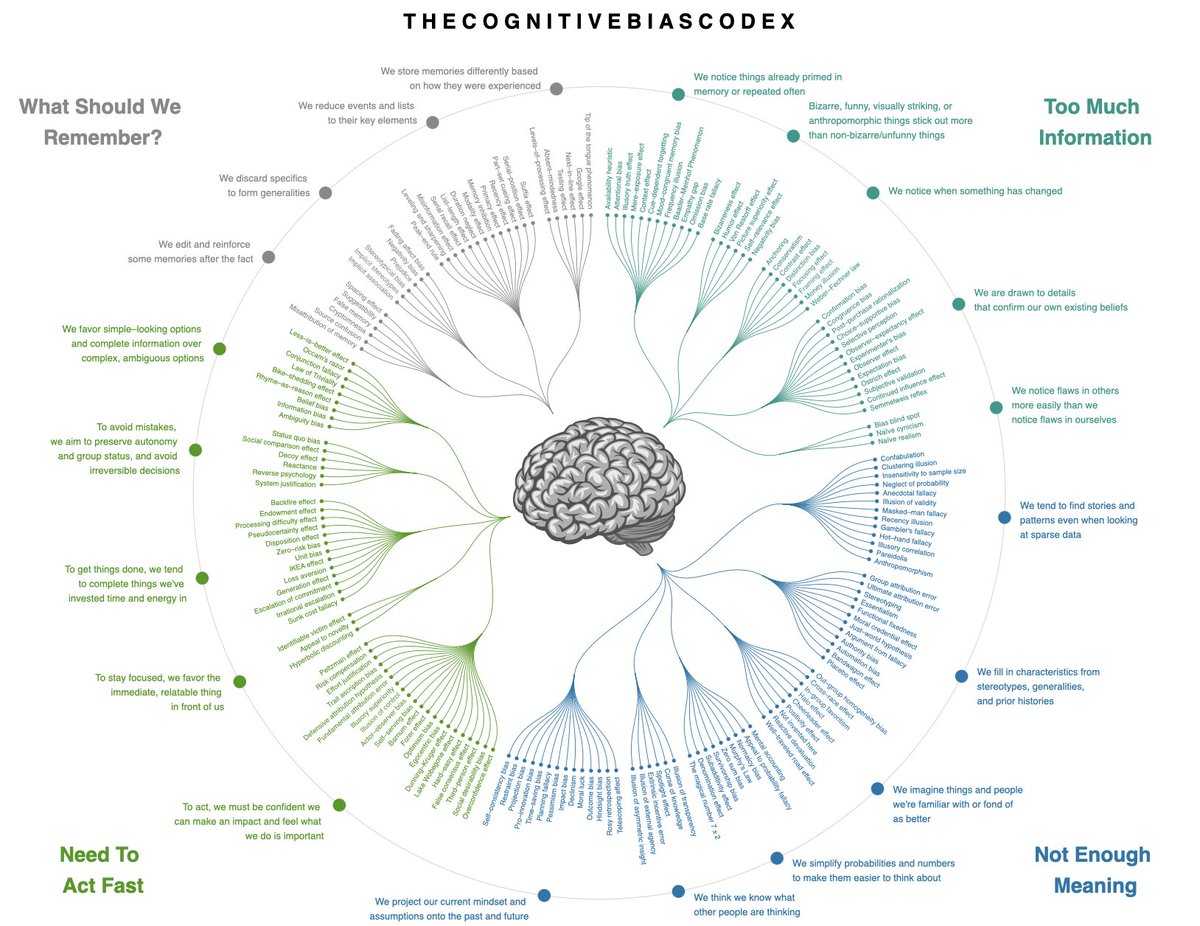
In this specific context I help myself with the "Cognitive Bias Codex" developed by Dr. Gary Fox, something extremely useful.
👁️ Ninth and final step 👁️
Make trading impersonal.
Auto-sabotage fades when trading stops being personal.
When it becomes:
- A process, not a proving ground
- A routine, not an escape
- Execution, not something to identify yourself with
The market will never judge you, test or challenge your intelligence.
It’s simply exposing how you behave
when money, uncertainty, and time pressure collide.
Master that and I promise you, strategy becomes the last thing you will think about.
👁️End bonuses 👁️
These are posts that you should save, print and attach on your wall:
- My trading routine: https://t.co/josMgig9ET
- Probabilistic mindset:
https://t.co/06mEOAHpTi
- Breaking the rules:
https://t.co/OZoAaploaq
- Rules to follow:
https://t.co/A6FQO2EhZD
If you found this useful, the like and repost buttons are just a few centimeters below.
If you didn’t, you probably weren’t meant to read it anyway.
If you’ve ever felt like you’re not enough and wondering if you can make it, this is for you.
I come from nothing, literally.
I never had a united family, wealthy relatives, or any particular talent or special skill to rely on.
If anything, I’ve always had to figure things out on my own in every area of life, sometimes because of circumstances, sometimes because of who I am.
Do you know what I’ve truly always had more than most people? 3 things.
Hunger, sacrifice, and the desire to improve my life.
Hunger isn’t just lack, It’s a constant tension toward something you don’t yet have, but deeply feel you deserve.
It’s waking up with a weight in your stomach and going to sleep with a question in your head: “Am I doing enough?”
That hunger didn’t come from theory or motivation videos.
It was built in very real, very heavy moments of my life:
- Working 10–12 hours a day, 6–7 days a week in a kitchen, earning €1,200 a month and being treated like s**t
- Being physically exhausted..didn’t like what I saw in the mirror, I didn’t recognize myself, and I carried more weight than I should have
- Going back home to a difficult family environment, where the weight of problems often fell on my shoulders
- Not having the possibility to enjoy my adolescence as it should have been due to the point above
I felt like I wasted years of my life and I wanted to give a full turnaround where hunger was the predominant beast consuming me from the inside.
Hunger makes you restless, uncomfortable, often lonely, but it keeps you alive.
It stops you from settling, from numbing yourself, from slowly switching off like so many people do when they realize no one is coming to save them.
I never lost that hunger, not even in the moments when it would have been easier to quit and tell myself, “It just wasn’t meant to be.”
Sacrifice has been my daily language, probably mastered through spoons and pans.
Giving things up while others took breaks.
Pushing forward while life seemed easier for those with support systems, shortcuts, and safety nets.
Sacrifice isn’t heroic, not even poetic.
It’s boring, repetitive, and often thankless. It’s doing the right thing when no one is watching and when no one is applauding. It’s choosing to be tired, misunderstood, sometimes even judged, just to stay loyal to a goal only you can see clearly.
And then there’s the desire to improve.
But not the kind shouted on social media or recycled motivational quotes.
I’m talking about a quiet, almost obsessive drive that forces you to look in the mirror and acknowledge your limits without excuses. To tell yourself the truth, even when it hurts. To study, observe, fail, and get back up with a little more awareness every time.
Improving doesn’t mean becoming perfect, it means becoming responsible for yourself.
Coming from nothing takes a lot away from you, that’s true, but it also gives you something incredibly powerful: you have nothing to defend, only everything to build.
You don’t have to protect an image or live up to someone else’s expectations.
You’re free to fail, to start over, to shed your skin and become someone new and most importantly, you learn early that no one owes you anything.
Every step forward is earned. Every result is paid for in full. That’s what makes you solid, even when everything around you shakes.
I’m not writing this for applause, if you're wondering.
I’m writing it for those who feel behind, out of place, without support. For those who believe they started at a disadvantage and are therefore doomed.
That’s absolutely not fucking true.
Your starting point does not define your destination.
I've built the life I wanted without ANY external help, not a single one.
What makes the difference is how much you’re willing to endure without losing yourself, how many times you’re ready to begin again without growing bitter, and how well you can turn hunger into discipline instead of anger.
If you come from nothing, know this: you are not empty.
You are space.
Space to grow, to become, to choose who you truly are and if you’re hungry, if you know how to sacrifice, if you want to improve even when it scares you, then you’re already much further ahead than you think.
No one is coming. That’s why you have to save yourself.
👁️ How I'm preparing moving forward into 2026 👁️
Ok guys, I want to share my personal plan for 2026, which will cover not only crypto but also external markets, including legacy markets.
Regarding the crypto segment, I am continuing to follow my plan, especially concerning altcoins, where I still expect the sector to outperform in the Q1.
I have been clear on this matter in numerous posts I created, detailing not only the technical aspects (such as liquidity dynamics) but also the psychological factors, which play a crucial role when it comes to investing.
If you haven’t read them yet or missed them, you can find everything here:
- Altcoins thesis: https://t.co/30DQbmSsxa
- Altcoins targets:
https://t.co/NgSVBdpFME
- Dominance and psychological connotation thesis:
https://t.co/OiX9e3zOjG
So for me is very simple and I'm continuing to respect the original plan accumulating on dips.
I don't need to tell you which coins I'm accumulating (admitting you're interested) but if you want to dive deeper, you simply have to read this post:
https://t.co/kuzMFaAiLH because it will help you to understand what truly sustain certain liquidity dynamics.
About Bitcoin instead, I'm definitely not interested in buying anything and even on this topic I've been clear since a while talking about a clean HTF distribution ongoing:
- August talks: https://t.co/71nc4tG6HW
- Reinforcement: https://t.co/Ss8bvUFHOh
While I'm always open to the possibility that the asset shoots higher (even a new ATH, though is hard) I will play it exclusively on leverage and regarding spot I'm planning to accumulate it again below 60K minimum,
ideally even below 40K but this will likely be monitored step by step depending on how the price will arrive there.
For the legacy markets part instead, I'm expecting an overall very turbulent 2026 and this will likely be translated into a market suffocation..why?
Well, the main theses are 2:
- The World Ahead 2026 analysis: https://t.co/KJS9qBUY6w
- The smart money plan:
https://t.co/Och3W6SScg
Therefore, based on a rough market expectation, I will hold the majority of my capital in cash looking to buy assets into these sectors https://t.co/dgn2AKNf7B where I already have a list of stocks I'm observing (some already bought) + commodities.
For the long term, therefore, the plan is to buy:
- BTC at discount (mainly)
- Stocks
- Commodities
- Increase liquidity through trades
Despite I'm not expecting an easy year and, on the contrary, I believe that hard times are upon us, liquidity will always flow on one side or another so there will be always an opportunity to capitalize but it's important to be rational and also look outside of crypto.
In a compressed and fragile macro environment, capital tends to rotate rather than disappear.
When risk appetite fades in one sector, it resurfaces elsewhere, often in less crowded trades or in assets that offer protection, yield, or asymmetric risk profiles.
Being able to identify where liquidity is migrating, rather than where it has already accumulated, will be essential.
At the same time, selectivity will be crucial.
Not every dip is an opportunity, and not every rally is worth chasing.
The goal is not to be constantly exposed, but to remain positioned in a way that preserves capital while maintaining the ability to act decisively when conditions align.
Cash, in this context, as said before, is not a passive position but a strategic one, allowing me to participate when others will likely be forced to liquidate or when volatility creates that blessed mispricing across assets.
Looking forward.
Important:
The probability that all metrics align perfectly, guaranteeing entries with a high success rate, is incredibly rare, almost mythical and something we might call the “Cassiopeia Conjunction” of trading.
In a macro context dominated by a clear HTF uptrend across most altcoins, the real secret isn’t chasing every single signal but knowing how to contextualize distinguishing between a “discount” and an "extreme discount".
In this framework, setups divide into good and optimal.
Good setups form frequently and have an acceptable probability of success while optimal setups are those few cases where the market aligns almost perfectly, with multiple confirmations, but paying the price of patience and the ability to wait without succumbing to the anxiety of immediate entry or even waiting for a moment that might not even come.
Psychologically, learning not to be greedy is crucial.
You don't know if all metrics will align, there are no certainties in trading.
One common trap is waiting for “just another 10% down” when the asset is already 30% off its highs, an endless chase that can mean missing the opportunity altogether.
The market rarely offers perfect entries repeatedly, and chasing deeper discounts can lead to paralysis or worse, complete missed moves.
The real competitive edge lies in adopting a scaled entry approach on the spot, spreading entries to capture different phases of a move, thus avoiding putting all capital at risk in a single moment and allowing the market to prove its direction.
For longs you would like to wait for optimal, if provided.
After all, the market owes us nothing, so make sure to always contextualize discount/macro discount | premium/extreme premium for your decisions.
One of the most valuable assets I have as a full-time trader isn’t a strategy, an edge, or even capital.
It’s something far more rare - and almost no one talks about it.
A supportive partner. 💯
You can’t put a price on that kind of belief.
When your significant other understands the path you’re on and stands behind you, it fuels your resilience. It keeps you grounded during the chaos. It makes the wins sweeter - and the losses survivable.
But the opposite?
A partner who constantly doubts what you’re doing? That kind of energy seeps in. It creates hesitation. It erodes confidence. And in this game, second-guessing yourself can be fatal.
So how do you get your partner on board - truly on board - so you’re walking this road together, not alone?
Here’s a simple method:
Educate, don’t evangelize. Don’t try to “sell” them on crypto or trading. Instead, explain your process. Show them the tools, the risk management, the logic. Help them understand, not just believe.
Involve them in the milestones. Share when you hit your targets. Celebrate small wins together. Let them feel what progress looks like - even if it’s just sticking to your system through a tough week.
Be transparent about the risk. Honesty earns trust. Let them know what’s at stake, what your contingency plans are, and how you’re managing exposure. Confidence comes from clarity.
Ask for their perspective. Sometimes, giving them a seat at the table - even just to listen - makes all the difference. They don’t need to trade with you, but they do need to feel seen.
Support is built through inclusion.
Make it a shared journey - and you might just find your greatest edge was sitting next to you the whole time.
I’m going to be real with you.
Too many good, hard-working people were finally in position to win big this cycle - and “they” couldn’t let that happen.
It would be too easy.
This market is not built to reward honesty, patience or belief.
It’s built to break those who still have both heart and conviction.
But stay with me for a second…
If you had massive power, how would you shake out the dreamers before the big run?
Maybe like this:
> Pump only Bitcoin - while everyone else bleeds out in alts.
>Make the market so brutal that holding feels stupid.
>Drown the space in memes and “insider” narratives to destroy trust.
> Manipulate sentiment until even the most passionate start doubting themselves.
Every chart. Every headline. Every wave of fear.
All perfectly designed to drain your belief and disconnect you from your passion.
And it worked.
People left.
Communities broke.
Sentiment died.
But here’s the truth:
The people who stayed - the ones who still care, still believe - they’re the ones who will thrive.
If you’re still here, I see you.
You’re not just surviving - you’re growing.
When the time comes (and it will come), you’ll be ready.
You've already outperformed 99% of investors just by staying in the game.
So when that next pump arrives, you'll be one of the very few who benefits massively.
Life changing potential.
I don't know when.
But that time is coming soon.
I'm going to be honest.
This market isn't making much sense.
Trump had “great news” from his from his meeting with the Chinese president.
The FED announced QT ending.
Gold just hit a new ATH.
Stocks just hit a new ATH.
And so did many other assets.
And how is Crypto reacting?
It's dumping.
You start realizing the headlines don’t drive this market anymore.
People do.
And the ones pulling strings aren’t doing it for you and me.
They’ve made the rules simple:
Keep retail confused, impatient and exhausted.
Accumulate quietly while everyone else fights over scraps.
Meanwhile, every other market is shining.
And Crypto? Left behind - again.
It’s not random.
It’s a psychological cycle.
Distract the crowd with “safe” narratives while the bold ones quietly build conviction.
Most won’t notice it happening in real time.
They’ll just feel the fatigue, the frustration, the urge to walk away.
And that’s when the shift begins.
Because history’s never been kind to impatience.
Every explosive move starts in silence.
Two or three candles later, everyone’s suddenly “early” again.
So if you’re still here, keep perspective.
You don’t need to time perfection - you need to survive the noise.
Use this void to build. To learn. To reconnect with why you started.
Markets will come and go, but integrity and empathy outlast every cycle.
Those who move with honesty and passion aren’t chasing luck - they’re preparing for inevitability.
This cycle won’t reward those who shouted the loudest over the next months.
It’ll reward those who cared enough to stay when no one else did.
Believe in yourself, seriously do it.
Not as a phrase on a poster, not as a cliché, but as a daily commitment you make when you wake up with a heavy heart and the world seems ready to crush you.
Look around: who hasn’t failed, who hasn’t lost, who hasn’t felt fear tighten around their throat?
And yet there are people who rise, who take their baggage of mistakes and turn it into a trampoline.
Think of those who failed dozens of times before finding their path, athletes who broke bones and dreams and kept running, artists who threw away hundreds of drafts before their work was noticed.
Believing in yourself means staring those obstacles in the face, acknowledging them for what they are, and choosing to move forward anyway.
Doors will slam in your face, voices will say “you can’t,” but every step you take in the right direction is a punch through the wall of fate.
And when you fall, you will fall with dignity, knowing you will rise stronger, because every scar is an invisible medal that tells the story of your resilience.
Seriously, don’t wait for permission, don’t wait for miracles.
Walk, run, scream, fail, rise again, until fear no longer feels like chains but like wind on your shoulders.
Life tests you every day, and you have one choice: be a spectator or be the protagonist.
And truly believing in yourself is the first act of rebellion.
Explaining the reasoning behind the last long taken at $104.800.
After the last push to the downside from the ATHs in a very aggressive manner (clear sign of genuine sell pressure) the market had to "unleash" pressure.
Especially in a context where you don't have a solid closure, this is a clean sign of rejection (also typical of the last price action's behavior -> take out the highs, immediate sell-off) which has also melted the 116K breaker using it a double one.
This brought the price toward my weekly CBOB which was an area in which the time spent 3+months above, therefore technically very valid to watch.
With the last swing formed (A-B) I calculated my zone of interest which always stands in the 1.272/1.454/1.618 extension box and which was matching an HTF key level.
Slightly below I marked 2 extra levels:
- Demand + breaker ($104.300/105.000)
- Multi week demand ($103.300)
So the idea was that, in case the price would have dipped below, those zones were covering my long.
The I found my entry on the 1H using the order flow.
When the price started to dip inside the breaker, it did it with violence and aggressiveness but what was really happening underneath that move was absorption.
Even though sellers were hitting the bid aggressively, price wasn’t truly breaking lower, it was being held.
All that heavy sell pressure was getting absorbed by passive buyers sitting deep inside the breaker and you could see it in the order flow: huge red prints (heavy delta negative) yet price barely moved down.
"And how do you know it? Any other elements?"
The CVD.
The CVD was bottoming while price was still pushing lower and that for me was the real tell.
Even though the candles looked heavy (full of aggression and red volume) the CVD stopped making new lows.
Sellers were still trying to hit the bid, but the delta wasn’t confirming the same intensity anymore.
That means the aggressive sell orders were being fully absorbed by limit buyers.
The selling effort was still visible, but the result had already started to fade.
When CVD bottoms like that inside a key area, especially a breaker or a demand zone, it often signals that the aggressive side is running out of "ammunition."
Smart money on the other side, quietly taking everything the market throws at them.
They don’t need price to move immediately: they just need everyone else to unload into their bids.
That’s why the CVD bottoming was such a crucial confirmation.
It showed that the flow had shifted.. the last wave of sellers had exhausted themselves, and the passive buyers were now in full control.
Once that pressure was absorbed, there was no one left to sell, and the market had only one way to go: up.
For much of the 20th century, the middle class wasn’t just an income bracket but more a story.
A promise that effort, education, and time could lift any family into comfort but over the last few decades that story has begun to unfold.
The numbers tell the truth: the share of national income held by the middle 60 % of earners has been falling in most advanced economies since the 1980s.
The forces behind the squeeze aren’t theatrical villains; they’re the predictable outcomes of policy, technology, and global finance moving faster than human adaptation.
Automation and digital consolidation remove the need for broad layers of human labor.
One software platform can now replace an entire sector of agents or drivers.
Each wave of innovation increases productivity while reducing the portion of value paid to workers.
The result is growth without prosperity, isn't it?
GDP rises, but median wages barely move.
Housing, healthcare, and education..the classic pillars of security have transformed into speculative markets:
- Homes became investment vehicles, not shelters
- Universities became debt machines
- Medical care became a subscription service
On top of this, debt is filling the gap.
Credit cards, student loans, and what I like to call "buy-now-pay-later" apps disguise stagnation as stability.
For a while, cheap money cushioned the decline, but as interest costs rise the illusion fades.
People aren’t getting poorer because they spend recklessly but they’re paying more for the same life their parents had.
Tax and policy frameworks built for an industrial age now reward capital over labor.
Money earns money faster than people can earn salaries.
The rich don’t just own more, they own different kinds of assets.. ones that appreciate automatically in a financialized world.
At the same time, governments face an impossible equation: ageing populations, slower growth, and mountains of public debt.
The likely answer will be more automation, more digitalization, and eventually some form of universal income.. a safety net that also serves as a monitoring tool.
Delivered through digital wallets, such systems could make welfare efficient but also conditional, linking benefits to behavior and compliance.
In that future, economic class becomes less about income and more about autonomy.
Those who can live independently of centralized platforms (who own productive land, unique skills, or intellectual property) will form a small, mobile elite.
The rest will rent everything: their homes, their tools, even their data.
It will be likely camouflaged as convenience while it's pure slavery.
People will trade privacy for frictionless living, freedom for security, and call it progress.
The middle class, once defined by ownership and self-determination, dissolves into 2 categories:
- System architects: investors, technologists, and policymakers who design and profit from the infrastructure.
- System participants: users whose livelihoods, identities, and credits exist inside it.
If the trend continues unchecked, the social contract may invert.
Governments will no longer guarantee opportunity.. they’ll guarantee stability.
Citizens will maintain the algorithms, feed the data streams, and service the automation that displaced them and not out of coercion, but because the system makes any alternative nearly impossible.
The compression is never a sudden collapse, It’s a long exhale..a quiet narrowing of what life can be bought, built, or believed in by the average person.
The challenge of the next generation will be to rebuild mobility and trust me, not just economic, but human..in a world that rewards compliance more than creativity.
A tear carves across my face while writing this, but I can't do nothing but expressing it.