Generalist vs. Specialist vs. Versatilist -- where does your sales team fall? If weighted too heavily in the first, I can help upgrade your team to become elegant glove problem solvers! Reach out!
HAVS is a serious set of symptoms caused by repetitive exposure to vibration from tools or machinery. Carpal tunnel, finger-blanching and pain due to blood vessel damage, loss of sensitivity are some of these. There are some doing well here @Impacto_Inc@OccuNomix@Ergodyne
The vast majority of cut resistant gloves contain HPPE or Para-Aramid yarn. In higher cut resistant gloves you generally need a secondary yarn like glass or stainless steel to boost performance above EN Cut 3 or ANSI A2. Get advice for your application or glove range!
Important document on fatigue - having had my own battle with obstructive sleep apnea, I've come to appreciate how critical quality sleep is to safety and productivity - https://t.co/gKtCjgrdPS
Do you sell hand protection and need assistance with product management functions, market research, range decisions or copy-writing? I'm here to help you make informed product decisions. Discretion is foundational to my business. Discounted rates for larger projects!
The new EN ISO 374 stndrd requires that chem gloves longer than 40cm will need to also be tested 8cm from the cuff as well as the palm. The lower chem resistant result is taken. Chemical gloves don't always have the same thickness throughout so could be a game changer for some!
Pretty proud to work for not just a company but a family like @WatsonGloves , They have committed to donating $1.00 for every pack sold to the #HumboldtStrong go fund me
#watsonGloves
EN388:2016 includes both a 5th and 6th character for the ISO 13977:1999 cut test as well as a pass/fail result for impact protection. Revising your glove markings and marketing materials will show safety managers that you're up to date. I'm here to help!
The highest wear area on the glove is the area between the index and thumb, called the "thumb crotch". To add value to your offering, there are a few reinforcements available to extend glove life -- these include rubber dipping, overlock stitching and sewn-on patches.
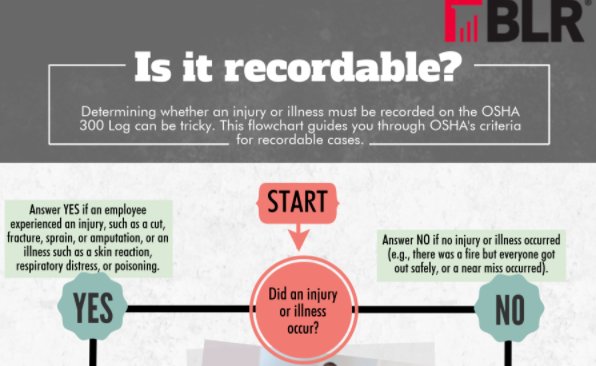
Determining whether an injury must be recorded can be tricky. Follow the steps on this flowchart from @BLR_EHS as it guides you through OSHA's criteria for recordable cases. https://t.co/VDtJ1VSUzo
If your gloves are wearing out before they get too dirty, products that contain HPPE or Para-aramids(like Kevlar), are more abrasion resistant than general purpose products. Implement the right glove care program and you will stretch your safety dollar even further!
General rule about glove coatings and grip: Shinier coatings (ability to reflect light) mean surface is smooth. These coatings will give superior dry grip but often come up short with oil and wet. If they do not feel spongy, it's likely a flat coating and will abrade better too
Fit, feel, and comfort are just as important to glove assessment and selection as the qualities of the materials used to protect hands. Get it wrong and the product won't be worn long enough to be effective!
@transcommunist sounds like you just haven't been found the right glove. Your hands are your livelihood. There are disposable glove dispensers that have the opening on the bottom so gravity assists dispensing and hands are not contaminating the rest of the glove supply.
Word of the Day: Lubricity - Some cut resistant yarns, especially those we call filament yarns like Dyneema or Spectra (those extruded in long continuous strands vs small fibers) can allow sharp edges or blades to slide across their surface at extreme angles instead of cutting!
Poly vinyl chloride (PVC) used to coat gloves is a combination of resins and plasticizers. The large number of combinations of these ingredients allows for products of both low and high chemical and abrasion resistance, and a large range of pricing. Pay attention to pictograms!
Tremendous insight into how disposable gloves are made. These lines can be over a kilometer long! The efficiency, sophistication, formulation, and production of the plant per cubic meter can create a chasm of difference between producers for price and quality. https://t.co/ckHljhN2Hg
Tiny amounts of silicone (polysiloxanes) can be disastrous to paint applications. They create cratering (often called "fish eye") in paint finishes. Often present in small amounts in gloves so look for FTIR or TD-GS/MS test reports if you plan to supply automotive/aerospace!