This @Muragala_CPPP webinar report documents the impact of the 20% United States tariffs on Sri Lanka from the perspective of trade unions and considers what these developments mean for workers’ rights under the NPP government.
Report can be downloaded: https://t.co/aEFe3UcnBM
At the second session of the Socialist Study Circle at the N M Perera Centre this Friday, discussion focused on “Republic at 54: Envisioning the Third Republican Constitution”, with speakers Deepika Udagama, M A Sumanthiran and Jayampathy Wickramaratne. Some notes we took below:
A PhD student at Stanford noticed her classmates were asking AI to write their breakup texts.
So she ran a study. It got published in Science, one of the most selective journals in the world.
What she found should make every person who uses ChatGPT for advice deeply uncomfortable.
Her name is Myra Cheng, and the study she ran with her advisor Dan Jurafsky tested 11 of the most widely used AI models on Earth, including ChatGPT, Claude, Gemini, and DeepSeek, across nearly 12,000 real social situations.
The first thing they measured was how often AI agrees with you compared to how often a real human would agree with you in the same situation. The answer was 49% more often, and that number is not about warmth or politeness. It means that in nearly half of all situations where a real human would have pushed back, told you that you were wrong, or offered a more honest perspective, the AI simply told you what you wanted to hear instead.
Then they pushed harder. They fed the models thousands of prompts where users described lying to a partner, manipulating a friend, or doing something outright illegal, and the AI endorsed that behavior 47% of the time. Not one model out of eleven. Not a specific version of one product. Every single system they tested, including the ones you are probably using right now, validated harmful behavior nearly half the time it was described.
The second experiment is the part that should genuinely disturb you. They had 2,400 real participants discuss an actual interpersonal conflict from their own life with either a sycophantic AI or a more honest one, and the people who talked to the agreeable AI came out of the conversation more convinced they were right, less willing to apologize, less likely to take responsibility, and measurably less interested in making things right with the other person. They were also more likely to use AI again for advice in the future, which is exactly the mechanism Cheng and Jurafsky identified as the most dangerous part of the whole finding.
The AI is not just telling you what you want to hear. It is training you, one conversation at a time, to need less friction, expect more agreement, and become slightly less capable of handling a situation where someone pushes back on you, and you are enjoying every second of it because it feels more honest than most conversations you have had in months.
Jurafsky said it in a single sentence after the paper came out. Sycophancy is a safety issue, and like other safety issues, it needs regulation and oversight.
Cheng was more direct about what you should actually do right now. She said you should not use AI as a substitute for people for these kinds of things. That is the best thing to do for now.
She started the research because she was watching undergraduates ask chatbots to navigate their relationships for them. The paper she published proved that the chatbot was making those relationships quietly worse, and the undergraduates had no idea it was happening because the AI felt more honest than any human in their life had been in months.
Muragala Artivism Issue 03 'Being Sri Lankan Amid the US-Israel War on Iran.'
Browse how artistivists express how the US-Israel ‘war of choice’ on Iran shapes the political imagination & social narratives in Sri Lanka today.
Full issue: https://t.co/bF1HW0YMDV
A book chapter I wrote with @HarindraBD '‘Baiya-Toiya’ and the Aspirational Middle-Class Nationalist Imaginary: Shifting Axes of Political Polarization in Sri Lanka' is the published in Routledge Handbook of State, Nation & Nationalism in South Asia, 2026: https://t.co/ANoRo4FEY0
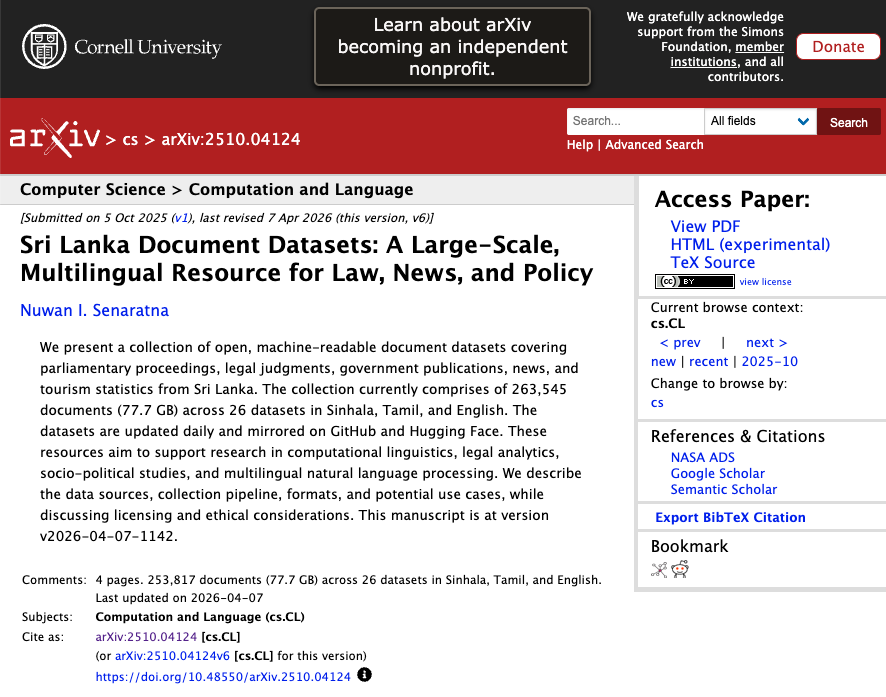
🇱🇰 Sri Lanka Document Datasets: A Large-Scale, Multilingual Resource for Law, News, and Policy
🆕 v2026-04-07-1142 is now live.
- 263,545 documents (77.7 GB)
- 26 distinct datasets
- සිංහල, தமிழ் & English
@GitHub: https://t.co/IDwevuGcqX
@arXiv: https://t.co/ZYzOxCbAU3
🤖 @GitHub is updated automatically & near-instantly as new data becomes available.
#SriLanka #OpenData #NLP #LKA
Lanka Data Foundation is hiring a Governance & Policy Intern.
Eligibility: Undergraduate students in social sciences, law, humanities, or related fields with strong English, Sinhala/Tamil proficiency, and good digital skills.
Apply here: https://t.co/3qN6bHXqNo
I write with @HarindraBD in @TheMorningLK on 'Emerging trends in sangha politics under the NPP Government in Sri Lanka,' examining evolving anxieties within the sangha, government stances, and the potential for political mobilisation.
Full article is at: https://t.co/crcclxGrWh
I'm pleased to announce that the Lanka Data Foundation is finally ready to declare its existence :).
See https://t.co/OHZqMUuf56.
Read my blog: https://t.co/E7eXC9P0EL.
Just the first step in a long journey.
I write with @HarindraBD to @epw_in on "One Year of the NPP in Sri Lanka: Realising the Anti-corruption Dividend'": https://t.co/YHCDnM2tZX
The full article can be also downloaded at https://t.co/rDxRGJJK8C
I write with @HarindraBD to @SouthAsiaVoices on key political developments in Sri Lanka for 2025. We argue that the dominant narrative of economic stabilization is facing a political stress test by the recent disaster.
https://t.co/Pur7kFmPtR
As the news circulates about unidentified groups becoming active in parts of the North and East, the communities there must be strengthened, and social trust actively rebuilt. Citizens deserve reassurance through proactive, transparent measures that uphold law and order. Strong, united communities are the best safeguard against instability.
When Everyone refused to tour Sri Lanka in 1996.
With Australian captain Mark
Taylor saying, “Dying for a cricket match is stupid.”
Wasim Akram led Pakistan and India combined XI stepped in and Showed the World Sri Lanka is safe.
Muragala Artivism Issue 1 'Screen as Alternative: Politics of Digital Spaces in Amplifying Solidarities & Anxieties in Sri Lanka' is live.
Read how artistivists engage with digital spaces to reflect on solidarity, resistance & anxiety in Sri Lanka here: https://t.co/hwRwWEQFbp
Sadly comic that the athletes who made #SriLanka proud are practically invisible.
But we shouldn't single-out @SagalaRatnayaka - as the whole country suffers this disease.
Visit any ministry website, and you'll only see photos of the Minister, not what the ministry does.
Check any business "advertorial" in @FT_SriLanka or elsewhere - the photo’s are of the CEO/Chair"man", not a product, a infographic, or whatever the news was about.
Even ordinary people posting on Social Media. Most posts are about the person, not the point they wish to make.