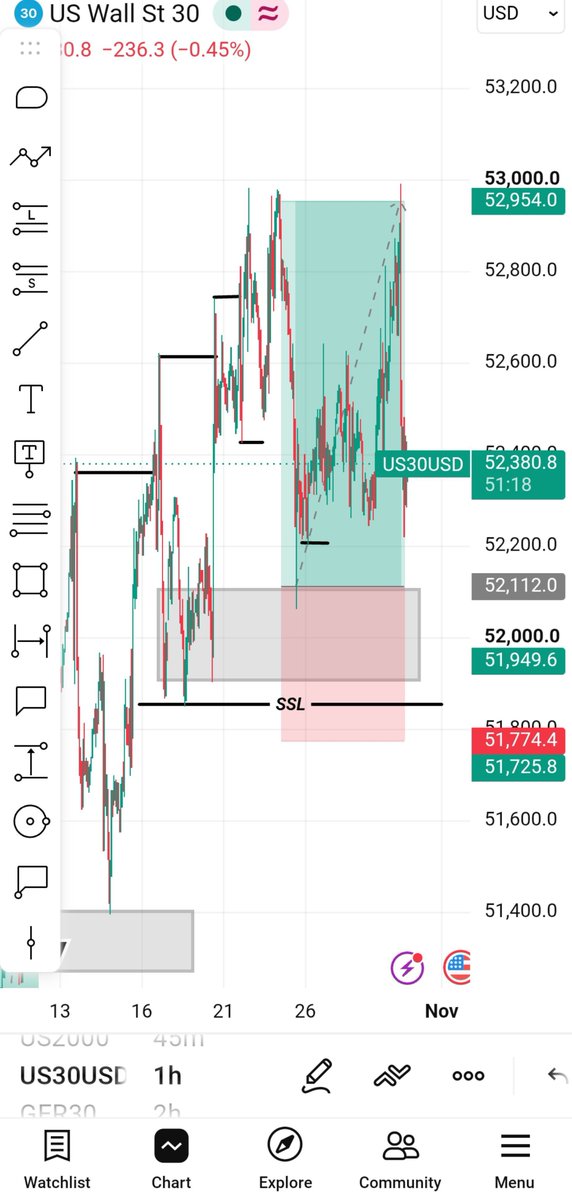
Good night, CT 🌙🎯
3 TPs hit ✅
NAS100 ✅ UK100 ✅ US30 ✅
GER30 hit SL ❌
Not every trade goes our way, and that’s part of the game. Take the wins, respect the losses, and live to trade another day. 📊
Charts closed. Time to rest. See you tomorrow, CT. 🤝
Everyone knows Bitcoin… but how many actually know the story behind its creation? 👀₿
The history is more interesting than you think. 🧵👇
$Bitcoin: The Idea That Challenged the Traditional Financial System
Before Bitcoin became a global financial conversation, it began as a question: Could people transfer value over the internet without needing a central authority to approve every transaction?
To understand Bitcoin, we need to go back to the financial uncertainty of 2008.
The Beginning: A New Idea in 2008
In October 2008, a person or group using the name Satoshi Nakamoto published a paper titled Bitcoin: A Peer-to-Peer Electronic Cash System.
The proposal described a way for people to send digital money directly to one another without relying on a traditional financial intermediary to process every payment.
The idea was not simply to create another digital currency. Digital money had existed in different forms before Bitcoin. The difficult problem was how to prevent someone from spending the same digital money twice without depending on a central authority.
Bitcoin proposed an alternative: a distributed network in which participants could independently verify transactions and agree on a shared transaction history.
Why Was Bitcoin Different?
Traditional financial systems generally rely on institutions to maintain account records, authorize transactions, and resolve certain disputes.
Bitcoin approaches this differently.
Its network uses cryptography, a public transaction ledger, and a consensus mechanism called Proof of Work to coordinate the validation of transactions and the addition of new blocks.
The ledger is maintained across participating computers rather than controlled by a single central operator. This design makes it possible to verify transactions without asking one company or government to maintain the entire system.
That does not mean Bitcoin has no risks or limitations. Transactions can be difficult or impossible to reverse, users must protect their private keys, and the network's Proof of Work system consumes energy.
Understanding both the design and its limitations is essential to understanding Bitcoin properly.
January 2009: Bitcoin Becomes Operational
On January 3, 2009, Satoshi Nakamoto created Bitcoin's first block, known as the genesis block.
This marked the beginning of Bitcoin's blockchain.
Bitcoin was no longer only a proposal on paper. Its software and network were operating, allowing participants to work toward maintaining a shared transaction history.
One of the most interesting details is that the genesis block contains a reference to a newspaper headline about a UK bank bailout. This is widely interpreted as historical context for the period in which Bitcoin emerged, although it does not by itself establish every motivation behind its creation.