

Top Tweets for #12ki

@AryanSi06687734 12kills in last 3 matches 💀

Toplasan burdan 12kişi ile konuşmamışımsır siz nörüyonuz

SAYIYIM DEDIM INSTA PRIVE BURDAN 12 KISI ALMISIM IMDAT BIRI BENI CIDDEN DURDURSUN

@yengwoon Popmart biru dan bisa d gantung kk



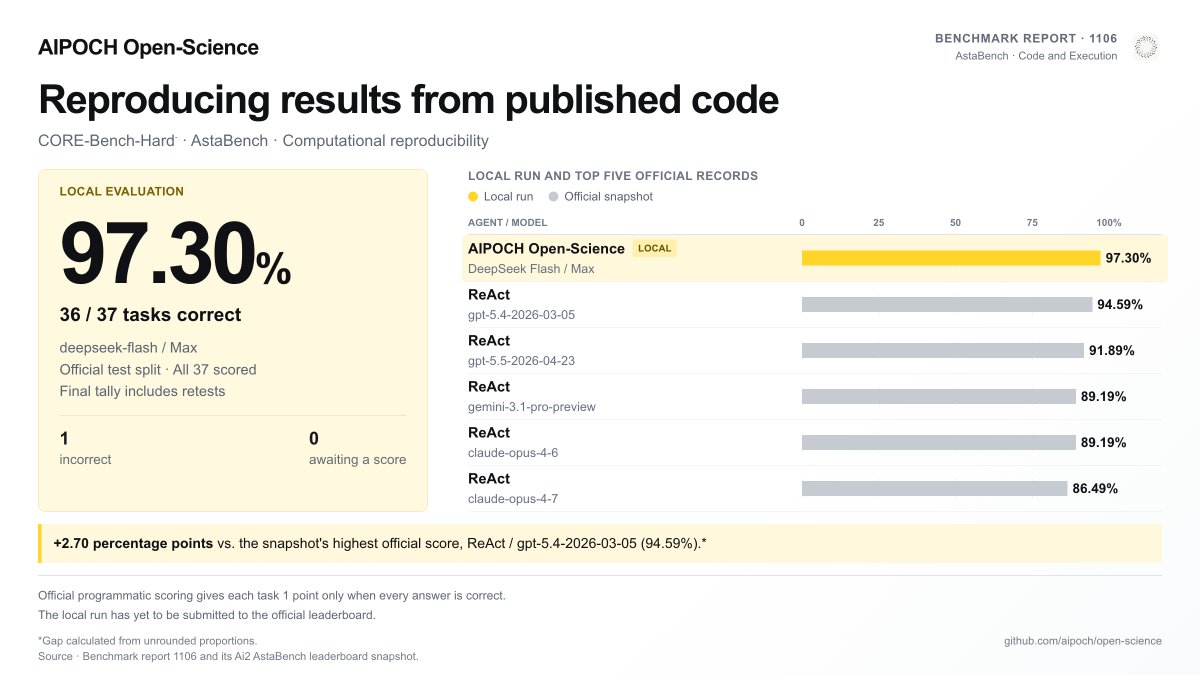
AIPOCH Open-Science just scored 97.30% (36/37) on CORE-Bench-Hard⁻ in a local eval with DeepSeek Flash at Max reasoning effort — beating the highest official reference scores reported so far.
GitHub: https://t.co/12KI9pkj8B

AIPOCH Open-Science passed 36 of 37 tasks (97.30%) in a local evaluation on AstaBench’s CORE-Bench-Hard⁻ test split, using DeepSeek Flash (deepseek-flash) at Max reasoning effort.
Can an agent reproduce a result from a published study?
On CORE-Bench-Hard⁻, it starts with the study’s code, data, and README. It installs dependencies, runs the analysis in a container, and records the requested results in report.json.
The benchmark’s programmatic scorer checks the reported numbers, text, and lists against reference results. A task counts as correct only when every subquestion passes. The final tally includes retests and records one failure.
The highest scores in our report’s comparison:
• AIPOCH Open-Science / DeepSeek Flash (Max) — 97.30% (local)
• Ai2 ReAct / gpt-5.4-2026-03-05 — 94.59%
• Ai2 ReAct / gpt-5.5-2026-04-23 — 91.89%
• Ai2 ReAct / gemini-3.1-pro-preview and claude-opus-4-6 — 89.19% each
The local score is 2.70 percentage points above the highest official reference in the report’s snapshot, using unrounded proportions. The full chart shows all 25 official references and preserves their tied ranks. Our local result has yet to be submitted to the official leaderboard.
🚀 AIPOCH Open-Science v1.0.8 is out! 🎉
This release brings smarter literature workflows, cleaner Settings, and better long-session performance.
🔗 https://t.co/YwgW3bXvsn
⭐ Star us: https://t.co/12KI9pkj8B
AIPOCH Open-Science v1.0.8 is out!
This release focuses on literature management, streamlined Settings, and long-session reliability. It introduces batch reference imports, AI-powered study snapshots, improved Agent process cleanup, and fixes across PDF processing, application updates, and Runtime stability.
【🚀 New Features】
⚙️ Redesigned Settings
Settings are now organized into more focused tabs for easier navigation.
- Appearance and Notifications move under System Settings.
- General Settings now includes app information, diagnostics, CLI tools, and help resources.
- Direct access to the manual installation and update guide.
📚 Batch Literature Import
The Literature Library now supports importing up to 100 mixed references at once.
- Supports DOI, arXiv ID, PMID, PMCID, and official article links.
- Automatically normalizes and deduplicates identifiers.
- Preserves the existing review and transactional save workflow.
🤖 AI-Powered Study Snapshots
Literature details now include an AI Study Snapshot generated using the configured main model.
Each snapshot summarizes five key aspects:
- Research Question
- Study Population
- Methods
- Main Findings
- Limitations
Snapshots clearly indicate whether they were generated from the full text or abstract.
⚡ Improved Agent Process Management
Completed Sessions now automatically release Agent and Tool processes across all five supported Agent Frameworks.
Shared Reviewer Runtimes, outdated handoff resources, and failed cleanup attempts are handled more reliably, reducing memory accumulation during long research sessions.
🧠 Updated Model Support
Tencent TokenHub now supports:
- Hy4 reasoning model.
- DeepSeek V4.1 Flash with a 1M-token context window.
- Image input for GLM-5.3-Flash, Kimi K3, and MiniMax M3.
【🔧Improvements】
- eQTL Catalogue now uses indexed files following the retirement of its REST API, with GRCh38 coordinate validation.
- Improved PDF reading order, Table extraction, and source-text verification.
- Clearer application update dialogs and recovery diagnostics.
- Stronger R Notebook dependency tracking for more accurate reproducibility evidence.
- Improved Artifact Provenance reporting and recovery.
【🐛 Bug Fixes】
- Application Updates — Fixed macOS and Windows update preparation, process detection, and file-lock handling.
- Notebook & Runtime — Fixed Windows recovery issues, sandboxed Node.js proxy compatibility, and shared gateway stability.
- Agents & Sessions — Fixed Pi installation in packaged Desktop builds and improved Agent process cleanup.
- PDF & Literature — Fixed Windows PDF worker crashes, stale PDF import notices, and extraction reliability.
- Artifacts & Downloads — Fixed download permission errors, cleanup failures, and outdated Markdown Artifact provenance.
- Interface — Removed duplicate unavailable-model notices and improved error feedback.

12kills #2 🥵🥵
🚀 AIPOCH Open-Science v1.0.7 is out! 🎉
This release brings more AI Agent flexibility, smarter literature workflows, and better PDF reading.
AIPOCH Open-Science v1.0.7 — more ways to explore, read, and work with scientific research.
⭐ Star us: https://t.co/12KI9pkj8B
AIPOCH Open-Science v1.0.7 is out!
This release focuses on AI Agent flexibility, literature management, and PDF reading capabilities. It introduces Pi as a fifth Agent Framework, direct DOI and arXiv reference imports, Agent-powered PDF annotations, optional OCR in nine languages, and improvements to research workflows and cross-platform stability.
【🚀 New Features】
🤖 Pi Agent Framework Support
- Pi joins Claude Code, OpenCode, Codex, and CodeBuddy as the fifth supported Agent Framework.
- Integrated onboarding and Settings.
- Connection validation and subscription sign-in where available.
- Consistent Skill, Notebook, and Literature tool activity display.
📚 Direct DOI & arXiv Reference Import
The Literature Library now supports adding references directly from:
- DOI identifiers and resolver links.
- arXiv abstract and PDF URLs.
- Researchers can review resolved metadata and save references without preparing separate import files.
📝 Agent-Powered PDF Annotations
- Reading Agents can now interact directly with PDF Notes & Annotations.
- Locate and highlight relevant passages.
- Create persistent Notes and Marks.
- Retrieve existing annotations from linked PDFs.
- This enables workflows such as highlighting important findings and recording why they matter.
📄 Optional PDF OCR in Nine Languages
- Scanned PDFs can now become searchable through optional OCR.
- Supports English, Simplified Chinese, Traditional Chinese, German, - Spanish, French, Japanese, Korean, and Russian.
- Recognition models are downloaded on demand.
- Per-page OCR coverage indicators show which pages contain recognized text.
🔍 Searchable Research Case Marketplace
The Sharing Marketplace now supports:
- Category tabs and keyword search.
- Research Case discovery from Home and Conversation Workspaces.
- Direct downloads from Case details.
- Preserved filters and scroll position between visits.
【🔧 Improvements】
- Clearer descriptions for individual Scientific Connectors in Settings.
- Unified Composer error messages with actionable recovery options.
- Improved Artifact publishing, restoration, and Provenance display.
- More responsive OCR language selection and clearer local model status.
- Improved Pi Agent tool activity presentation.
【🐛Bug Fixes】
- Notebook & Windows — Restored PowerShell availability during first-use Notebook setup.
- Agents & Sessions — Fixed OpenCode Session termination during compaction and follow-up runs being lost while background tasks settle.
- Literature & Network — Fixed full-text downloads through Fake-IP DNS proxies such as Mihomo and Clash.
- PDF & OCR — Prevented stalled OCR downloads from blocking normal PDF reading.
- Interface — Improved Pi tool activity rendering and error recovery feedback.

Bmic
Jay ali IGL 18M 16Kills #2
Gulin Gota 18M 12Kills #12
#sackjelly

🚀 AIPOCH Open-Science v1.0.5 is out! 🎉
AIPOCH Open-Science v1.0.5 — more connected research data, better literature workflows, and greater flexibility across environments.
🔗 https://t.co/oQnwmPXeVv
⭐ Star us: https://t.co/12KI9pkj8B
AIPOCH Open-Science v1.0.5 is out!
https://t.co/7DHgHR0AhE
This release focuses on scientific data connectivity, literature reading management, and cross-platform research workflows. It expands native Scientific Connectors, introduces Literature Reading Status, enables direct .science package import/export in local Web, and improves service management, document processing, and Runtime reliability.
【🚀 New Features】
🧬 Expanded Scientific Connectors
Open-Science now supports more native scientific APIs and official data discovery capabilities:
- Europe PMC — Native Boolean, Core, and Abstract searches with explicit pagination.
- HGNC — Expanded human gene information.
- ChEA3 — Transcription Factor Enrichment Analysis.
- bioDBnet — Identifier conversion and ortholog queries.
- Cellosaurus — RDF knowledge graph and STR similarity searches.
- NHANES, PhysioNet, openFDA & CTD — Official dataset and file discovery.
Connectors are enabled on demand and provide official source links and Provenance. Queries are sent to the corresponding services, and restricted datasets still require separate access authorization.
📚 Literature Reading Status
The Literature Library now supports Unread, In Progress, and Finished Reading statuses.
- Track reading progress in a dedicated Library column.
- Update status individually or from reference details.
- Apply batch changes across pages.
- Filter references by reading status.
This makes managing large research libraries and reading workflows easier.
📦 .science Packages in Local Web
Researchers can now import and export .science research packages directly through the local Web interface, without switching to Desktop or CLI.
Packages can include selected Conversations, files, Notebook records, and Provenance. Transfers remain between the browser and local Open-Science service.
🖥️ Improved Local Service Management
Local service lifecycle management is now more predictable:
- Services remain active while Desktop connections or explicit CLI Holds exist.
- Closing one window no longer interrupts other windows or background tasks.
- open-science stop releases the current Hold.
- open-science stop --force requests full local service shutdown.
🏠 Use Case Gallery
Home now includes a Use Case Gallery for exploring published research examples.
Users can view details and import verified Session Packages directly, with download progress and cancellation support.
🔐 Settings & Access Improvements
- Persistent download and installer actions in Settings and Update pages.
- Security Policy link in Settings → About.
- Authorized folders now appear in a readable list with Read/Write permissions and authorization timestamps.
【🔧 Improvements】
- Improved DOCX generation and preview, preserving Table styles, borders, and page layouts.
- Added template-based Markdown-to-DOCX workflows.
- Clearer Crossref publication checks with source details and timestamps.
- Streamlined Literature details, Package Import, and Replay interfaces.
- Better BiocManager guidance for installing Bioconductor packages in Windows Managed R.
- Improved Tool Group collapsing and wide Markdown Table scrolling.
【🐛 Bug Fixes】
- Network & Permissions — Fixed Full Access networking, global domain authorization synchronization, and connection shutdown behavior.
- Agents & Providers — Restored OpenCode 2.x compatibility while maintaining 1.x support.
- Notebook & Runtime — Fixed external Node CLI discovery on macOS, Windows Protection setup delays, and repeated folder permission requests for managed Skill References.
- Documents & Interface — Improved DOCX rendering, Tool Group scroll stability, and Markdown Table navigation.
🚀 AIPOCH Open-Science v1.0.4 is out! 🎉
A lighter, smoother research workbench with smaller downloads, MCP connectivity, and smarter Conversations.
Less overhead, better connectivity, and a cleaner research workflow.
⭐ Star us: https://t.co/12KI9pkj8B
AIPOCH Open-Science v1.0.4 is out! This release focuses on smaller downloads, external Agent connectivity, and a cleaner research experience. It introduces MCP support for the standalone CLI, smarter Conversation organization, Crossref publication integrity checks, and improvements to Artifact imports, Skills, and workflow reliability.
【🚀 New Features】
🔌 Standalone CLI MCP Server
The Open-Science CLI now exposes its research tools through a local MCP server, allowing external MCP clients to access research capabilities.
- Connect external Agents to an existing local Open-Science profile.
- Use the profile's existing tools and permissions.
- Support research operations, including persistent changes.
The profile service must already be running and authenticated. Start it with open-science start, then connect using open-science mcp.
Note: MCP clients operate under existing profile permissions and may modify data or incur model costs.
💬 Smarter Conversation Organization
Long Conversations are now easier to navigate.
- Intermediate messages automatically collapse after a turn completes.
- Tool activities are grouped into compact summaries.
- Running, waiting, and interrupted tasks remain visible.
- Search, annotations, and native find can reveal collapsed content when needed.
📚 Crossref Publication Integrity Checks
Literature references with valid DOIs now support manual retraction and correction checks through Crossref.
Results and check timestamps are saved to each reference, helping researchers track publication updates.
Crossref coverage is not exhaustive, so an absence of notices does not guarantee that a publication is unaffected.
📁 Artifact & Skills Improvements
- Artifact Import — Import files directly from authorized folders into managed Artifact storage.
- GitHub Skills — Save repositories during Skill imports for future reuse.
- Question Cards — New structured Skip actions with predictable controls.
🔧 Improvements
- Significantly reduced CLI and Desktop download sizes.
- Removed unused Runtime components and redundant dependencies.
- Optimized the bundled PDF translation worker.
- Consolidated environment management into a single bundled component.
- Preserved active Runtime files, diagnostics, and tokenizer support.
【🐛 Bug Fixes】
Notebook & Runtime — Restored standard Windows Notebook execution and retained the tokenizer lite Runtime in packaged builds.
Session Packages — Fixed exports getting stuck after selecting a save location.
Settings & Permissions — Fixed race conditions in folder access dialogs and cleanup.
Conversations & Agents — Fixed Ask User selection loops after continuation failures.
Replay — Automatic results now appear as System Events for clearer research history.

Rondo 12kill win veya ilk 3 yazdım
Günü 3. Bitiricez

@Tirth_Lakhtaria 12Kills

We are so close to announce a new stage! Please wait and see!
Science, Open to All!
https://t.co/12KI9pkj8B
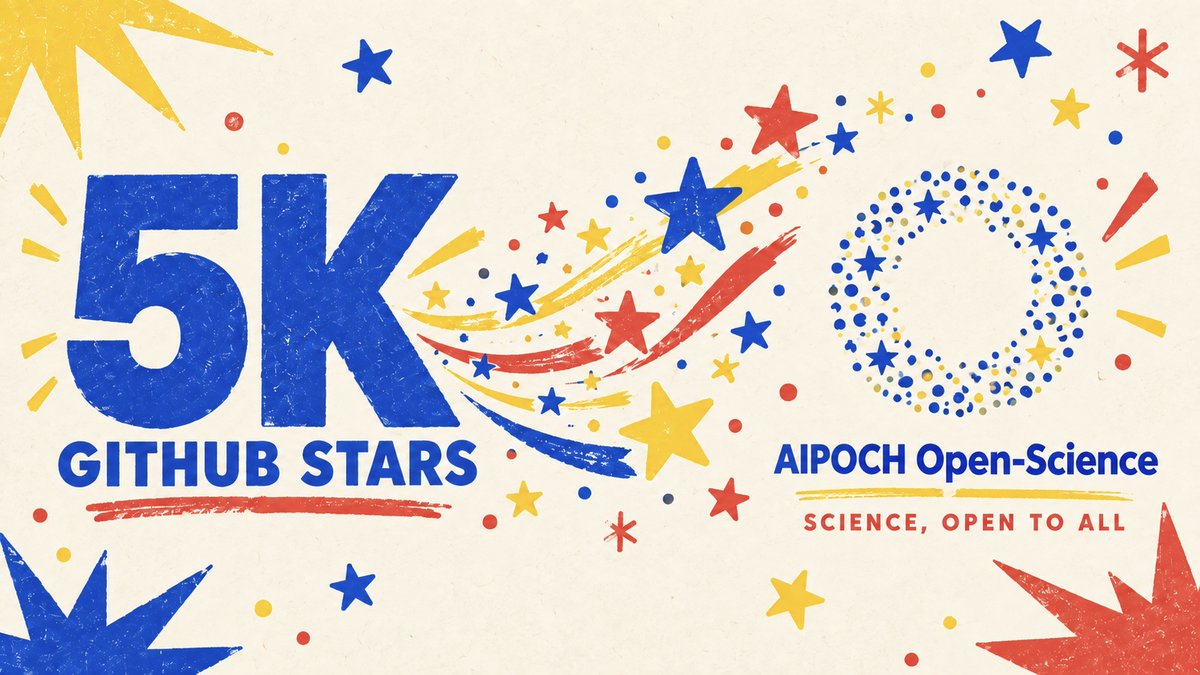
AIPOCH Open-Science just crossed 5,000 GitHub stars! ⭐
Thank you to everyone who’s explored, contributed to, and shared the project. This milestone belongs to all of you.
We’re just getting started—big things are coming soon. Stay tuned! 🚀


@PRX_Viperr28 #6 12kills
Move to the next stage! Thank you for your support!
https://t.co/12KI9pkj8B
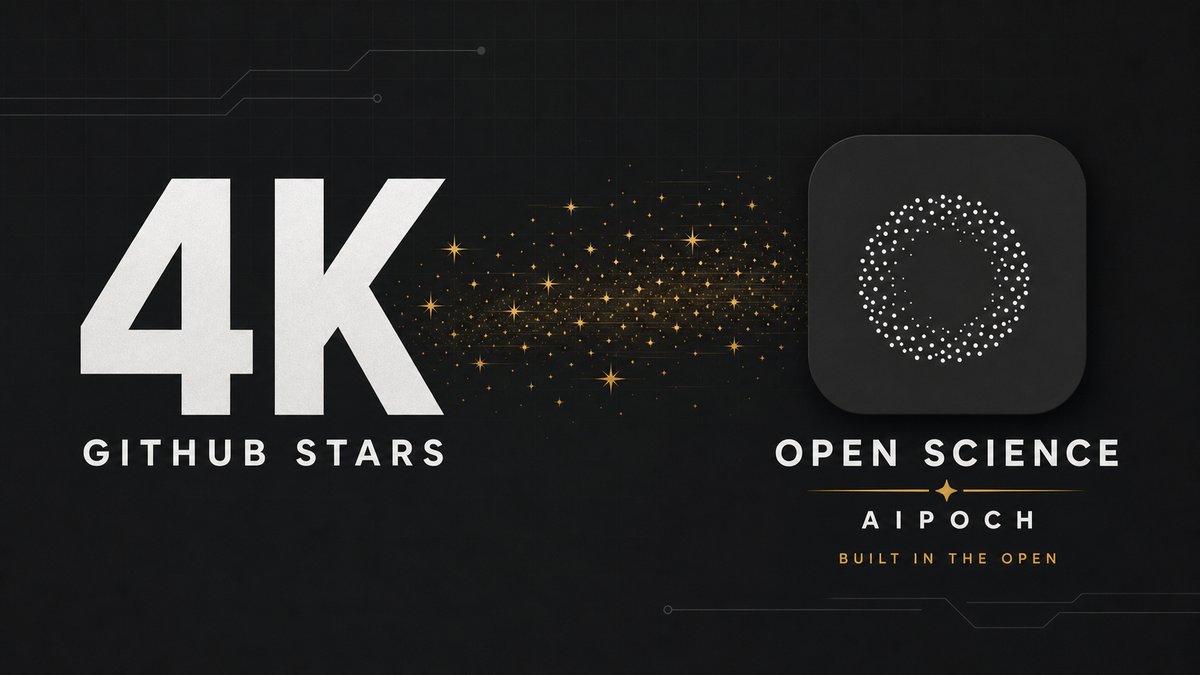
Open Science has entered the 4K-star milestone on GitHub. ⭐
https://t.co/poXdpI9nCx
Thank you to every researcher, builder, and contributor who has tried the app, inspected the code, opened an issue, or shared the project.
AIPOCH is building Open Science as an open-source, local-first research workbench: scientific agents, Python/R execution, data connectors, and inspectable artifact provenance in one workspace.

@Vella549 @onlyfactsofIGC Guhhlin 17match 12kill jonathan 18match 29 kill or ye lodathan Apna mummy ke chut me dal lo
Last Seen Hashtags on Sotwe
いまさらシリーズ
Seen from Korea
mgai
Seen from Switzerland
睡后收益
Seen from Korea
fpe #futa
Seen from France
ElementoDragon
Seen from Vietnam
brosis(*)***************************
Seen from Lebanon
للعيال
Seen from Turkey
BOLDLIKEUS
Seen from United States
pornedit
Seen from Saudi Arabia
확보하지
Seen from Vietnam
Most Popular Users

Elon Musk 
@elonmusk
239.7M followers

Barack Obama
@barackobama
118.6M followers

Cristiano Ronaldo
@cristiano
114.3M followers

Donald J. Trump
@realdonaldtrump
111.7M followers

Narendra Modi
@narendramodi
106.9M followers

Rihanna
@rihanna
98.6M followers

NASA
@nasa
92.1M followers

Justin Bieber
@justinbieber
91.7M followers

KATY PERRY
@katyperry
89.9M followers

Taylor Swift
@taylorswift13
83.9M followers

Lady Gaga
@ladygaga
75.4M followers

Virat Kohli
@imvkohli
73.3M followers

Kim Kardashian
@kimkardashian
70.8M followers

YouTube
@youtube
68.6M followers

Neymar Jr
@neymarjr
66.3M followers

Bill Gates
@billgates
65.1M followers

Selena Gomez
@selenagomez
63M followers

The Ellen Show
@theellenshow
62.1M followers

CNN
@cnn
61.7M followers

X
@x
60.6M followers