

Top Tweets for #AIForChemistry

RetroGFN: Diverse and Feasible Retrosynthesis using GFlowNets
1. This paper introduces RetroGFN, the first GFlowNet-based model for single-step retrosynthesis, designed to generate a diverse and feasible set of reactions leading to a given product—an essential task in drug discovery pipelines.
2. Unlike prior models limited by incomplete datasets, RetroGFN explores outside known reactions using a learned reaction feasibility model. This allows it to generate novel but realistic reactions that existing datasets do not capture.
3. RetroGFN uses a three-phase generation process: selecting a reaction center, composing reactant patterns, and creating atom mappings. Each step is modeled as a stochastic policy in the GFlowNet framework, guided by neural scoring functions.
4. The model is trained using a trajectory balance objective with a reward function based on round-trip reaction feasibility—determined by whether a forward reaction model can reconstruct the product from predicted reactants.
5. RetroGFN outperforms all existing retrosynthesis models on the round-trip accuracy metric for k > 3 across USPTO-50k and USPTO-MIT datasets, while maintaining competitive top-k accuracy.
6. The paper makes a compelling case for replacing top-k accuracy with round-trip accuracy as the standard metric in retrosynthesis. Round-trip better captures chemical feasibility and reaction diversity, and correlates more with expert judgment.
7. RetroGFN-generated reactions include more diverse molecular scaffolds than baselines, especially at higher k values, addressing the critical need for structural diversity in synthesis planning.
8. While its ranking of candidates is suboptimal for low-k scenarios, RetroGFN excels in generating a wide pool of high-quality reactions, making it ideal for downstream multi-step planning algorithms.
9. The authors also show that optimizing round-trip accuracy yields better expected financial outcomes in simulated drug development pipelines compared to optimizing top-k accuracy, especially when the cost of missing viable syntheses is high.
10. Despite modest inference speed, RetroGFN scales well and generalizes across datasets. Future improvements may include better ranking strategies and the development of a fully template-free GFlowNet for retrosynthesis.
💻Code: https://t.co/k0x4hLiMw0
📜Paper: https://t.co/7D1ZhIHErL
#retrosynthesis #drugdiscovery #GFlowNet #AIforChemistry #computationalchemistry #molecularsynthesis #machinelearning #bioinformatics

Genetic-Guided GFlowNets for Sample-Efficient Molecular Optimization
• This study introduces a novel framework that combines Genetic Algorithms (GA) with GFlowNets, enhancing sample efficiency in molecular optimization by leveraging domain-specific genetic knowledge.
• The approach utilizes GFlowNets to sample a diverse range of molecules, refining them with genetic operations (mutation, crossover) to converge on high-reward structures, outperforming baseline methods in the Practical Molecular Optimization (PMO) benchmark.
• With off-policy training, this method significantly reduces reward calls, generating SARS-CoV-2 inhibitors with ten times fewer calls compared to existing models.
• The hybrid GA-GFlowNet model achieves superior exploration and exploitation balance, showcasing higher accuracy in identifying top-10 high-reward candidates, with increased diversity control through adjustable parameters.
• By integrating a rank-based reweighting mechanism, the model selectively focuses on high-reward candidates, making it ideal for applications in drug discovery and material design.
💻Code: https://t.co/M8zPAMfuEN
📜Paper: https://t.co/zXmJFNTaHZ
#MolecularOptimization #Bioinformatics #DrugDiscovery #MachineLearning #GeneticAlgorithms #AIforChemistry

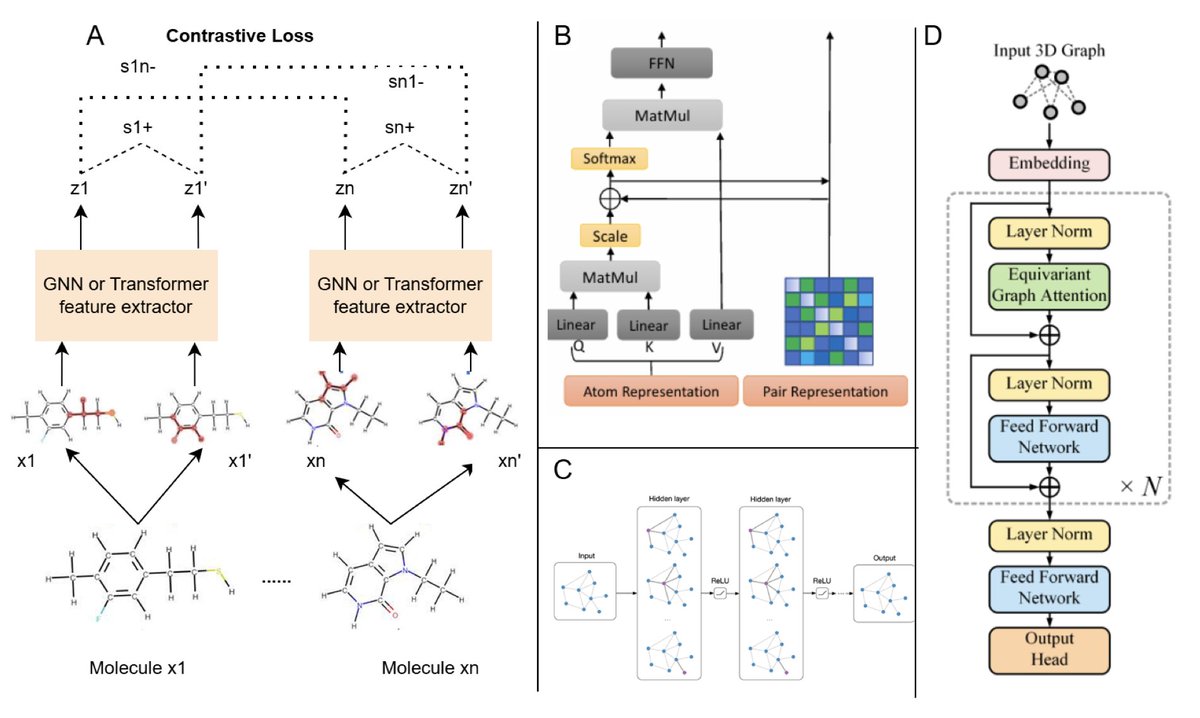
A Probability Contrastive Learning Framework for 3D Molecular Representation Learning
• This study proposes a probability-based contrastive learning framework designed to tackle false positive and false negative pair issues in 3D molecular representation learning, enhancing accuracy in molecular property prediction.
• Unlike conventional methods like MolCLR, which rely on fixed augmentations that can mislabel structurally similar molecules as negatives, this framework introduces learnable weights for data pairs, dynamically adjusted using Bayesian inference.
• The model optimizes representation quality by applying a stochastic expectation-maximization (EM) algorithm, which iteratively refines data pair weights and model parameters.
• Experimental results show state-of-the-art performance across 13 of 15 property prediction tasks on MoleculeNet and 8 of 12 on QM9, demonstrating improved downstream effectiveness.
• By reducing reliance on rigid augmentation heuristics, this method adapts well to both 2D and 3D datasets, enhancing robustness in drug design and molecular property predictions.
• The probabilistic framework’s flexibility allows integration with existing models, including Uni-Mol and Equiformer, showing marked improvements over traditional contrastive and non-contrastive learning approaches.
📜Paper: https://t.co/suGVVhs4nT
#MolecularRepresentation #ContrastiveLearning #MachineLearning #Bioinformatics #DrugDesign #AIforChemistry

Chemists are leveraging #MachineLearning to decipher the mystery of life's origins. From predicting the behaviour of complex chemical reactions to simulating the primordial Earth's conditions, AI is accelerating the quest for a universal theory of life's origins. Read the full article at https://t.co/1tlcaubXjL
#Hyperstack #AI #LifeOrigins #ScienceAdvancements #Chemistry #AIforChemistry #ML #ScientificBreakthrough #ArtificialIntelligence #TechInnovation #GPUCloud #CloudComputing #NVIDIA #GPU #GPUisWhatWeDo

Last Seen Hashtags on Sotwe
すごく好きで
Seen from United States
Jantar
Seen from United States
mgai
Seen from Turkey
Stanburn
Seen from United States
722studio
Seen from United States
habeshaporn
Seen from Germany
นครปฐมนัดเยส
Seen from Thailand
bakırköytraveſti
Seen from Turkey
waynelearns
Seen from United States
朱可儿
Seen from Malaysia
Trends for you
Most Popular Users

Elon Musk 
@elonmusk
239.6M followers

Barack Obama
@barackobama
118.6M followers

Cristiano Ronaldo
@cristiano
114.3M followers

Donald J. Trump
@realdonaldtrump
111.7M followers

Narendra Modi
@narendramodi
106.9M followers

Rihanna
@rihanna
98.6M followers

NASA
@nasa
92.1M followers

Justin Bieber
@justinbieber
91.7M followers

KATY PERRY
@katyperry
89.9M followers

Taylor Swift
@taylorswift13
83.9M followers

Lady Gaga
@ladygaga
75.4M followers

Virat Kohli
@imvkohli
73.3M followers

Kim Kardashian
@kimkardashian
70.8M followers

YouTube
@youtube
68.6M followers

Neymar Jr
@neymarjr
66.3M followers

Bill Gates
@billgates
65.1M followers

Selena Gomez
@selenagomez
63M followers

The Ellen Show
@theellenshow
62.1M followers

CNN
@cnn
61.7M followers

X
@x
60.6M followers