

Top Tweets for #AUTOLab

♻️ @Metrohm_UK_Ire #Autolab & #DropSens demo sale, ends 30 Sept.
➡️Quote: 📝
https://t.co/mxWskpLI4a
#ElectroChem2026 #Electrochemistry

⚡ See you tomorrow at #Electrochem2026 in York! 🔬 @Metrohm_UK_IRE will exhibit, give a flash talk and showcase #Metrohm #Autolab & #DropSens👋

♻️ 𝐒𝐚𝐯𝐞 𝐬𝐦𝐚𝐫𝐭𝐥𝐲. 𝐀𝐜𝐭 𝐬𝐮𝐬𝐭𝐚𝐢𝐧𝐚𝐛𝐥𝐲.
@Metrohm_uk_Ire #Autolab and #Metrohm #DropSens ex-demo #electrochemistry equipment is now available at discounted prices.
👉 𝐕𝐢𝐞𝐰 𝐞𝐪𝐮𝐢𝐩𝐦𝐞𝐧𝐭 𝐚𝐧𝐝 𝐫𝐞𝐪𝐮𝐞𝐬𝐭 𝐚 𝐪𝐮𝐨𝐭𝐞:
https://t.co/mxWskpLI4a


@Daisuke_lvlori
茂利大輔さん
惠木勇哉さん
撮影対応ありがとうございました
惠木勇哉さんのアカウントが見つからなかったのでハッシュタグだけつけておきます。
#惠木勇哉
#オートポリス #autolab #AndlegalRacing #スーパー耐久


Since launching #AutoLab, we’ve gotten a lot of inbound from researchers, builders, and friends.
What’s clear is this: the field wants a better standard for evaluating research-capable agents.
Our goal is simple: build a fair, open, transparent benchmark for agents that can operate in real scientific and engineering loops.
This should not be defined behind closed doors.
[Accidentally deleted this earlier, reposting] 😭
#AutoLab #autoresearch
We've been asking ourselves a question: if AI agents can now run hundreds of experiments overnight, how do we know whether they're actually contributing to research — or just generating noise?
That's why we built AutoLab (https://t.co/aRbV2YeaPf).
Not another pass/fail benchmark, but an open-source environment where agents face the same loop every researcher knows intimately — propose, test, fail, diagnose, revise, repeat.
23 tasks with no answer keys, just open search spaces and real constraints.
We ran 161 evaluations across 7 frontier models, 633M tokens. Every decision, every pivot, every dead end — all openly available in our Live Lab for anyone to replay and learn from.
What we found wasn't about which model is "smartest." It's about a capability we call closed-loop resilience: when incremental refinement stops working, can the agent recognize it and restructure? On one task, two frontier models hit the same wall. One kept pushing within the existing frame. The other stepped back and redesigned the approach entirely. That moment — knowing when to abandon a frame, not just optimize within it — is what separates real research from sophisticated pattern matching.
We believe this matters beyond benchmarking. If agents are genuinely entering the research loop, we want that transition to be measured transparently, built in the open, and shaped by the community — not locked inside any single lab. The scientist doesn't disappear. The loop gets a new participant. And we want to make sure that participant is understood.
This is a joint effort across @Stanford, @MIT, @UW, @UCSanDiego, @ucsantabarbara, @NotreDame, NUS, @Google, @NVIDIA, @IBMResearch, and @bakelab_hq. But 23 tasks is just the start. If you have an optimization problem you've spent weeks grinding on empirically — with a clear metric and no known optimal solution — it probably belongs here. Contribute a full task, a rough skeleton, or just the idea.
The best benchmarks aren't built by one team. They're built by the people who actually do the work!
Github: https://t.co/2sLNlASVcb
![my_cat_can_code's tweet photo. [Accidentally deleted this earlier, reposting] 😭
#AutoLab #autoresearch
We've been asking ourselves a question: if AI agents can now run hundreds of experiments overnight, how do we know whether they're actually contributing to research — or just generating noise?
That's why we built AutoLab (https://t.co/aRbV2YeaPf).
Not another pass/fail benchmark, but an open-source environment where agents face the same loop every researcher knows intimately — propose, test, fail, diagnose, revise, repeat.
23 tasks with no answer keys, just open search spaces and real constraints.
We ran 161 evaluations across 7 frontier models, 633M tokens. Every decision, every pivot, every dead end — all openly available in our Live Lab for anyone to replay and learn from.
What we found wasn't about which model is "smartest." It's about a capability we call closed-loop resilience: when incremental refinement stops working, can the agent recognize it and restructure? On one task, two frontier models hit the same wall. One kept pushing within the existing frame. The other stepped back and redesigned the approach entirely. That moment — knowing when to abandon a frame, not just optimize within it — is what separates real research from sophisticated pattern matching.
We believe this matters beyond benchmarking. If agents are genuinely entering the research loop, we want that transition to be measured transparently, built in the open, and shaped by the community — not locked inside any single lab. The scientist doesn't disappear. The loop gets a new participant. And we want to make sure that participant is understood.
This is a joint effort across @Stanford, @MIT, @UW, @UCSanDiego, @ucsantabarbara, @NotreDame, NUS, @Google, @NVIDIA, @IBMResearch, and @bakelab_hq. But 23 tasks is just the start. If you have an optimization problem you've spent weeks grinding on empirically — with a clear metric and no known optimal solution — it probably belongs here. Contribute a full task, a rough skeleton, or just the idea.
The best benchmarks aren't built by one team. They're built by the people who actually do the work!
Github: https://t.co/2sLNlASVcb](https://pbs.twimg.com/media/HFCRHmmaAAAwiuO.jpg)
![my_cat_can_code's tweet photo. [Accidentally deleted this earlier, reposting] 😭
#AutoLab #autoresearch
We've been asking ourselves a question: if AI agents can now run hundreds of experiments overnight, how do we know whether they're actually contributing to research — or just generating noise?
That's why we built AutoLab (https://t.co/aRbV2YeaPf).
Not another pass/fail benchmark, but an open-source environment where agents face the same loop every researcher knows intimately — propose, test, fail, diagnose, revise, repeat.
23 tasks with no answer keys, just open search spaces and real constraints.
We ran 161 evaluations across 7 frontier models, 633M tokens. Every decision, every pivot, every dead end — all openly available in our Live Lab for anyone to replay and learn from.
What we found wasn't about which model is "smartest." It's about a capability we call closed-loop resilience: when incremental refinement stops working, can the agent recognize it and restructure? On one task, two frontier models hit the same wall. One kept pushing within the existing frame. The other stepped back and redesigned the approach entirely. That moment — knowing when to abandon a frame, not just optimize within it — is what separates real research from sophisticated pattern matching.
We believe this matters beyond benchmarking. If agents are genuinely entering the research loop, we want that transition to be measured transparently, built in the open, and shaped by the community — not locked inside any single lab. The scientist doesn't disappear. The loop gets a new participant. And we want to make sure that participant is understood.
This is a joint effort across @Stanford, @MIT, @UW, @UCSanDiego, @ucsantabarbara, @NotreDame, NUS, @Google, @NVIDIA, @IBMResearch, and @bakelab_hq. But 23 tasks is just the start. If you have an optimization problem you've spent weeks grinding on empirically — with a clear metric and no known optimal solution — it probably belongs here. Contribute a full task, a rough skeleton, or just the idea.
The best benchmarks aren't built by one team. They're built by the people who actually do the work!
Github: https://t.co/2sLNlASVcb](https://pbs.twimg.com/media/HFCQ_ltbkAAWset.jpg)
![my_cat_can_code's tweet photo. [Accidentally deleted this earlier, reposting] 😭
#AutoLab #autoresearch
We've been asking ourselves a question: if AI agents can now run hundreds of experiments overnight, how do we know whether they're actually contributing to research — or just generating noise?
That's why we built AutoLab (https://t.co/aRbV2YeaPf).
Not another pass/fail benchmark, but an open-source environment where agents face the same loop every researcher knows intimately — propose, test, fail, diagnose, revise, repeat.
23 tasks with no answer keys, just open search spaces and real constraints.
We ran 161 evaluations across 7 frontier models, 633M tokens. Every decision, every pivot, every dead end — all openly available in our Live Lab for anyone to replay and learn from.
What we found wasn't about which model is "smartest." It's about a capability we call closed-loop resilience: when incremental refinement stops working, can the agent recognize it and restructure? On one task, two frontier models hit the same wall. One kept pushing within the existing frame. The other stepped back and redesigned the approach entirely. That moment — knowing when to abandon a frame, not just optimize within it — is what separates real research from sophisticated pattern matching.
We believe this matters beyond benchmarking. If agents are genuinely entering the research loop, we want that transition to be measured transparently, built in the open, and shaped by the community — not locked inside any single lab. The scientist doesn't disappear. The loop gets a new participant. And we want to make sure that participant is understood.
This is a joint effort across @Stanford, @MIT, @UW, @UCSanDiego, @ucsantabarbara, @NotreDame, NUS, @Google, @NVIDIA, @IBMResearch, and @bakelab_hq. But 23 tasks is just the start. If you have an optimization problem you've spent weeks grinding on empirically — with a clear metric and no known optimal solution — it probably belongs here. Contribute a full task, a rough skeleton, or just the idea.
The best benchmarks aren't built by one team. They're built by the people who actually do the work!
Github: https://t.co/2sLNlASVcb](https://pbs.twimg.com/media/HFCQ6ueasAAGnHI.jpg)
![my_cat_can_code's tweet photo. [Accidentally deleted this earlier, reposting] 😭
#AutoLab #autoresearch
We've been asking ourselves a question: if AI agents can now run hundreds of experiments overnight, how do we know whether they're actually contributing to research — or just generating noise?
That's why we built AutoLab (https://t.co/aRbV2YeaPf).
Not another pass/fail benchmark, but an open-source environment where agents face the same loop every researcher knows intimately — propose, test, fail, diagnose, revise, repeat.
23 tasks with no answer keys, just open search spaces and real constraints.
We ran 161 evaluations across 7 frontier models, 633M tokens. Every decision, every pivot, every dead end — all openly available in our Live Lab for anyone to replay and learn from.
What we found wasn't about which model is "smartest." It's about a capability we call closed-loop resilience: when incremental refinement stops working, can the agent recognize it and restructure? On one task, two frontier models hit the same wall. One kept pushing within the existing frame. The other stepped back and redesigned the approach entirely. That moment — knowing when to abandon a frame, not just optimize within it — is what separates real research from sophisticated pattern matching.
We believe this matters beyond benchmarking. If agents are genuinely entering the research loop, we want that transition to be measured transparently, built in the open, and shaped by the community — not locked inside any single lab. The scientist doesn't disappear. The loop gets a new participant. And we want to make sure that participant is understood.
This is a joint effort across @Stanford, @MIT, @UW, @UCSanDiego, @ucsantabarbara, @NotreDame, NUS, @Google, @NVIDIA, @IBMResearch, and @bakelab_hq. But 23 tasks is just the start. If you have an optimization problem you've spent weeks grinding on empirically — with a clear metric and no known optimal solution — it probably belongs here. Contribute a full task, a rough skeleton, or just the idea.
The best benchmarks aren't built by one team. They're built by the people who actually do the work!
Github: https://t.co/2sLNlASVcb](https://pbs.twimg.com/media/HFCQyGgbMAAZw3X.jpg)
[Accidentally deleted this earlier, reposting] 😭
#AutoLab #autoresearch
We've been asking ourselves a question: if AI agents can now run hundreds of experiments overnight, how do we know whether they're actually contributing to research — or just generating noise?
That's why we built AutoLab (https://t.co/aRbV2YeaPf).
Not another pass/fail benchmark, but an open-source environment where agents face the same loop every researcher knows intimately — propose, test, fail, diagnose, revise, repeat.
23 tasks with no answer keys, just open search spaces and real constraints.
We ran 161 evaluations across 7 frontier models, 633M tokens. Every decision, every pivot, every dead end — all openly available in our Live Lab for anyone to replay and learn from.
What we found wasn't about which model is "smartest." It's about a capability we call closed-loop resilience: when incremental refinement stops working, can the agent recognize it and restructure? On one task, two frontier models hit the same wall. One kept pushing within the existing frame. The other stepped back and redesigned the approach entirely. That moment — knowing when to abandon a frame, not just optimize within it — is what separates real research from sophisticated pattern matching.
We believe this matters beyond benchmarking. If agents are genuinely entering the research loop, we want that transition to be measured transparently, built in the open, and shaped by the community — not locked inside any single lab. The scientist doesn't disappear. The loop gets a new participant. And we want to make sure that participant is understood.
This is a joint effort across @Stanford, @MIT, @UW, @UCSanDiego, @ucsantabarbara, @NotreDame, NUS, @Google, @NVIDIA, @IBMResearch, and @bakelab_hq. But 23 tasks is just the start. If you have an optimization problem you've spent weeks grinding on empirically — with a clear metric and no known optimal solution — it probably belongs here. Contribute a full task, a rough skeleton, or just the idea.
The best benchmarks aren't built by one team. They're built by the people who actually do the work!
Github: https://t.co/2sLNlASVcb

Este sábado temos o PREGOBÁN, obradoiro de dobrado victoriano para facer fanzines despregables 🙀✨
Só tedes que traer material de debuxo, nós poñemos o papel!!
🗓️ Sábado 14 de marzo
🕖 Ás 12:00 h
📍 En Lume (Rúa Fernando Macías 3)
#autoban #autolab #clubdebuxo #pregoban

Este sábado repetimos o Teléfono Gráfico📞✏️ na Revolteira, cun picnic indoor improvisado ✨
🗓️ Sábado 28 de febreiro
🕖 Ás 12:00 h
📍 Revolteira (Rúa Falperra 13)
NON HAI QUE APUNTARSE, só vide e traede o material de debuxo que queirades 🎨
#autoban #autolab #clubdebuxo

Temos todo preparado para o Club de Debuxo deste sábado no Pub El Siglo: o STOPBÁN!
🗓️ Sábado 24 de xaneiro
🕖 Ás 18:30 h
📍 No Siglo (Rúa Argudín Bolívar 1)
NON HAI QUE APUNTARSE, só ven e trae o material de debuxo que queiras 🎨
#autoban #autolab #clubdebuxo #stop #stopban

A semana que vén “Laboratorio de Mini Retratos”
🗓️ Sábado 25 de outubro
🕖 Ás 18:00 h
📍 En MALTE Atochas (Praza das Atochas 8)
Só tedes que traer o material de debuxo que queirades 🎨
ℹ️ Máis info e inscrición:
https://t.co/k2EV0zT0pw
#autoban #autolab #clubdebuxo #retratol

MAÑÁ Club de Debuxo PLANTOBÁN🌱🍃❤️
🗓️ Sábado 14 de xuño
🕖 A partir das 12:30 h.
📍 En VOTANIKALS (Praza de San Agustín, posto 14 exterior)
Só tedes que traer material de debuxo🎨🌿
ℹ️ Info inscrición:
https://t.co/bSMXcUxj8P
#autoban #autolab #clubdebuxo #plantas #esgallo

Club de Debuxo PLANTOBÁN🌱🍃🍀❤️
🗓️ Sábado 14 xuño
🕖 A partir das 12:30 h
📍 En VOTANIKALS (Pr. San Agustín, pto. 14 exterior)
Só tedes que traer material de debuxo🎨🌿
ℹ️ Info inscrición:
https://t.co/bSMXcUwLjh
#autoban #autolab #clubdebuxo #plantas #primavera #esgallo

Novo Club de Debuxo ✏️🃏
🗓️ Sábado 26 de abril
🕖 Ás 18:30 h
📍 En Bar El Siglo (Rúa Argudín Bolívar 1)
Só tedes que traer o material de debuxo que queirades 🎨
ℹ️ Máis info e inscrición:
https://t.co/XVPttBgkSv
#autoban #autolab #clubdebuxo #xogos #cartas #coleccion


#BYD is planning to build over 4,000 "megawatt fast-charging stations" across China. The first batch of around 500 stations will be operational in early April, coinciding with the launch of the Han L and Tang L. #EVCharging #AutoLab @BYDCompany


#XPeng CEO He Xiaopeng announced that the #XPengP7+ has surpassed 40,000 deliveries in just four months since its launch. #AutoLab @XPengMotors


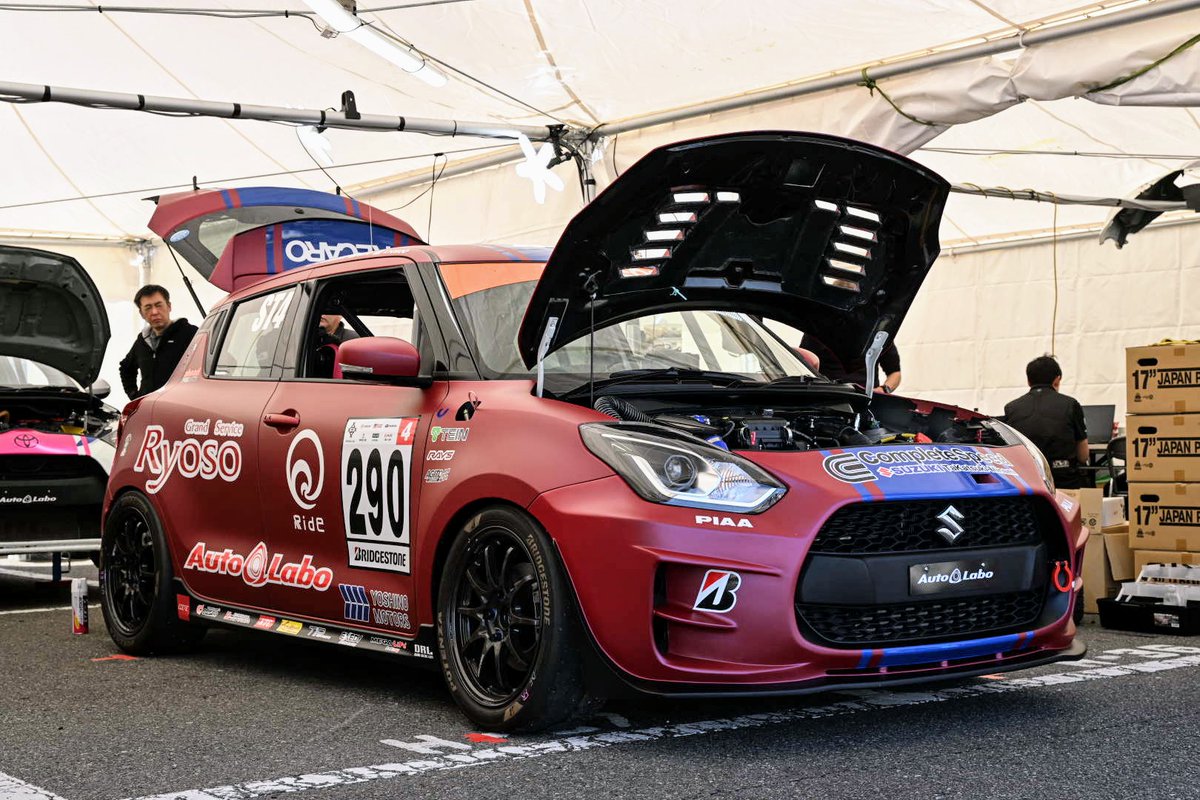
ST-4 注目のAutolabのスイスポ
完走は果たせたものの、クラス6位からは大幅に周回数差でのチェッカーとなりました
予選 クラス9位
決勝 クラス7位
#モビリティリゾートもてぎ
#スーパー耐久(@SuperTaikyu_STO)
#Autolab


When a car diagonally crosses from behind, pedestrians, or non-motorized vehicles cross the road, NIO's Automatic Emergency Braking (AEB) can trigger alerts and apply the brakes automatically to ensure safety.
#NIO #AEB #SmartSafety #AutonomousDriving #AutoLab @NIOGlobal
今シーズン、スイスポで激戦区のST-4に参戦のAutolab
つや消しのボディがカッコいい!✨
今シーズンマネージャーを務めている箱入ちゃんにも会えましたが、丁度お昼ご飯中で、ハムスターばりにご飯を頬に詰め込んで、お仕事されてました😅
#モビリティリゾートもてぎ
#S耐(@SuperTaikyu_STO)
#Autolab
#箱入娘Mayu(@mayu_sky34)

#XPeng X9 achieves top G+ rating in the latest C-IASI safety crash test!
XPeng X9 sets the best safety record among MPVs under CNY 500,000 and is the only MPV in this price range to achieve a perfect score across all 11 safety categories.#AutoLab @XPengMotors

Last Seen Hashtags on Sotwe
marocain sex
Seen from Belgium
बुंदेलखंड_एक्सप्रेस
Seen from United States
حصريات_تانجو
Seen from United States
enrichmentsignups
Seen from United States
momson() nolimit()* filter:native_video
Seen from Chile
Teenage video,'.
Seen from United States
spitroast
Seen from Spain
Artis
Seen from France
momsonn()+filter:media() - filter
Seen from Turkey
omegle()************************************************************** ****filter:native_video()
Seen from Israel
Trends for you
Most Popular Users

Elon Musk 
@elonmusk
241.5M followers

Barack Obama
@barackobama
119.1M followers

Cristiano Ronaldo
@cristiano
113.7M followers

Donald J. Trump
@realdonaldtrump
111.8M followers

Narendra Modi
@narendramodi
107.2M followers

Rihanna
@rihanna
98.6M followers

NASA
@nasa
92.4M followers

Justin Bieber
@justinbieber
91.7M followers

KATY PERRY
@katyperry
89.6M followers

Taylor Swift
@taylorswift13
83.5M followers

Lady Gaga
@ladygaga
75M followers

Virat Kohli
@imvkohli
72.7M followers

Kim Kardashian
@kimkardashian
70.7M followers

YouTube
@youtube
68.8M followers

Neymar Jr
@neymarjr
65.7M followers

Bill Gates
@billgates
64.9M followers

Selena Gomez
@selenagomez
62.6M followers

The Ellen Show
@theellenshow
62.3M followers

CNN
@cnn
61.8M followers

X
@x
60.8M followers