

Top Tweets for #AkGOP


#aklng #akleg #akgop
So at the Gov and Senator part of the candidate forum, Sen Rauscher, Tilton, Trig and Broson blew it with their continued support of the Glenfarne giveaway. Truth be told HB381 was never a gasline bill, it was a tax bill. So the present gov and the House blew it. They so wanted to give Glenfarne more corporate welfare. I was surprised at Sheldon and Ryan Berry's replies. For Gov, Wilson ruled that Debate. She was the one with a real vision. For Senator Berry and Sheldon did very good on the issues. The others were just repeating party lies about the Glenfarne bill.
#akgop #akleg #matsu
HB 50 and the Question of Whose Standards Alaska Is Actually Meeting
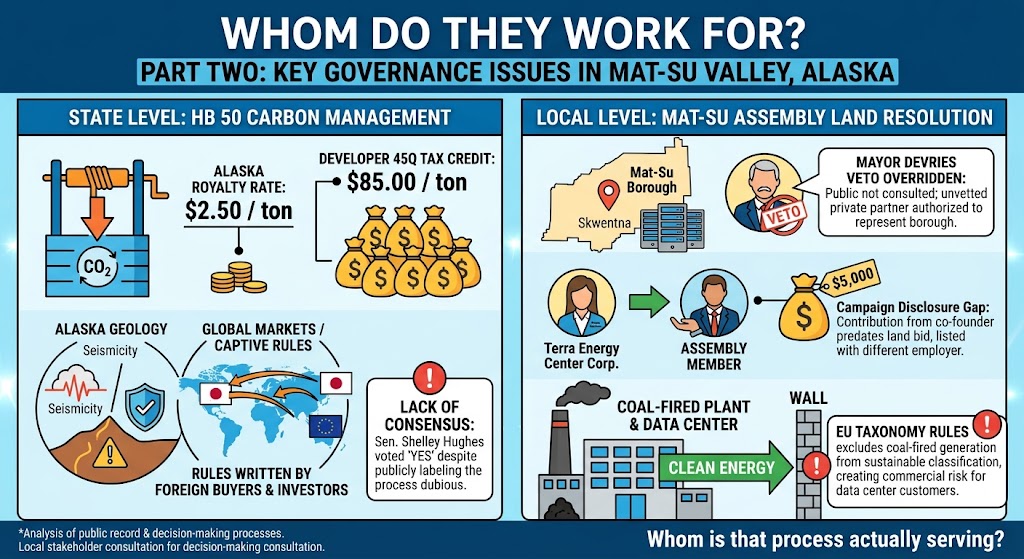
To understand what HB 381 was really built around, it helps to go back one step further, to HB 50, the carbon management bill the Legislature passed in 2024 that made all of this possible in the first place. HB 50 established Alaska’s Class VI primacy for CO2 injection wells, built the state’s regulatory framework for carbon capture and sequestration, and set the royalty rate the state collects when a private developer injects carbon into Alaska’s geology: $2.50 per metric ton.
That number only becomes meaningful next to the other number attached to the same ton of carbon. The federal government, through the 45Q tax credit, pays a developer up to $85 per metric ton of sequestered CO2. Alaska provides the geology, carries the seismic and long-term monitoring liability, and collects $2.50. The developer uses that same geology to collect $85 from the federal treasury. That gap, not a rounding error, not a policy nuance, is where the actual financial architecture of these projects lives.
The reason that gap exists at all is worth stating plainly, and it comes directly from the man who has been the Mat-Su delegation’s technical voice on this project throughout. In an unguarded exchange about an entirely different power plant, Rep. Kevin McCabe explained why carbon capture matters to the developers pursuing it in Alaska, in his own words, not as an argument for HB 381 but as a description of how the financing actually works: “Glenfarne would not be here without the ability to sequester CO2 on the slope. Japan would not buy our gas or invest in a purchase agreement without CCUS.” That is not a critic’s characterization. That is the delegation’s own subject-matter authority confirming, in a conversation where he had no reason to soften the point, that the entire premise of Alaska’s gas export ambitions runs through satisfying carbon credentialing standards that Alaska did not write.
Those standards come from two places, and neither of them is Juneau. They come from Japanese buyers operating under their own government’s and their own shareholders’ ESG requirements, and they come from international capital markets, Glenfarne’s own investors and lenders, who increasingly will not fund a fossil energy project without a credible decarbonization story attached to it. HB 50 was Alaska’s answer to that pressure: build the legal machinery to let carbon sequestration happen here, so that gas extracted here can be sold as meeting standards set somewhere else. That is not necessarily an illegitimate thing for a state to do. Plenty of resource economies build regulatory frameworks that let them sell into markets with rules they didn’t write. But it is worth being honest about what that arrangement actually is: Alaska’s own statute, tailored to the compliance requirements of foreign buyers and foreign capital, at a royalty rate that captures a small fraction of what the same activity is worth to the party using it.

“PICK ONE! ONE PERSON, ONE VOTE!”
Also them: “RANK! RANK! FOR THE LOVE OF GOD, RANK EVERYBODY!” 😂
Holy hell. They went from repealing RCV to running its fan club in about 15 minutes. Where the hell is @akgop
#rcv #akgop @realDonaldTrump @JDVance @WhiteHouse
So stupid!

Pick one.


@draffaniello The people have had enough of the so called #akgop that nobody want to join the party there a bunch of BOOMERS that hate anybody who dont like them!! They are the UNIPARTY THAT TOLD THE CITIZENS TO FCK OFF!!
#akgop #akleg #akgov
So the AKGOP version of team work is a husband calling conservatives asking/telling them to drop out of races where the AKGOP glenfarne stooge is not doing so good. AKGOP team work is also a sitting assembly rep saying if you drop out of the race so our rubber stamp wins we will get you a spot on a board or committee. The lack of ethics is just amazing. The amount of bullying and intimidation the AKGOP has against Rank and file people and grassroots people is unreal. And they wonder why the state is looking at going Blue. As we used to say back home a long time ago before I made Alaska my home. Get the EFF out of here.

#akleg #akgov #akgop
Before you vote again, look at how they voted last time.
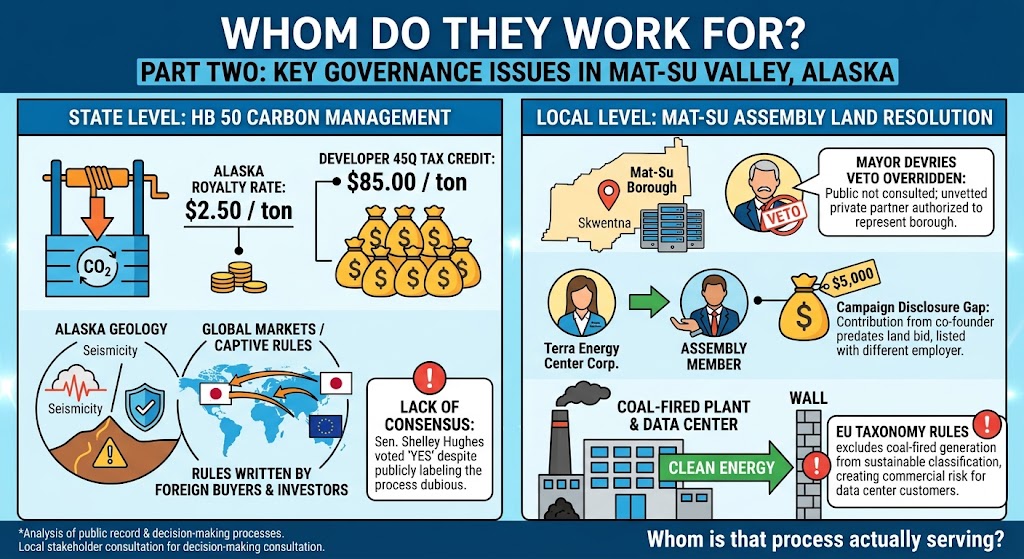
In April 2024, four of five Mat-Su House reps voted yes on HB 50, the bill that built Alaska's legal framework for carbon storage. To be clear, this isn't a states-rights argument, subsurface resource management sits with the state under our Constitution, and that's not in dispute here. The issue is that a bill enabling permanent underground storage of imported industrial waste, next to the Castle Mountain Fault, a fault USGS says is capable of magnitude 6 to 7 seismicity, passed the House 32-8, the Senate 18-2, and cleared concurrence 37-3. Those aren't the vote counts of a bill that got real scrutiny. This framework is now the basis for a real, publicly confirmed plan to import industrial CO2 from Japan by tanker and bury it in Cook Inlet, not North Slope CO2 used for enhanced oil recovery, that's a different, older domestic process, but another country's waste, accepted for a fee. HB 50 needed more debate before it became law. The one Mat-Su rep who voted no is running to get his old seat back.
Two years later, June 2026, every single Mat-Su House seat, all six, voted yes on HB 381. Its own short title says what it is: Oil and Gas Property Tax, Municipal Tax, AGDC. Not a gasline bill. A tax bill. It swapped the borough's ordinary property tax on the Alaska LNG project for a state-controlled throughput tax. DOR's own modeling: the pipeline alone would have generated $116 million a year in municipal property tax by 2033. Under the AVT instead, the entire project's total state revenue was projected at $15 million. The bill also wrote that lost assessed value out of the formula that determines how much MORE our own borough is even allowed to voluntarily spend on our own schools. Same year Mat-Su closed three elementary schools over a $28 million deficit.
Then there's the land. Late last year, AIDEA applied to DNR for a no-cost conveyance of 20,000 acres in Houston, for what's widely understood to be a hyperscale data center. Houston found out from a news outlet forwarding a public notice, not the state. Houston's City Council voted unanimously against it. Five state senators signed a letter to DNR raising legal concerns, Giessel, Wielechowski, Dunbar, Claman, Kawasaki. All five represent Anchorage or Fairbanks. The one Mat-Su senator on that committee, whose own district includes Houston, didn't sign it.
Three episodes. Three chances for someone representing this Valley to say something in public, on the record, before the fact. None of our legislative delegation and none of our Assembly did.
This isn't anti-development. It's a conservative governance question in the oldest sense: power belongs closest to the people it affects, and the burden of proof sits with whoever wants to move it to Juneau. The Assembly is supposed to be the body watching what the state does to us. Listen for who's actually talking about that while they campaign, and who never has.
Full vote records, letters, and DOR figures, sourced, linked below.
#akleg #akgop #aklng #akgov
The Vote Nobody’s Messaging Mentioned
On June 12, 2026, the House passed the version of HB 381 that set up the tax swap described in the previous section, by a vote of 34 to 5. Every member of the Mat-Su Valley’s House delegation voted yes. That is not a majority of the delegation. It is all of it: Kevin McCabe, DeLena Johnson, Steve St. Clair, Garret Nelson, Elexie Moore, and Jubilee Underwood, six representatives, six districts, six yes votes, with no dissent from a single seat covering the borough.
That unanimity is worth sitting with, because it means this was never a matter of one legislator’s individual judgment call that voters could weigh against five others who saw it differently. The entire geographic representation the Mat-Su Valley sends to Juneau landed on the same side of a bill that, as the previous section laid out, cut the borough’s own taxing authority over a major new revenue source inside its boundaries, permanently, by statute, without ever putting the question to a borough vote. Whatever disagreements exist among these six on other issues, and there are plenty, none of them showed up here.
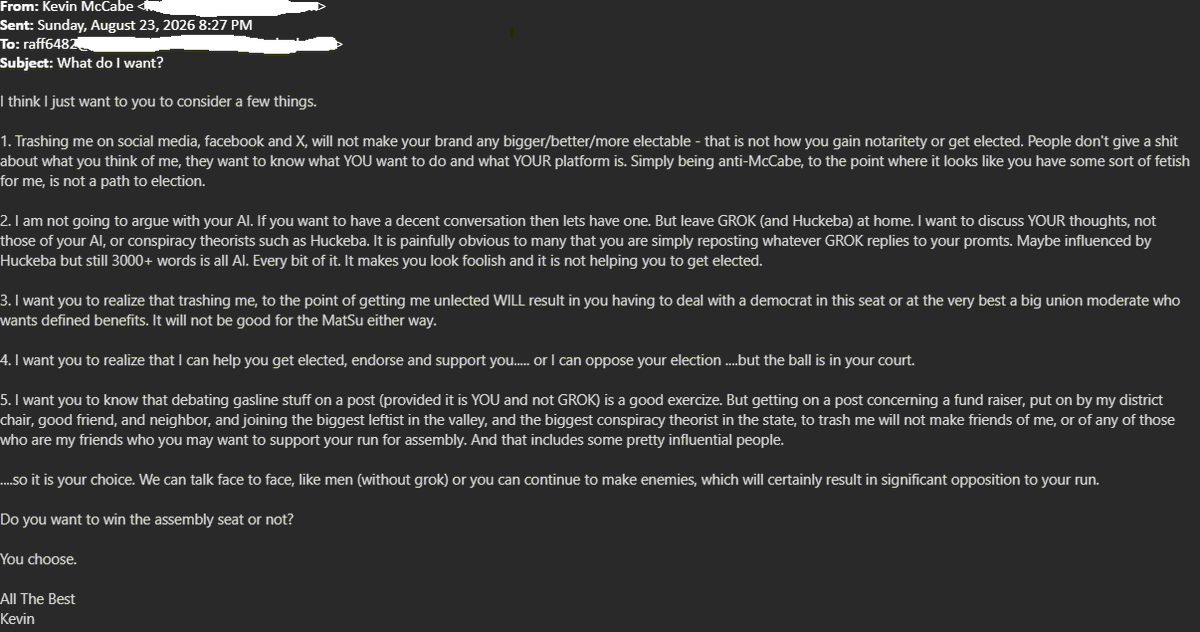
Rep. McCabe’s public defense of the bill ran the same way, just with sharper edges. In a Substack post published days after the vote, titled “The Gasline Tax Bill Without the Drama,” he characterized concerns about the bill as “scare tactics” and “drama,” and dismissed critics as misrepresenting what the legislation did. What he did not do, anywhere in that piece, was walk through the specific rate structure his own coalition had just adopted on the House floor, six cents and thirteen cents per thousand cubic feet, against what current law would have generated for the boroughs he represents. A response that calls the concern dramatic without engaging the arithmetic behind it is not a rebuttal. It is a way of not answering the question.

#akleg #akgov #akgop
What is interesting is the desperation from the gatekeepers in the AKGOP. The most unconservative people are the gatekeepers, and they are more aligned with the left than they are Conservative values. How many phonecalls are they making. Remember come November if they are supported by the gatekeepers they need to be voted out. If they supported HB381, even if they did not understnd it, they need to be voted out. The AKGOP has lost site that elected politicians work for the people, they are not the boss, nor are they leaders.
#aklng #akgop #akgov
The Matsu House and Senate delegation failed the people of the Matsu. Time for sending Conservatives to Juneau
Property Tax Relief Is a Governance Test. Right Now, We're Failing Half of It.
The Borough is doing the work. Our state delegation is undoing it.
Property tax relief is the clearest test we've got right now for whether our elected officials actually work for us. At the borough level, that work looks like it should: multiple proposals in front of the Assembly, real debate about how to do relief responsibly. At the state level, it looks like the opposite. This year Alaska gave us two bills, House Bill 50 and House Bill 381, that show our own delegation quietly giving away the industrial tax base that would actually make residential property tax relief possible. You can't fix property taxes locally while the state strips away the resource extraction revenue that could carry that load instead.
Start with HB 50, passed in 2024 to build Alaska's legal framework for carbon capture and sequestration. Here's the problem in plain terms: it opens the door to injecting compressed CO2 into the Cook Inlet basin, an active seismic zone sitting next to the Castle Mountain fault, a fault capable of a magnitude 7 earthquake, so operators can qualify for the federal 45Q tax credit. That risk never got a real hearing on the House floor. It was waved off as the cost of doing business with the federal government, by legislators who still haven't said what happens if it goes wrong, or how that federal credit pathway connects to the tax fight that followed a year later.
HB 381 is the follow-through. It would pull qualified natural gas project property out of ordinary municipal property tax entirely and replace it with a fixed, state-set formula the borough has no say in. The Department of Revenue's own numbers show what that costs us: current law could bring Mat-Su somewhere between 957 million and 1.9 billion dollars in local revenue through 2062. The alternative tax caps that at a flat 191 million no matter what, roughly a tenth of what we'd get otherwise, in the same year Mat-Su closed three elementary schools for want of a few million dollars.
And once an exemption like that exists in statute for one gas pipeline, what's stopping the next mine or processing facility from asking for the same deal? Our own delegation voted yes. The Governor and the House already agree the bill got loaded up with things that have nothing to do with building a pipeline, which is why they killed the version with the pass-through entity tax attached and sent everyone back to Juneau today for a narrower bill. Fine. Apply that same logic to the rest of it. If HB 381 is supposed to be a gasline bill and nothing more, strip out the permanent volumetric tax too, and give the project a temporary construction-phase abatement instead, one that expires once the pipeline hits a specified flow threshold, the same limited exemption the House itself passed before the Senate turned it into a permanent tax swap. That keeps the borough's taxing authority intact once the project is actually running and paying for itself, instead of signing it away by statute forever.
That's the contrast worth sitting with. Locally, working through several property tax relief proposals right now looks like governance should: public debate, real numbers, tradeoffs argued out in the open before anything goes to voters. But none of that matters if the tax base underneath it gets pulled out from under us. A borough can spend a year building careful, community-backed relief, and Juneau can undo it in a single session. That same standard, public first, numbers on the table, debate before the ordinance gets written, should apply to every relief proposal the Assembly takes up, and it needs to include renters too, since property tax is baked into every rent check a landlord collects.
Our Assembly members and our state reps and senators work for us. Their job is to get the best outcome for the borough and the state, not to protect whatever they've already decided to do. So when a sitting official tells you that you just don't understand, because they're privy to information you're not, that should set off five alarm bells at once. That is not a sign you need to catch up. It is a sign they have lost sight of who the boss actually is. It is not them. It is us. Nothing about a budget, a tax structure, or a development deal should ever be hidden from the people paying for it. If someone can't explain their vote in plain English to the people back home, that's not on you. That's on them.
Mat-Su deserves people who read the bills, check the numbers, and say so before the vote, not after the schools close. Property tax relief is possible, but only if it works in both directions, real process here at home, and a delegation in Juneau that protects our tax base instead of giving it away. So ask yourself: why vote for someone who would strip away our ability to tax the resource development happening in our own backyard, and pump compressed carbon into an earthquake fault under our feet, and call it a win for Mat-Su?
#akleg #akgov #aklng #akgop
I am writing to urge you to protect our local tax base and vote NO on the permanent Alternative Volumetric Tax (AVT) framework currently proposed for the upcoming special session.
While I fully support building the Alaska LNG pipeline and getting our gas to market, the current structural design of HB 381 is a bad deal for our local communities. Replacing our standard 20-mill property tax with a volumetric tax through 2060 slashes our projected local corridor revenues from $116 million a year down to just $5 million. Capping municipal relief at a state-controlled $80 million grant fund to be split among six different boroughs is not an acceptable solution for the road wear, public safety demands, and school growth our community will face.
Furthermore, passing a permanent, multi-decade rewrite of the state's tax base during an emergency special session—just three weeks before half the legislature faces a primary election is highly risky governance.There is a rational, safe path forward that protects both the project and Alaska's voters.
Slice out and pass a standalone Construction-Period Tax Abatement (utilizing the logic already built into Section 7 of the bill). This ensures the developer pays $0 while building, giving international lenders total certainty.
Allow the developer to use standard IRS 5% safe harbor capital allocation to easily lock in their federal 45Q and 45V carbon and hydrogen credits without rushing the state's process.
Defer the permanent, long-term rewrite of Alaska’s tax base until the regular session next year, allowing a newly mandated legislature to conduct proper public committee hearings.
Do not use the popular slogan of "building the pipeline" to shield a massive, permanent corporate concession. Please vote to protect local borough autonomy and keep our government close to the people. I will be tracking your votes closely as the July 27 session begins.
#akleg #akgov #aklng #akgop
As the debate over the Alaska LNG project intensifies, a dangerous narrative has emerged: that you must support House Bill 381 to be "pro-pipeline." This is a false choice. You can be 100% pro-pipeline while entirely opposing HB 381. In fact, if you care about local control, educational freedom, and the future of our schools, opposing this bill is the only logical position to take.
The hidden danger of HB 381 is that it permanently blinds our state school funding formula until the year 2060. By replacing standard property taxes with a permanent Alternative Volumetric Tax (AVT), the multi-billion-dollar value of the pipeline, the gas treatment plants, and the liquefaction facilities will effectively "not exist" for local education purposes. The industrial wealth is walled off, forcing our boroughs to remain permanently dependent on Juneau’s volatile funding cycles, political gridlock, and top-down mandates for the next three decades.
There is a much better, common-sense alternative that protects both the developer and our community.
We should reject the permanent AVT and return to Alaska’s standard industrial tax framework, but grant the operator a temporary property tax abatement during construction. This shields the developer’s financing while the steel is being put in the ground, ensuring our state school funding remains steady while no gas is flowing.
However, the moment the first commercial gas flows, the abatement expires. The massive infrastructure hits the local tax rolls at its true multi-billion-dollar value. Yes, this will cause our Required Local Contribution to skyrocket, dropping our state education aid to zero. But we won't need it.
Just like the North Slope Borough does today with TAPS, our boroughs would collect massive, stable property tax revenues directly from the project to fund our schools locally.
This is the ultimate form of local control. By outgrowing our dependence on state foundation money, we take our financial destiny out of Juneau's hands. We can dramatically expand our highly successful vocational-technical training, supercharge our elective offerings, and build state-of-the-art career academies tailored to our local workforce. We can achieve all of this without begging state bureaucrats for a Base Student Allocation increase.
Furthermore, a massive industrial tax base allows us to comfortably fund our schools while driving down residential property tax mill rates for everyday homeowners and small businesses.
HB381 is a trap that trades our long-term economic sovereignty for decades of state dependence. We can build the pipeline, support the developers during construction, and still demand that our local industrial wealth stays right here to fund educational freedom for our children.
It's time to reject HB 381 and stand up for true local control.
https://t.co/mb48TUPECg

#akleg #akgov #akgop #aklng
Why Did Our Legislators Vote to Make Mat-Su Beg Juneau for Its Own Money?
On June 12, 2026, House Bill 381 passed the Alaska House 34 to 5, with the support of Mat-Su's own delegation. That vote deserves a direct question from every resident of this borough: why did our delegation vote to convert this borough's own tax authority into something we now have to ask the legislature for?
HB 381 replaces the standard 20-mill property tax on the AKLNG pipeline with a throughput-based Alternative Volumetric Tax. Section 1(b) declares the new structure won't serve as precedent for taxing other property. That declaration won't survive a real legal challenge, and this borough is most exposed when it fails.
The Alaska Constitution's Uniform Application Clause, Article VIII, Section 17, requires laws governing natural resources apply equally to similarly situated parties. Courts decide who is similarly situated, not the legislature, and under the equal protection framework from State v. Erickson (1978), applied in State v. Enserch Alaska Construction (1989), a legislature cannot declare its own statute off-limits as precedent and expect that to survive review. TAPS and Red Dog Mine would each have a strong argument for the same tax tier as AKLNG, since both meet the standard this bill uses to justify the pipeline's treatment.
Some point to AKLNG's project labor agreement as proof the pipeline is legally unique. It isn't. TAPS was built under a broad project labor agreement in 1974, credited with its on-time completion, and Glenfarne's own PLA framework with Alaska's building trades this June cited that history as precedent. A labor practice the developer's own materials call a longstanding norm can't also be the feature that makes this project legally unique.
If a court agrees that other operators are similarly situated, the AVT doesn't disappear. It expands into this borough's own long-term industrial tax base, the revenue Port MacKenzie and West Susitna are supposed to generate for our roads, schools, and emergency services for decades.
The mismatch shows up clearest in the money. Under standard property tax law, DOR's own May 2026 modeling projects Mat-Su's pipeline corridor alone generating $116 million a year by 2033. HB 381 replaces that with a developer-funded municipal impact grant fund capped at $80 million total, split among six “impacted municipalities,” not allocated to Mat-Su specifically, and distributed at department discretion based on need and severity of effects, not on how much tax base any one borough is actually giving up. And this isn't a short-term swap. The sections that would revert this borough to standard 20-mill taxation don't take effect until January 1, 2060, locking this arrangement in place for more than three decades.
Nothing in the public record shows anyone raised this specific risk before the vote. During the July conference committee, Senator Stedman flagged a different constitutional concern, that Alaska can't permanently surrender its taxing power under Article IX, proof the category wasn't unthinkable to at least one legislator. But nowhere in the floor debate or committee hearings does anyone ask whether TAPS or Red Dog could claim the same tax tier AKLNG just received. Either the delegation understood that risk and voted for it without bringing the borough into the conversation, or the one theory that actually threatens this borough's tax base never got tested. Both explanations are bad, and both point to the same missing step: the borough should have been at the table before this vote, not after.
This raises a conservative governance question as much as a legal one. Keeping government close to the people is a core principle, not a slogan. HB 381 does the opposite with this borough's own revenue, taking a levy we collect as a matter of right and turning it into an allocation we have to petition for. House members sit closer to their constituents than anyone else in Juneau. Our delegation voted to hand a piece of local authority upward instead.
None of this argues against getting Alaska's gas to market. Throughput-based taxation can be a legitimate tool for capital-intensive infrastructure, though the pipeline's own $16 per Mcf price already runs several times the state's break-even estimate for in-state gas, so tax structure and affordability are separate problems here. A version phased in broadly across every similarly situated operator under one standard would avoid this problem. HB 381 instead handed the treatment to one pipeline first and hoped a disclaimer would hold up against a constitutional clause the legislature can't waive on this borough's behalf.
The Legislature moves fast when it wants to. In 2024, a Mat-Su legislator's bill to fix Cook Inlet's own gas shortage passed the House 34 to 5 and died in the Senate the next day for lack of review time. HB 381 got two special sessions and a dedicated conference committee. This borough can ask why one Valley fix got a single day and the other got the institution's full weight.
Our delegation owes this borough a straight answer: why wasn't Mat-Su in the room before it voted away pieces of its own tax authority, and what happens to our roads, our schools, and our emergency services if a court later agrees with the argument nobody in Juneau bothered to test?
#akleg #akgop #akgov
The AKGOP slogan that a pipeline that never gets built produces zero benefit has been repeated for months by Representative McCabe and others, long before the Governor used it on June 28. It is designed to inflame passions and shut down constitutional analysis. It works as a slogan because it sounds simple and absolute. It is not a constitutional argument. It is not a fiscal argument. It is not a public interest argument. It is a rhetorical device.
The slogan depends on a trick. It assumes that any development is better than no development. It never asks the basic question: benefit to who. Under the Mat Su delegation’s version of HB 381, the Borough loses its industrial property taxing authority. The Borough receives nothing. It is zero of zero. It is nothing of nothing. The Borough is left with the costs and none of the revenue. That is the real effect of the bill.
The slogan is meant to create urgency and fear. It suggests that if legislators do not accept Glenfarne’s preferred tax structure, Alaska will lose everything. It frames any legislative protection as a threat to the project. It frames any public transparency requirement as a risk. It frames any municipal protection as obstruction. It is a pressure line, not a constitutional standard.
Article VIII does not say development at any cost. It says maximum benefit to the people of Alaska. HB 381 does not provide that benefit. It gives away tax power, municipal revenue, public leverage, and ownership control without proving any enforceable return to Alaskans. It does not guarantee in-state gas. It does not guarantee affordable energy. It does not guarantee jobs. It does not guarantee public revenue. It does not protect AGDC’s retained ownership interest. It does not provide enforceable remedies if the project fails. It does not disclose the material terms of the AGDC and Glenfarne agreement. It does not protect municipalities from tax-base loss or unfunded service burdens.
The slogan is emotionally effective because it creates a false binary. It says either accept Glenfarne’s terms or get nothing. The Constitution does not operate on false binaries. It requires proof, safeguards, and public accountability. A pipeline that never gets built produces no benefit. A pipeline deal that gives away public value without public proof also produces no benefit. HB 381 does not satisfy Article VIII because it does not show any enforceable benefit to the people of Alaska.
The slogan is politically useful. It is constitutionally empty.
#akleg #akgop
Something important about HB 381 that the "Build the Gasline" messaging leaves out.
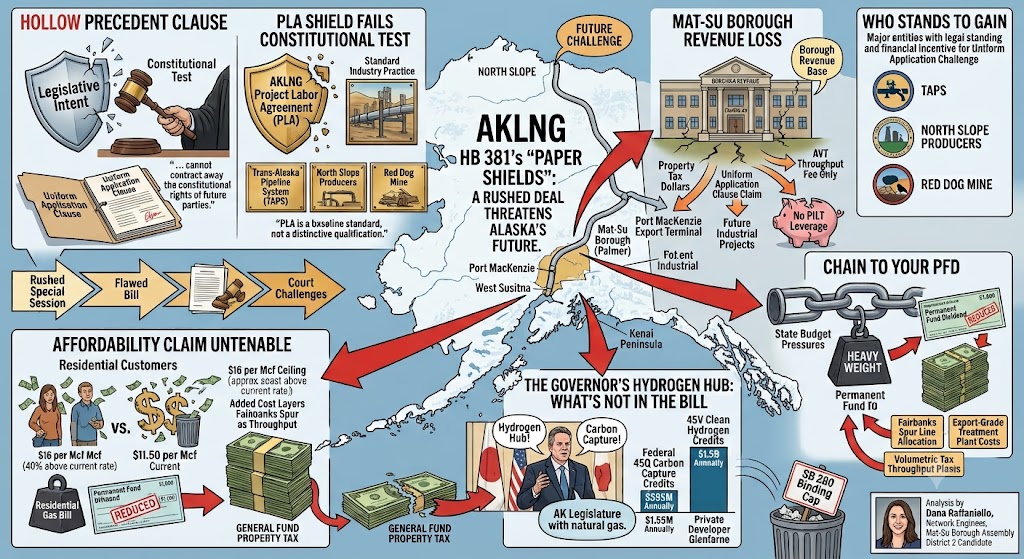
I support bringing North Slope gas south. Cook Inlet production is declining and new infrastructure is eventually going to be necessary. What I cannot support is the specific legal architecture of Version Q, the conference committee draft sitting in Juneau right now, because two of its key provisions are constitutionally hollow and the fiscal consequences of that hollowness reach directly into your annual PFD check and your borough's revenue base.
The "Not Precedent" declaration.
Section 1(c) of the bill states that it "shall not serve as precedent" for taxing any other property in Alaska. That sounds protective. It isn't. Alaska's courts apply the Uniform Application Clause of our state constitution independently of whatever the legislature says about itself. Once this tax structure is law, every major industrial operator on the North Slope, every future developer at Port MacKenzie, every mining company looking at the West Susitna corridor, has a documented benchmark to point to and demand equal treatment. A legislative declaration cannot change that. Courts decide what the law means, not the legislature's commentary about its own intentions.
The Project Labor Agreement "shield."
The bill conditions its tax structure on requiring a union Project Labor Agreement, presented as what makes this project legally unique. Alaska is not a right-to-work state. TAPS has operated under a PLA since the 1970s. ConocoPhillips, Hilcorp, and Red Dog Mine all operate under collective bargaining agreements with apprenticeship programs. An attorney representing any of those operators in an equal protection lawsuit would walk into court, hand the judge their existing union agreements, and ask what exactly the AKLNG PLA makes distinctive. The honest answer is very little.
What happens when these shields fail in court.
If North Slope operators and industrial developers successfully argue they deserve the same tax treatment as AKLNG, the 20-mill property tax on billions of dollars of assessed infrastructure value shifts to a small throughput fee. That is hundreds of millions of dollars annually removed from Alaska's general fund. The legislature funds the PFD from the same annual earnings reserve draw it uses for everything else. It has already reduced your dividend to roughly $1,000 citing budget pressure. Add hundreds of millions in annual general fund revenue loss to those existing pressures and you are watching the mechanism by which this bill makes the PFD fight harder to win every single year going forward.
For Mat-Su specifically.
Port MacKenzie and the West Susitna Access corridor represent the borough's long-term industrial tax base. Once Version Q passes, every future developer at those sites has a legal blueprint to demand the same property tax exemption AKLNG receives. The borough could not even negotiate a PILT agreement in that scenario, because a court ruling establishing AVT entitlement removes the legal basis for that negotiation. The Mat-Su Assembly closed three elementary schools this year over a budget gap measured in single-digit millions. The revenue at stake in this equal protection exposure is measured in hundreds of millions.
The transparency question nobody in Juneau will answer directly.
The governor has been publicly advocating clean hydrogen and carbon capture as Alaska's energy future since December 2022, including an op-ed, a DOE concept paper, and a Japan trade mission where the central propositions were hydrogen export and carbon sequestration. The project's own paid consultant told the Senate Finance Committee under oath that natural gas itself "is not the driver" of this project's value. The federal 45Q carbon capture credit, worth $85 per ton at a planned 7 million tonnes annually, generates approximately $595 million per year in transferable, tax-free cash for the developer. The 45V clean hydrogen credit could add up to $1.5 billion more annually. Neither credit appears in a single fiscal note attached to any version of this bill. The December 31, 2027 federal deadline for that 45V credit is almost certainly the real reason for the urgency nobody in the administration will name directly.
If this were honestly presented as a hydrogen hub and carbon capture project, Alaska could negotiate from its actual position of strength: we own the pore space, the right-of-way, the royalty gas, and the geology the credits depend on. Instead it is being presented as a property tax adjustment for a gas delivery project, with the real financial architecture kept out of the fiscal record, so the legislature cannot negotiate for value it has not been told exists.
https://t.co/x1YLCg9tj9
Last Seen Hashtags on Sotwe
hashtaginspiration
Seen from United States
candid
Seen from Argentina
sellingcontent
Seen from Switzerland
snapchat
Seen from United Kingdom
สมุทรสาครนัดเย็ด
Seen from Thailand
k9
Seen from United States
spycams
Seen from Oman
minichat()()()()*+filter:videos
Seen from Poland
anxiouspanda()*+*+* filter:native_video since:2026-05-11
Aov #Liliana
Seen from Vietnam
Trends for you
Most Popular Users

Elon Musk 
@elonmusk
241.8M followers

Barack Obama
@barackobama
119M followers

Cristiano Ronaldo
@cristiano
114.5M followers

Donald J. Trump
@realdonaldtrump
111.9M followers

Narendra Modi
@narendramodi
107.2M followers

Rihanna
@rihanna
98.7M followers

NASA
@nasa
92.4M followers

Justin Bieber
@justinbieber
91.8M followers

KATY PERRY
@katyperry
90.1M followers

Taylor Swift
@taylorswift13
84M followers

Lady Gaga
@ladygaga
75.5M followers

Virat Kohli
@imvkohli
73.5M followers

Kim Kardashian
@kimkardashian
70.9M followers

YouTube
@youtube
68.8M followers

Neymar Jr
@neymarjr
66.5M followers

Bill Gates
@billgates
65.2M followers

Selena Gomez
@selenagomez
63.1M followers

The Ellen Show
@theellenshow
62.3M followers

CNN
@cnn
61.8M followers

X
@x
60.7M followers