

Top Tweets for #CoDesign

CODesign: Consistency from Data to Trajectory in All-Atom Protein Binder Co-Design
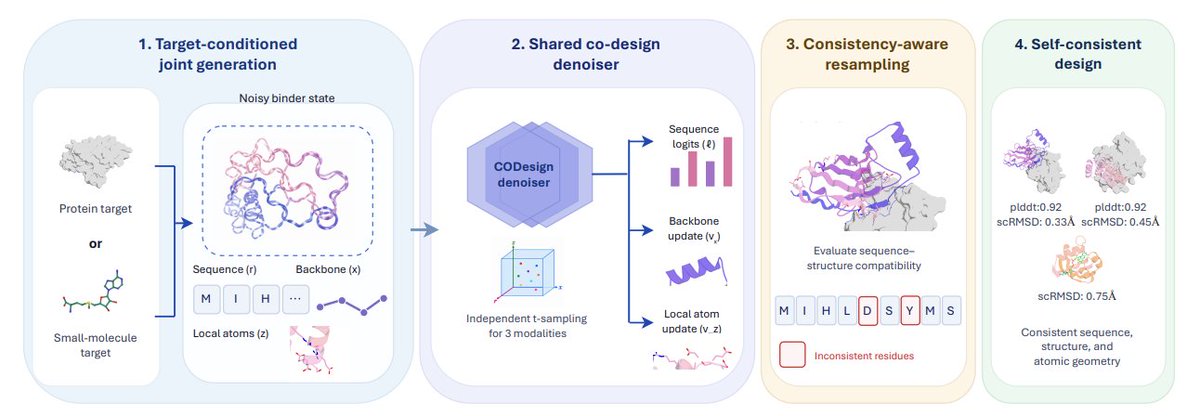
1. CODesign is an all-atom, target-conditioned protein binder co-design framework that explicitly prioritizes sequence–structure consistency during both training and sampling, jointly generating (r) discrete sequence, (x) Cα backbone, and (z) local side-chain/heavy-atom geometry for binders conditioned on either protein targets or small-molecule ligands.
2. The paper frames “consistency” bidirectionally: sequence compatibility with geometry (approx. log p(r | x, target)) and structural recoverability from sequence in context (approx. log p(x, z | r, target)). CODesign’s main contribution is to make these two directions actionable via (a) data distillation and (b) an inference-time correction mechanism built into the same model.
3. Data bottleneck: many synthetic or predicted complexes are not self-consistent (refolding the paired sequence doesn’t recover the paired structure). The authors report that only 8.49% of AFDB high-confidence heterodimers are recovered within complex Cα scRMSD < 2 Å by folding oracles, motivating a dedicated “consistency distillation” pipeline for complexes.
4. Codimer dataset: ~104,528 consistency-distilled dimers built from 191,836 reference dimers across AFDB heterodimers, HumanPPI predictions, and PINDER experimental holo dimers. For each reference complex, ProteinMPNN jointly redesigns both chains (K=4 candidates), ESMFold2-Fast co-folds each candidate, then candidates are filtered by pLDDT ≥ 0.7 and interface pAE ≤ 10 Å, selecting the one with lowest complex-level Cα RMSD to the reference—yielding sequence–structure pairs that are co-folded directly from their sequences.
5. Model: a multimodal flow-matching generator with independent modality times (tx, tr, tz) so training exposes the network to multiple conditional regimes (structure→sequence “inverse folding-like” and sequence→structure). It uses a residue-level Transformer plus an atom-level Transformer encoder–decoder with cross-attention, operating in a fixed-dimensional Atom37 representation while masking residue identity leakage for masked residues via pseudo-atoms.
6. Sampling innovation (CAR: Consistency-Aware joint Resampling): during late backbone denoising, the model performs an internal “inverse-folding assessment” pass by masking currently revealed residues and hiding their side-chain inputs, then compares the model’s preferred residue types to the current decoded identities. The most inconsistent residues (top fraction ρ, default 0.4 of revealed positions) are remasked and jointly reset with their local atomic states for resampling—without resetting Cα coordinates—allowing backbone trajectories to adapt through self-conditioning rather than external guidance.
7. Protein-target binder benchmark (19 targets; AlphaFold2-Multimer evaluation; success requires ipAE < 7 Å, complex pLDDT > 0.9, binder scRMSD < 1.5 Å): CODesign reports the highest in silico unique success rates among compared baselines across self sequences and ProteinMPNN redesign settings. Aggregate unique successes: Self 9.84, MPNN@1 10.32, MPNN@8 18.81 (vs Complexa 8.54/8.53/14.65; RFDiffusion3 MPNN@8 10.96).
8. Ligand-target binder benchmark (SAM, OQO, FAD, IAI; RosettaFold-3 evaluation; success requires min-ipAE < 2 Å, binder scRMSD < 2 Å, ligand scRMSD < 5 Å): CODesign achieves the best mean unique successes (20.8), ranking first on OQO and IAI and second on FAD, while reporting substantially lower inference time than DISCO in their setup (CODesign ~39.9 s/sample vs DISCO ~181.8 s/sample).
9. Ablations isolate the two consistency levers: adding Codimer yields a large gain in mean unique successes on protein targets (reported +70.9%, 9.46 vs 5.54 for self sequences without CAR), and CAR adds a further ~4% improvement in unique successes with negligible added cost (time ~27.96 s/sample without CAR vs ~28.41 s/sample with CAR).
10. Practical training recipe: stagewise training first on Teddymer + PDB, then mixing in Codimer for targeted consistency supervision; ligand conditioning is obtained via LoRA adaptation using PLINDER plus consistency-distilled monomers (CDDB) to retain strong sequence–structure supervision while learning ligand-context conditioning.
📜Paper: https://t.co/U6OLtgLrXw
#ProteinDesign #ComputationalBiology #GenerativeModels #FlowMatching #ProteinBinders #DrugDiscovery #MachineLearning #StructuralBiology

Extreme codesign in @nvidia by @JensenHuang
A very useful way to minimize the office politics, get all the stakeholders in one room, making whole process transparent.
1-on-1 is reserved only for personal issues such as family situations and mental health.
#AI #NVIDI #management #officepolitics #OneOnOne
$NVDA

管理学奉为圣经的 1 对 1 密谈,被黄仁勋一把掀了桌子,Groq 创始人 Jonathan Ross 最近在播客里聊起老东家 NVIDIA,说那是他见过最没有办公室政治的万亿巨头,核心动作极度反直觉,老黄从不跟任何人私下一对一通气
职场里的政治很少源于坏人搞阴谋,基本都是被信息差喂养出来的,老板分别找不同的人私下聊,给的语气、重点稍有偏差,信息不对称市场就建成了,谁能单独见老板谁就有特权情报,背后打小报告还不用承担当场澄清的成本,小圈子随之而生
黄仁勋的做法是直接把这个特权市场拆了,他带大约 60 个直接下属,砍掉多余的传话层,任何业务方向全拉到公开会议一次讲透,邮件全员抄送,
只要有人私聊告状说某某把事情搞砸了,老黄的默认反应是立刻把当事人拉进同一个对话让对方当场辩,不给背后捅刀留任何温床,
这套打法在 NVIDIA 叫 Extreme co-design,芯片、系统、软件、算法全员同场推理,老黄甚至把业务反馈也全部当众给,
他的逻辑非常冷酷,私下复盘保护的是个人面子,公开复盘放大的才是组织杠杆,凭什么犯错的学费只让当事人一个人学,组织里最高效的进化是看别人踩坑并从中避坑,
普通团队不需要学他一人带 60 个人,但有两条规则极度管用,第一条是告状即三方对质,直接掐死告密机制,第二条是把一对一彻底去业务化,一对一只留给家庭、健康、去留等纯私人关怀,只要涉及业务事实和协同判断,全部移到阳光下,
当然这套系统有极其苛刻的运行边界,它只适用于高手密度极高、业务强耦合的硬核团队,如果组织本身的心理安全感根本没建立,当众反馈会直接退化成当众羞辱,
砍掉一对一不难,难的是你必须先补上一套让所有人站在同一张公开地图上的协同底座,光砍会不补系统,政治只会换个阴暗角落继续长。

btw its just one cli command away
npx shadcn@latest add CoDesign-Spa27/skecher-ui/morph-menu
direction based morphing popover menu
built with @motiondotdev .
now live one skecher-ui.
Link below ⤵️
SimpleDesign: A Joint Model for Protein Sequence and Structure Codesign
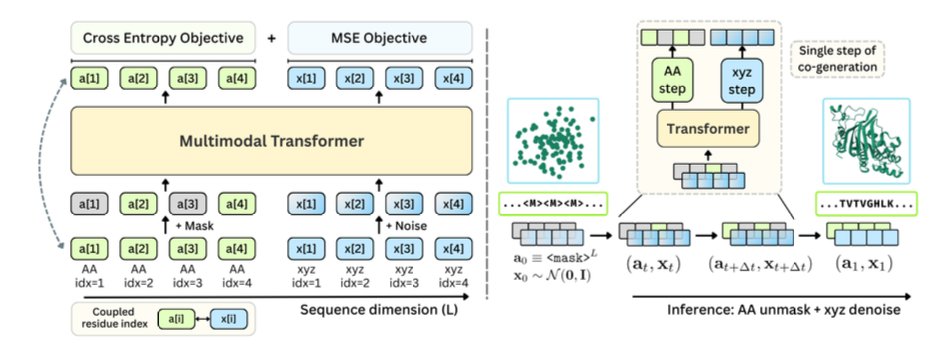
1 SimpleDesign proposes a minimalist alternative to structure-tokenizer pipelines: a single Transformer jointly models discrete amino-acid sequences and continuous 3D Cα coordinates directly in data space, trained end-to-end in one stage.
2 The core idea is a coupled objective with two corruption processes on independent time axes: masked recovery for sequence (cross-entropy under a time-dependent masking rate) + coordinate denoising for structure (velocity-field regression with MSE under a linear noise-to-data interpolant).
3 Sampling timesteps (t for sequence, t′ for structure) independently makes the training region span folding-like behavior (sequence mostly observed, structure highly noisy), inverse-folding-like behavior (structure mostly clean, sequence heavily masked), and intermediate co-design states where both modalities are partially corrupted.
4 Architecturally, sequence tokens and structure coordinates are embedded separately, then concatenated as a joint token stream (sequence positions + structure positions) so global self-attention can mix modalities while keeping residue-wise alignment via shared positional signals.
5 Structures are embedded without discretization: raw coordinates are Fourier-feature encoded, projected, and normalized; the model predicts continuous structure outputs with a time-conditioned head (adaptive LayerNorm modulation by t′).
6 To account for modality differences without losing joint reasoning, the default backbone is a Mixture-of-Transformer (MoT): modality-specific QKV projections, LayerNorm, and FFNs, but a shared attention operation over the concatenated multimodal sequence.
7 A key ablation: a vanilla Transformer (shared parameters across modalities) is highly competitive, implying the main contribution is the tokenizer-free, single-stage objective rather than specialized architecture components.
8 Training uses ~2M high-confidence sequence-structure pairs: ~1.8M filtered AFESM cluster representatives (length 32–512, pLDDT > 85) plus ~442k SwissProt-distilled structures; SwissProt finetuning improves sequence–structure consistency but tends to reduce FoldSeek cluster diversity (a fidelity–diversity trade-off).
9 On unconditional co-generation benchmarks (length 100–500), SimpleDesign is competitive with tokenized multimodal PLMs (e.g., ESM3, DPLM2) on co-design consistency, while remaining simpler (no structure tokenizer, no multi-stage training). Specialized geometric flow/diffusion co-design models (e.g., MultiFlow) still often lead on strict consistency metrics, highlighting complementary trade-offs.
10 Beyond co-generation, SimpleDesign produces plausible sequences and structures: sequence plausibility (ProGen2 perplexity) and predicted foldability (ESMFold pLDDT) are strong relative to many geometric design baselines, while structure designability (ProteinMPNN → refold consistency) is improved over other PLM-style co-design baselines.
📜Paper: https://t.co/bbZHxKvpCJ
#ProteinDesign #GenerativeModels #Transformers #ComputationalBiology #MachineLearning #ProteinStructure #InverseFolding #MultimodalAI #FlowMatching #DiffusionModels

New Mac, first hour:
flutter → command not found
altool → not a developer tool
codesigning → 0 valid identities
I copied Flutter from my old Intel Mac:
“Bad CPU type in executable.”
It took 7 failures to get back to: “I can ship.”

We just launched CoDesign MCP.
A local graphics design tool for any agent with a builtin editor for a human.
Think of Canva but free, local and agent first.
https://t.co/zLjBmqKpRX

@NDeWestelinck Similar to the Onedrive app it's codesigned with a Windows cert, so actually trusted by most AppControl for Business implementations too 🤷♂️
A-CODE: Fully Atomic Protein Co-Design with Unified Multimodal Diffusion
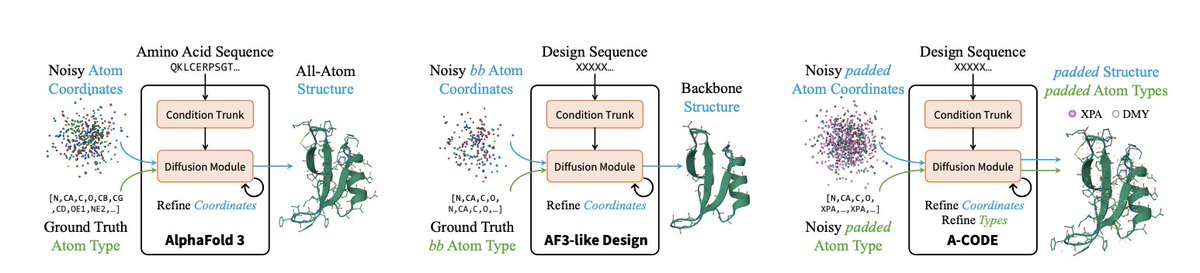
1. A-CODE is a one-stage protein co-design model that generates fully all-atom structures while simultaneously denoising discrete atom types and continuous atom coordinates in a single unified multimodal diffusion process (modeling p(X, S) directly rather than a two-stage p(X) then p(S|X) cascade).
2. The key design choice is atom-centric co-design: residue identities are never provided or predicted during diffusion. Instead, the model predicts atom names (e.g., CG, ND1, OE2) plus explicit dummy atoms (DMY) in an atom14 representation, and the final amino-acid sequence is inferred only after sampling by exact matching of the predicted atom-name set per residue.
3. Discrete + continuous diffusion are coupled: coordinates use an EDM-style diffusion solver, while atom types use masked discrete diffusion with a square masking schedule and an RDM-style sampling procedure that can remask low-confidence tokens, improving robustness during iterative generation.
4. A practical issue in joint all-atom generation is early side-chain commitment causing clashes and destabilizing global folds. A-CODE introduces a side-chain denoising lag: backbone atoms follow the standard noise schedule, while side-chain atoms remain noisier longer (η=1.5), encouraging the model to establish backbone topology before refining side-chain geometry; a variance correction keeps inputs numerically consistent under mixed noise.
5. Architecture-wise, A-CODE is built on an AF3-like all-atom design backbone but removes pairformer stacks for efficiency (169M parameters). A shared transformer denoiser takes noisy coordinates + noisy atom-type tokens and outputs both denoised coordinates and atom-type logits with lightweight heads.
6. Unconditional generation results show improved co-design quality: compared with La-Proteina (the strongest reported baseline), A-CODE reports +6–9% gains in designability/codesignability and a 2.5–12x inference-time speedup across lengths 100–500, while maintaining physically plausible all-atom geometry (bond/angle deviations and reduced clashscore vs baseline).
7. Binder design: on 10 standard targets, A-CODE as a co-design (one-stage) model consistently outperforms the one-stage baseline Protpardelle-1c, and on hard targets reports up to ~10x higher success rates. As a two-stage system (A-CODE structure generation + ProteinMPNN redesign), it rivals or exceeds prior two-stage methods on multiple targets.
8. A notable capability enabled by atom-level typing is non-canonical amino acid (ncAA) modeling. Because residue labels are not hard-coded, A-CODE can be finetuned on ncAA-containing PDB entries using an atom-name semantic mapping (keeping the same atom-type vocabulary), enabling generation of structurally plausible ncAA side chains and interface placements.
9. The paper also introduces quantitative ncAA analyses: side-chain RMSD to CCD references for common ncAAs, distance-to-target distributions peaking in interaction-relevant ranges, and interface interaction proxies (e.g., fractions participating in hydrogen-bond-like and salt-bridge-like contacts), suggesting the model can place ncAAs in chemically meaningful contexts.
📜Paper: https://t.co/P98N19GPox
#ProteinDesign #DiffusionModels #ComputationalBiology #StructuralBiology #GenerativeAI #Bioinformatics #ProteinEngineering #AllAtom #ncAA #BinderDesign

@TheAhmadOsman Absolutely true, moreover, this holds for any workflow not just inference. This is also why software-hardware codesign wins long term.

Architecting solutions for edge AI is not about minimizing cloud solutions or making small extensions of existing MCUs/MPUs. It’s a HW/SW/model co-development problem. https://t.co/nG4ThJJwuv
#lowpower #EdgeAI #codesign #semiconductor #semiEDA

Microsoft shares early details on next-gen Xbox “Project Helix” at the GDC Festival
• Plays Xbox & PC games.
• Powered by custom AMD SOC.
• Codesigned by Next Generation of DirectX.
• Features next-gen ray tracing, neural rendering, ML upscaling (FSR Next), deep neural texture compression
and direct storage + Zstd.
• Codesigned by Next Generation of DirectX.
The console is also expected to reach alpha around 2027.



🔥 #NVIDIA JUST BROKE THE #AI SOUND BARRIER WITH VERA RUBIN 🔥
Move over, Blackwell. Jensen Huang just pulled the Vera Rubin architecture out of his signature leather-jacket oven, and the specs are spicier than Gordon Ramsay at a raw chicken convention. 🥩🔥
Shipping in H2 2026, Vera Rubin isn't just a hardware refresh—it's a complete architectural paradigm shift. Energy has been the ultimate bottleneck for scaling AI (well, that and trying to secure a Taylor Swift Eras Tour ticket 🎟️), but NVIDIA just flipped the script.
Here is why these numbers are absolutely wild:
⚡ 10x More Performance Per Watt vs. BlackwellIt’s not just about raw compute anymore; it’s about thermal and electrical efficiency. The Vera Rubin NVL72 rack pushes the throughput-per-megawatt frontier into a new dimension. You are essentially getting 10 times the AI "thinking" capacity for the exact same electricity footprint.
💸 10x Cheaper Inference Token Cost This is the holy grail for deploying Agentic AI. Because Rubin integrates a massive 288GB of next-gen HBM4 memory with an insane 22 TB/s of bandwidth, the GPU never starves for data. Cheaper tokens mean multi-step, persistent reasoning AI agents are finally economically viable for mainstream consumer apps.
📉 4x Fewer GPUs to Train the Same MoE Model Training a massive Mixture-of-Experts (MoE) model? You now need 75% less hardware, less space, and less cooling. Mark Zuckerberg is probably ordering these by the pallet right now just to make sure Meta's next open-source Llama model can render the metaverse in real-time. 🦙
🧠 EXPERT DEEP DIVE: The secret sauce here isn't just stamping out a bigger GPU. Vera Rubin is NVIDIA’s first "extreme-codesigned" 6-chip platform. It marries the 336-billion transistor Rubin GPU (built on TSMC's 3nm process) with the brand-new, purpose-built Vera CPU (an 88-core custom Arm processor).
By tying them together with NVLink 6—which delivers 3.6 TB/s of bidirectional bandwidth per GPU—NVIDIA has effectively eliminated the PCIe bottlenecks that have strangled data center performance for years. They aren't just selling chips anymore; they are selling entire AI data centers packaged into a single rack.
The era of trillion-parameter AI agents is officially here. Are you ready? 🚀
👇 Stay ahead of the AI curve and never miss an update!
🐦 Follow us on Twitter: @Verxomy
📱 Join our Telegram for raw, unfiltered AI alpha: https://t.co/Wo4Giz1FLl

@codesign_patty Mann reference nundi coding cheyadaniki alavatupadithe, Figmatho konchem different untundi.
1.Neekunachina oka simple website teesuko
2.Daani design-ni Figma-lo recreate cheyadaniki try cheyyi. Perfection ani pettukoku, tools nerchukovali
3. Design ayyaka coding start cheyyi

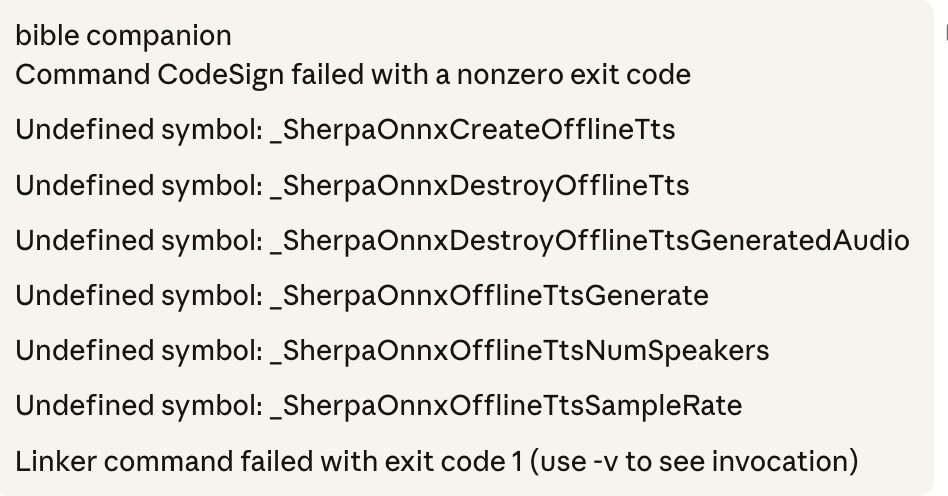
just lost 24 hours to a codesign error vibecoding a Bible app with Claude Code 😭
app ran perfectly in the simulator. wouldn't install on my actual iphone. kept getting codesign exit failures
i tried everything. reprompted claude like 50 times. stackoverflow. nothing worked
turns out it wasn't even a code problem lol
my Apple Development certificate in Keychain Access was corrupted
the fix took 2 minutes:
open Keychain Access → My Certificates → find your Apple Development cert → delete it → build again in Xcode
xcode just makes a new one automatically. that's literally it
no AI tool is gonna catch this for you because it's your machine not your code
bookmark this. you'll need it one day

Hey fam-
A quick pop in to say hi between taking codesignal certs- my brain is on fire and it’s freezing outside. Is anyone else ready for warmer weather yet or do you guys enjoy the frigid temperatures?


@codesigner_jmk AutoSense sounds good , thanks

TIL: Debugging Notarized macOS App
Symptoms
- Notarized app launches
- Sidecar crashes immediately
- Logs show repeated restart attempts
Debugging Steps
1. Check app logs
ls -la ~/Library/Application\ Support/MyApp/logs/
2. Check crash reports
ls ~/Library/Logs/DiagnosticReports/ | grep -i mysidecar
3. Analyze crash report
Some things to look for:
```json
"signal": "SIGKILL (Code Signature Invalid)"
"termination": {"namespace": "CODESIGNING", "indicator": "Invalid Page"}
"symbol": "LLVMPY_TryAllocateExecutableMemory"
```

@codesigner_jmk Thanks for the feedback.
Appreciate ✨️

🗓️ Day 9 #BuildInPublic
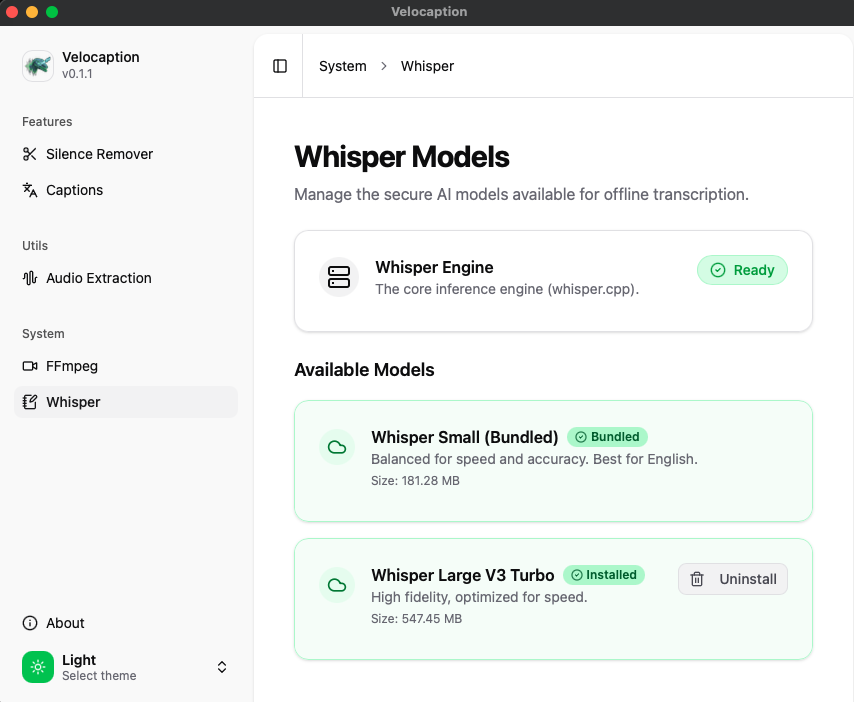
Worked on user's feedback
⚖️ 2.69G -> 500M
🔡 super text styling
🔇 auto-detect silence 🆕
🧰 Download heavier transcription models via TUF system
🎛️ Get the most out of your @Apple Silicon chip: full model control.
codesign the app now. β-test anyone?



@codesign_ak47 I loved the upper one because I love this color so much 🤍
Most Popular Users

Elon Musk 
@elonmusk
239.8M followers

Barack Obama
@barackobama
118.6M followers

Cristiano Ronaldo
@cristiano
114.3M followers

Donald J. Trump
@realdonaldtrump
111.7M followers

Narendra Modi
@narendramodi
106.9M followers

Rihanna
@rihanna
98.6M followers

NASA
@nasa
92.1M followers

Justin Bieber
@justinbieber
91.7M followers

KATY PERRY
@katyperry
89.9M followers

Taylor Swift
@taylorswift13
83.9M followers

Lady Gaga
@ladygaga
75.4M followers

Virat Kohli
@imvkohli
73.3M followers

Kim Kardashian
@kimkardashian
70.8M followers

YouTube
@youtube
68.6M followers

Neymar Jr
@neymarjr
66.3M followers

Bill Gates
@billgates
65.1M followers

Selena Gomez
@selenagomez
63M followers

The Ellen Show
@theellenshow
62.1M followers

CNN
@cnn
61.7M followers

X
@x
60.6M followers