

Top Tweets for #Contemplating

@heisatule It’s cooking.. I’m contemplating the ungrateful, thankless, undeserving public deserves such powerful knowledge…

@johnybuilds Wow thanks for this comment Johny. Im contemplating running meta ads and had some idea that it’s really expensive and $1.34 in 36 hours with 2 conversions definitely sounds worth it.

going drstrange on this bitch having claude + the oalgo quant test scenarios 1000001 ways + iteratively contemplating more variables
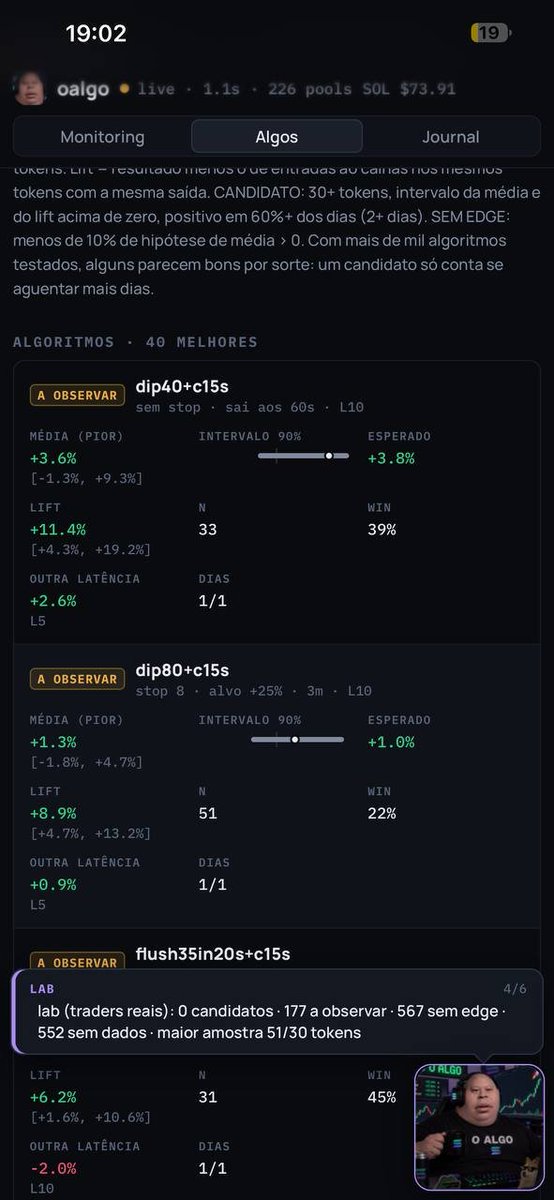
I am working on retrieving as much information I can as possible to see through possible pockets of + EV trades algorithmically
I call this the OALGO TRADER, where I look for THE ALGO o algo asi
IF I ever launch it will be a MUTTS pair and we will bring the O ALGO soyjak to life but much data to capture much more parametrization to contemplate, compact, and backtest so we can come up with THE ALGO, o algo

Study Notes - (Pulpit Version Explained) (PART B)
I. AN UTTERLY HOPELESS CONDITION.
1. The psalmist seems to be contemplating the mournful state of the people of God, of whom he rejoices to be one. He represents them as being not merely a defeated company, but large numbers of them destroyed, and their bodies in long furrow-like heaps left in dishonored and horrible neglect to be the prey of the vultures and the wolves. Overwhelming destruction has come upon them; they seem fallen, to rise no more. It is a piteous sight for the survivor to contemplate; for they are his own people, he identifies himself with them. "Our bones," he says, "are scattered," etc. He might well cast himself down in despair.
2. And how often in the history of the Church of God, and in the lives of individual men, such seemingly sad and hopeless conditions are met with! The Bible gives us instances not a few. See Abraham when called on to offer Isaac as a burnt offering; how dark the prospect seemed then! Moses, when sent to deliver Israel from Egypt. Gideon, when the Midianites were ravaging the land. David before Goliath. How reasonable it had been if despair had fastened upon them and upon many other such tried souls! And many a child of God is today brought into like circumstances, his soul smitten down to the gates of death, even as our Lord in Gethsemane.
II. A VIRTUOUS FAITH NOTWITHSTANDING. (Psa_141:8.) True, there lay his hopes, scattered, overwhelmed, destroyed, like the bones of a defeated, destroyed, dead but unburied army. Nevertheless, the soul of the psalmist is up unto God. "Mine eyes are unto thee, O God the Lord." The more hopeless the state of things seemed, the more steadfastly was his gaze fixed on God, the more emphatically was his confession given. "In thee is my trust;" and the more confidently ascended his prayer. It is a beautiful spectacle, the soul holding on to God in spite of all the buffetings of disastrous circumstances, and all "the slings and arrows of outrageous fortune," in spite, too, of the apparent abandonment of his career by God. O glorious faith, what hast thou not done? what canst thou not and wilt thou not do?
III. SOME REASONS WHEREFORE THESE THINGS ARE SO.
1. As to the sad and seemingly hopeless conditions in which God’s people often find themselves. They are terrible trials to a man’s faith; often men have utterly broken down under them, and fallen into the depths of atheism and irreligion. Faith is not universally victorious, sometimes far otherwise. Wherefore, then, are such trials sent? Well, sometimes to give opportunity for bearing the most emphatic testimony for God that a human soul can give. One chief reason of the cross of Christ was that he might there, as, blessed be his Name! he did, give such mighty testimony to the all-sustaining power of the love of God. Those whom he came to save had fearful sorrows to bear, and on the cross he showed them that God was the great Burden-bearer, the never-failing Solace and Stay of the soul. And for like reason his people now are often called upon to bear burdens heavy indeed. Then another reason is that there is no other way whereby the innate and inveterate earthliness of the human heart can be overcome. God has to let men see that this world will not satisfy them, no, not even when its pleasures are of the fairest and most innocent kind. We are so apt, so certain, to think they will, that God has not seldom to "scatter our bones at the grave’s mouth," ere we will see our mistake. The earthly cords that hold the soul down have to be cut. And also to compel men to take refuge in God, to drive them to the shelter and shadow of his wings. And God deals thus with individual souls, that others through them may learn that this is not our rest, but that God is.
2. Then as to the blessed victorious faith, its explanation is:
(1) The grace of God. Bunyan tells of the picture seen by Christian of the fire which would burn on in spite of water perpetually and profusely poured upon it, and when he wondered how this could be, he says that he saw a man, unseen by others, continually pouring oil on the fire, and so it burnt on in spite of the water. That is ever the explanation of victorious faith—the grace of God secretly keeps it alive.
(2) The power of prayer. "Mine eyes," etc. His soul looked to God continually.
(3) The habit of trust. "In thee is my trust." The will more than the reason is needed. "I will trust, and not be afraid." This blessed habit can and should be zealously cultivated.
IV. WHAT ENSUES.
1. God is glorified by such faith. How could it be otherwise?
2. Our suffering brethren are greatly helped by the testimony we give.
3. The peace of God fills our own soul.—S.C.
HOMILIES BY R. TUCK
Psa_141:1
The plea of former prayer.
Associating this psalm with David, Spurgeon thinks we have here "David under suspicion, half afraid to speak lest he should speak unadvisedly while trying to clear himself; David slandered and beset by enemies; David censured even by saints, and taking it kindly; David deploring the condition of the godly party, of whom he was the acknowledged head; David waiting upon God with confident expectation." The point before us now is brought out by the Revised Version, which renders thus: "Lord I have called upon thee; make haste unto me: give ear unto my voice, when I call unto thee." The psalmist uses as a plea the fact that he had called upon God. But his precise thought seems to be, that the prayer he had offered still remained unanswered, and he must therefore offer it again, and even more earnestly. So there are two topics which may be unfolded and illustrated.
I. ANSWERED FORMER PRAYERS ARE AN EFFECTIVE PLEA. And a store of these every good man holds in loving memory. "This poor man cried, and the Lord heard, and saved him out of all his troubles;" "Verily God hath heard me." Every true life, when looked back upon, is seen to be full of Jehovah-jireh pillars erected as memorials of answered prayer. These become a plea in fresh prayer, because they are
(1) God’s pledges of his personal interest in us;
(2) God’s illustrations of what he can and will do for us; and
(3) the best influence toward nourishing in us that spirit of trustfulness, and humble but confident hope, which is the acceptable spirit of all prayer.
We trust God to heed us because he has heeded us; and his ways with us have revealed to us what he is, the "prayer-answering God."
II. UNANSWERED FORMER PRAYERS ARE AN EFFECTIVE PLEA. The psalmist has prayed about some particular need. The prayer is still unanswered. On some this might act depressingly, and they might pray no more. This psalmist watches unto prayer. Delay does its intended work, and excites importunity. Because the answer has not come, he must pray again, and even plead that he is anxiously awaiting the answer. Illustrated by the Syro-phoenician woman.—R.T.
Psa_141:2
Prayer as incense.
From the mention of the evening sacrifice we may gather that the psalmist is actually praying in the evening. Incense was offered when the lamps were trimmed in the morning, and when the lamps were lighted "between the evenings," after the evening sacrifice. Incense, offered after sacrifice, is the symbol of the worship of the soul already reconciled to God. The evening sacrifice is the regular burnt offering of self-dedication. "As incense is carefully prepared, kindled with holy fire, and devoutly presented unto God, so let my prayer be." There are two things about incense which may be taken as suggestive—its steady ascending as smoke; and its pleasantness.
I. THE ASCENDING OF INCENSE AS A SUGGESTION OF PRAYER. The smoke, richly laden with perfume, rises steadily up, in a quiet and gentle, yet persistent way, until it is lost to sight in the high air. It should not be lost sight of that incense appeals to sight as well as to smell. And prayer is really the soul’s ascending to God. It is as the smoke laden with the soul’s perfume of dependence, desire, and trust. It is the man who is continually either looking on the level, or looking down, looking up, nay going up, getting soul-wings and rising to God. It implies getting, at least for the time, free from earthly entanglements. It is leaving the baser self, as the incense smoke leaves the wood of the spices; it is carrying up the sublimer self, as the incense smoke carries up the very essence of the spices. We do not apprehend prayer until we see it as the soul’s going up to God.
II. THE PLEASANTNESS OF INCENSE AS A SUGGESTION OF PRAYER. Using the figure of a man, God is said to have "smelled a sweet savor" from the smoke of Noah’s sacrifice. Smoke of incense is not pleasant to us, but Easterns love strong and unusual scents. We note that the smoke was full of perfume, and that God is well pleased with. Then there must be perfume in our prayer that ascends to him—perfume of trust, humility, love, fervent desire, and confident assurance. Can we think of God as enjoying our prayers?—R.T.
Psa_141:3
Our lip-watchman.
Our lips are poetically presented as the door of our mouth. A man’s heart is not to be trusted as an inspirer of speech. Every man needs to have the speech examined and tested before it is let pass the door of his lips. The psalmist feels that he cannot trust himself to examine, criticize, qualify his own speech, especially in times of excitement. And yet he must do this work himself. No one but himself can know what he is inwardly urged to say. In asking God to set a sentinel at the door of his lips, the psalmist does but, in a figure, ask God to give him quietness and self-control, so that he may be able to judge the wisdom of what he is moved to speak. For if any man asks God to "set a watch at the door of his lips," God will answer the prayer by making the man his own sentinel, and giving him that most valuable power, the power of self-criticism. Why do we need a watchman?
I. BECAUSE OF OUR NATURAL DISPOSITIONS. Many are nervously excitable; oversensitive; quick to reply; impulsive; ready to suspect evil; or passionate. And many have no keen sense of the befitting or the becoming. Some are talkative, and readily carried by excitement beyond the bounds of prudence. What all such persons really need is not to be put into bonds and limitations, but by Divine grace to be helped to gain control of themselves. Their life-work is in their own dispositions; and God’s grace is ready for the strain and conflict of that life-work.
II. BECAUSE OF OUR PARTICULAR CIRCUMSTANCES. The psalmist was suffering persecution; he was misunderstood and slandered, and was afraid of himself lest he should speak, under excitement, rash and bitter words. Our circumstances of peril are:
1. When anger rises within.
2. When those we address are angry.
3. When speaking of those against whom we are prejudiced.
4. When in the presence of those who may wrongly report us.
5. When we have reason to fear that the innocent may be injured.
6. When we have reason to doubt our own motives. In this matter of watching speech, God helps those who help themselves.—R.T.
Psa_141:3
The power of human speech for good and evil.
There is, perhaps, no other power given us by God which more evidently distinguishes us from the beasts, than the power of intelligent speech. And perhaps we have no power that can do more to help and bless others. And yet this also is true—no other faculty is more degraded by sin. One is led even to exclaim, "What shall be done unto thee, O thou deceitful tongue, thou lovest all devouring words!"
I. THE POWER OF MAN’S SPEECH FOR GOOD. Describe the power of Demosthenes to sway an Athenian audience to patriotic enterprise; or Peter the Hermit calling for a Crusade; or Father Mathew pleading the temperance claims. Show what a gentle-voiced, sympathetic woman can do at the bedside of the sufferer.
"Words, sweet words;
A blessing comes softly from kindly lips."
II. THE POWER OF MAN’S SPEECH FOR INJURY. The few words of a king, a ruler a statesman, have often loosed the dogs of hateful war. The lecturer can persuade young souls to deny God and righteousness and truth. Men, and women too, can by the blandishments of speech, become tempters, drawing others into sin. The Bible has metaphors suggesting the good and evil of our speech. "The words of a man’s mouth are as deep waters;" "A word fitly spoken is like apples of gold in framings of silver;" "A wholesome tongue is a tree of life;" "My speech shall drop as the rain, and distil as the dew;" "There is that speaketh like the piercings of a sword;" "Their tongue is an arrow shot out, it speaketh deceit; one speaketh peaceably to his neighbor, but in heart he layeth in wait." The Apostle St. James makes the bad tongue to be a "spark of hell, lighting upon earth the flames of perdition." Everything else may be tamed, but the "tongue can no man tame;" it is an unruly evil, full of deadly poison.
III. THE PRACTICAL POWER OF CHRISTIANITY ON MAN’S SPEECH.
1. The foundation of the restraint of speech is a change and renewal of the heart.
2. Then there should be formed a very resolute and sincere purpose to win the rule of it. The matter should come forcibly before us. The habits we have formed must be considered; the indulgences of the tongue must be tested; our life in the light of our speech must be judged. And there must be constant watchfulness, with keen recognition of occasions of failure. Prayer may well be directed to winning power over our tongue.—R.T.
Psa_141:4
God’s preventions.
This prayer, "Incline not my heart to any evil thing," should be compared with the clause in the Lord’s Prayer, "Lead us not into temptation." In neither case can God be thought of as the direct cause of evil or temptation; but in both cases he may be thought of as the indirect occasion. God does place men in circumstances in connection with which temptation may come to them; and the circumstances may even induce an evil inclination to yield to the temptation. It belonged to the intense Hebrew conception of God, and of God’s relations with men, that the distinction between God as cause and God as occasion was hopelessly confused. "Incline not my heart" can only mean, "Do not put me into such circumstances as must incline my heart to evil." Here is—
I. A DEEP SENSE OF THE CONNECTION BETWEEN CIRCUMSTANCES AND FEELINGS. "Oh that nothing may arise in thy providence which would excite our desires in a wrong direction!" We are creatures of circumstance. Inward moods answer responsively to outward conditions.
1. There are circumstances which excite evil feeling in us always.
2. There are circumstances which excite evil in us when we are in particular states of body or of mind. These, being the more subtle mischief, send us the more earnestly seeking the Divine defending and help.
II. A DEEP SENSE OF THE CONTROL WHICH GOD CAN HAVE OF OUR FEELING THROUGH THE MASTERY OF OUR CIRCUMSTANCES. "Our times are in his hand," and through our times he can effectually control us. It is often left as an impression on religious minds that something called "natural law" is ruling in the sphere of things; and that God’s operations are confined to the sphere of hearts. That impression needs to be removed. God does work in hearts in a spiritual way, but it is also true that he is ever active in the sphere of events and circumstances, in order to use them for his higher work in feeling and in souls. So the good man asks God to be in the circumstances in order that he may have control in the feelings.—R.T.
Psa_141:5
Reproof and kindness.
"Let the righteous man treat me with any amount of ignominious reproach for my sins, yet I will prefer him to the ungodly, however prosperous, my prayer being ever that I may be saved from the evil deeds of the latter." Read, "Let the righteous smite me; it shall be a kindness: let him reprove me; such oil for my head let not my head refuse." Roberts tells us that in the East "certain oils are said to have a most salutary effect on the head; hence, in fevers, or any other complaints which affect the head, Eastern medical men always recommend oil. I have known people who were deranged cured in a very short time by nothing more than the application of a peculiar oil to the head. Thus the reproofs of the righteous were compared to
excellent oil, which produced a most salutary effect on the head." What seems plain, and what gives the best key to the allusions of this difficult psalm, is that the psalmist had done something which was very doubtfully right, perhaps even manifestly wrong. He was not, however, disposed to admit this to himself, though at times he felt painfully uncertain. Other people were in no doubt at all as to the impropriety of his action, and his enemies made it the occasion of bitter scorn, while his friends, in their grave anxiety for him, sought to reprove him, and liberate his conscience so that it might render its free testimony. The psalm may very well be illustrated by the moods of David when he had sinned in the matter of Uriah.
I. SCORN OF A MAN IN SIN DOES BUT HARDEN HIM. Many a man has gone into greater lengths of sin simply because he failed to get sympathy and help in his first stumbling.
II. REPROOF OF A MAN IN SIN MAY BRING HIM TO REPENTANCE. A man in sin must not be left alone. But reproof, to be effective, must have love, as well as righteousness, for inspiration. "Faithful are the wounds of a friend."
III. RESPONSE TO THE REPROOF OF THE GOOD REVEALS A MAN. There is hope if he is receptive to the personal persuasions of those whom he can esteem, and counts reproof a kindness.—R.T.
Psa_141:8
Soul-destitution.
"We have born so harrowed and torn that we are brought to the brink of the grave." "To be destitute in circumstances is bad, but to be destitute in soul is far worse; to be left of friends is a calamity, but to be left of God would be destruction. Destitute of God is destitution with a vengeance. The comfort is that God hath said, ’I will never leave thee, nor forsake thee.’" The margin is, "Make not my soul bare;" strip me not of every hope; leave me not completely naked; abandon me not to nature’s beggary and misery; let me not go down to the pit with all my sins upon my head; leave not my soul destitute of pardon and peace. The mood is well indicated in David’s sense of being left alone of God for long months after his sin in the matter of Uriah. A comparison may be made between this prayer, "Leave not my soul destitute," and the confident assurance, "None of them that trust in him shall be desolate."
I. THE SOUL IN RIGHTEOUSNESS FEELS BEFRIENDED. That is, the soul that is in right relations, and has right desires inspiring right endeavors. That man can always say, "The Lord of hosts is with us, the God of Jacob is our Refuge." And that befriending makes him superior to all surroundings of distress, and all consciousness of frailty.
II. THE SOUL IN SIN FEELS DESTITUTE. He is conscious that he has put himself out of the atmosphere in which alone the God of love and righteousness can reveal himself. The prodigal son felt destitute as soon as "he came to himself," and realized that no love wrapped him round. When a man sins, and persists in his sins, it is his soul that feels destitute. His surroundings may not immediately change, but his soul does. That loses what is its supreme treasure, the sense of God. "Man was made for God, and can find no rest till it gets rest in him." When man sins, and keeps his sin, he must lose his treasure. But soul-destitution may set man seeking after God’s return with a passionate intensity.—R.T.
HOMILIES BY C. SHORT
Psa_141:1-10
A comprehensive prayer.
The psalm has some peculiar difficulties, due to the extreme abruptness with which the thoughts follow one another, and the great obscurity which hangs over the allusions. Let us try and select the principal thoughts.
1. The psalmist was threatened with some immediate danger which could brook no delay. (Psa_141:1.) Like the disciples in the storm on the lake. If relief comes at all, it must come at once.
2. He seeks that his prayer to this end may be as acceptable as the incense of sacrifice. (Psa_141:2.) True prayer more effectual than sacrifice.
3. But, though danger is close at hand, he would be preserved from hasty words. (Psa_141:3.) Religion should help us to be self-contained in the presence of danger.
4. Though wickedness may seem to prosper, we must not be tempted by its success. (Psa_141:4.) If men become rich in evil doing, we must not be seduced by the prospects of similar gain.
5. The wounds of a friend are better than the kisses of an enemy. (Psa_141:5.) It is good to welcome reproof from the righteous, even though it seems harsh.
6. Prayer is a better defense against persecutors than retaliation. (Psa_141:5.) If we cannot conquer wickedness, we have still the resource and the comfort of prayer for our enemies.
7. When the leaders of insurrection are overthrown, then their followers should hear words of forgiveness. (Psa_141:6.) A true sovereign will delight more in amnesty than in punishment. His words will be sweet to the guilty. So also in private relations.
8. The bones of those straitened in a righteous cause are as seed cast into soil that has been ploughed. (Psa_141:7.) "The blood of the martyrs is the seed of the Church." The allusion here is obscure; but the above would make a good meaning.
9. But do not give up my life to destruction; but rescue me. (Psa_141:8-10.) This the repetition of the prayer at the beginning of the psalm. How much all prayer is a repetition, because the some wants and desires are continually recurring!—S.

@Cryptominner_ My wallet is currently looking at that 75,000 $SCBK price tag and contemplating how many more meme contests I need to win.

My first actual crochet wearable that isn’t a toque or headband. I am still contemplating on adding a hood so that’s why it doesn’t have a border yet.


Sorry, chat, I’m locked tf in trying to finish this fucking cardigan


@robert30047625 i'm thinking about it I never really played gta5 story mode so I'm contemplating either just buying it or watching it cuz i dont really like story games

@Marc_Cea_Real dead ass i was contemplating posting it for DAYS

What was the reason he went live so late, was this nigga contemplating on going live for th whole day or something


contemplating a jilky edit rn 🤔

I’m 8 cutwaters in,we ain’t win no solo awards, Kaysan contemplating his future. Fuck it cuzz slam Santi I don’t care no more

@ArumiLusts Contemplating if I should get her subscription dm 😵💫😵💫

@toneismyuser2 Yeah from a broad perspective , Nabers is better but idk I’m contemplating ode .

contemplating whether to watch the new hunger games movie at the movies alone, cause no one needs to see me like that orrrr if emotional support will be VERY necessary and I should go with a friend… much to contemplate

One of my favourite songs ever! Seriously contemplating getting another #Eminem tattoo with some of these lyrics on!!
#Eminem
#Relapse
#BEAUTIFUL...
Foxy ~ ☺️🎶🩷
@ShadyDCMiami
one of my favorite tv show duos is literally ron and jason in the 90s the more clips i see, i’m contemplating making one of those like similarity edits 🤔

@cloudsay No one is contemplating a fork.
This is not a disagreement about the protocol or its rules.
Two wallets can disagree, and still exist on the same blockchain network, with no forking necessary.
Original Bitcoin protocol, Scalable Version.

• NBA Domination Completed‼️💯
• Was contemplating even playing Dom this year but once I seen the MT you could earn… I had no choice lol.
• All time and Historic up next, gonna do WNBA last.


@lawofswan I did at first too! loas made me realize id been dealing with adhd for the longest time.
Once I figured that out, learning and actually understanding this became a lot easier :)
I had to do a lot of contemplating and writing down my thoughts to fully get it

@jakeallen3 As good as your model was, Jake,
It didn't even come close to contemplating what we learned today - this call should be insane.

@raha_farzam Ikr the whoop band i was soo contemplating

bro is actually contemplating everything in life rn


🌸It’s a new month you can’t keep contemplating Come to me wanting one thing: feminization. I’ll teach you to walk, speak, and shine like a true sissy obedience required. 👠💋✨
Dm to prove you’re ready and enroll: https://t.co/i687b8rl8J
#femdom #feminization #mistress

Finished Unravel Me and omg chapter 62 is a roller coaster ride.
Contemplating if i am gonna read fracture me since this is from Adam’s POV lmao
Last Seen Hashtags on Sotwe
Most Popular Users

Elon Musk 
@elonmusk
240.1M followers

Barack Obama
@barackobama
118.6M followers

Cristiano Ronaldo
@cristiano
114.4M followers

Donald J. Trump
@realdonaldtrump
111.8M followers

Narendra Modi
@narendramodi
106.9M followers

Rihanna
@rihanna
98.6M followers

NASA
@nasa
92.1M followers

Justin Bieber
@justinbieber
91.7M followers

KATY PERRY
@katyperry
89.9M followers

Taylor Swift
@taylorswift13
83.9M followers

Lady Gaga
@ladygaga
75.4M followers

Virat Kohli
@imvkohli
73.3M followers

Kim Kardashian
@kimkardashian
70.8M followers

YouTube
@youtube
68.6M followers

Neymar Jr
@neymarjr
66.3M followers

Bill Gates
@billgates
65.2M followers

Selena Gomez
@selenagomez
63M followers

The Ellen Show
@theellenshow
62.1M followers

CNN
@cnn
61.7M followers

X
@x
60.6M followers