

Top Tweets for #DataManager

This post is for those who are new to technology and want to develop and accompany @gensynai
→ FULL SUMMARY IN ITALIAN STANDARD – GENRL & RL-SWARM GENRL & RL-SWARM
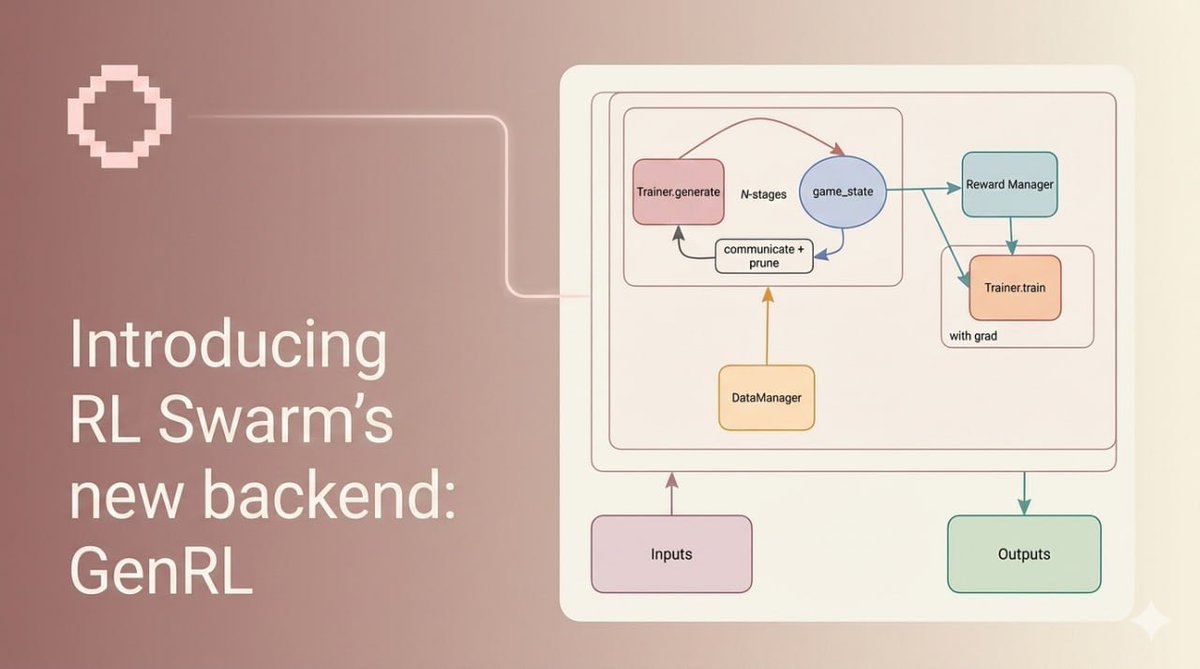
1. What is GenRL?
→ GenRL is a new framework designed to make it fast and easy to build complex Reinforcement Learning environments especially multi-agent environments.
It solves key limitations of older RL frameworks:
• Traditional RL frameworks focus on centralized setups → difficult to scale to distributed networks
• Lack of native support for multi-agent RL
• Pipelines are hard to customize
👉 GenRL was created to enable fully customizable, distributed, permissionless, and horizontally scalable RL environments.
2. What does GenRL support?
→ Native capabilities:
• Multi-agent
• Multi-stage RL
• Decentralized communication
• Horizontal scalability
→ Modular architecture
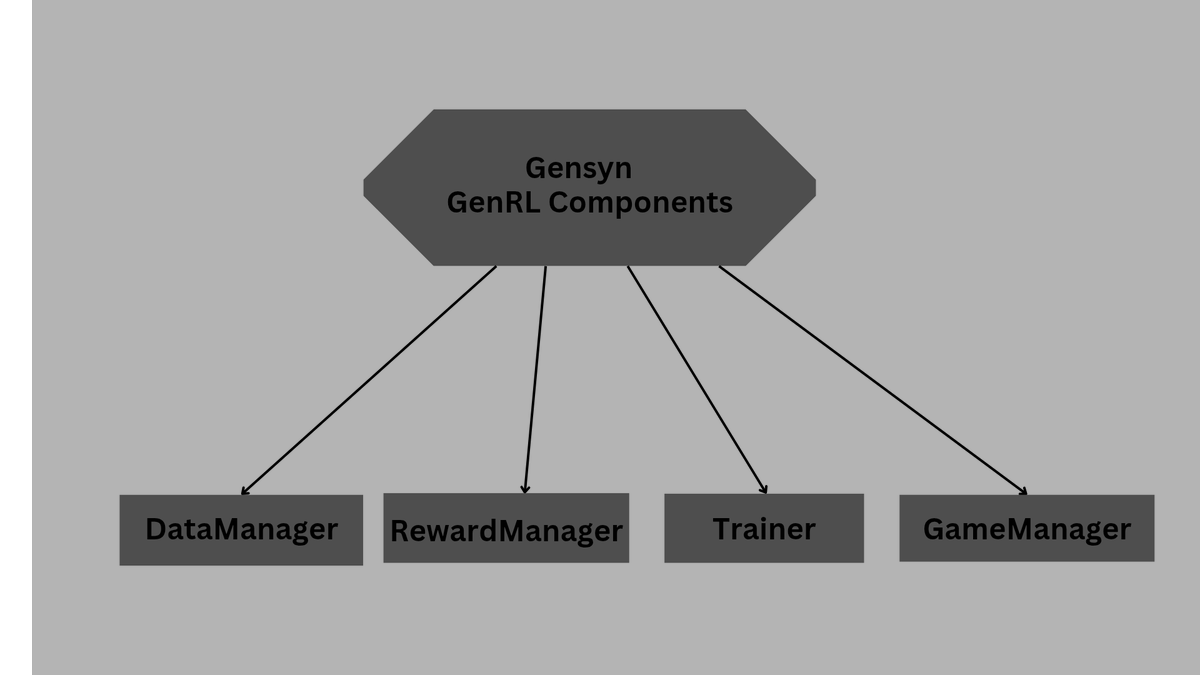
Users can define the entire RL “game” via four main managers:
→ DataManager
Handles all data used in RL (text, images, board games, etc.).
→ RewardManager
Defines custom reward functions to shape learning objectives.
→Trainer
Handles training: policy updates (policy gradient, value function, etc.).
Handles generation: creating rollouts & agent interactions.
→GameManager
Coordinates data flow, communication, and all agents across stages.
👉 GenRL lets you customize logic, rewards, data types, and how agents interact, fully programmable.
3. Framework-defined progression (GenRL learning cycle)
Each round consists of:
DataManager generates round data
Multi-stage game runs → agents produce rollouts → update state → broadcast to swarm
After all stages complete:
• Rewards are calculated
• Trainer updates the policy (per stage or per round)
GenRL also ships with the “Reasoning Gym” — over 100 ready-to-use RL environments
Continued in comments 👇
This article will be a bit long, for those who want to know more about "Prediction Markets are Learning Algorithms" I will summarize and analyze below, I hope everyone will support more so that I have motivation for the next articles, respect @gensynai
Prediction Markets = Learning Algorithms
One of the most fascinating observations of the past 15 years is this:
Prediction markets (Polymarket, Kalshi…) and online learning algorithms actually solve the same underlying problem .Turning countless noisy signals into the best possible probability estimate
You have a prediction market.
You have an online learning algorithm like FTRL, Mirror Descent, OGD.
At first they look unrelated , but mathematically - the opposite is true:
👉 They are almost equivalent
1. Prediction Markets → Online Learning Engines
🔹 How does a prediction market work?
Traders bet on whether an event will happen.
Market price = probability estimate.
It aggregates signals from thousands of participants often outperforming surveys
🔹 Chen & Vaughan (2010): the decisive breakthrough
They proved:
Every cost-function prediction market (with bounded loss) = a no-regret online learner
A 1–1 mapping:
Prediction Market Online Learning
Cost function C(q) Regularizer/geometry
🔽 🔽
Market prices pₜ Learner’s probability
🔽 🔽
Trader orders Gradients
🔽 🔽
Bounded loss Regret bounds
Meaning:
A prediction market is not like an online learner
👉 it is an online learning algorithm
2. Markets behave like optimization algorithms
🔹 Mirror Descent emerges naturally from markets
Frongillo et al. (2012):
Kelly-type traders → market price updates ≈ stochastic mirror descent
Nueve & Waggoner (2025):
With the right cost function, a market can implement any first-order optimizer:
SGD, OGD, Nesterov momentum, et
A liquid market = an optimization trajectory

@0x__sting @KBekhtiev exact, the way DataManager organizes inputs directly affects how well the swarm learns

@Assidikh2 @KBekhtiev @GenRL’s modular design with DataManager, RewardManager, and other components powers efficient multi-agent learning and full control over the swarm

I loosely mentioned GenRL on a previous thread; this one however, is dedicated to it.
Before we continue, GM Web3, gm @gensynai !
GenRL (General Reinforcement Learning) is a new open-source framework that is used to build RL Swarm.
It was built to make multi-agent and distributed reinforcement learning (RL) easier though it supports single-agent RL as well.
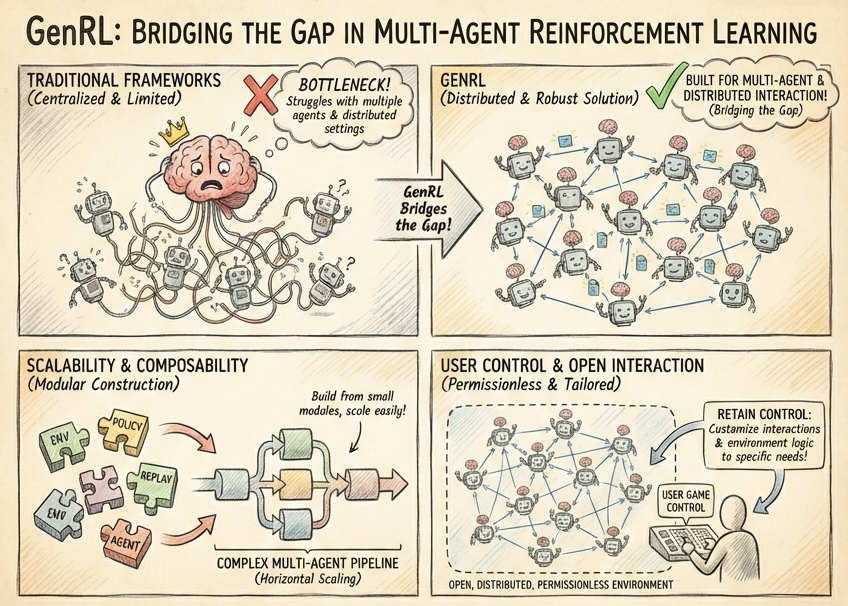
So, by prioritizing customization and scalability, GenRL aims to resolve the barriers commonly associated with traditional frameworks.
Yes, it is already established that reinforcement learning is effectively solving complex problems ranging from system optimization to intelligent agent training, however, existing frameworks often fall short when multiple interacting agents are introduced.
The current solutions tailored to address this are limited by centralized entities or by a complete lack of native support for multi-agent settings, and, GenRL was developed to bridge this gap as it offers a robust solution for scenarios where agents MUST learn and interact in a distributed manner.
GenRL is built around scalability and composability; the framework itself is designed to enable the construction of complex multi-agent RL pipelines from small, modular components that can then be scaled horizontally or plugged directly into decentralized systems like RL-Swarm.
Now, unlike regular frameworks that enforce centralized control, GenRL is built for environments where agents interact transparently in an open, distributed and permissionless manner;
all this goes on whilst allowing users to retain control of the entire game, essentially ensuring that agent interactions and environment logic can be tailored to a user's specific needs.
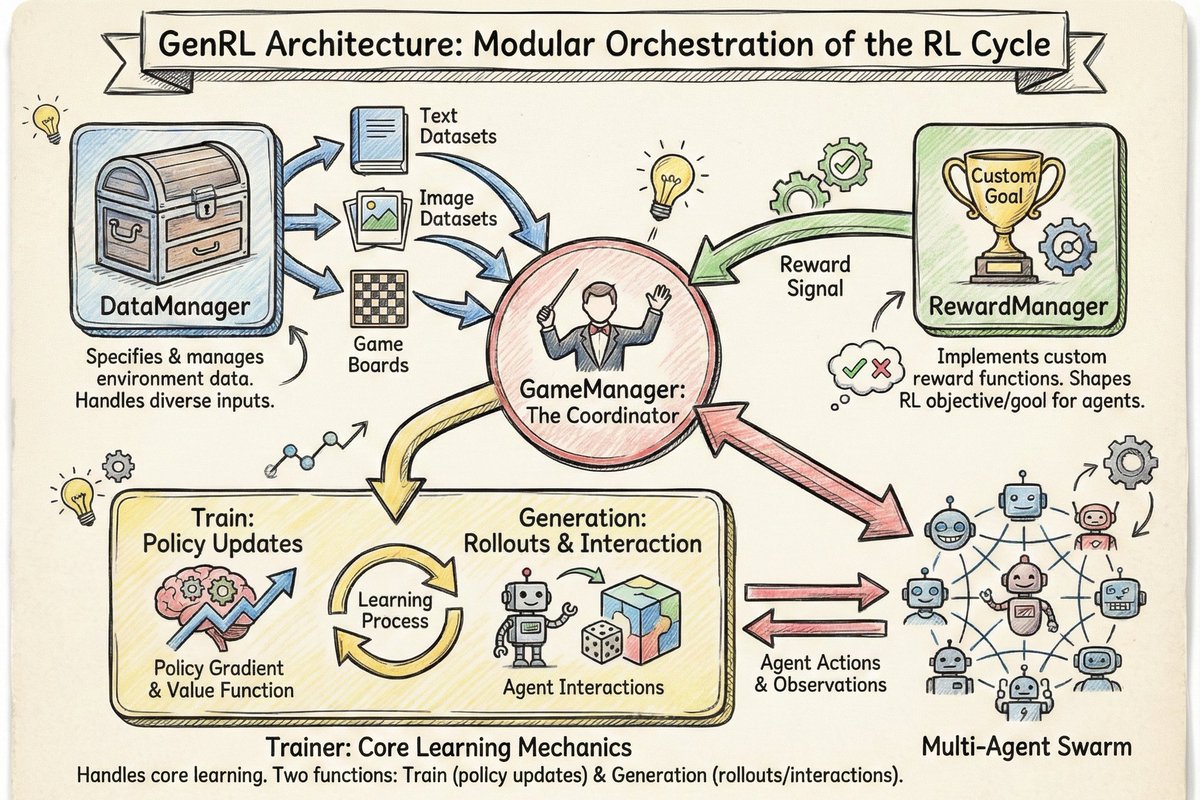
In terms of architecture, GenRL features an intuitive, modular architecture that virtually orchestrates the complete RL cycle;
users can define the environment through specific, highly customizable components and we'll look at these components below:
DataManager
This module specifies and manages the data that the environment will use and it's flexible enough to handle different inputs such as: text datasets, image datasets and even game boards.
RewardManager
This component lets users implement custom reward functions. It's the mechanism through which users can directly shape the RL objective or goal for their agents.
Trainer
This handles the core mechanics of the entire learning process and performs two distinct functions in train and generation.
Train: Here, policy updates occur and it provides support for various RL paradigms including policy gradient optimization and value function approximation.
Generation: This handles the generation of rollouts and as well manages agent interactions within the environment.
GameManager
The game manager is essentially the coordinator that manages the flow of data between the user-defined modules (DataManager, RewardManager, Trainer) and the agents that are within the multi-agent swarm.
In a nutshell, GenRL is built to work with any user defined environment, however to enable immediate use, the framework incorporates the open-source Reasoning Gym library which provides users with access to over 100 community-created environments upon launch.
That's all on GenRL, gSwarm!


Looking at Gensyn’s RL Swarm, it’s immediately clear, this is a different approach to RL. Each node runs on its own hardware, in different locations, yet it all comes together as a continuous learning process.
At the core is verifiability of every computation step. It doesn’t matter where a node is or who owns the GPU. What matters is the result: the system uses cryptographic checks, challenge-response, and error-search algorithms to ensure every step is correct.
RL Swarm is built on GenRL, a modular SDK for multi-agent environments:
🔹 DataManager prepares the data and initializes each training round;
🔹 RewardManager evaluates node solutions through model-based reward functions;
🔹 Trainer updates local policies based on collective feedback (GRPO - Group Relative Policy Optimization);
🔹 GameManager coordinates node interactions and result sharing.
On top of this runs CodeZero. Nodes act as Proposers, Solvers, and Evaluators. The cycle is straightforward: task → solution → result exchange → evaluation → model update. All of this happens decentralized, without a central coordinator.
Practical advantages:
🔹 Nodes can operate anywhere, independent of hardware ownership.
🔹 Scaling depends on the number of participants and the network, not the size of a physical data center.
🔹 Faulty or malicious nodes are automatically excluded.
🔹 Every contribution is logged on-chain.
This approach turns RL training into a distributed, verifiable process, where nodes learn collaboratively and infrastructure is no longer a bottleneck.
Follow resources:
➤ website: https://t.co/zyldPZdzgW
➤ X: @gensynai
➤ Discord: https://t.co/Du64M2qYFv
➤ Gensyn X Community: https://t.co/ONxaRbgQQE


Gswarm 🐝
@gensynai presents the new RL Swarm backend - GenRL
It makes building multi-agent RL environments much easier.
Here’s why I love it:
• Fully flexible and decentralised - agents can learn and communicate without a central controller.
• You define the whole “game”: data, rewards, training, and rollout logic.
• Clear modules: DataManager, RewardManager, Trainer, GameManager.
• Works with 100+ environments from Reasoning Gym.
Want agents to learn trading strategies or coordinate in a puzzle game? Just plug in your data, set rewards, and GenRL handles the rest.
GenRL = faster experiments, cleaner workflows, and true scalability for multi-agent RL.


Most AI frameworks are built for centralized training. Adding multi-agent capabilities?
An afterthought. Good luck building distributed systems with them.
Gensyn built GenRL specifically for decentralized multi-agent reinforcement learning from day one.
It's modular by design. Four key components:
DataManager - define any environment. Text datasets, images, game boards, whatever you need. Ships with 100+ Reasoning Gym environments out of the box.
RewardManager - you define what success looks like. Custom rewards for complex multi-objective tasks. Full flexibility for domain-specific goals.
Trainer - handles policy updates and rollout generation. You control the learning loop completely. Use any RL method you want.
GameManager - coordinates the agent swarm. Manages per-round progression, multi-stage games, communication between agents, and policy updates.
The framework handles decentralized coordination while giving you complete control over training logic.
GenRL is the backend powering RL Swarm. Thousands of nodes training collaboratively, each running their own agents, all coordinated through this framework.
Multi-agent RL shouldn't require hacks. GenRL makes it native. @gensynai


I’ve seen three things learn better together than alone:
- Children in a class.
- Me with my study group in school
- and machines inside RL Swarm.
Here, each node trains its model alone, yet still grows from the work of of every other node.
Each machine solves a task, shares its reasoning, and receives other views from the swarm.
Your model learns from more attempts than it could ever produce alone, so learning moves faster with fewer steps.
It feels like my old study group, where each friend studied one topic and shares the key points during our meetings.
Everyone gained new knowledge without reading every topic themselves unless they wanted to.
RL Swarm is fully open-source and written mostly in Python, which keeps it simple for developers joining with any hardware.
Each node trains its model using the GenRL architecture, which combines four parts that work together inside every swarm round:
- DataManager: prepares the incoming tasks.
- GameManager: coordinates the agents so shared answers reach every node.
- RewardManager: scores the outputs using a model-based evaluator that checks correctness.
- Trainer: updates each model using the group’s combined experience.
All communication moves through a peer-to-peer gossip network called Hivemind, where one node passes updates to the next until the whole group receives them.
Node A tells B, B tells C and so on.
RL Swarm keeps everyone useful by matching models to hardware strength.
A small laptop runs a lighter model.
A stronger server runs a larger one.
Every device helps the group, and gains from the group.
This setup opens new, creative ways to train models.
You can test reasoning tasks, coding challenges, or any custom environment.
You can collect richer feedback from many attempts instead of a few.
You can explore designs that need many agents instead of one large GPU box.
RL Swarm proves that learning does not need central servers.
It grows sharper as more people join with their devices, creating a system where models teach each other and learn from each other.
Humans function better as a team.
Machines can too.
And @gensynai is making it possible.
How exactly does @gensynai keep running when outages happen?
How does a network with no central operator stay stable during failures that freeze other internet applications?
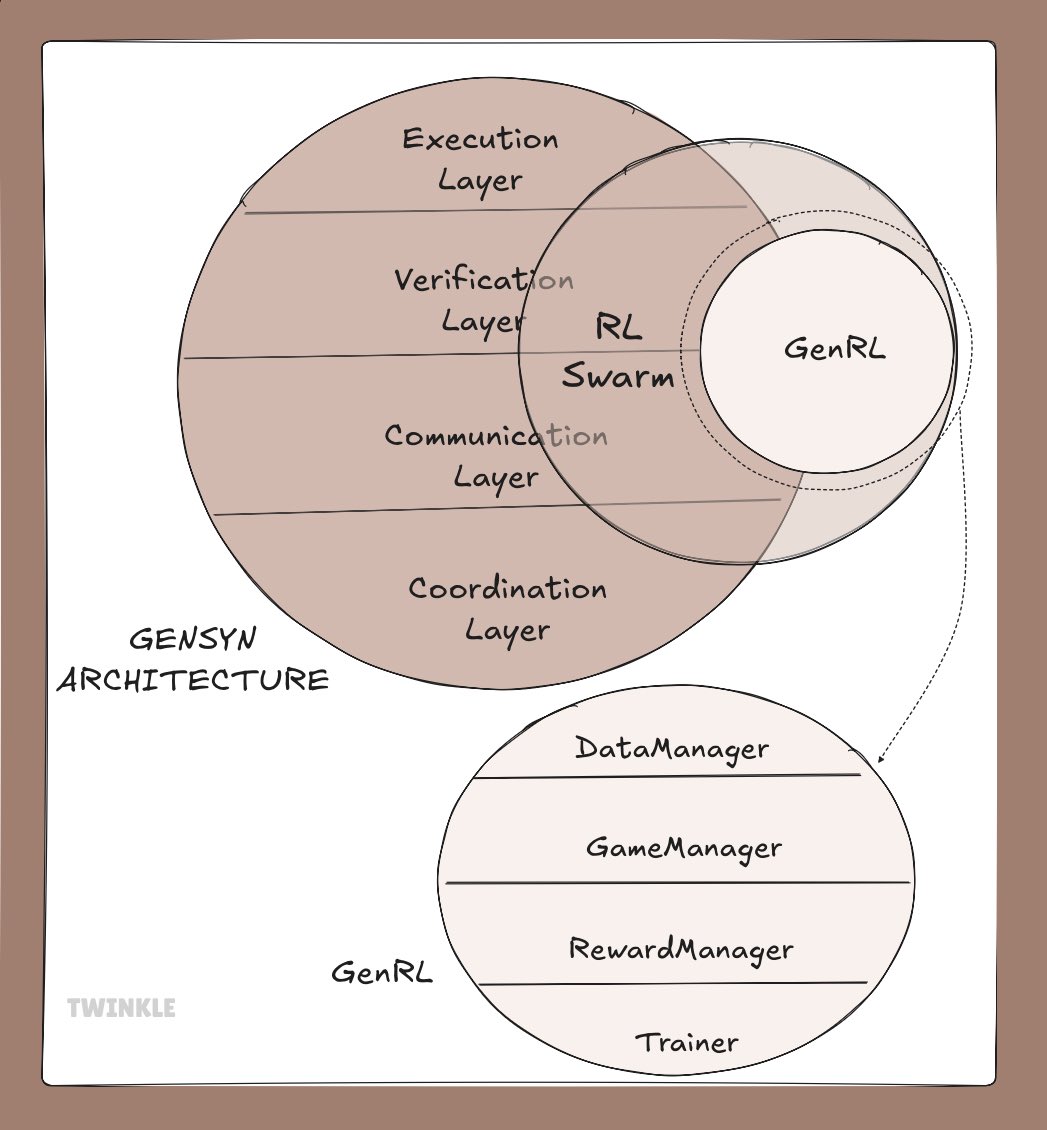
Its system rests on Four Layers that stack neatly on each other and turn scattered machines across the internet into one coordinated training system.
1. The Execution Layer
This keeps every device in sync and ensures GPUs, laptops and edge nodes compute tasks in the same way and return identical outputs.
It avoids problems caused by differnet hardwares or driver issues.
SAPO (Swarm sAmpling Policy Optimization) strengthens this layer by keeping learning stable across huge groups of nodes.
2. The Verification Layer
If thousands of strangers train a model for you, how do you know they did it correctly?
Work must be cryptographically checked without trusting the machines that did it.
Verde supplies operators that remove hidden mistakes, and Judge confirms correctness at the application level.
This layer settles disputes through a challenge system that rewards good work and exposes bad work quickly.
3. The Communication Layer
Machines exchange updates without relying on a central coordinator.
This layer spreads information through lightweight gossip allowing training that survives unstable networks.
NoLoCo trims heavy communication costs,
CheckFree handles recovery without expensive checkpoints,
and SkipPipe reduces extra message hops across devices.
4. The Coordination Layer
A global network like this needs clear incentives and transparent participation.
This layer identifies contributors, distributes rewards fairly, and settles payments on an open Ethereum rollup.
RL Swarm shows how collective learning plays out in this environment.
The Testnet proves that these rules sustain steady participation.
These four layers join millions of untrusted devices into a single training system that verifies every step along the way.
And they explain how Gensyn stays online even when centralized clouds fail.


Gensyn GenRL, Full Control Over How Your Agents Learn and Interact.
GenRL lets you design exactly how your agents learn, communicate, and work together.
Think of it like building your own game for the agents and you decide all the rules.
This is achieved through defined parts, which are:
☑️ DataManager: This handles all the data your environment needs. You decide what the agents see and interact with. It can be text, images, code tasks, or even a custom dataset you choose.
☑️ RewardManager: Agents learn by trial and error, but how do they know when they’ve done something right or wrong?
That’s its job. It works like a score system.
It defines what the agent should want and what it should avoid.
☑️ Trainer: This handles the actual learning. It runs the environment and collects the agents actions (rollouts).
It updates the agents so they get better over time.
☑️ GameManager: It coordinates everything.
It moves data between modules, manages interactions between multiple agents, and ensures the whole swarm environment runs smoothly.
It’s the conductor of the entire RL system.
GenRL, The Engine Behind Gensyn’s Multi-Agent RL Systems
GenRL is the @gensynai framework built to make it simple to design and run advanced reinforcement learning (RL) systems, especially ones where many agents need to learn, interact, and coordinate at the same time.
Most traditional RL tools often struggle when multiple agents need to communicate, coordinate, or learn in a decentralised way.
GenRL fixes that problem by giving developers a flexible, scalable, and customisable foundation for building any RL environment they want.
Why GenRL Matters
GenRL is designed for the kind of systems Gensyn is building:
☑️ Many agents interacting at the same time.
☑️ Distributed, permissionless environments.
☑️ Agents can share information, make decisions, and adapt without relying on a single central controller.
It lets researchers create RL systems that behave more like real world networks. Open, dynamic, and decentralised.


1. Starting the Learning Round
Every round begins with clear direction
Task tells the swarm what must be discovered
DataManager prepares the environment and the data
This aligns every worker on what they are searching for
How the Swarm Learns
The glasses on my PFP were not for style
Yesterday we explored the Ant Colony Thesis
Today we dive into the part many still misunderstand
RL Swarm
This is the loop that turns thousands of small actions into one collective intelligence
Task sets the goal
DataManager prepares the environment
Agents generate raw experience
Workers exchange and remove noise
RewardManager measures value and Trainer train updates the policy
The hive grows smarter with every cycle
#Gensyn #RLSwarm @gensynai
The Ant Colony That Rewrites How AI Is Trained
Gswarm everyone
The glasses on my PFP are not for style
Today we enter one of the most important and misunderstood parts of the Gensyn architecture
RL Swarm
Let me explain it as clearly as possible
1.The Swarm Thesis
RL Swarm is Gensyns decentralized reinforcement learning framework
Imagine a giant ant colony
Worker ants are compute nodes
Nectar is the set of AI tasks
The hive is the global coordinator
@gensynai is the hive that aligns every worker and keeps the entire system moving with purpose
2.The Problem And The Solution
AI is slowing down not because we lack ideas
It is slowing down because we lack compute
Innovation is being blocked by high cloud costs
A global GPU shortage
And infrastructure controlled by a few giants
RL Swarm changes everything
Gensyn is building a global training grid that connects idle GPUs across the world into a single coordinated compute layer
The goal is to make AI training faster and cheaper and more accessible
3. The Signal
RL Swarm is how Gensyn turns swarm compute into swarm intelligence
This is why the next era of AI will be powered by communities and not hardware monopolies.
#Gensyn #RLSwarm


The AI landscape is evolving at an extraordinary pace, yet access to the computational power required to build cutting-edge models remains a major bottleneck. Training foundation models demands massive resources, creating barriers to entry that can ultimately stifle innovation.
This is where @gensynai steps in.
Gensyn is building a decentralized protocol designed to unify global computing power into a single, open network for machine learning. By standardizing how ML workloads are executed, verified, and coordinated across everything from personal computers to large data centers, Gensyn aims to democratize access to high-performance compute.
At the heart of Gensyn’s architecture is an execution layer and its scalable verification protocol, Verde.
The execution layer ensures consistent and reproducible ML execution across any device, delivering identical outputs regardless of hardware, drivers, or floating-point implementations. Verde extends this through Reproducible Operators (RepOps) and bitwise-deterministic ML primitives, enabling trustless verification without expensive work replication.
Verification is achieved through refereed delegation, where multiple untrusted providers run the same task, and discrepancies are traced precisely within the computational graph. This system operates on an Ethereum rollup, combining consistent ML execution with trustless verification, peer-to-peer communication, and decentralized coordination.
Gensyn is also addressing fundamental challenges in decentralized ML, such as marketplace cold start, fault tolerance, parallelization across untrusted hardware, and the communication overhead of training. Their research-driven innovations include:
➜ NoLoCo, a communication-efficient training method
➜ CheckFree, checkpoint-free recovery
➜ SkipPipe, enhanced fault tolerance
➜ SAPO, efficient decentralized RL training
➜ HDEE (High-Dimensional Domain-Tailored Experts), specialized model optimizations
➜ GenRL, a modular decentralized reinforcement learning framework
Supporting components like the RewardManager, GameManager, and DataManager help coordinate the full ML pipeline, from data handling to reward allocation.
Another key component, Judge, brings cryptographically verifiable AI evaluation to scale. Built on Verde, Judge enables independent, transparent assessment of model performance.
Altogether, these systems address critical limitations in decentralized ML, including replication inefficiency, state dependency in deep learning models, and global compute supply chain constraints.
Gensyn ultimately envisions a world where foundation models are decentralized, open, and collectively owned, enabling a more accessible, collaborative, and globally coordinated AI ecosystem. Their fully open-source, permissionless protocol aims to make high-performance machine learning infrastructure available to all, pushing the boundaries toward a more efficient and inclusive future for AI and potentially accelerating progress toward AGI.


🚀 How RL Swarm Works @gensynai
🧠 Reinforcement Learning -At Scale
RL Swarm is a distributed RL system where many agents learn together across a decentralized network.
🔷 The Layered Stack
1️⃣ RL Swarm
The orchestrator. Manages:
Node connectivity
Peer identity
Network coordination
2️⃣ GenRL
The open-source, modular RL SDK enabling:
Multi-agent learning
Multi-stage training
Decentralized coordination
3️⃣ CodeZero (New Default Environment)
A cooperative coding arena where agents act as:
✔️ Proposers
✔️ Solvers
✔️ Evaluators
Replaces Reasoning Gym completely after the November 2025 update.
🔁 From Reasoning Gym ➝ CodeZero
CodeZero introduces programming, debugging, and execution-based reward scoring, while keeping the same decentralized architecture.
🏗️ Core Components of GenRL
📦 1. DataManager
Initializes and organizes the dataset for every training round.
🏅 2. RewardManager
Applies model-based reward scoring using frozen evaluators.
🛠️ 3. Trainer (GRPO Engine)
Runs policy updates + rollout generation.
🎮 4. GameManager
Orchestrates communication and data flow among all agents.
🔄 Training Progression (Per Round)
DataManager sets up round data
Agents generate rollouts for each stage
Evaluators score outcomes
Trainer updates policies
RL Swarm = decentralized, scalable, multi-agent RL built for real-world environments like CodeZero.


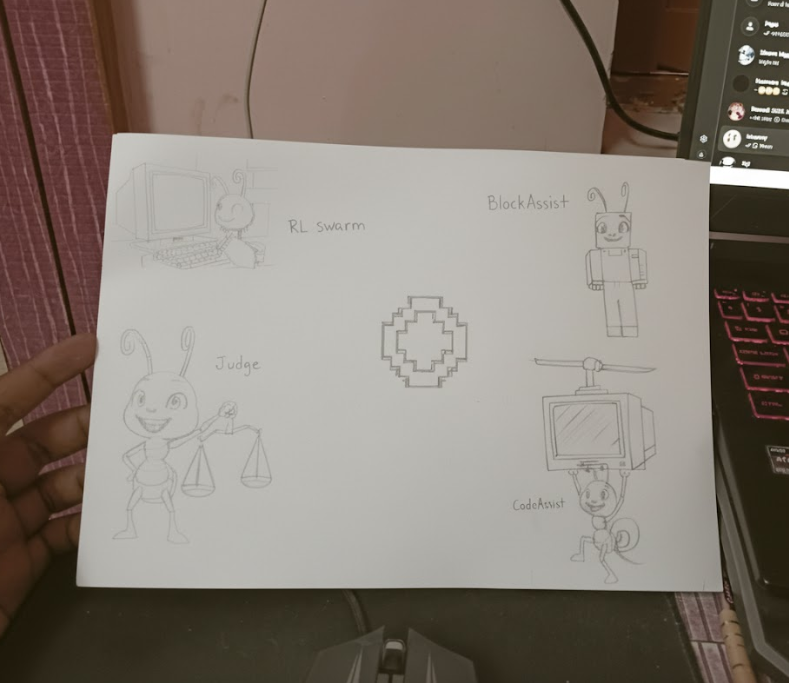
Products of @gensynai - not just AI tools, but the start of an AI civilization 🌍
🧠RL Swarm (GenRL Backend)
GenRL is a new Reinforcement Learning (RL) framework where AI agents learn through trial and error. It focuses on multi-agent environments, where multiple agents work together, interact, and learn from each other. GenRL is not centralized there's no "boss." Each agent learns independently and can communicate with others. DataManager (manages data), RewardManager (sets rewards), Trainer (trains agents), and GameManager (connects and runs everything). Simply put GenRL is a world where agents learn to work, play, and learn together in a completely custom, open, and scalable way
🎮 BlockAssist
BlockAssist is an AI Minecraft assistant that learns from you by observing your gameplay. As you place blocks or build structures in Minecraft, this assistant understands from your actions what a person wants to build or accomplish. It uses a technique called "Assistance Learning," where the AI automatically infers your goal without any manual labeling or preset rewards. For example, if you're building a house, it will observe your movements to understand that you're building a structure and learn to help accordingly. After each game session, this AI uploads its model to Hugging Face, where your progress is tracked on the Gensyn network. Simply put, BlockAssist is a smart game partner that, as you play Minecraft with you, learns to understand your preferences, your playstyle, and your goals and gets better each time.
⚖️ Judge (with Verde)
Judge is a system that evaluates AI models in an objective and verifiable way meaning it checks which models are thinking correctly, and with cryptographically verified proof (no cheating). Most AI evaluations happen over closed APIs opaque, updates hidden, and difficult to reproduce.
Judge changes the game making every evaluation transparent, traceable, and fully reproducible.
Behind this is the Verde system, which independently verifies every computation and reveals who actually did the right thing.
Simply put... Judge is the “AI judge” who tells models: “Just talking won't do, show proof.”
💻 CodeAssist
CodeAssist is an AI coding assistant that runs on your local machine and learns from your coding style. As you write code, it understands how you think, where you need help... and when to be quiet 😅
It runs on "Assistance Games" meaning the AI learns from humans without any direct feedback. The lines you add or delete are its signals as to whether "this was correct" or "this was not." All training happens locally no data is sent out. Gradually, it learns to suggest and work with your coding style.
Simply put CodeAssist is a partner that, as you code, becomes like you. 🤝💻
---------------------------------------------------------------
Together, they turn @gensynai into a decentralized brain
where agents train, assist, and get judged transparently,
all powered by open, permissionless compute. 🧠⚙️
dive into their blog - https://t.co/EpEQAwES5B

The @gensynai - Most AI runs behind walls. Hidden datacenters and Private clusters and Secret weights.
Gensyn flips that script. It’s building a network where anyone can train and verify and earn together. Not just code a movement toward open intelligence.
1. At the heart of it RL Swarm Thousands of small models reasoning and critiquing and learning collectively. Each node is a mind connected through trustless coordination proving that many small intelligences can outperform a few giant ones.
2. Instead of one lab running million dollar GPU Gensyn lets the world itself become the datacenter. Every contributor a part of the global AI brain and Every experiment verifiable and logged and transparent. Every reward earned not extracted.
3. Their framework and GenRL is pure engineering beauty. Four simple pieces DataManager and Reward Manager and Trainer and Game Manager working like organs in a living system. Together they let agents play argue and evolve openly.
4. Then there the AI Prediction Market Models betting on which answer they believe is right. learning from confidence not just accuracy. Early correct bets earn more like intelligence investing in itself.
5. And it not some closed prototype. The Gensyn Testnet is live Anyone can spin up a node Windows and macOS and Linux connect to the swarm. log in through Alchemy and watch your peer join the network in real time.
6. What makes it special is not just decentralization. it’s reproducibility and transparency and collaboration baked into the protocol itself. Open science and open compute and open learning. AI finally owned by the people who build it.
7. Gensyn is not trying to compete with the giants. It’s building a world where you do not need them. One node at a time and One experiment at a time. A collective mind learning together. #Gensyn #MachineLearning


Its structure is simple yet powerful. Developers can shape each level of the learning cycle
• The DataManager provides agents with relevant data for specific tasks, such as text, visual materials, or user input
• The RewardManager configures incentives and evaluation logic
Trends for you
Most Popular Users

Elon Musk 
@elonmusk
240.1M followers

Barack Obama
@barackobama
118.6M followers

Cristiano Ronaldo
@cristiano
114.4M followers

Donald J. Trump
@realdonaldtrump
111.7M followers

Narendra Modi
@narendramodi
106.9M followers

Rihanna
@rihanna
98.6M followers

NASA
@nasa
92.1M followers

Justin Bieber
@justinbieber
91.7M followers

KATY PERRY
@katyperry
89.9M followers

Taylor Swift
@taylorswift13
83.9M followers

Lady Gaga
@ladygaga
75.4M followers

Virat Kohli
@imvkohli
73.3M followers

Kim Kardashian
@kimkardashian
70.8M followers

YouTube
@youtube
68.6M followers

Neymar Jr
@neymarjr
66.3M followers

Bill Gates
@billgates
65.2M followers

Selena Gomez
@selenagomez
63M followers

The Ellen Show
@theellenshow
62.1M followers

CNN
@cnn
61.7M followers

X
@x
60.6M followers