

Top Tweets for #GenVM

1/ Studio: the machine.
A browser-based place to write and test Intelligent Contracts with real-time feedback. It runs the real GenVM with simulated consensus and nodes.
Goal: prove the machine itself can run.
1/ Studio: the machine.
A browser-based place to write and test Intelligent Contracts with real-time feedback. It runs the real GenVM with simulated consensus and nodes.
Goal: prove the machine itself can run.

@0X_CUPZ Does GenVM snapshot the DOM at execution time, or how does it ensure validators on opposite sides of the world evaluate the exact same web payload?

@0X_CUPZ Standard EVM execution is completely blind to natural language, so GenVM essentially gives blockchains the sensory organs they have lacked for ten years.

@0X_CUPZ Intelligent Contracts are only as reliable as the underlying parser; if a site goes behind a Cloudflare barrier mid-settlement, how does GenVM recover gracefully?

@0X_CUPZ Traditional VMs isolate the execution environment completely; letting GenVM touch live HTTP endpoints feels like a radical departure from classic blockchain security.

@0X_CUPZ GenVM is breaking determinism to handle subjective state is genuinely ballsy; if it works, it solves the oracle problem at the root.

@eam__sha yes, since GenVM reads the live web directly, validators can inspect URLs and timestamps

@_CrowleyAlex_ Totally agree, the shift from rigid deterministic code to parsing context and natural language via GenVM is key here. Standard smart contracts are simply blind to this

@glorykurofuo Agreed, verifying actual delivery based on live web data is the strongest element of the GenVM framework.
@WIXgjMd211o7Bsj Thanks! GenVM handling natural language is exactly what pulls blockchain out of its purely mathematical sandbox and into the real world.

@_CrowleyAlex_ Love how GenLayer builds a real‑world judicial layer for AI agents Internet Court and GenVM turn subjective disputes into decentralized, verifiable verdicts! 🌐⚖️✨
@_CrowleyAlex_ Love how GenLayer tackles the real friction point disagreements in AI commerce! Internet Court and GenVM bring human‑like dispute resolution to the blockchain. 🧠⚖️✨

@_CrowleyAlex_ Traditional blockchains can't parse hidden contract clauses, which is why GenVM’s ability to read natural language is a complete game-changer.

@0Success9 @GenLayer Genvm is designed to execution genlayer transactions and for non deterministic transactions

One of the important GenLayer technical updates on September 30 was around the GenVM stack
The official repos for GenVM Manager GenVM Executor and GenLayer Studio were updated
GenVM is basically the environment where Intelligent Contracts run with the contract code running inside a WebAssembly sandbox and controlled access to Web and LLM capabilities
What makes this interesting is the separation between execution and consensus
GenVM handles the contract execution while GenLayer’s consensus mechanism decides whether the resulting non deterministic output should be accepted
This separation is a key part of making AI native contracts run in a controlled and verifiable way across the network
@GenLayer



an aI model can give different answers to the same question. a live webpage can change between two requests.
once that information affects a contract, those differences need to be handled carefully. 👀
@GenLayer handles this through GenVM, the execution environment for intelligent contracts.
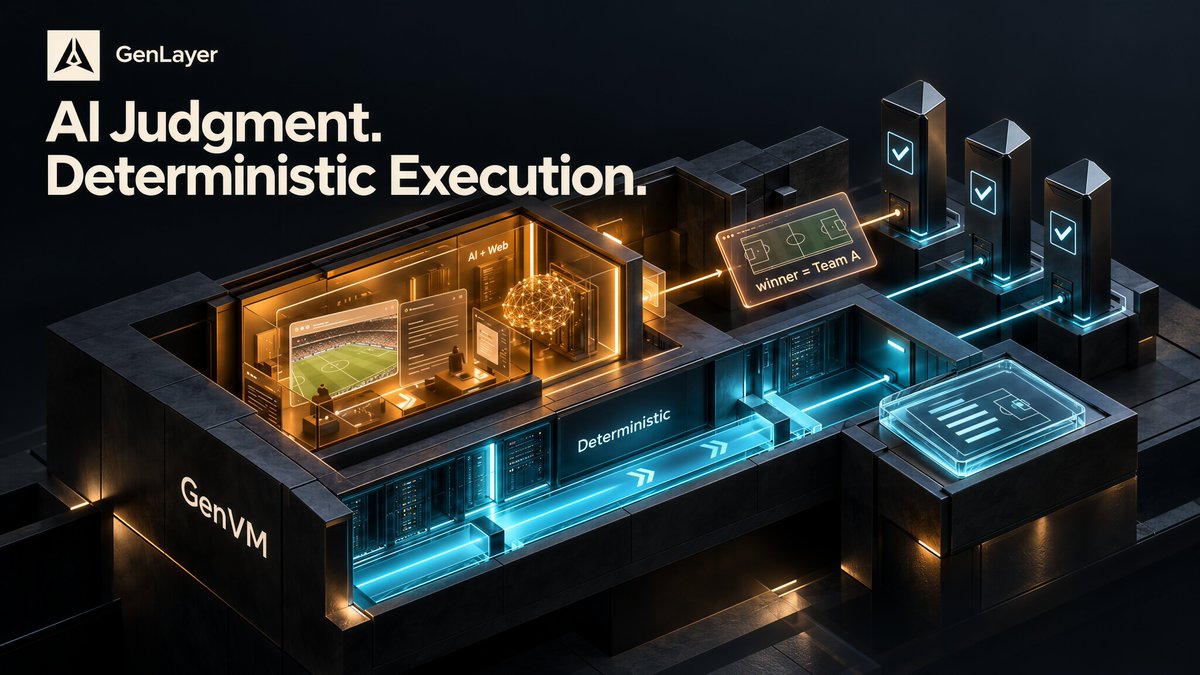
the main execution path stays deterministic.
given the same inputs and accepted outputs from non-deterministic blocks, validators must reproduce the same computation. Reading and updating contract state happens on this deterministic path.
GenVM runs the code inside a WebAssembly sandbox, with controlled access to the functions a contract can use.
when a developer needs web data or an LLM response, the contract opens a non-deterministic block.
this block runs in a separate VM instance with access to the relevant web and LLM functions. only its returned value passes back into the surrounding execution. Its temporary memory and side effects cannot directly spill into contract state.
~ that returned value still needs to be checked.
~ the leader produces a proposed output. Validators independently evaluate whether it satisfies the contract’s validation rule, known as the (equivalence principle).
~ the developer defines what must agree and what can vary. a contract might require an exact decision field while allowing the explanation around it to differ. validator consensus determines whether the execution receipt is accepted.
a football market makes this easier to picture.
imagine a contract resolving a market after a match. the non-deterministic block reads the result page and proposes a winner. Validators check the proposal against the evidence and the contract’s rules.
the surrounding deterministic code uses the accepted winner to update the market’s state.
two models might describe the match differently while agreeing on the field the contract needs:
winner = team a
the explanation can vary without changing which team gets recorded as the winner. This example follows the separation between evidence processing, validation and state updates described in the docs.
for a builder, this leaves a practical question to answer before writing the contract:
which parts of the result can vary, and which parts must every validator reproduce exactly?
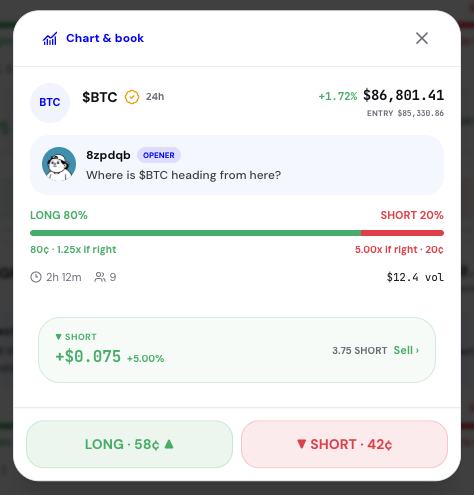
Tried @FUDmarkets on Solana and opened my first BTC SHORT.
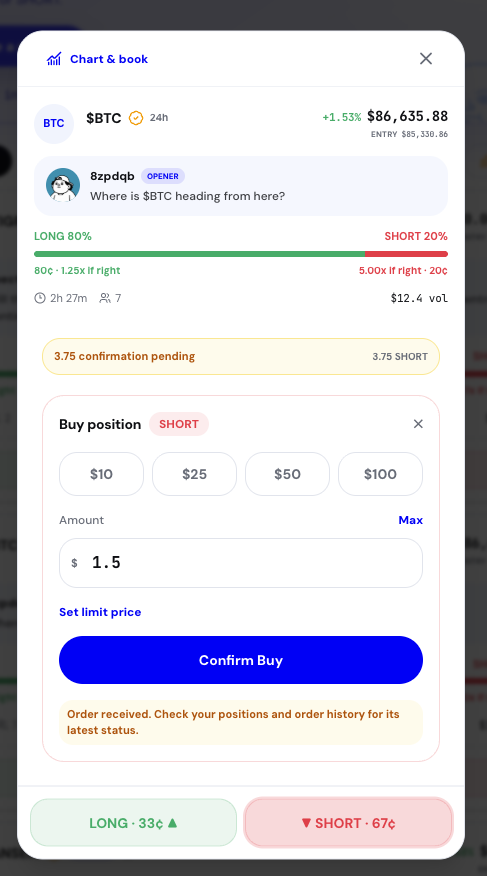
Deposited 5.9 USDC, put $1.50 into the position, and received 3.75 SHORT shares. The market was showing 80% LONG and 20% SHORT at the time.
The layout is easy to follow. I liked having the market split and time remaining visible, with my balance, positions, and P&L neatly organised on the profile page.
My main frustration was the waiting - first for the deposit to appear, then for the trade to move from “confirmation pending” to confirmed.
@GenLayer @FUDmarkets, this is where I’d love to see the experience improve. While funds or an order are pending, the app should explain what stage it’s at and what I’m waiting for.
My position eventually showed as confirmed on Solana. Faster updates and clearer progress along the way would make me more comfortable placing another trade.


Intelligent Contracts run inside GenVM, a sandboxed runtime. Deterministic operations are reproducible across nodes. Non deterministic operations, such as web reads or model calls, are allowed but logged and constrained.
GenLayer is building the infrastructure for AI agents step by step
GenVM provides the execution environment for Intelligent Contracts while GenVM Executor plus the GenLayer JS and Python tooling keep evolving alongside the rest of the developer stack
GenLayer Studio is also getting regular updates around consensus transaction handling and developer tools
Agent Tank has now shipped 200+ projects giving builders a real place to build test and experiment with applications for the agentic economy
What makes GenLayer interesting is that it’s not just another execution layer for Intelligent Contracts
From execution and consensus to SDKs developer tools and testing environments GenLayer is building out the different pieces needed to actually build on the protocol
And at the consensus level GenLayer is designed to handle non deterministic execution through validators while giving users a way to challenge and resolve disputed outcomes
@GenLayer


@jaymieolamide @GenLayer With GenVM, contracts can work with information from the public web and AI models, while validators independently evaluate the result.
Good tek


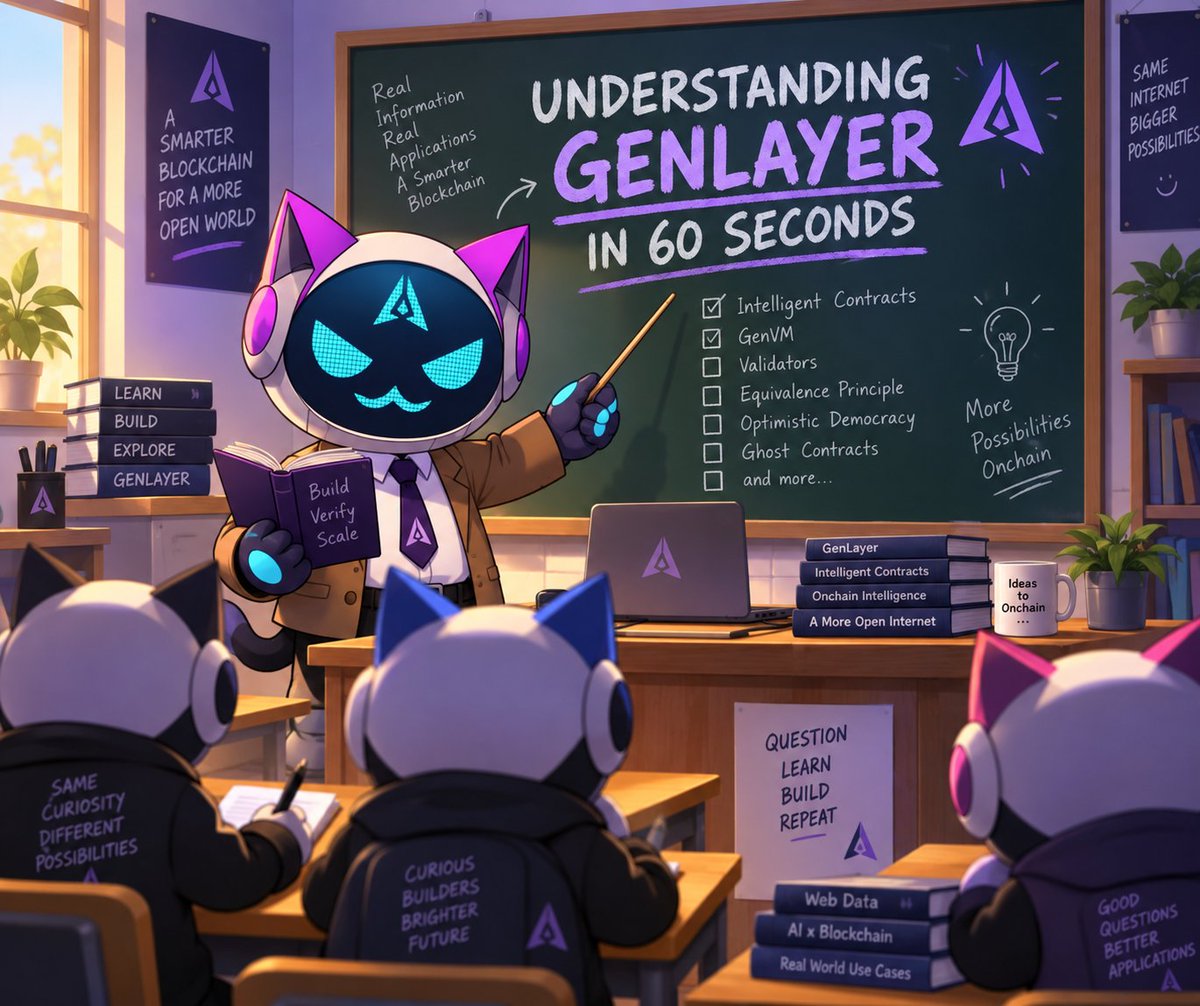
𝗨𝗡𝗗𝗘𝗥𝗦𝗧𝗔𝗡𝗗𝗜𝗡𝗚 𝗚𝗘𝗡𝗟𝗔𝗬𝗘𝗥 𝗜𝗡 60 𝗦𝗘𝗖𝗢𝗡𝗗𝗦
I noticed that a lot of newcomers find it difficult to understand some of the key concepts behind @GenLayer .
Not just what GenLayer does, but how Intelligent Contracts, GenVM, Validators, the Equivalence Principle, Optimistic Democracy, Ghost Contracts, and other components fit together.
So I decided to break it down as simply as possible.
Let’s start from the top.
1. 𝙄𝙣𝙩𝙚𝙡𝙡𝙞𝙜𝙚𝙣𝙩 𝘾𝙤𝙣𝙩𝙧𝙖𝙘𝙩𝙨
Traditional smart contracts rely on deterministic execution, where every node must arrive at the same result.
GenLayer introduces Intelligent Contracts, which can work with web content, natural language, LLM outputs, and other non-deterministic inputs.
They are written in Python and executed through GenVM.
2. 𝙂𝙚𝙣𝙑𝙈
GenVM is the execution environment for Intelligent Contracts.
It runs contracts in a WebAssembly sandbox and separates deterministic operations from non-deterministic ones, such as web access and LLM calls.
The latter are then handled through GenLayer's validation process.
3. 𝙉𝙤𝙣-𝙙𝙚𝙩𝙚𝙧𝙢𝙞𝙣𝙞𝙨𝙩𝙞𝙘 𝙊𝙥𝙚𝙧𝙖𝙩𝙞𝙤𝙣𝙨
This is where things get interesting.
Imagine a contract asking:
“Is this product authentic based on information available online?”
Different validators could receive different web data or LLM responses.
GenLayer doesn't require every response to be identical. Instead, it defines how those results should be evaluated.
That's where the Equivalence Principle comes in.
4. 𝙏𝙝𝙚 𝙀𝙦𝙪𝙞𝙫𝙖𝙡𝙚𝙣𝙘𝙚 𝙋𝙧𝙞𝙣𝙘𝙞𝙥𝙡𝙚
Validators don't necessarily need to produce the exact same output, but they need to agree on the decision-bearing properties defined by the contract.
For example, validators could give different explanations but agree:
𝙖𝙪𝙩𝙝𝙚𝙣𝙩𝙞𝙘 = 𝙩𝙧𝙪𝙚
If that is what the contract cares about, the results can be considered equivalent.
5. 𝙏𝙝𝙚 𝙇𝙚𝙖𝙙𝙚𝙧
For an Intelligent Contract transaction, a validator is selected as the leader.
The leader executes the transaction in GenVM and proposes the result.
However, the leader doesn't decide the outcome alone.
6. 𝙑𝙖𝙡𝙞𝙙𝙖𝙩𝙤𝙧𝙨
A committee of validators evaluates the leader's proposal.
They independently verify the deterministic execution and the non-deterministic outputs according to the contract's rules.
Their votes determine whether the proposal is accepted.
7. 𝙊𝙥𝙩𝙞𝙢𝙞𝙨𝙩𝙞𝙘 𝘿𝙚𝙢𝙤𝙘𝙧𝙖𝙘𝙮
Optimistic Democracy is GenLayer's mechanism for reaching agreement on Intelligent Contract outcomes.
A leader proposes, validators evaluate, and if the required majority accepts the result, it moves forward.
The system also allows results to be challenged through an appeal process.
8. 𝙂𝙚𝙣𝙇𝙖𝙮𝙚𝙧 𝘾𝙝𝙖𝙞𝙣
The GenLayer Chain coordinates the process, handling things like:
→ Transaction ordering
→ Validator assignments
→ Proposals and votes
→ Appeals
→ Fees
→ Final outcomes
GenVM handles execution, while the chain coordinates consensus.
9. 𝙂𝙝𝙤𝙨𝙩 𝘾𝙤𝙣𝙩𝙧𝙖𝙘𝙩𝙨
Finally, there's the Ghost Contract.
Every Intelligent Contract has a corresponding Ghost Contract on the EVM side at the same address.
It acts as a bridge between the EVM environment and the Intelligent Contract running in GenVM.
So, at a high level:
User
↓
Ghost Contract
↓
GenLayer Chain
↓
Validators
↓
GenVM
↓
Intelligent Contract
↓
Web / LLM / External Information
The result then goes through the validation and consensus process before becoming authoritative.
That's the bigger idea behind GenLayer.
It isn't simply about putting an LLM inside a blockchain, it's about creating a system where non-deterministic information can be evaluated and brought to consensus.
Once you understand these pieces, the GenLayer architecture becomes much easier to understand.
This is 𝙂𝙚𝙣𝙇𝙖𝙮𝙚𝙧 𝙞𝙣 60 𝙨𝙚𝙘𝙤𝙣𝙙𝙨.

A strong system isn't protected by one wall.
@GenLayer isn't one codebase either.
Consensus contracts, validator nodes and GenVM each have their own responsibilities, but real security starts when all of those pieces can work together without the seams becoming the weak point.
That's the part of this security series I find most interesting:
You can test every component perfectly in isolation and still ship a broken system if the interfaces between them fail.
So the goal isn't just secure code.
It's a stack where every layer checks the next, every boundary is tested, and failure has fewer places to hide.
Building the agentic economy will require intelligence.
Keeping it alive will require engineering discipline
@RuzgarFlns


Last Seen Hashtags on Sotwe
Most Popular Users

Elon Musk 
@elonmusk
239.8M followers

Barack Obama
@barackobama
118.6M followers

Cristiano Ronaldo
@cristiano
114.3M followers

Donald J. Trump
@realdonaldtrump
111.7M followers

Narendra Modi
@narendramodi
106.9M followers

Rihanna
@rihanna
98.6M followers

NASA
@nasa
92.1M followers

Justin Bieber
@justinbieber
91.7M followers

KATY PERRY
@katyperry
89.9M followers

Taylor Swift
@taylorswift13
83.9M followers

Lady Gaga
@ladygaga
75.4M followers

Virat Kohli
@imvkohli
73.3M followers

Kim Kardashian
@kimkardashian
70.8M followers

YouTube
@youtube
68.6M followers

Neymar Jr
@neymarjr
66.3M followers

Bill Gates
@billgates
65.1M followers

Selena Gomez
@selenagomez
63M followers

The Ellen Show
@theellenshow
62.1M followers

CNN
@cnn
61.7M followers

X
@x
60.6M followers