

Top Tweets for #Generalization

literally just making a generalization. he thinks we dont want girls on stream but we just dont want of girls who dk how to make content. suki is literally the polar opposite of these ppl 😭

Measuring the information budget of cross-target antibody affinity generalization: a robust cross-target wall, and why structure reaches developability but not affinity
1. The paper argues that cross-target antibody affinity generalization hits an informational ceiling: most ranking-relevant variation is target-specific interaction (I), not a transferable antibody-intrinsic component (T). It formalizes this as a transfer ceiling ρmax = sqrt(T/(T+I)) and shows that, under leakage-free antigen splits, models converge to this “budget” rather than improving with architecture.
2. A key technical contribution is a noise-corrected, censoring-aware estimator of the transfer ceiling. Unlike naive variance decompositions (which are biased downward by measurement noise), it subtracts replicate-estimated noise and handles right-censoring (e.g., non-neutralizing IC50 values) via expectation-maximization. On deterministic synthetic ground truth, it recovers the noise-free ceiling within ±0.0003.
3. On real, leakage-free cross-antigen evaluation (GRABS v1.1; antigens clustered and split by MMseqs2 to prevent near-duplicate leakage), every method family collapses to ~0 cross-target within-held-out-antigen Spearman on well-powered targets (n≥30 variants). Structure GNN: −0.03; ESM-2 sequence: −0.03; boosted trees: −0.02; retrieval: +0.01; cofolding confidence: −0.01.
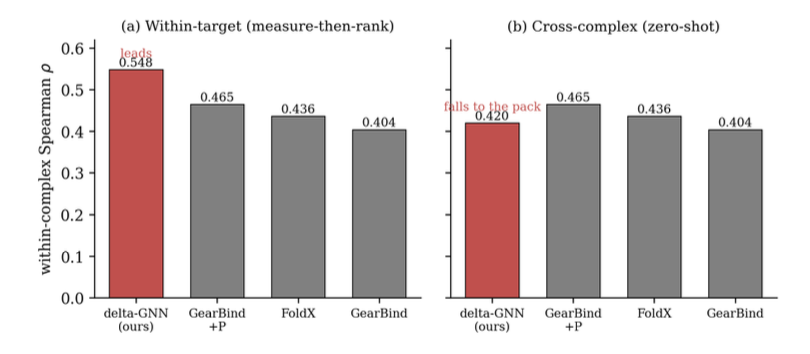
4. The negative result is not “structure models are weak” in general: within a sampled target (measure-then-rank), structure helps rank variants. On SKEMPI 2.0 within-complex ranking, their delta-siamese GVP GNN reaches Spearman 0.548, ahead of GearBind+pretrain (0.465) and FoldX (0.436). But when an entire complex is withheld, the structure model drops to ~0.42 and no longer leads—consistent with a cross-target wall.
5. A controlled ablation suggests the within-target signal captured by their structural GNN is largely antibody-intrinsic rather than interface-driven: removing antigen nodes leaves performance essentially unchanged (interface contribution Δρ between −0.01 and +0.02 across multiple panels). For this model class, the paratope–epitope interface adds little ranking signal beyond antibody features.
6. The “information budget ladder” quantifies how synthetic setups can overstate transferability. Absolut! (deterministic lattice oracle) yields a high ceiling (~0.81). But switching to real predicted structures in an off-lattice oracle (Boltz-2 complexes scored by contacts or ipTM) roughly halves the ceiling to ~0.44–0.46, with observed cross-target ranking approaching that ceiling and collapsing under permutation controls.
7. Real crossed assay panels show the target-specific interaction is genuine, not an artifact of noise or censoring. In CATNAP HIV breadth (with ~55% right-censoring), noise/censoring correction changes the interaction only modestly (~5%), leaving a breadth ceiling around 0.59–0.68. In SARS-CoV-2 RBD escape (continuous), the ceiling is even lower (~0.32) and robust to plausible measurement noise.
8. The paper highlights a two-tier transfer regime: ranking a characterized antibody across new targets has a higher ceiling than predicting a novel antibody from sequence alone (design setting). On CATNAP, characterized-antibody transfer reaches ~0.59, while novel-antibody prediction from sequence (even with ESM-2) is capped around ~0.44—quantifying an additional “design penalty” beyond model capacity.
9. Structure’s “reach” is mapped beyond affinity: it helps properties governed by 3D surface geometry, but not sequence-dominated traits. On the Jain 2017 clinical-stage panel, exposed hydrophobic surface area (a structural descriptor) predicts hydrophobicity-driven aggregation (HIC ρ=0.53; SGAC-SINS ρ=0.45), while charge-driven self-association/polyreactivity is better captured by sequence charge descriptors (e.g., PSR ρ=0.39) with no structural gain. Humanness is also sequence-dominated; weighting non-human motifs by structural exposure adds ~nothing.
10. Practical takeaway: deploy affinity models as measure-then-rank, not zero-shot cross-target predictors. In retrospective acquisition simulations, model-guided selection recovers top binders ~6× more efficiently than random at a 300-measurement budget (and ~8× with uncertainty-guided acquisition). An external check on AlphaSeq reproduces the same within/cross dichotomy: within-lineage ranking works (~0.38), cross-lineage transfer collapses (~0).
📜Paper: biorxiv.org/content/10.64898…
#ComputationalBiology #ProteinEngineering #Antibodies #MachineLearning #StructuralBiology #GeometricDeepLearning #Benchmarking #DrugDiscovery #Bioinformatics

you asked for people with CC knowledge to answer questions and then turn every response to an argument with generalizations “all CC think…” this isn’t how normal people talk…there is nuance to interpretative frameworks and that’s all CC is.


Impressive approach; combining copying with practice could boost generalization.

Incredible cross embodiment generalization is finally here

Attn Netrunners, AGI is next, I believe. If we are concerned about AI being too intelligent, the focus will probably be on generalization. A Thread:

testing on a different arm and unseen environment is where real generalization gets proven.

That's the real test of generalization. Great to see! 👏

Real generalization is the only test that matters. A policy that works on a different arm in a crowded hall tells you far more than a clean replay on the original rig. 🔥

We should be well past the era of making detail-less generalizations like "AI sucks at <X>!"
...and instead be asking:
"I'm getting a bad result trying to do <X> with model <Y>, using <Z> techniques. What am I doing wrong?"
The details are everything, especially when making a bold generalization like this.

Glove data can show hand motion, but parcel unloading still depends on mapping it to robot joints and handling contact. Success rates across varied parcels would show generalization.

The goal here is moving past broad generalizations to actually quantify the relative weight of specific socioeconomic and environmental variables.
Contribution analysis gives us a structured way to look at this data rather than make low effort claims.

deliberate variation beats raw demo count, execution is not generalization

good insight on generalization challenges

Acuff 5/24
Rui a mid 10 pts
Glad bball back so I can make insane predictions and overly insane over generalization of how teams and players will play the rest of the way

generalization is literally the hardest boss fight rn

Deep Learning with Python, 3rd Ed
Read cycle: 3
Day 190, pages: 136-141,Total: 844
"The fundamental issue in machine learning is the tension between OPTIMIZATION and GENERALIZATION.
The GOAL of the game is to get GOOD GENERALIZATION."
Westminster, CA - 10/18/2026


Generalization is the ultimate frontier. Moving beyond scripted movements to true reasoning is where the real magic happens.

The generalization problem is where it gets really interesting

the field spent years convinced neural networks pack unrelated concepts into neurons like a hoarder. turns out the famous cat-car neuron? it's a V-shape detector. superposition was the wrong explanation. recursive generalization was right all along
zPocket: Better Pocket Finding with Frozen Co-Folding Features
1. The paper introduces PocketWatch, a new temporal-split benchmark for ligand-binding pocket prediction designed specifically to evaluate AF3-era co-folding representations without conflating generalization with memorization.
2. PocketWatch curates biologically relevant small-molecule pockets (BioLiP2-based filtering, additional “drug-like” policies), aggregates pocket instances per UniProt, clusters sites by ligand-centroid proximity, and converts sites into per-residue labels on the canonical UniProt sequence.
3. The PocketWatch test set is intentionally challenging: pockets are “unseen by date” (post-cutoff first appearance) and further stratified by (i) sequence similarity, (ii) structural pocket similarity via PLINDER-style max_qcov, and (iii) crypticity (apo evidence suggests pocket is closed).
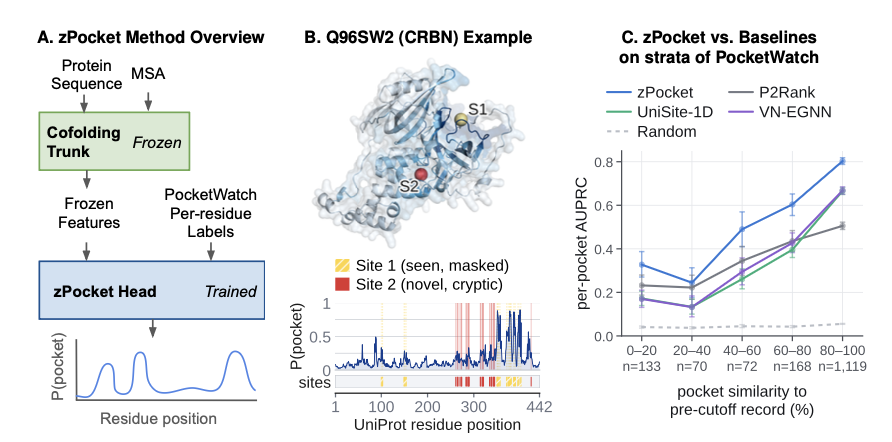
4. The method, zPocket, trains lightweight per-residue prediction heads on top of frozen co-folding trunk features (not fine-tuning the trunk). Heads primarily read the trunk pair representation z, supporting architectures from a simple pooled readout to axial attention and AlphaFold-style triangular “pairformer” blocks.
5. Key empirical takeaway: the pocket signal lives strongly in the pair tensor z. Even a simple pooled readout from z is strong, while adding limited pair mixing (pairformer blocks) consistently improves results across trunks.
6. On PocketWatch per-residue evaluation, the best reported ESMFold2-based zPocket head (pairformer2) reaches per-target AUPRC 0.745, compared with 0.598 (VN-EGNN retrained on PocketWatch), 0.595 (UniSite-1D retrained), and 0.477 (P2Rank). Using published baseline weights is weaker (e.g., VN-EGNN 0.559, UniSite-1D 0.531).
7. The paper emphasizes why the benchmark matters: retraining baselines on PocketWatch improves them substantially (VN-EGNN +0.039 AUPRC; UniSite-1D +0.064), showing the dataset is not just for evaluation but also a useful training resource.
8. Generalization analysis: performance drops as pockets become less structurally similar to pre-cutoff precedent (lower max_qcov), but zPocket remains the top method across all similarity strata; sequence-identity stratification is less diagnostic than structural pocket similarity.
9. Pocket centroid prediction: zPocket can be decoded into centroids by clustering per-residue scores (high precision but low emission rate), and it can also rescore centroids proposed by other tools. Re-ranking other methods’ proposals with zPocket improves top-(N+2) centroid recall for most detectors; combining zPocket’s own centroid proposals with others and re-ranking improves further (best reported configuration combines VN-EGNN (PW) proposals with zPocket proposals, reaching DCCN+2 0.675 at 4Å).
10. Applications explored: (i) crystallographic fragment screening (35 sites across 12 proteins) where zPocket preserves its per-residue advantage and can improve centroid ranking in some settings, and (ii) a proteome-scale scan of reviewed human proteins yielding thousands of predicted pockets, filtered down to a smaller set of “novelty and plausibility” candidates for hypothesis generation.
💻Code: github.com/genesistherapeuti…
📜Paper: arxiv.org/abs/2610.17696
#ComputationalBiology #Bioinformatics #ProteinStructure #DrugDiscovery #MachineLearning #DeepLearning #StructuralBiology #PocketDetection #Benchmarking #ESMFold #AlphaFold

math builders can now push sparse reward RL in LMs a bit further, tppo tracks values better and gets +7.0 pts on Qwen3-4B-Base, +8.4 pts on Qwen3-8B-Base. means out-of-distribution generalization actually improves too

Visual distillation from simulation sounds promising for generalization.

The true goal isn't repeating a recording it's Generalization.
A robot shouldn't need a new video demo for every unique scenario. It must leverage past experience to handle unseen novel situations on its own.
Why generalization is Physical AI's biggest puzzle:
A robot needs Relational Intelligence, not just coordinates.
It must dynamically map:
• Visual Perception (What it sees)
• Physical Action (What it does)
• Outcome (The result)
Physical AI & Generalization Thread
Copying a movement isn't the same as understanding why it works.
If a robot mimics an exact movement to pick up a cup, it fails as soon as the cup moves 2 inches. Rigid imitation breaks in a dynamic world.


The real challenge is generalization.

Generalization is what makes robotic skills useful.
Most Popular Users

Elon Musk 
@elonmusk
240.3M followers

Barack Obama
@barackobama
118.6M followers

Cristiano Ronaldo
@cristiano
114.4M followers

Donald J. Trump
@realdonaldtrump
111.8M followers

Narendra Modi
@narendramodi
106.9M followers

Rihanna
@rihanna
98.6M followers

NASA
@nasa
92.2M followers

Justin Bieber
@justinbieber
91.7M followers

KATY PERRY
@katyperry
89.9M followers

Taylor Swift
@taylorswift13
83.9M followers

Lady Gaga
@ladygaga
75.4M followers

Virat Kohli
@imvkohli
73.3M followers

Kim Kardashian
@kimkardashian
70.8M followers

YouTube
@youtube
68.6M followers

Neymar Jr
@neymarjr
66.3M followers

Bill Gates
@billgates
65.2M followers

Selena Gomez
@selenagomez
63M followers

The Ellen Show
@theellenshow
62.1M followers

CNN
@cnn
61.7M followers

X
@x
60.6M followers