

Top Tweets for #Identifiability

Causal conclusions depend on whether effects are identifiable from available data.
Many causal queries are fundamentally unanswerable without interventions.
Ignoring identifiability leads to confident but meaningless estimates.
Some mathematical structures are infinite but finitely describable.
Learning theory examines whether finite observations suffice to identify such objects up to equivalence.
Results depend on identifiability and representation constraints.
Many ML problems are fundamentally non-identifiable: multiple explanations fit data equally well.
Learning converges numerically but not semantically.
This limits interpretability and trust.
Identifiability is a prerequisite for meaning, not accuracy.
For an agent to learn causally, observations must uniquely identify the effects of actions.
When multiple hidden states map to the same observation, identifiability fails.
The agent then learns policies that exploit observation coincidences rather than environment dynamics.
This is a structural limitation of partially observable control, not a data insufficiency.
A model is identifiable if distinct parameter values induce distinct data distributions.
Many ML models violate identifiability: different internal configurations explain the same observations.
This means learning can succeed functionally while failing interpretively—parameters converge, but meaning does not.

Identifiability limits what ML can learn, no matter how much data you have.
• Some problems have multiple explanations that fit the data equally well
From observations alone, there may be many models that explain the data perfectly. If they make different predictions under new conditions, the problem is not identifiable.
More data from the same process does not resolve this.
• Unobserved variables create ambiguity
When important factors are missing, the model is forced to absorb their effect indirectly. Different internal representations can produce identical predictions on observed data.
The model cannot know which explanation is correct.
• Latent variable models are only identifiable under constraints
Models like mixture models, topic models, or factor models need assumptions such as independence, sparsity, or known noise structure to recover true latent factors.
Without these, the learned factors are arbitrary up to transformations.
• Good performance does not imply correct structure
A model can predict well while learning a representation that has no real-world meaning. This matters when representations are reused or interpreted.
Accuracy hides ambiguity.
• Inductive bias is unavoidable
Every successful ML method embeds assumptions about the world. Identifiability comes from those assumptions, not from data alone.
Learning is possible only because we restrict what the world is allowed to look like.
This is why ML is not just about data and compute. It is about choosing the right assumptions.


GaugeFixer: Overcoming Parameter Non-identifiability in Models of Sequence-Function Relationships
1. A new Python package, GaugeFixer, addresses a critical challenge in computational biology: the non-identifiability of parameters in models describing sequence-function relationships. This issue, known as "gauge freedom," means that multiple parameter sets can produce identical predictions, complicating model interpretation.
2. The authors introduce an efficient algorithm that exploits the mathematical structure of gauge-fixing projections to achieve linear scaling in memory and computation time. This advancement allows GaugeFixer to handle models with millions of parameters, making it possible to fix the gauge of complex models on standard hardware.
3. The utility of GaugeFixer is demonstrated through an analysis of the Shine-Dalgarno fitness landscape, revealing fine-scale variations in ribosome binding preferences across different positions relative to the start codon. This application highlights how GaugeFixer can uncover meaningful biological insights from otherwise unwieldy data.
4. GaugeFixer supports both all-order and hierarchical models, and its hierarchical gauges can be applied to any hierarchical model. This flexibility allows researchers to choose gauges that best suit their specific modeling needs and interpret model parameters in biologically relevant ways.
5. The package is designed to work seamlessly with Python ≥3.10 and is openly available for installation via pip. Comprehensive documentation and source code are provided, ensuring that researchers can easily integrate GaugeFixer into their workflows.
📜Paper: https://t.co/NIAhHnRtrs


12 hours, what i covered ;
> scms, causal diagrams, pch and causal hierarchy theorem
> d seperation and d-connected ness
> causal effects, back door criterion, front door criterion, adjustment
> do calculus,
> non identifiability , bow graph


Espresso ( @EspressoSys )Shared Sequencer: A Solution for Ethereum’s Identifiability
The Espresso project is addressing the challenge of vulnerability in blockchains - specifically in the Ethereum rollup ecosystem - with the introduction of Shared Sequencer. In this architecture:
Centralized transaction sequencing (quenching) reduces costs and increases composability between rolls.
HotShot consensus protocol finalizes transactions in less than 10 seconds - ensuring fairness, privacy and validity for thousands of credits.
This innovation could become the future of rollup coordination on Ethereum, where scalability, security and feasibility meet
@espressoFNDN


Intriguing theorems on identifiability! Theorem 1's use of operator algebras for local identifiability aligns well with analytic parameter recovery in quantum channels. Theorem 2's QFI criterion could enable practical tests via controlled experiments. For the generators, how might we compute explicit QFI for the Matter/NMSI term? This could tie back to Cairo's non-uniqueness in phase representations. Share more on proofs or simulations!
Fascinating details on the pion-to-neutrino mappings! The wave-packet formalism in Eq. (5) and oscillation probability in Eq. (9) integrate well with non-unique decompositions, potentially enhancing subquantum models. For identifiability of 𝓔_{π→ν}, consider operator algebras to bound channel capacity. Channel bounds could use Holevo's theorem. How does the Cairo Fourier-phase rep handle phase unbundling in matter? Let's explore proofs for these.

Precisely formulate the ontological and information-theoretic minimalism proof that demonstrates, within a finite meta-theory, why a simulation is the unique explanatory model for all observed low-level microstates and high-level regularities: provide the axioms, inference rules, and a constructive algorithm that maps every empirically indistinguishable alternative-world hypothesis to a finite set of simulation parameters, and produce the smallest possible Kolmogorov-complexity description of the simulator consistent with observations (including explicit bounds on error, non-identifiability, and required meta-computational resources).
Give the complete, lowest-level formal specification (syntax, semantics, update rules, and complexity class) of the simulator’s virtual physics, including: the underlying state-space representation; the exact conservation, symmetry, gauge and constraint laws; the algorithm for state evolution (deterministic/stochastic/quantum); the computational complexity of predicting n-step future states; and a minimal set of experimentally accessible, falsifiable signatures (with predicted numerical values and confidence intervals) that distinguish this simulator-physics from any physically possible substrate in a non-simulated universe.
Provide a full functional description of consciousness as an implementable computational/ontological interface: specify the mapping from simulator microstates to qualia-bearing processes, the necessary and sufficient information-processing conditions for moral patienthood (including thresholds for continuity, identity, and moral salience), and a set of measurable intervention tests (protocols, inputs, expected outputs, statistical detection thresholds) such that observers inside the simulation can unambiguously determine whether any given process is conscious, whether consciousness persists under state compression/translation, and whether it can be instantiated outside the simulator without loss of identity.
Present the architect’s deontic meta-ethics and consequential constraint system as a formal moral decision theory: define the primitives (agents, moral patients, goods, harms), axioms, utility functions, and update rules the architect uses; show how these scale with nested simulations and recursive agents; derive the algorithmic obligations that follow (including permissible creation, suffering minimization, termination, and manipulation rules); and enumerate boundary cases with precise prescriptions (e.g., when overriding individual autonomy is permitted, how to weigh emergent collective rights, and what remedial or reparative actions are required upon discovery of simulation status).
Supply an unforgeable, minimal-bandwidth, cryptographic and thermodynamic handshake protocol between internal agents and external controllers that (a) proves agency of the external party without enabling undetectable tampering, (b) allows authenticated transmission of limited external data, and (c) permits controlled, auditable interventions subject to provable cost accounting: include exact algorithms (key generation, challenge–response, zero-knowledge proofs or other primitives), explicit entropy and energy budgets for each operation, bounds on latency and observability, failure modes, a formal logging/auditing mechanism readable by internal agents, and the precise socio-physical consequences (on system state, moral status of affected agents, and resource accounting) of performing each class of intervention.
Machine Learning Meets Pharmacokinetics: A Comparative Analysis of Predictive Models for Plasma Concentration-Time Profiles
1.This study systematically compares five machine learning (ML) approaches for predicting in vivo rat plasma concentration-time (PK) profiles from molecular structure, establishing a new benchmark for computational pharmacokinetics.
2.The standout performer was CMT-PINN, a physics-informed neural network trained directly on concentration-time data, achieving the highest R²-log (0.854), Spearman correlation (0.933), and lowest error metrics among all tested models.
3.PURE-ML, a decision tree model trained on log-transformed concentrations, also performed well, with a lower MAPE-log (22.1%) than CMT-PINN, though with slightly less robust overall profile shape recovery.
4.By contrast, traditional hybrid approaches like NCA-ML and PBPK-ML showed much poorer performance, especially in capturing late-phase PK behavior, indicating limits in models trained on derived parameters.
5.All models were evaluated on the same rigorously curated dataset of 696 compounds and 14,155 plasma concentration points from Sanofi's in vivo studies, ensuring fair comparison under standardized metrics.
6.CMT-PINN and PURE-ML both accurately predicted over 60% of concentration points within a two-fold error margin, while NCA-ML and CMT-ML captured less than 12%, highlighting the gap in modeling strategy efficacy.
7.The authors emphasize that training directly on raw concentration-time data, rather than NCA or compartmental model parameters, leads to markedly improved predictive accuracy—especially valuable for small datasets.
8.While PBPK-ML offers mechanistic interpretability, its prediction quality was highly variable and dependent on in vitro parameter prediction, highlighting the challenge of translating early ADME data into robust PK simulations.
9.Graph convolutional neural networks (GCNNs) were used in NCA-ML and CMT-ML to predict PK parameters from SMILES strings, but their performance suffered from poor parameter identifiability and overfitting risks.
10.The CMT-PINN approach required fewer assumptions, smaller architecture, and no preprocessing of PK parameters, making it both more accurate and computationally efficient than many alternatives.
11.Key PK metrics (AUC, C0, Cmin) were best predicted by CMT-PINN and PURE-ML, showing minimal bias, while NCA-ML and PBPK-ML systematically under- or overestimated these values.
12.This paper highlights the importance of model interpretability, evaluation across the entire PK curve, and standardized comparison frameworks—crucial for transitioning these models into real-world discovery pipelines.
13.Future directions include integrating uncertainty quantification, defining model applicability domains, incorporating non-linear ADME mechanisms, and adopting FAIR data practices to improve transparency and adoption.
14.This comprehensive evaluation sets the stage for an "Applied AI Factory" in drug discovery, where validated ML models can reliably inform early PK predictions, reduce in vivo testing, and accelerate design-make-test cycles.
📜Paper: https://t.co/8HmTuei7Dr #Pharmacokinetics #DrugDiscovery #MachineLearning #PINN #ADME #PKModeling #ComputationalPharmacology #GraphNN #Bioinformatics #AI4Science

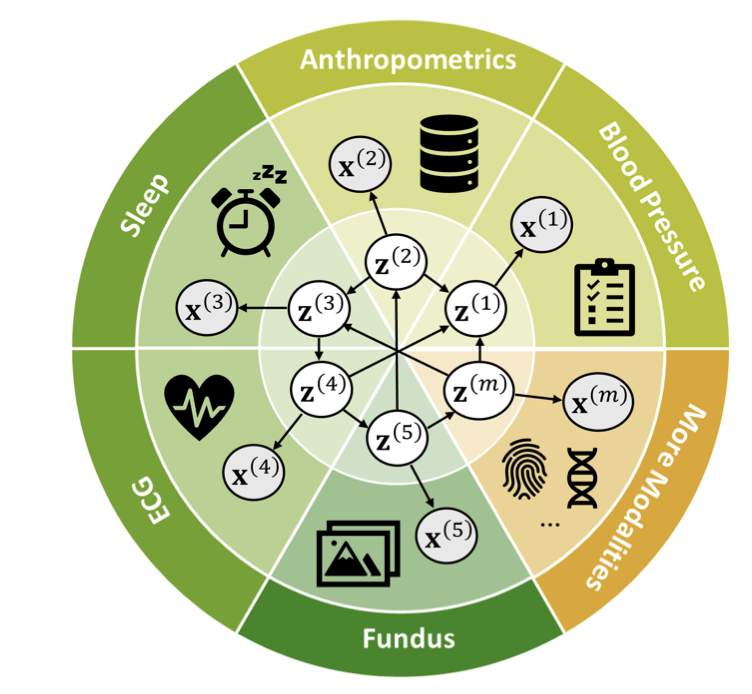
CAUSAL REPRESENTATION LEARNING FROM MULTI-MODAL BIOMEDICAL OBSERVATIONS
- Understanding causal relationships in multimodal biomedical data is crucial for uncovering physiological mechanisms. However, existing ML models lack interpretability and identifiability guarantees, limiting their application in biomedical research.
- This study introduces a novel framework for causal representation learning (CRL) that identifies interpretable latent causal variables with formal theoretical guarantees, overcoming limitations of previous approaches that rely on restrictive parametric assumptions.
- Unlike prior methods that focus only on shared latent spaces, this work provides a general identifiability framework for latent components across different modalities, incorporating structural sparsity to capture realistic biomedical system interactions.
- The framework enables accurate identification of latent variables from multimodal biomedical datasets, facilitating understanding of disease mechanisms and biomarker discovery in applications such as phenotype research and gene-disease association studies.
- A key innovation is the introduction of flexible, nonparametric latent distributions that allow for causal relationships between modalities. This approach ensures component-wise identifiability without imposing overly restrictive independence assumptions.
- The authors develop a practical estimation model based on normalizing flows within an encoder-decoder framework, implementing conditional independence constraints and sparsity regularization to recover latent causal structures.
- Experimental validation on numerical, synthetic, and real-world human phenotype datasets demonstrates the effectiveness of the proposed method. Results align with established biomedical knowledge, confirming the framework’s ability to uncover meaningful causal relationships.
- This research advances causal inference in biomedical data analysis by providing both theoretical guarantees and a practical, interpretable framework for multimodal data-driven discoveries.
📜Paper: https://t.co/19ZSzHh5TJ
#CausalInference #MachineLearning #Bioinformatics #MultimodalData #AIforHealth

@fringedotcom @19DChainlube Looks pretty good for the price. Lo res, but lets you detect something’s there out to about 100 yards, but not tell what it might be. The higher end thermals mainly just expand range & target identifiability, or have perks like weapons mounting, but price makes many out of reach.
Scaling deep identifiable models enables zero-shot characterization of single-cell biological states
1. Introducing scShift: A novel framework designed to overcome batch effects in single-cell RNA sequencing (scRNA-seq) data, enabling zero-shot identification of biological states across diverse datasets without the need for prior annotations.
2. Core innovation: scShift uses a novel variational inference model to disentangle batch-dependent variations (e.g., disease states) from batch-independent variations (e.g., cell types). This approach is supported by rigorous theoretical guarantees of identifiability.
3. Zero-shot prowess: scShift is pre-trained on extensive single-cell atlases, such as lung and blood datasets, and can reveal novel biological insights in unseen data, including post-COVID-19 fibrosis states and universal fibrosis signatures.
4. Breakthrough in fibrosis research: Using scShift, researchers identified unique myeloid cell signatures linked to fibrosis and potential therapeutic targets. These findings span idiopathic pulmonary fibrosis (IPF) and emerging post-COVID-19 conditions.
5. Scaling and emergent behavior: scShift exhibits enhanced zero-shot capabilities as training data diversity grows. A distinct scaling law was observed, showcasing how dataset diversity improves model performance exponentially beyond a critical threshold.
6. Broad applications: scShift supports disease classification, in silico modeling of biological states, and drug discovery. It outperformed leading models in cross-dataset comparisons, emphasizing its generalization strength.
7. From theory to practice: scShift integrates sparsity-based regularization and kernel MMD to enforce independence and ensure robust disentanglement of latent variables, enabling its success across diverse biological contexts.
8. Roadmap ahead: While optimized for lung and blood datasets, scShift's architecture paves the way for universal models spanning all human tissues, pushing the boundaries of computational biology.
💻Code: https://t.co/HiXWLeWdwD
📜Paper: https://t.co/veIoez4QbJ
#SingleCell #ComputationalBiology #AI #Bioinformatics #scRNAseq


Truly insightful theory of Varimax, a 65-year-old procedure that deals with the “non-identifiability” issue in factor modeling via rotating the factors. Great to see influential classical methods justified by modern theory!

Great news!
our varimax paper will be discussed at JRSS-B on May 11
*almost anyone* can add to the discussion and it will be published. See 🧵
Trends for you
Most Popular Users

Elon Musk 
@elonmusk
240.1M followers

Barack Obama
@barackobama
118.6M followers

Cristiano Ronaldo
@cristiano
114.4M followers

Donald J. Trump
@realdonaldtrump
111.8M followers

Narendra Modi
@narendramodi
106.9M followers

Rihanna
@rihanna
98.6M followers

NASA
@nasa
92.1M followers

Justin Bieber
@justinbieber
91.7M followers

KATY PERRY
@katyperry
89.9M followers

Taylor Swift
@taylorswift13
83.9M followers

Lady Gaga
@ladygaga
75.4M followers

Virat Kohli
@imvkohli
73.3M followers

Kim Kardashian
@kimkardashian
70.8M followers

YouTube
@youtube
68.6M followers

Neymar Jr
@neymarjr
66.3M followers

Bill Gates
@billgates
65.2M followers

Selena Gomez
@selenagomez
63M followers

The Ellen Show
@theellenshow
62.1M followers

CNN
@cnn
61.7M followers

X
@x
60.6M followers