

Top Tweets for #KnowledgeDistillation

HAD: Hybrid Architecture Distillation Outperforms Teacher in Genomic Sequence Modeling
1.A new compact model, HAD, distills knowledge from a 500M-parameter genomic transformer (NTv2) into a 1.1M-parameter hybrid student, outperforming the teacher on multiple benchmarks—challenging the belief that bigger is always better.
2.The key innovation is a dual-branch training scheme combining feature alignment (distillation) on visible tokens with masked nucleotide reconstruction. This design ensures the student learns both global biological context and fine-grained sequence grammar.
3.The student architecture is a hybrid of Gated Delta Net (GDN) and a self-attention layer. GDN efficiently handles local and long-range patterns with gating and delta rules, while attention ensures global sequence understanding.
4.HAD introduces a novel two-stage masking strategy. First, the teacher uses k-mer-level group masking, ensuring coherent biological context. Then, masks are mapped to nucleotide-level positions for the student, preventing information leakage during distillation.
5.To align representations, HAD downsamples and projects student outputs to match the teacher’s dimensionality, then minimizes MSE between visible token embeddings—a rare but effective strategy for genomic feature transfer.
6.Reconstruction is handled via a cross-attention decoder: masked positions query visible tokens to reconstruct the original sequence, promoting deeper understanding of DNA syntax.
7.Despite its tiny size, HAD surpasses NTv2 on 11 of 18 Nucleotide Transformer Benchmark tasks and five of eight Genomic Benchmark tasks, showing clear gains especially on histone markers and enhancer prediction.
8.Ablation studies confirm the necessity of both visible-token distillation and masked reconstruction. Removing either leads to substantial performance drops, demonstrating their complementary roles.
9.Teacher model size matters. Only the largest (500M) NTv2 model provides rich enough features for the student to truly benefit, reinforcing the value of pretraining quality over quantity.
10.t-SNE visualization shows HAD learns discriminative genomic features akin to its teacher, while models without visible-token distillation fail to form clear biological clusters.
11.Overall, HAD provides an efficient framework for scalable DNA modeling. It allows small models to learn from large ones without losing the biological richness needed for downstream tasks.
📜Paper: https://t.co/AZH02C8NAt #Genomics #AI #DeepLearning #Transformer #KnowledgeDistillation #DNA #Bioinformatics

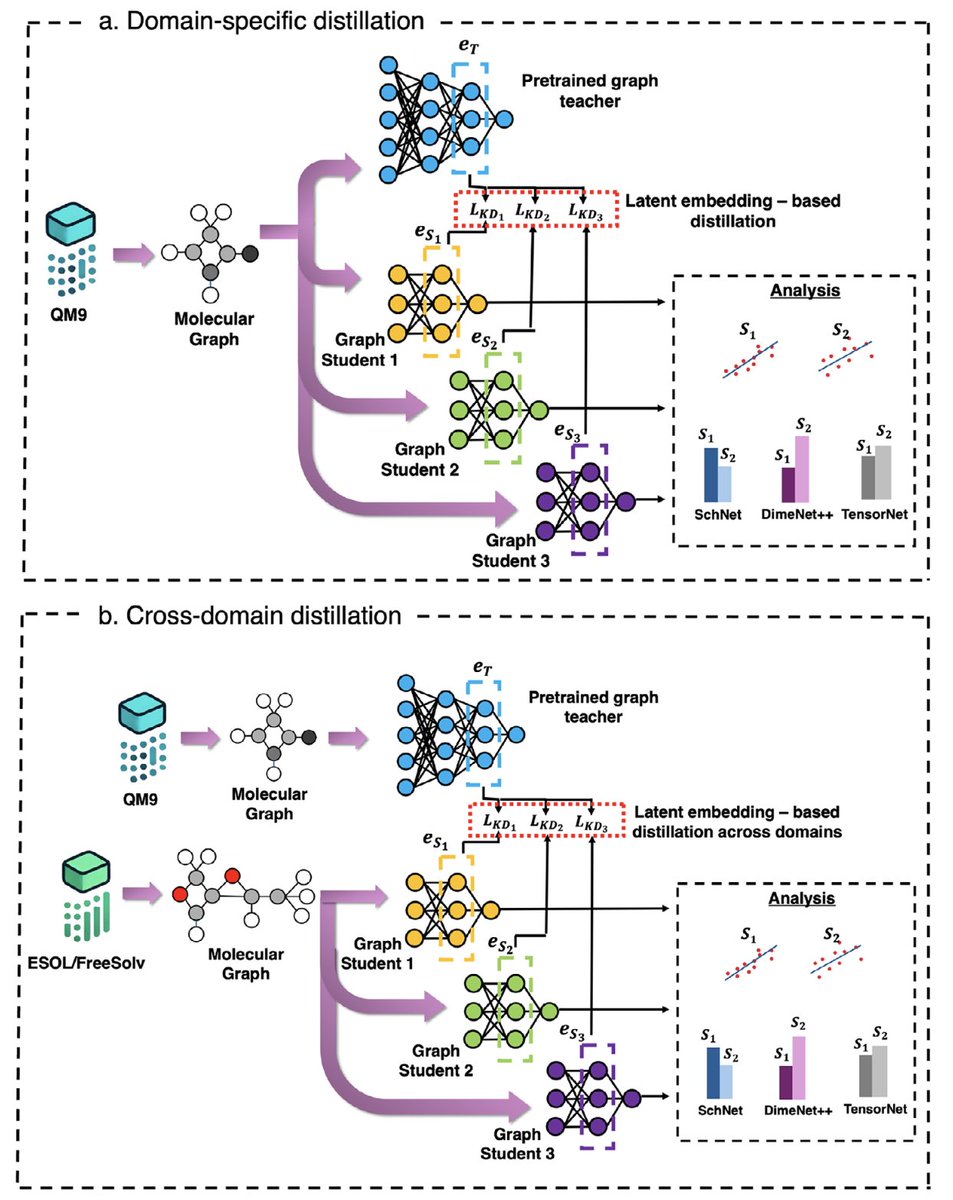
Knowledge Distillation for Molecular Property Prediction: A Scalability Analysis
1. This study presents a comprehensive framework for applying knowledge distillation (KD) to molecular property prediction, achieving up to 70% improvement in R² for regression tasks while reducing model size and training time.
2. KD enables compact student models (up to 2x smaller) to match or exceed the performance of complex teacher models across quantum datasets (QM9) and experimental benchmarks (ESOL, FreeSolv), demonstrating its effectiveness in both domain-specific and cross-domain settings.
3. Across three GNN architectures—SchNet, DimeNet++, and TensorNet—KD consistently improved embedding alignment and predictive accuracy, especially for complex properties like atomization energy and solubility.
4. In the QM9 domain-specific setup, DimeNet++ showed up to 90% R² gain for simpler quantum properties with smaller students, while SchNet exhibited the largest gains for complex properties using larger student models.
5. Cross-domain transfer from QM9-trained teachers to experimental datasets like ESOL (logS) and FreeSolv (ΔGhyd) showed that KD helps bridge distributional gaps between theoretical and empirical data, with SchNet achieving ~65% R² gain on solubility prediction.
6. Embedding analysis revealed significantly improved cosine similarity between student and teacher embeddings under KD, confirming successful knowledge transfer and structural representation learning across models and datasets.
7. KD particularly enhances generalization to non-QM9-like molecules—those with atoms or motifs absent from QM9—indicating its utility for drug-like or chemically diverse compounds.
8. The framework uses a combined MAE and cosine similarity loss with learnable uncertainty weighting, ensuring task-adaptive optimization without manual tuning.
9. Compared to pruning or transfer learning, KD provides a structured and robust approach to model compression, preserving critical chemical knowledge while enabling faster inference—crucial for high-throughput screening.
10. This work highlights KD's scalability for molecular regression, its compatibility with modern architectures, and its potential role in future few-shot and transformer-based molecular modeling applications.
💻Code: https://t.co/6CFmNkF12L
📜Paper: https://t.co/ZZOBYZZeKe
#MolecularPropertyPrediction #KnowledgeDistillation #GraphNeuralNetworks #Cheminformatics #DeepLearning #TransferLearning #ModelCompression #DrugDiscovery #MaterialsScience #Bioinformatics
Towards Fast, Specialized Machine Learning Force Fields: Distilling Foundation Models via Energy Hessians
1/ This work introduces a novel method called Hessian distillation, aimed at creating specialized, fast machine learning force fields (MLFFs) from large general-purpose foundation models (FMs). The approach distills knowledge from the teacher model's energy Hessians into smaller, more efficient student models, improving speed and accuracy.
2/ The central idea behind Hessian distillation is to match the Hessians of the energy predictions between the teacher FM and the student MLFF. This process ensures the student models conserve energy and provide better stability during molecular dynamics (MD) simulations.
3/ By applying this distillation approach, the specialized MLFFs are able to perform up to 20× faster than the original FMs. The resulting models also show better performance than undistilled models, with improvements in energy conservation and simulation stability.
4/ The method significantly accelerates MD simulations, geometry optimization, and free energy calculations, all while maintaining high accuracy in energy and force predictions. The Hessian distillation approach is demonstrated on multiple chemical subsets, including biomolecules and materials with specific properties.
5/ Key to the success of this technique is the subsampling of Hessian rows during training, which allows for efficient computation and fast model development without sacrificing accuracy. This technique can be applied to a wide range of MLFF FMs.
6/ The research also highlights that large FMs, trained with minimal inductive biases, can be distilled into specialized student models that incorporate physical constraints, making them suitable for specific applications like MD simulations, where energy conservation is crucial.
7/ This approach not only improves the efficiency of MLFFs but also paves the way for future applications in materials science, drug discovery, and other fields requiring rapid and accurate molecular simulations.
📜Paper: https://t.co/6HPx4iGXwa
#MachineLearning #ForceFields #ComputationalChemistry #MLFF #KnowledgeDistillation #MolecularDynamics #AI #Chemistry


LLM-Neo: Parameter Efficient Knowledge Distillation Framework for LLMs
This work introduces LLM-Neo, a parameter efficient knowledge distillation framework for LLMs.
LLM-Neo combines LoRA and KD to enhance the efficiency of knowledge transfer.
Experimental results on compressing Llama 2 and Llama 3 show that LLM-Neo outperforms various baselines.
Further analysis demonstrates the robustness of the proposed LLM-Neo on variants of LoRA.
Paper - https://t.co/czwF5gN20I
#llms #knowledgedistillation #nlproc #deeplearning


🔍✨ Brief Review — Making Monolingual Sentence Embeddings Multilingual using Knowledge Distillation
📚🔥 Knowledge Distillation: Transfer knowledge from monolingual to multilingual models using distillation techniques.
👨🏫👩🎓 Teacher-Student Approach: A pre-trained monolingual model (teacher) guides a multilingual model (student) to learn embeddings.
🌐📝 Multilingual Sentence BERT (SBERT): This model handles multiple languages and excels in cross-lingual tasks.
🔄🔤 Knowledge Distillation Application: Transform monolingual embeddings into multilingual ones by "distilling" knowledge across languages.
👨🏫👩🎓 Teacher-Student Framework: The teacher model is a mature monolingual embedding model; the student model improves multilingual embedding capabilities by learning from the teacher's outputs.
🌐📝 Multilingual Sentence BERT (MSBERT): A specific implementation that effectively processes texts in various languages, showcasing outstanding performance in cross-lingual tasks.
#NLP #Multilingual #SBERT #KnowledgeDistillation #MachineLearning #AI

Last Seen Hashtags on Sotwe
Trends for you
Most Popular Users

Elon Musk 
@elonmusk
239.8M followers

Barack Obama
@barackobama
118.6M followers

Cristiano Ronaldo
@cristiano
114.3M followers

Donald J. Trump
@realdonaldtrump
111.7M followers

Narendra Modi
@narendramodi
106.9M followers

Rihanna
@rihanna
98.6M followers

NASA
@nasa
92.1M followers

Justin Bieber
@justinbieber
91.7M followers

KATY PERRY
@katyperry
89.9M followers

Taylor Swift
@taylorswift13
83.9M followers

Lady Gaga
@ladygaga
75.4M followers

Virat Kohli
@imvkohli
73.3M followers

Kim Kardashian
@kimkardashian
70.8M followers

YouTube
@youtube
68.6M followers

Neymar Jr
@neymarjr
66.3M followers

Bill Gates
@billgates
65.1M followers

Selena Gomez
@selenagomez
63M followers

The Ellen Show
@theellenshow
62.1M followers

CNN
@cnn
61.7M followers

X
@x
60.6M followers