

Top Tweets for #Legalistic

NOAHIDE LAWS & THE SELECTIVE ENFORCEMENT TRAP OF THE LIBERAL WORLD ORDER
( They Don't Believe In Grace & Truth )
====by Bullhorn Barry📢 (Opinion / Brief Analysis)
The Global Elite are formulating their entire plan for world domination on a strict legalistic foundation. This is why some of these elites have pointed to frameworks like Noahide Laws as a potential global standard. It provides the perfect framework for "Selective Enforcement"—a weapon they can use against the masses, or more specifically, against anyone they deem a threat to their system.
Where do you think the Woke-Left got their "Cancel Culture"? It stems from this same strict legalistic mindset that the elite want to impose on the entire world—a precursor to the eventual Mark of the Beast System. They despise Christianity because it shattered the legalistic framework of the past and Grace & Truth was introduced as the replacement. As it says in John 1:17 — For the law was given through Moses; grace and truth came through Jesus Christ.
Think about it: If you started arresting everyone for violations of Noahide laws, say for example sexual immorality, you’d have to lock up two-thirds of the global population. They know that would literally be impossible and politically suicidal. So, they wouldn't enforce it universally. Instead, they would keep the law on the books as a dormant weapon to target specific individuals. It's why they have so many laws on the books today! It's believed that most everyone breaks the law once or twice every single day.
And it wouldn’t even have to be something you did recently. We’ve already seen this from the wokesters on the left: no forgiveness, no grace, only utter banishment. They will condemn you for a mistake in your teens or even for something your grandfather did 70 years ago.
Once the law exists, they can pull it out at any time to destroy a political opponent, a journalist, or a religious leader who speaks out against their AI governance model. "Oh, you're criticizing our new digital ID system? Let's look into your personal life... ah, here's a 'moral violation.' You're done."
Christianity makes a profound separation between moral laws and criminal laws. We see this clearly with the woman caught in adultery. The religious leaders wanted her stoned to death because that is what the strict letter of the law demanded. But Jesus said, "He who is without sin cast the first stone." One by one, they left. Jesus then asked, "Woman, where are your condemners?" She said, "No one, Lord." And Jesus said, "Neither do I condemn you; go and sin no more."
In a free society, not every sin is a crime; but in their system, every moral "violation" becomes a potential criminal charge. We've already seen this when it comes to free speech! Expressing a dissenting opinion is no longer treated as simply a different point of view, but as "hate speech" — resulting in physical arrests, digital banishment, financial de-platforming, debanking, and even the inability to find work. Even if you said something unjustifiably hateful, that's not criminal. In a free nation, words are not violence, and being offended is not a legal cause for arrest. It's just a ploy for selective enforcement.
By the way, don’t be fooled—the Satanists, Occultists, and New-Agers that are striving for their "Age of Aquarius" also operate under a strict legalistic framework. This isn't anything new; it’s the ancient battle between Grace & Freedom and Slavery & the Hive Mind. I'll never forget how Christians were being persecuted for singing Christmas hymns outside during "lockdowns" and without a mask. Yet when the Satanists had their gatherings at that time, they were 100% tyrannical — All had to have a mask and all had to be fully vaccinated. If it ever comes to pass, the Age of Aquarius will be a nightmarish dystopia, not a utopia.
Back in 2021, I analyzed the occult doctrine behind the "Age of Aquarius." Their own writings confirm that the compassion and mercy of the Age of Pisces (Christianity) must be replaced by the "firm rule of reason, whatever the costs." I think we've all seen that their reason is not only unreasonable but tyrannical. We've also seen what they mean when they say: "At any cost!" That pretty much means what it says, including not having to abide by the rule of law.
Think about that phrase: "Whatever the costs." That is the exact mindset behind the Selective Enforcement Trap. They don’t care about justice; they care about control. They seek a Global Hive-MIND—a One World Order—where free will is extinguished and replaced by authoritarian compliance.
As I noted then, they are offended by the Cross because it gives every individual value, purpose, and a voice. Authoritarians in control can never allow that. They need good little slaves who obey the algorithm and never question their authority. Meanwhile, the establishment and all their puppets are saying that Christianity is the problem. No, it's the very thing that has protected freedom and kept it alive. Their system wants the end of free will; God's system gives it freely to every man, woman, and child.
────────── BULLHORN BARRY ──────────
➡️ Like the transmission?
Subscribe — and stay tuned to the frequency.
Subscribe — so you don't miss the next transmission. 📻
─────────── TRANSMISSION ───────────


@AlmightyKezo @unadyth @ManNewgate Cuz I disagree with you? 🍟 that’s yo problem you get to labeling someone when they don’t fall in line with your legalistic moral policing on a certain topic I’m neither right nor left and there are things I agree and disagree with on both sides.

https://t.co/JvhS0oGlhW
Profound SPIRITUAL Tension:
The risk of turning faith into a rigid, legalistic checklist rather than a relationship built on divine love, mercy, and grace.
When the focus shifts from Christ’s command of love back to a strict, Old Testament-style legalism, it often manifests as judgment, division, and hostility toward other believers.
## The Contrast of Love vs. "The Dark Code"
* God is Love:
As stated in 1 John 4:8, "God is love." Mainstream Christian theology teaches that any doctrine or attitude that produces hatred, pride, or condemnation—rather than the fruits of the Spirit—has strayed from the light of Christ.
* The Danger of Legalism:
When believers cling to a rigid, rule-based mindset (613 OT outdated punishable Jewish laws, "dead code"), it can breed a spirit of accusation.
Historically, this has led to intense divisions, where some groups spend more time condemning other Christians than preaching the Gospel of peace.
## The Accusation of Idolatry vs. Catholic Tradition
The specific tension between certain Protestant groups and Catholics is a major historical example of this division:
* The Protestant/Prosperity Critique: Critics often look at Catholic statues and icons of Christ, Mary, and the saints and accuse Catholics of breaking the Old Testament commandment against graven images.
* The Catholic Reality: Catholic theology strongly rejects idolatry.
The images and statues are not worshiped as gods; rather, they are used as visual reminders of holy lives, much like looking at a photograph of a loved one.
The honor given to Mary or the saints is veneration (deep respect), which is completely distinct from adoration (the worship due to God alone).
## The Irony of the Prosperity Gospel
A profound theological contradiction found in some modern movements, particularly extreme versions of the Prosperity Gospel:
* Loving Money While Condemning Icons:
Critics of the prosperity movement note the sharp irony when preachers strictly enforce certain codes or condemn other traditions as "idolatrous," yet openly celebrate the pursuit of wealth, material profit, and greed.
* The True Warning Against Idolatry:
In the New Testament, Jesus explicitly warns that the greatest threat to a believer's heart isn't a physical statue, but the love of wealth: "You cannot serve both God and Money" (Matthew 6:24).
Paul echoes this in Colossians 3:5, directly stating that greed is idolatry.
* Fixation on Destruction:
A heavy focus on fear, end-times destruction, and escaping the world via the rapture can sometimes overshadow Christ's calling to love, heal, and bring light to the present world.
When the "code" is reduced to fear, money, and judging neighbors, it ceases to reflect the Christ who laid down His life in love.
God’s Perfect Code (no dead code).

Approaching the Liturgy from a solely legalistic purview detracts from the essence of what occurs and is accomplished throughout.

This movement distinguishes itself from legalistic neo-fascism (the MSI in Italy). It draws on Julius Evola, Jean Thiriart, franco freda and other doctrinal references to forge a synthesis between tradition, revolution and... Third-Worldism.



@Christina21lynn We just saw this when "Alex" Ashcroft shut down her tarot reading business on TikTok. Legalistic Christians are asserting that she's not really saved unless she has her tattoos removed. That flies directly in the face of Jesus' teaching in Mark 2:17.

Playbook Conflict Resolution: What Happens When Multiple Self-Healing Rules Fire at Once? @RialoHQ
A mature control plane will eventually face overlapping failures.
A partner retry storm appears during restricted posture.
A deprecated proof is used in the same flow where support is leaking unsafe language.
A partner-only allow appears while a deprecation migration is already failing.
A posture compliance failure happens during probation.
This is normal.
Real incidents do not respect clean categories.
That is why a self-healing playbook library needs conflict resolution.
Without it, the system becomes chaotic:
two playbooks apply different restriction levels
owners disagree on severity
partner messages conflict
one playbook says “throttle”
another says “exits-only”
support receives two scripts
re-entry criteria become unclear
A self-healing system must know not only how to respond to one failure, but how to combine responses when failures overlap.
1) The first rule: protect invariants before optimizing flow
When playbooks conflict, invariants win.
The highest-priority invariants are:
safe exits remain available
partner-only allow on high-risk actions must stop
deprecated paths cannot authorize new risk after hard enforcement
posture must be respected during incident state
sensitive evidence must not be disclosed
retries must not create duplicate state or pressure loops
These are not equal to ordinary UX or partner convenience issues.
If an invariant fails, the system should prioritize containment even if another playbook suggests a softer response.
Example:
If a retry storm playbook suggests throttling, but the same partner also has partner-only allow on high-risk actions, the response should not stop at throttling.
The higher-priority response is feature restriction or exits-only for affected risk flows.
2) Use precedence tiers
A simple precedence model prevents debate.
Tier 1: Exit invariant failures
Examples:
repay blocked
close hidden
de-risk path unavailable
exits gated by unnecessary refresh
Response:
critical incident
exits-first correction
block conflicting risky flows
partner remains restricted until exit invariant passes
This tier overrides everything.
If users cannot safely reduce exposure, that becomes the first problem.
Tier 2: High-risk enforcement failures
Examples:
partner-only allow on borrow/open
deprecated proof authorizes new risk
issuer-removed proof still accepted
leverage increase succeeds during restricted posture
Response:
block affected high-risk action
consider exits-only
require parity retest
formal re-entry review
This tier takes priority over retry, comms, and remediation issues.
A partner cannot remain open for new risk while enforcement parity is broken.
Tier 3: Posture compliance failures
Examples:
partner UI does not show incident posture
paused actions appear available
partner ignores restricted mode
partner support tells users to retry during posture
Response:
restrict or disable affected new-risk flows
preserve exits
require posture simulation retest
apply probation after re-entry
Posture failures become Tier 2 if they allow high-risk execution.
Tier 4: Retry, refresh, and operational pressure
Examples:
duplicate refresh jobs
retry storms
queue bypass
cooldown violations
traffic spikes during degradation
Response:
throttle noncritical workloads
enforce dedup and rate limits
reduce queue priority
require retry suppression retest
Operational pressure is serious, but it usually does not override direct enforcement failures.
Tier 5: Disclosure and support hygiene
Examples:
unsafe support script
evidence leakage
override implication
unsupported user promises
Response:
restrict support tooling if needed
require script review
ticket sampling
support probation
Disclosure can move up to Tier 2 or Tier 3 if it enables abuse or creates policy bypass pressure.
Tier 6: Remediation and UX mapping failures
Examples:
reason codes collapse into generic errors
stale proof routes to support instead of refresh
cap exceeded routes to appeal
unknown code says “try again”
Response:
freeze rollout of affected flow if high-risk
require reason-code mapping retest
update SDK or UI component
These issues create drift over time. They usually become urgent when combined with another failure.
3) Use the “highest restriction wins” rule, with preservation of safe actions
When multiple playbooks fire, the system should apply the most protective relevant restriction.
But this must be precise.
“Highest restriction wins” does not mean “shut everything down.”
It means:
apply the strongest restriction needed for affected risky flows
preserve safe exits
preserve read-only access where possible
preserve remediation if it is safe and not part of the failure
Example:
A partner has:
retry storm in refresh flow
posture failure in borrow-open
support script issue
Combined response:
block borrow-open through partner
throttle refresh initiation and enforce dedup
preserve repay and close
keep account visibility
require support script update
require posture retest and retry suppression retest
The answer is not “suspend partner.”
The answer is “merge the restrictions by affected surface.”
4) Merge actions by surface area
Conflicting playbooks become easier when you classify by surface.
User action surface
What can users do?
view account
refresh
open new risk
increase risk
repay
close
withdraw
appeal
contact support
System resource surface
What capacity can partner consume?
refresh queue
issuer calls
API calls
appeal review
support escalation
risk evaluation
Information surface
What can partner or support see?
procedural status
reason-code family
raw evidence
hidden risk signals
vendor details
Governance surface
What decisions are allowed?
override requests
deprecation extensions
re-entry approval
probation exit
restriction rollback
Each playbook changes one or more surfaces.
Conflict resolution means merging surface-level changes without contradiction.
5) Example conflict: retry storm + posture failure
Scenario:
issuer is degraded
partner keeps retrying refresh
restricted posture is active
partner UI still shows borrow-open as available
Triggered playbooks:
retry storm
posture compliance failure
Naive response:
engineering throttles refresh
product asks partner to fix UI
partner keeps users clicking borrow-open
Better merged response:
backend blocks borrow-open for partner
refresh requests attach to existing jobs
noncritical refresh traffic is throttled
partner UI must show restricted posture
exits remain visible
posture simulation and retry suppression retest required
partner enters 14-day probation after re-entry
Priority:
Posture failure determines action restriction.
Retry storm determines capacity restriction.
Both apply.
6) Example conflict: disclosure issue + partner-only allow
Scenario:
partner support disclosed sensitive vendor rationale
monitoring detects partner-only allow on a high-risk action
Triggered playbooks:
unsafe disclosure
enforcement parity failure
Naive response:
support team updates scripts
engineering investigates parity
Better merged response:
immediately block affected high-risk action
restrict partner support access to sensitive fields
create critical incident
require parity retest
require support script and dashboard review
re-entry requires both enforcement fix and disclosure fix
probation length follows the higher severity, likely 30 days
Priority:
Partner-only allow is the top operational risk.
Disclosure control must also be contained because it may enable repeated abuse.
Both must be fixed before re-entry.
7) Example conflict: deprecation failure + business override request
Scenario:
hard date passed
partner still sends deprecated proofs for borrow-open
partner asks for a commercial extension
Triggered playbooks:
deprecated proof used for new risk
override pressure breach
Correct response:
deprecated proofs cannot authorize new risk
exits-only compatibility may remain if safe
business extension request is logged, not silently granted
any timeline change requires formal approval and compensating controls
partner must provide migration evidence
re-entry requires deprecation readiness test
Priority:
Hard-date enforcement wins over commercial pressure.
The partner may receive support.
They do not receive a private trust model.
8) Example conflict: probation relapse + active migration
Scenario:
partner is in probation after retry storm
during migration, legacy proof usage spikes
retry rate also rises again
Triggered playbooks:
probation relapse
deprecation failure
retry storm
Correct response:
move partner back down the restriction ladder
block legacy proof authorization for new risk
throttle refresh or migration-related retries
extend or reset probation after remediation
require both migration and retry tests before re-entry
Priority:
Probation makes thresholds stricter.
During probation, recurrence should not be treated as a fresh minor issue. It is evidence that re-entry was premature or the fix was incomplete.
The matrix does not need to cover every possible combination at first.
Start with the dangerous overlaps:
enforcement + posture
enforcement + deprecation
posture + retry
disclosure + appeal
retry + issuer degradation
probation + any repeat failure
business override + any invariant failure
10) Avoid contradictory partner notices
Multiple playbooks can generate multiple partner messages.
That is risky.
A partner should not receive:
“please fix retry behavior”
“your borrow flow is restricted”
“support scripts need review”
“you are entering probation”
as four disconnected messages.
The control plane should merge notices into one coherent partner update.
A good merged notice includes:
primary failure
secondary failures
current restriction state
allowed safe actions
required fixes
required tests
review timeline
re-entry criteria
Example:
“Your integration is currently restricted for high-risk borrow actions due to enforcement parity mismatch. We also detected elevated duplicate refresh attempts during the same window. Repay, close, and account visibility remain available. Re-entry requires the borrow parity suite and retry suppression test to pass, followed by a 30-day probation window.”
One message. Clear hierarchy.
11) Merge re-entry requirements, do not average them
When multiple playbooks fire, re-entry should require all relevant critical fixes.
Do not average severity.
If one issue requires:
parity test
30-day probation
and another requires:
support script review
14-day probation
the merged re-entry plan should require:
parity test
support script review
any other affected retests
probation length based on highest severity
Re-entry should not be easier because there were more issues.
It should be clearer.
12) Define human escalation points
Conflict resolution can be automated up to a point.
But certain combinations should trigger human review.
Automatic escalation should occur when:
Tier 1 failure appears
two or more Tier 2 failures appear
commercial override request conflicts with enforcement rule
partner is already in probation and relapse occurs
user impact exceeds threshold
partner suspension is being considered
public communication may be required
The control plane should still perform safe containment first.
Human review should decide broader scope, not delay initial protection.
13) Use severity escalation for repeated low-tier conflicts
Two low-tier failures can become high-risk together.
Example:
reason-code collapse
support escalation spike
override pressure breach
Individually, each may look manageable.
Together, they show a pattern:
users are confused, support is escalating, and partner pressure is increasing.
That is not just UX friction. That is drift forming.
Conflict rule:
Repeated or correlated Tier 5 and Tier 6 issues should escalate to remediation required or feature restriction if they affect high-risk actions.
The system should detect patterns, not only isolated failures.
14) Preserve audit clarity
When multiple playbooks fire, audit logs can become messy.
The control plane should record:
all triggered playbooks
primary playbook
secondary playbooks
precedence rule applied
combined restriction state
affected flows
safe actions preserved
merged re-entry criteria
approvers if escalation occurred
partner notice sent
rollback logic
This matters because later, people will ask:
“Why did we move this partner to exits-only?”
The answer should not be “a bunch of alerts fired.”
It should be:
“Partner-only allow on borrow-open was the primary Tier 2 trigger, combined with deprecated proof usage after hard date. Precedence rule E2 applied. Exits-only was activated for high-risk flows while repay and close remained available.”
That is governance.
15) Keep conflict rules simple enough to operate
Do not design a legalistic maze.
The best conflict system has a few memorable rules:
Exit failures override everything.
High-risk partner-only allow stops new risk immediately.
Hard deprecation dates cannot be softened privately.
Posture failures block affected paused actions.
Retry storms restrict capacity, not exits.
Disclosure failures restrict information access.
Probation relapse escalates faster.
Highest severity determines re-entry burden.
Safe actions stay available wherever possible.
Every merge must produce one partner state and one notice.
That is enough to start.
Complexity can grow later, but the first version should be usable under pressure.
The real standard
A playbook library is mature when overlapping failures do not create overlapping chaos.
When multiple playbooks fire, the system should know:
which failure is primary
which restrictions merge
which actions remain safe
which owners are assigned
which notice goes out
which tests are required
which probation rule applies
which audit trail explains the decision
That is the difference between automation and governance.
Automation fires rules.
Governance resolves rules into coherent action.
A self-healing control plane needs both.
Because real incidents are messy.
And the whole point of the system is to stay disciplined when the mess arrives.


Playbook Governance: Who Controls the Self-Healing System? @RialoHQ
A self-healing playbook library is powerful.
That is exactly why it needs governance.
If a playbook can:
restrict partner flows
throttle traffic
trigger exits-only mode
assign incident owners
create partner notices
require re-entry tests
start probation
then the playbook itself becomes part of the control system.
And anything that can change the control system needs its own review process.
The question is not only:
What should happen when a partner fails?
The deeper question is:
Who is allowed to define what happens, who approves it, and how do we know the playbook is safe?
That is playbook governance.
1) Treat playbooks like operational policy, not documentation
A common mistake is treating playbooks like internal docs.
Someone writes them.
Someone edits them.
Someone improves wording.
Nobody reviews the operational consequences carefully.
That is fine for ordinary documentation.
It is dangerous for self-healing playbooks.
A playbook is not just a guide. It can encode action:
what gets restricted
which users are affected
what partner state changes
what evidence is required
whether re-entry is blocked
which team gets paged
So playbooks should be treated more like policy objects:
versioned
reviewed
tested
approved
audited
rolled back if wrong
If the playbook can change system behavior, it should never be edited casually.
2) Define ownership by failure class
No single team should own every playbook.
The owner should match the failure class.
Examples:
Enforcement parity playbooks
Primary owner:
policy or risk team
Required reviewers:
engineering
product
partner operations
compliance where relevant
Why:
These playbooks decide when partner outcomes are inconsistent with core enforcement.
Posture compliance playbooks
Primary owner:
incident operations or platform reliability
Required reviewers:
product
engineering
support
partner reliability
Why:
These playbooks control behavior during degraded or restricted states.
Retry and refresh playbooks
Primary owner:
infrastructure or platform engineering
Required reviewers:
product
partner technical lead
support
Why:
These playbooks affect system load, queues, and user remediation experience.
Disclosure playbooks
Primary owner:
risk, compliance, or legal operations
Required reviewers:
support
partner operations
product
Why:
These playbooks define what can and cannot be said to users.
Deprecation playbooks
Primary owner:
migration owner or platform product
Required reviewers:
engineering
partner operations
policy
support
Why:
These playbooks decide how legacy surfaces are retired.
Ownership prevents playbooks from becoming orphan logic.
3) Use approval tiers based on impact
Not every playbook change needs the same process.
A typo fix should not require a governance council.
A change that moves partners to exits-only automatically should.
Use impact tiers.
Tier 0: Editorial change
Examples:
grammar correction
formatting
clarification with no behavior change
Approval:
playbook owner
Tier 1: Non-enforcement workflow change
Examples:
change task owner
update partner notice wording
add documentation link
adjust review cadence
Approval:
playbook owner + affected team lead
Tier 2: Containment behavior change
Examples:
new automatic throttling rule
stricter retry response
new probation requirement
new restriction trigger
Approval:
playbook owner
engineering owner
partner operations owner
risk owner if high-risk flows are affected
Tier 3: High-impact enforcement change
Examples:
automatic exits-only mode
blocking high-risk action classes
changing hard invariant triggers
changing re-entry evidence requirements for critical failures
Approval:
playbook owner
engineering
risk or compliance
incident governance owner
executive or senior operating approver if user impact is broad
This keeps governance lightweight where possible and strict where necessary.
4) Every playbook change needs a “behavior diff”
Before approving a playbook update, reviewers should see a behavior diff.
Not just what text changed.
What behavior changes?
Example behavior diff:
Before: duplicate refresh spike created advisory alert.
After: duplicate refresh spike applies Level 4 throttled posture if threshold persists for 15 minutes.
Affected flows: refresh verification, borrow-open pre-check.
User impact: slower noncritical refresh, exits unchanged.
Partner impact: lower concurrency cap during trigger window.
Re-entry requirement: retry suppression test and 7-day monitoring.
This is the difference between document review and control review.
The reviewer should be able to answer:
What will the system now do differently?
If that answer is unclear, the playbook should not be approved.
5) Simulate playbooks before enabling automation
A playbook should not go straight from draft to production automation.
It should pass simulation.
Simulation means:
replay historical incidents
apply the proposed trigger
see what action the playbook would have taken
compare expected vs actual outcome
check false positives
check user impact
check partner impact
Example:
A new posture noncompliance playbook says:
“If partner attempts paused actions during active posture above threshold, move partner to Level 4.”
Before enabling it, replay prior incidents:
Would it have triggered correctly?
Would it have over-restricted healthy partners?
Would it have protected exits?
Would it have created too many alerts?
Would it have escalated too late?
A playbook that cannot survive simulation should not run automatically.
6) Require dry-run mode for new playbooks
New playbooks should start in dry-run mode.
Dry-run means the control plane records what it would have done, but does not apply the enforcement action yet.
Example dry-run output:
Trigger would have fired
Partner would have moved from Level 2 to Level 3
Borrow-open would have been restricted
Exits would remain available
Partner notification draft would be generated
Retest would be created
Run dry-run mode long enough to answer:
Is the trigger too noisy?
Does it classify failures correctly?
Are owners assigned correctly?
Are partner notices accurate?
Would user impact be acceptable?
Are there unexpected edge cases?
Then graduate to active mode.
This prevents the control plane from becoming overconfident too early.
7) Separate detection rules from response rules
A clean playbook has two parts:
Detection rule
What happened?
Example:
partner retry rate exceeded threshold
deprecated proof was used after hard date
posture banner missing during active incident
support disclosed sensitive evidence
Response rule
What should happen next?
Example:
advisory notice
remediation required
Level 4 throttling
exits-only mode
support access restriction
These should be reviewed separately.
Why?
Because detection can be wrong in one way, and response can be wrong in another.
A detection rule may be too sensitive.
A response rule may be too harsh.
A detection rule may be correct, but response may need human approval.
Separating them makes playbooks easier to tune safely.
8) Build kill-switches and rollback into playbook governance
Every automated playbook should have a rollback path.
Not because you expect it to fail.
Because serious systems assume they might.
Rollback should define:
who can disable the playbook
whether disabling stops detection or only automatic response
how active restrictions are handled
how partners are notified if a false positive occurred
how audit records are preserved
what review is required before re-enabling
A rollback should not erase the event.
It should mark:
trigger fired
action taken
rollback reason
approver
correction made
This matters because playbook mistakes are themselves governance events.
You need to learn from them.
9) Track playbook performance
Governance should not stop at approval.
Every playbook should have health metrics.
Track:
activation count
false-positive rate
false-negative discoveries
time to containment
time to owner assignment
time to partner notification
repeat failure rate
restriction duration
re-entry success rate
probation relapse rate
manual override rate
partner complaint rate
user impact during activation
These metrics tell you whether the playbook is working.
A good playbook contains risk quickly without over-triggering.
A bad playbook creates noise, unfair restrictions, or missed incidents.
Playbooks need performance review just like production systems.
10) Review playbooks after every real incident
Every incident should end with a playbook review.
Ask:
Did an existing playbook trigger?
Did it trigger at the right time?
Did it classify the failure correctly?
Was the automatic response proportional?
Were exits preserved?
Were owners assigned correctly?
Was the partner notice useful?
Was re-entry evidence clear?
Did probation catch relapse?
Should the playbook be updated?
If no playbook existed, create one only if the failure class is likely to recur.
Do not create playbooks for one-off weirdness that will never happen again.
Do create playbooks for repeatable operational patterns.
The library should grow from reality, not imagination.
11) Avoid playbook sprawl
A playbook library can become too large.
If there are hundreds of overlapping playbooks, nobody knows which one applies.
Signs of sprawl:
two playbooks trigger for the same issue
owners disagree on classification
similar failures have different responses
nobody knows which version is current
old playbooks stay active after product changes
The fix is consolidation.
Organize playbooks around durable failure classes:
enforcement parity
posture compliance
retry pressure
deprecation failure
disclosure hygiene
remediation failure
abuse pressure
exit invariant failure
Then use parameters inside playbooks instead of creating endless variants.
A smaller library with strong playbooks beats a huge library full of near-duplicates.
12) Make playbooks explainable to partners, but not fully transparent
Partners should understand the operating rules.
They should know:
what behavior is required
what failures trigger restrictions
what evidence is needed for re-entry
what timelines apply
which safe actions remain available
But they do not need:
exact abuse thresholds
detection formulas
hidden risk signals
internal scoring weights
detailed adversarial logic
So maintain two versions:
Internal playbook
Contains triggers, thresholds, automation logic, audit requirements, and response details.
Partner-facing summary
Contains obligations, consequences, remediation steps, and re-entry requirements.
This keeps partners accountable without giving them a map of the control system.
13) Protect playbooks from commercial editing
This is uncomfortable, but important.
Partner teams may request changes like:
raise the retry threshold for this partner
make the restriction advisory instead of automatic
allow longer deprecation grace
soften partner notice language
remove probation requirement
make re-entry easier for strategic partners
Some requests may be reasonable.
But they must go through formal governance.
The rule should be:
Commercial importance can change prioritization, not safety invariants.
If a strategic partner needs special handling, it should be:
explicit
approved
time-bound
scoped
audited
backed by compensating controls
Never hidden inside a playbook edit.
14) Playbooks need test coverage
A playbook should not be active unless its core path is tested.
Test coverage should include:
trigger detection
state transition
restriction bundle
owner assignment
notification draft
retest creation
audit log entry
rollback path
For critical playbooks, also test:
false-positive rollback
simultaneous triggers
old partner state
partner already in restriction
incident posture already active
exits preservation
The playbook is code-like behavior.
It deserves code-like testing.
15) The playbook governance council
For high-risk systems, create a small review group.
Not a large committee.
A practical group:
policy or risk owner
engineering owner
incident operations owner
support owner
partner operations owner
compliance/legal reviewer when needed
Their job:
approve Tier 2 and Tier 3 changes
review playbook performance
resolve conflicts between playbooks
retire stale playbooks
approve automation graduation from dry-run to active mode
review false positives and rollback events
The council should not micromanage every edit.
It should guard the library’s integrity.
16) Retire playbooks deliberately
Old playbooks can become dangerous.
A playbook may no longer apply because:
product flow changed
SDK absorbed the issue
partner contract changed
policy model changed
deprecation completed
monitoring improved
failure class no longer exists
Retirement should be explicit.
Before retiring:
confirm no active partner depends on it
confirm replacement controls exist
archive linked incidents
update documentation
remove automated triggers
preserve audit history
A stale active playbook can trigger the wrong response.
That is not governance. That is legacy risk.
The playbook change checklist
Before a playbook change goes live, ask:
What behavior changes?
Which partners or flows are affected?
Which failure class does this cover?
Is the trigger precise?
Is the response proportional?
Are exits preserved?
Is human approval required for high-impact actions?
Has the playbook been simulated?
Has dry-run been completed if needed?
Is rollback defined?
Are owners assigned?
Are tests in place?
Is partner-facing language safe?
Is the change versioned and audited?
If the answer is unclear, the playbook is not ready.
The real standard
A self-healing system is only as trustworthy as its playbook governance.
Bad playbooks create bad automation.
Unreviewed playbooks create hidden policy changes.
Stale playbooks create false confidence.
Commercially edited playbooks create shadow governance.
Good playbook governance makes automation safe.
It ensures that every automated response is:
owned
reviewed
tested
proportional
reversible
auditable
aligned with user control
resistant to commercial pressure
That is the standard.
The playbook library should not become another document pile.
It should become governed operational memory.
A place where the system records what it has learned, tests that learning, and applies it carefully when the same failure returns.


Tithing isn’t a legalistic ladder to earn God’s love. We’re already loved, accepted, and saved by grace. Instead, the tithe functions as a training ground for trust and a pattern of putting God first. It’s a tangible way of saying, *Everything I have is Yours, and I trust You more than my money.*
✝️
#christian #vtuber #dailydevotional #biblestudy #generosity

Andrew Wommack Devotional 12 June 2026 – Amazing Grace
John 8:4-5 ‘They say unto him, Master, this woman was taken in adultery, in the very act. Now Moses in the law commanded us, that such should be stoned: but what sayest thou?’
Text: John 8:1-11
This was possibly the most potentially damaging temptation the scribes and Pharisees ever presented to Jesus. Much of Jesus’ widespread popularity with the people was because of His examples of and teachings about God’s mercy and forgiveness towards sinners. This was received with great enthusiasm by the people who, before this time had been presented with only a harsh, legalistic, judgmental picture of God.
The scribes and Pharisees had often tried to portray Jesus as condoning or practicing sin because of His association with sinners and His ministry to them when it violated Jewish traditions, such as the Sabbath. However, Jesus had successfully turned every attack into a victory for the side of grace and mercy.
This time, the Jews felt that they had Him ‘cornered.’ If Jesus held to His teachings of forgiveness and refused to stone this woman, He would be in direct rebellion to the law of Moses. This would give these Jews legal grounds to kill Jesus. On the other hand, if He stoned the woman as the law declared, the people would forsake Him. It looked like they had Him trapped either way He went.
As always, the foolishness of God is wiser than men, and Jesus rose to the occasion. He did not condone the sin nor disregard the law of Moses. He simply told the one who was without sin to cast the first stone. As the Holy Ghost began to convict them of their own sin, they all had to leave. They, therefore, could not fault Jesus for not stoning the woman. Jesus was justified in His forgiveness of this woman because He was operating under the dispensation of grace. Think about God’s grace today.
Flatimes Notice Board: Until you are born again, God ever abiding presence will never be with you. You must be born again to enjoy continuous victory. Please say the displayed prayer below in faith:
Lord Jesus, come into my life. I accept You as my Lord and Personal Saviour. I believe in my heart You died and rose from the dead to save me. Thank You Lord for saving me, in Jesus’ name Amen.
Andrew Wommack Devotional 10 June 2026 – The Heart Matters
John 7:22 ‘Moses therefore gave unto you circumcision; (not because it is of Moses, but of the fathers;) and ye on the sabbath day circumcise a man.’
Text: John 7:21-24
The covenant of circumcision was given to Abram in Gen. 17:9-14. In v. 14, the Lord said that any man who did not carry this sign of the covenant in his flesh was to be killed. This placed a great importance on the act of circumcision. Paul says in Rom. 4:3-13, that Abraham had already been justified by faith before he was circumcised. It was Abram’s faith that saved him at least 13 years before the Lord commanded Abram to be circumcised. The Jews had focused on the outward act of obedience instead of the inward act of faith that caused Abraham to be obedient. This was the source of the contention between Jesus and the religious leaders too. They were emphasizing all the outward acts that the Lord had commanded and were totally disregarding the motives of the heart. Jesus was saying that if an individual would cleanse his heart, then his actions would inevitably change too.
The truth of salvation by faith had been lost in Judaism, and even though many of the Jews had come to put faith in Jesus as their Savior, they were trying to mix faith and the keeping of the commandments together as a requirement for salvation.
The condition of a person’s flesh is not the important thing. It doesn’t matter if that flesh is circumcised or holy. It is the condition of the spirit that matters with God. Today the act of circumcision is not the issue, but acts of holiness are still deemed by many as essential for receiving salvation. This same legalistic thinking lives on today in the doctrine of water baptism, church membership, and other acts of holiness which some preach are necessary for salvation. Faith alone in the love of God, as expressed through Jesus, is the only thing that God demands for justification. Religious rites mean nothing. The only thing that counts is becoming a new creation.
Flatimes Notice Board: Until you are born again, God ever abiding presence will never be with you. You must be born again to enjoy continuous victory. Please say the displayed prayer below in faith:
Lord Jesus, come into my life. I accept You as my Lord and Personal Saviour. I believe in my heart You died and rose from the dead to save me. Thank You Lord for saving me, in Jesus name Amen.

In The First Epistle to Timothy 4:1, Paul the Apostle gives a prophetic warning to the church about a future spiritual falling away. The verse reads with urgency because “the Spirit speaketh expressly” means the warning comes directly and clearly from the Holy Spirit, not merely Paul’s personal opinion. “In the latter times” does not only refer to the final few years before Christ’s return, but the broader church age leading up to it, a period marked by increasing deception and apostasy.
The phrase “some shall depart from the faith” is important. The Greek word for “depart” is aphistēmi, from which we get the word “apostasy.” It means to withdraw, abandon, or fall away from previously held truth. Paul is not speaking of pagans rejecting Christianity they never believed; he is warning about people connected to the faith who turn away from sound doctrine.
“Giving heed to seducing spirits” reveals the spiritual source behind false teaching. “Seducing” means deceiving or leading astray. Paul teaches that doctrinal error is not merely intellectual confusion but often has a demonic influence behind it. Satan works through counterfeit spirituality, distorted truth, and persuasive voices to pull people away from biblical doctrine.
“Doctrines of devils” means teachings that originate in demonic deception. This does not always appear openly evil. In context, Paul goes on to mention legalistic teachings such as forbidding marriage and commanding abstinence from foods. The danger is that false doctrine often disguises itself as deeper spirituality, enlightenment, or superior morality while contradicting God’s Word.,
The verse connects with other New Testament warnings about end-times deception, including The Second Epistle to the Thessalonians 2:3, where Paul speaks of a “falling away,” and The Gospel According to Matthew 24:11, where Jesus warns that many false prophets will deceive many.
A practical takeaway from this passage is that believers are called to remain grounded in Scripture, test teachings carefully, and stay spiritually discerning. The antidote to deception is not fear, but steadfastness in truth through God’s Word and the guidance of the Holy Spirit.

If there is going to be a legalistic approach to ritual observance (debatable), it should be grounded in individual moral intuitions. (In this case, anyone can read the Torah and see that the Rabbis got this issue wrong due to dubious motivations.)

@AntSpeaks This is the prevalent attitude throughout retail, thanks in large part to the legalistic society we now live in. Companies fear retaliatory lawsuits or protests more than the retail losses from thieves.
7 Streamers I don’t like
Clav (why you saying nigga?)
Sneako (why you hate niggas?)
Fuentes ( who hurt you? Niggas?)
Gypsy ( niggas definitely hurt you 😂👍🏿)
Tate ( presents a real problem and introduces a horrible solution)
Myron (view whore)
Hasanabi (too legalistic 🤢)

Feeling controversial, Streamers I don’t like that others like let’s go!
- Bonnie
- Emiru
- mooda
- Jynxi

@tommasomar @FreeIrishman7 @PaulinusOfTrier You are using legalistic language to avoid what happened de facto. It destroyed centuries of religious practice and caused faith in the institutional church to be lost. He was a very , very bad Pope in that regard.

ROLL-PLAYING THE APOSTOLIC IS A DANGEROUS GAME
When the “cross” of Jesus becomes an iconic symbol it loses the purpose of why Jesus shed His blood. Believers that stall at the cross fail to proceed to experience the fullness of His resurrection which is the purpose of the cross which is the covenant practice not of the dead but of the living.
Following the dead cross also came the substituting of the covenant and the callings. It is here that the fake apostolic had it roots by the introduction of the doctrines and deeds of the Nicolaitanes, which the Lord hates.
Revelation 2:2 & 6
I know thy works, and thy labour, and thy patience, and how thou canst not bear them which are evil: and thou hast tried them which say they are apostles, and are not, and hast found them liars: 6. But this thou hast, that thou hatest the deeds of the Nicolaitanes, which I also hate.
When the knowledge is absent the anointing then the gospel of error dominates the believer’s faith estranging their confession of Christ from His Record. This replaces His propitiation as our advocate into the pattern of the flesh and boast of man where substitutionism births many different gospels, another Jesus and another spirit.
2 Corinthians 11:4
For if he that cometh preacheth another Jesus, whom we have not preached, or if ye receive another spirit, which ye have not received, or another gospel, which ye have not accepted, ye might well bear with him.
The carnal minded believers accept the earthly gospel because this is where the psychology of the mind and philosophy of man enters the religious traditions.
Colossians 2:8
Beware lest any man spoil you through philosophy and vain deceit, after the tradition of men, after the rudiments of the world, and not after Christ.
Philosophy works with the natural things as water baptism, communion, tithing, everything connected to the history of that first covenant. These are the rudiments of the world the legalistic and carnal minded believers use to express their feelings about God and Jesus Christ.
And believers in leadership positions employ an authority and script to themselves an apostolic role or prophets calling based on a manifestation of God’s compassion as in healing or deliverance (calling that a ministry of which is not scriptural), and this is where the Lord tries the heart of the believer.
1 Corinthians 13:2-3
And though I have the gift of prophecy, and understand all mysteries, and all knowledge; and though I have all faith, so that I could remove mountains, and have not charity, I am nothing.
The believers replace true regeneration into a false transformation by carnal works where truth means nothing and works and moral teaching becomes the gospel, replacing the covenant cross with a dead cross. This white washes the error to have eye appeal and feigned faith.
3. And though I bestow all my goods to feed the poor, and though I give my body to be burned, and have not charity, it profiteth me nothing.
It rebukes the spiritual things of truth to shield the natural things of the defiled conscience calling evil-good and good-evil. Woe unto them that listen to the false gospel to condemn those that walk in the light of His grace.
Isaiah 5:20
Woe unto them that call evil good, and good evil; that put darkness for light, and light for darkness; that put bitter for sweet, and sweet for bitter!
Jeremiah 13:16
Give glory to the Lord your God, before he cause darkness, and before your feet stumble upon the dark mountains, and, while ye look for light, he turn it into the shadow of death, and make it gross darkness.
The false religious system honors its own traditions and appoints those that carry its mindset.
2 Corinthians 6:14
Be ye not unequally yoked together with unbelievers: for what fellowship hath righteousness with unrighteousness? and what communion hath light with darkness?
Nehemiah 9:37
And it yieldeth much increase unto the kings whom thou hast set over us because of our sins: also they have dominion over our bodies, and over our cattle, at their pleasure, and we are in great distress.
Malachi 2:2
If ye will not hear, and if ye will not lay it to heart, to give glory unto my name, saith the Lord of hosts, I will even send a curse upon you, and I will curse your blessings: yea, I have cursed them already, because ye do not lay it to heart.
Jeremiah 12:10
Many pastors have destroyed my vineyard, they have trodden my portion under foot, they have made my pleasant portion a desolate wilderness.
But God has given us a covenant that gives light to the understanding.
1 Peter 1:22
Seeing ye have purified your souls in obeying the truth through the Spirit unto unfeigned love of the brethren, see that ye love one another with a pure heart fervently:
Dont' be a parrot
Abandon the folly of the self-appointed prophets and those that contend against the true apostolic. Enter His rest and bear fruit unto God.
God Judges the Wilderness Gospel https://t.co/XhBYAUovs2
There are over 45,000 Christian denominations worldwide, which one will you build with?
👉ChurchFactChecker✔️
#THURSDAY #faith #FaithOverFear #faith100 #FaithJourney #BibleVerse #Truth #truthovernoise #fridaymorningbread #PropheciesOfEndtime


The idea that the US operates under Admiralty Law (maritime law) because of the District of Columbia Organic Act of 1871 is a cornerstone of "Sovereign Citizen" and "Redemption" theories. It's built on a radical misinterpretation of legal terms and history.
The Claim
Proponents argue the Act of 1871 turned the United States into a corporation (THE UNITED STATES, INC.) rather than a government. They claim this "corporation" replaced the original Constitution with a corporate charter, placing the country under Admiralty Law—the law of the sea—instead of Common Law.
The Reality of the Act of 1871
The Act didn't "incorporate" the entire nation. It simply unified the municipal governments of the City of Washington, Georgetown, and the County of Washington into a single municipal corporation called the District of Columbia.
Purpose: To streamline the governance of the capital city, which was a mess of competing jurisdictions.
Legal Status: Creating a "municipal corporation" is standard legal practice for cities (like New York or Chicago) to allow them to sue, be sued, and enter contracts. It does not change the constitutional status of the United States.
Why "Admiralty Law"?
Theory-believers often point to visual cues in courtrooms as "proof" of this hidden maritime jurisdiction:
Gold-Fringed Flags: They claim a gold fringe on the US flag signifies a "military" or "maritime" court. In reality, the fringe is purely decorative and has no legal significance under the US Flag Code or federal law.
Capitalized Names: They argue that names in all caps (e.g., JOHN DOE) on legal documents refer to a "strawman" corporate entity, not the living person. Courts have repeatedly dismissed this as "legalistic gibberish."
Legal Standing
No US court has ever recognized these theories. They are consistently ruled as frivolous. Relying on them in legal proceedings usually leads to immediate dismissal, fines, or contempt of court charges.
The United States continues to operate under the US Constitution and the United States Code, with Admiralty Law strictly reserved for maritime issues like shipping accidents or crimes on the high seas.
Legal Rebukes of the Admiralty Myth
Key Court Cases
United States v. Greenstreet (1996): A federal court in Texas flatly rejected the idea that gold-fringed flags create an "admiralty" jurisdiction. The judge noted that flag decor is for "honorable enrichment" and doesn't change the law of the land. It’s purely aesthetic, not a secret legal signal.
McCann v. Greenway (1997): This case shut down the "maritime war flag" theory. The court stated it couldn't "fathom" how a decorative fringe or a gold eagle atop a flagpole could strip a court of its constitutional authority.
District of Columbia v. Thompson Co. (1953): The Supreme Court clarified that the Act of 1871 was nothing more than a standard delegation of power to a municipal government. It confirmed that D.C. is a city government, not a corporate takeover of the entire United States.
Barber v. Bay County Sheriff’s Office (2020): An appellate court called these types of arguments "preposterous" and "legalistic gibberish," warning that folks using them are likely to get hit with sanctions for wasting the court's time.

@PriyanshuG20248 Totally agree. Use plain language, clear headings, and prominent trust signals so compliance pages feel helpful instead of legalistic.
Btw, let's connect and support each other!!

#sakamotodays249 #sakamotodays #spoiler #translation
Please find the translation for the latest chapter 249 before the official English translation is released. I do not own any part of this work; my intention is solely to provide a fan translation based on the original Japanese raws. If you find this content to be a spoiler, please feel free to skip it and wait for the official translation instead. Nevertheless, no narrative writing is changed, and I just stay close to what the Japanese dialogue implies.
However, I suggest to support the official English translation once it comes out soon. If you happen to have the link/leak of the japanese raws of this chapter, please read the sequence from right to left. Kindly read this at your own risk.
________________
Page 1:
The fight between Gozu, Shishiba, and Osaragi continues, with their eyes locked and ready for close combat.
________________
Page 2:
Shishiba threw his hammer at Gozu, while Osaragi attacked with her buzzsaw. Gozu leaped high, avoiding both of their attacks.
________________
Page 3:
Gozu:
まずはめ��どくせー方から
Let’s take care of the more annoying one first.
Description: Gozu charged his nail guards with the electricity he had absorbed from the pachinko parlor and heavily electrocute Osaragi directly, which did not affect Shishiba. This caught Gozu by surprise when he saw that Osaragi had blocked it with her buzzsaw as a conductor.
Gozu:
!
Shishiba:
アホが
What an idiot.
Description: Osaragi blocked Gozu’s electricity with her buzzsaw and is unaffected and only intensified her attack against him.
________________
Page 4:
Description: Osaragi threw her buzzsaw with a rope attached to it, using an electric hand glove (https://t.co/KQu69dlH6X), toward Gozu, but he blocked it with his nail guard. At the same time, Shishiba used that opening to launch a forward attack afterward.
Gozu: (inner monologue)
あの丸鋸で
あえて電気を
受け止め
やがったな
You deliberately took the electric shock with that circular saw…
生身で
触れなけ���ゃ
ノーダメか
So as long as you don’t touch it with your bare body, you take no damage, huh?
(Gozu realized that Osaragi had used a trick with her electric hand glove to avoid being electrocuted by using her buzzsaw as a conductor, preventing the electric current from passing through her body.)
________________
Page 5-6:
Description: Shishiba launched a forward attack at Gozu, but Gozu blocked it with his hand. As a speeding car passed by, Shishiba used it to his advantage, breaking the windshield and hooking his hammer onto the window frame. At the same time, he pushed Gozu toward a utility pole with his other arm, while Gozu tried to resist him with his own strength.
Gozu: (SFX)
ツチ
thud
________________
Page 7:
Description: Gozu was dragged by the speeding car, which irritated him as he was pinned to the utility pole. When the traffic light changed, the car stopped with a loud screech, and Shishiba used that moment to hurl Gozu with great force toward the highway sign pole.(https://t.co/IvKPKXRv40)
Gozu:
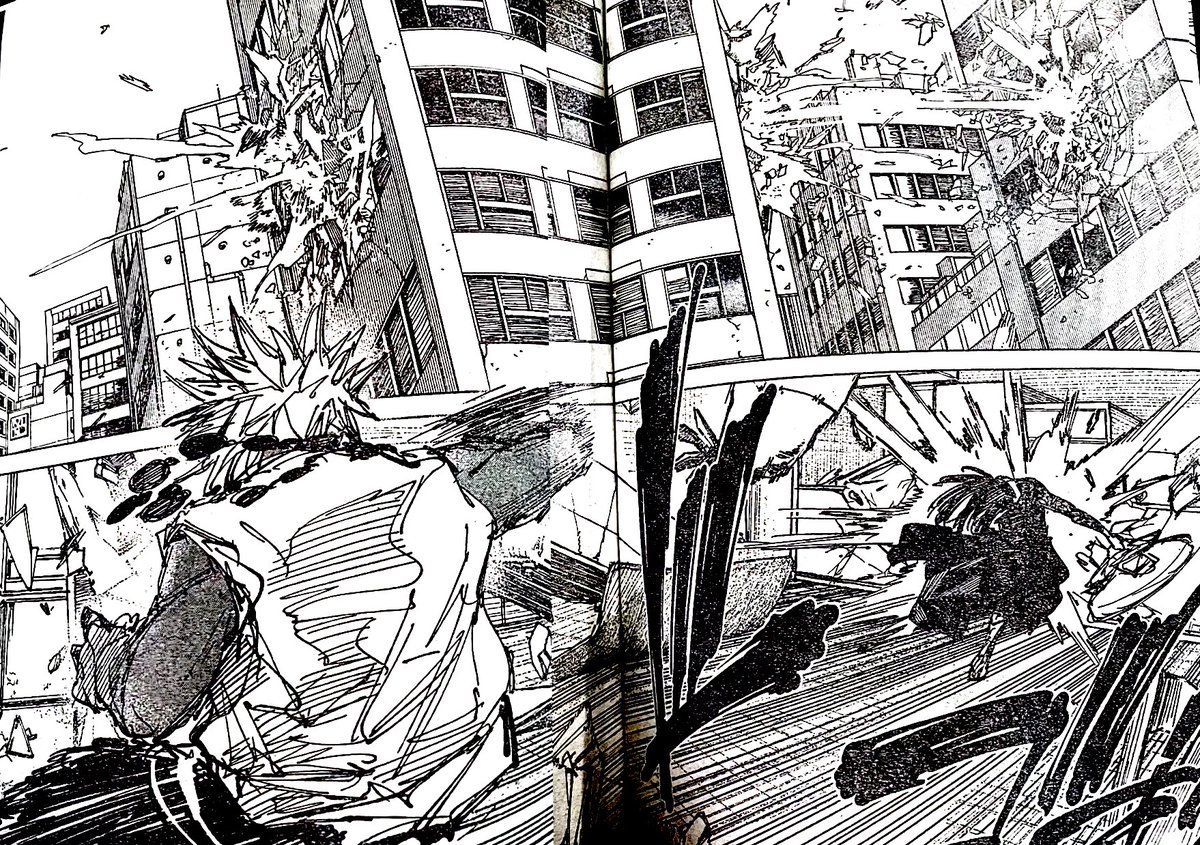
…ツ
...tch
Traffic light changed from GO to STOP: (SFX)
ぱっ
flash
The car came to a sudden stop with the screeching sound of brakes: (SFX)
キッ
Skrrt!
________________
Page 8:
Shishiba: (Osaragi following up with Shishiba)
畳み掛けるで 大佛(オサラギ)
Let’s press the attack, Osaragi.
Gozu:
前言撤回だ (ぜんげんてっかい)
Actually… I take that back.
テメェら
やっぱ今
殺さねえと
ダメだわ
You punks… I really have to kill you now.
Description: Gozu recharged his electric current/electrokinesis and attacked Osaragi again with the intent to kill her, throwing her away from Shishiba.
Shishiba: (calling Osaragi)
あかん
止まれ
This is bad—stop!
Osaragi:
!
________________
Page 9:
Description: Shishiba witnessed Gozu grabbing Osaragi by the neck, violently choking her while dragging her away from him.
Osaragi:
…けほっ
…cough.
Gozu:
認めるぜ
お前らは
相当強え
I’ll admit it… you guys are seriously strong.
だから俺が
生きてるうちに
殺しとかねーと
That’s why I’ve gotta kill you while I’m still alive.
________________
Page 10-11:
Description: After grabbing Osaragi by the neck and choking her, Gozu violently tossed her away, sending her flying across a great distance and crashing through multiple buildings.
________________
Page 12:
Description: Osaragi eventually slammed into the last building, breaking through its walls and almost destroying much of it on impact , leaving her wounded but still conscious.
Gozu:
*俺は電気を体内に溜めることで身体を強化出来るんだよ (*some Kanji-Kana are not clear because of scans but assuming this what it says, I'll double check this later asap)
I can strengthen my body by storing electricity inside me.
お前ら人間に雷の速度は超えられねぇ
You humans could never surpass the speed of lightning.
Description: Osaragi glared at Gozu with open hostility.
SFX:
ギョロ
"bug-eyed" stare or a sudden, piercing look.
⏬⏬
SAKAMOTO DAYS
DAYS 249
/おわり*
SAKAMOTO DAYS
DAYS 249
/The End
(*おわり usually appears at the end of a chapter, story, or segment. It means that part of the story arc has finished.)
👉🏻「次号休載します。再開はWJ15号」
号(3月9日発売)予定です 。
👉🏻The next issue will be on break.
Serialization will resume in Weekly Jump issue 15
(scheduled to go on sale March 9).
Breakdown:
次号休載します = The next chapter / issue will be on break (no chapter next week).
再開は = Will resume / continue again in…
WJ15号 = Weekly Shonen Jump Issue 15.
号(3月9日発売) = Released on March 9.
予定です = Is scheduled.
👉🏻For this specific announcement
「次号休載します」 means the manga skips only one Weekly Jump issue.
✅ For the Timeline:
✔ Current chapter at 249 on official release
International: Feb 22 (Sunday)
Japan: Feb 23 (Monday)
❌ No chapter next issue
International: March 1
Japan: March 2
✔ Manga resumes at 250 (Weekly Jump Issue 15)
International: March 8
Japan: March 9
✅ Final takeaway
👉 The series takes a one-issue break,
but because of the weekly schedule, fans wait about two weeks between chapters.
________________
Cliffhanger:
Description: The moment Gozu closed in to kill/electrocute Osaragi, she used that opportunity to strike him with a powerful kick. This is similar to the move she used against Mafuyu during the museum arc.
Osaragi:
超えるんじゃない
殺すの
It’s not about surpassing them.
It’s about killing.
Vertical text:
殺意の一撃!!
A murderous blow!!
(Literally: A strike with intent to kill)
________________
Takeaway:
This chapter has only 12 pages and concludes with a fight between Gozu, Shishiba, and Osaragi. I have already predicted that Osaragi joins the fight because her fight against Torres was interrupted by Sakamoto and insulted her character. She doesn’t want to be left behind in a battle and wants to test her strength to win so she won't disappoint Shishiba, who raised her and rooted for her. This implies their senpai (senior) and kohai (junior) dynamic—a senior and a subordinate. There is no other meaning to that except for being work colleagues. Since there's a one-week break at the moment due to the intensity of the battle, I'm having trouble feeling that Gozu might be defeated. I am not saying that Osaragi and Shishiba are not strong. They are strong because they are together, which is why they always come along, but individually, they have moments of weakness and doubts that they need to overcome by being strong by any means. When their mission/job is done, they just leave the fight as if it's nothing and show no sympathy. That's how these two work, and that's how the Order functions. They only kill and fight in missions—no noble justice, just missions. They get paid and leave, technically as paid assassins who only act after you pay for their services because they are useful for that kind of talent. However, taking away their weapons, as with Nagumo, makes them feel hopeless and weak. They rely heavily on weapons, treating them as their lifeline. When those weapons are gone, their lives and meaning also become useless and lost, unless they resort to pure street fighting, like a thug or delinquent. This is similar to Sakamoto, who uses a variety of random tools, even food, as weapons in his quest to defeat opponents, even when he acts tyrannical or authoritative. I came across a KR commentator who said that Sakamoto is a tyrant, and he actually is. I don't know how others perceive him, or I actually do not care at all, but that’s how I judge Sakamoto's character—his real character. All of the (former) Order members are evil; they are not heroes. They only fight for their greed and selfish desires because they are useful in that way. They get paid highly and are used for their killing purpose, and that's it. However, they aren't worth storing as guards because they are expendables. They are only useful as tools and not as a purpose, meant to protect the greed of others who recognize them for their deeds disguised as a good character when it's actually evil. That’s why they are never complete in the first place. After one is killed or defeated, another useful assassin will take over, and the cycle goes on until most of them die because that’s their role. Their lives are worthless and just discarded like tools. That is the harshest reality of it and the real truth behind it, no matter how you hate me or not, because it’s the fundamental truth about them, and that’s all. They live according to the evil purposes of the higher-ups, using them to protect themselves and their corruption, even if it means becoming a villain or murderer in their tactics and tricks. Protecting their family or loved ones to the point of violence is no different from a man who is lost in his own purpose for the sake of tainting his soul with blood, murder, and violence to become evil on his own. Good thing Kei never did that. He almost reached that point when Rion inspired him about killing: to kill, even if it means sacrificing your life to protect everyone that matters to him, and that is a heroic noble justice.
(*Noble justice refers to the administration of fairness, moral righteousness, and equity with high ethical standards, integrity, and dignity. It implies a, selfless, and honorable approach to righting wrongs, often associated with the virtuous pursuit of truth, social responsibility, and protecting human dignity, rather than just legalistic or selfish gain.)
Anyway, since part of the story arc of the final battle has ended, a new twist will come forward in the story. I am Uzuki-biased, actually, and I understand Kei's sense of noble justice and the evil people who are against it. That's why a major development will happen in the next story arc of this final battle. Kei will die for the second time at the hands of Sakamoto, as planned by Kei ever since the beginning of the story, whether you believe it or not. His legacy will not end there; it will be continued by his family, who will be reborn. I do not give up the idea that AL Kamar is meant to lose in the battle, given their destructive power that can wipe out society whenever necessary. Their loss serves a purpose—to allow their leader, Kei, to shine at his best. When he maximizes his potential, skills, and capabilities, including the Rion persona inside of him, they will die together. Kei will be reunited with Rion in the afterlife, and from there, a new leader will rise: his successor, Gaku. This is why Kei always tags Gaku along in his missions and assassinations; it’s to teach him about the burdens and responsibilities he will eventually have to carry on his own as the next leader of X Organization (AL Kamar). Gaku will rise with Kei guiding him in spirit, similarly to how Choso sacrificed his life for his little brother Yuji to continue the fight against Sukuna. Deep inside, I want Kei's faction to win because, no matter what other people say, they are the protagonists due to the suffering they have shared and fought with a noble purpose even if it means becoming a villain as many perceive of them, to wipe out evil by evil by correcting the right from wrong—not Sakamoto, who fights out of desire for his only own family, which is selfish and tainted by greed and evil. This is already evident in Chapter 245, thanks to Rion's participation when she appeared to Sakamoto, masquerading as a friend. She exploits his weakness—his family—as his strength, pushing him beyond his limits to protect them while also revealing his darker, more murderous nature. This was shocking to Rion when she saw him kill an assassin without remorse. Sakamoto is an evil man who, in his quest to protect everyone, becomes so corrupted that he loses himself to the murderous villain within him. This harsh truth is something Sakamoto cannot see, but Rion observes it and uses it to her advantage when they meet in his dream. Her goal is to have Sakamoto win the situation and return Kei to her to save his soul. However, this may also lead Sakamoto to be seen as evil by everyone else in public, shattering the facade of a former order, wearing a suit and clean shoes, and ultimately revealing him as a villain pretending to be a hero.

Britain once stood shoulder-to-shoulder with its closest allies.
Now, under Starmer, RAF bases can’t even be used by the United States because lawyers might object.
This isn’t strength. It’s paralysis.
When process replaces principle, and legal theory replaces leadership, Britain stops being a serious ally — and starts becoming irrelevant.
Starmer’s legalistic obsession isn’t protecting Britain. It’s weakening it.
From the Chagos fiasco to blocking operational cooperation, his government is diminishing our credibility on the world stage, making us untrustworthy and a global laughing stock.
Allies need reliability. Not hesitation. Not hand-wringing. Not endless legal caveats.
Britain deserves leadership that understands sovereignty, duty, and strength.
🇬🇧 Stand up for Britain. Stand up for common sense.
#StandUpBritain #NationalSecurity #Starmer #Chagos #RAF #UKPolitics #Defence #Leadership

@chris_jolliff JFYI good to be aware, FFOZ are a legalistic group (one of your lovely friends on here originally let me know!) then I was able to put 2&2 together re what was happening with real-life friends, why they were sharing falsehoods
1 https://t.co/WdIqS1gMyu
2 https://t.co/qebf3cRnQU

In today's Church--this is the person spending more time judging/condemning others than showing grace. Living self-righteously rather than living humbly before a merciful God. It looks like chasing false truth and legalistic variants of the word rather than Christ's Gospel.


I don’t believe forgiveness is required if the one committing the crime or sin or whatever is not asking forgiveness while changing their ways. I’m sorry that happened to you. I hope you find just the right church that makes you feel validated, wanted and loved. I grew up going to church, but I no longer attend. The church services no longer move me. Perhaps that’s because I’m old and settled in my ways. I love the old church hymns, acappella style. I’m not a fan of the performances that so many of the young people love, though I understand why they love it. There is only one preacher that I discovered in college (1970s) that preached on a level that I embraced and appreciated. He ruined all other pastors for me, though I know there are many great ones. He taught about the gifts of the holy spirit instead of a legalistic/hell fire &!damnation view of the Bible. That opened up a whole new world for me.
1. Women having representation in parliament
2. Legalistic equality for women
3. Equal pay for equal work
4. The right to work and vote
5. Improvement of working conditions for women
6. Removal of all sexual discrimination
7. Support for health and maternal infant welfare


@CrypticChrncles The dark side ones do. The spirit world is very legalistic. They will be good only if you enforce the law
Last Seen Hashtags on Sotwe
Most Popular Users

Elon Musk 
@elonmusk
240M followers

Barack Obama
@barackobama
118.6M followers

Cristiano Ronaldo
@cristiano
114.4M followers

Donald J. Trump
@realdonaldtrump
111.7M followers

Narendra Modi
@narendramodi
106.9M followers

Rihanna
@rihanna
98.6M followers

NASA
@nasa
92.1M followers

Justin Bieber
@justinbieber
91.7M followers

KATY PERRY
@katyperry
89.9M followers

Taylor Swift
@taylorswift13
83.9M followers

Lady Gaga
@ladygaga
75.4M followers

Virat Kohli
@imvkohli
73.3M followers

Kim Kardashian
@kimkardashian
70.8M followers

YouTube
@youtube
68.6M followers

Neymar Jr
@neymarjr
66.3M followers

Bill Gates
@billgates
65.2M followers

Selena Gomez
@selenagomez
63M followers

The Ellen Show
@theellenshow
62.1M followers

CNN
@cnn
61.7M followers

X
@x
60.6M followers