

Top Tweets for #Lowdata

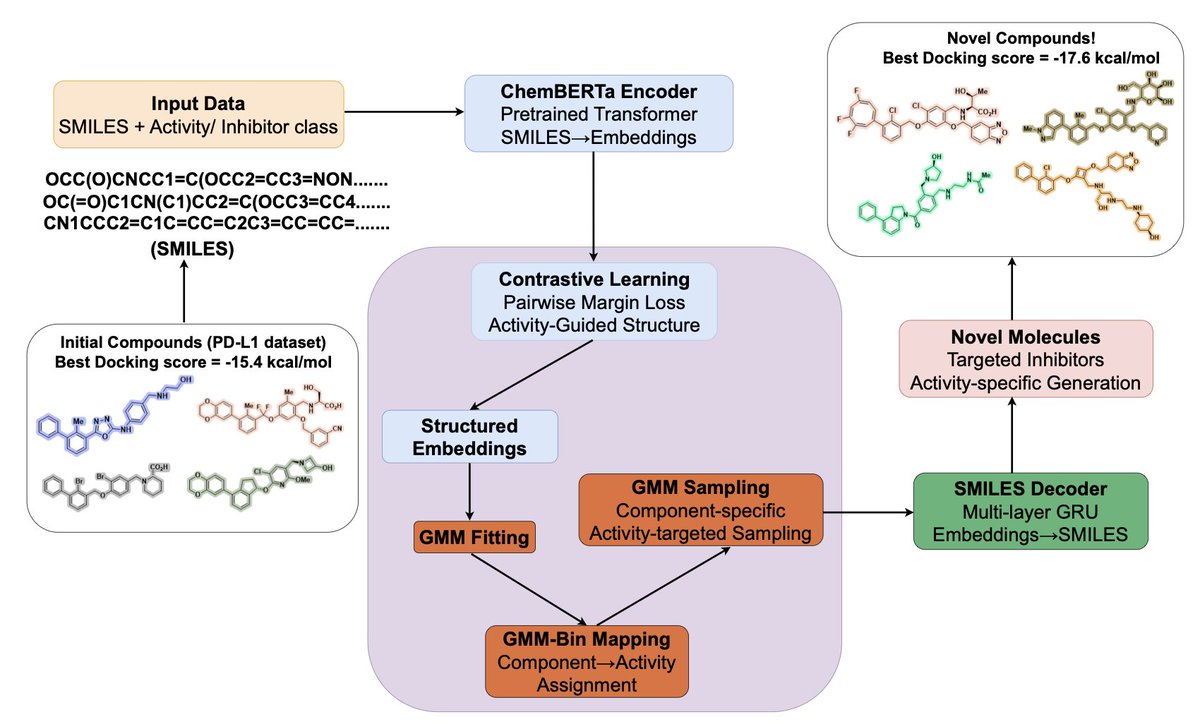
Valid Property-Enhanced Contrastive Learning for Targeted Optimization & Resampling for Novel Drug Design
1. The article introduces VECTOR+, a novel framework for drug discovery that combines contrastive learning and latent sampling to generate new molecules with optimized pharmacological properties. This approach is particularly effective in low-data regimes, a common challenge in targeted drug design.
2. VECTOR+ leverages property-guided representation learning to structure the chemical latent space according to biological function. This enables the generation of meaningful molecular representations from limited datasets, addressing a significant bottleneck in drug discovery.
3. The method is validated on two distinct datasets: a curated set of PD-L1 inhibitors and a set of receptor kinase inhibitors. Despite limited training data, VECTOR+ successfully generates novel, synthetically tractable candidates with superior docking scores compared to known inhibitors.
4. VECTOR+ demonstrates superior performance over state-of-the-art generative models like JT-VAE and MolGPT across multiple metrics, including docking score, novelty, uniqueness, and Tanimoto similarity. This highlights its potential for reproducible, AI-accelerated drug design.
5. The framework is broadly generalizable and can be extended to accelerate drug discovery across diverse therapeutic targets. It also introduces a curated dataset of 296 small-molecule PD-L1 inhibitors, providing a valuable resource for future research in this critical immuno-oncology task.
6. The authors provide a detailed methodology, including the use of a transformer-based encoder, contrastive learning, and Gaussian Mixture Model (GMM) for targeted molecule generation. This pipeline enables efficient exploration and generation of target-specific, structurally novel molecules.
7. Computational evaluations, including molecular docking and molecular dynamics simulations, confirm the binding stability and potential efficacy of the generated molecules, further supporting the practical impact of VECTOR+ in drug discovery.
📜Paper: https://t.co/SmaSLHSHu9
#DrugDiscovery #AI #ContrastiveLearning #GenerativeModeling #LowDataRegime
Leveraging Protein Language Model Embeddings for Catalytic Turnover Prediction of Adenylate Kinase Orthologs in a Low-Data Regime
1. This study benchmarks the use of protein language model (PLM) embeddings for predicting catalytic turnover rates (kcat) across 175 diverse orthologs of Adenylate Kinase (ADK), demonstrating that PLM-based probing outperforms all traditional and specialized kcat prediction models.
2. The top-performing configuration used zero-shot ESMC-600M embeddings with a simple MLP probe, achieving RMSE of 0.473 and R² of 0.416, surpassing models like DLKcat and CatPred by large margins, particularly in this low-data, high-diversity setting.
3. Learnable aggregation techniques (e.g., Transformer-based attention layers) offered only marginal gains over fixed pooling strategies (e.g., min, mean), indicating that simple aggregation is often sufficient when using strong pretrained embeddings.
4. Surprisingly, fine-tuning PLMs with LoRA on relevant subspaces (e.g., ADK homologs or EC 2.7 enzymes) failed to improve kcat prediction performance and, in the case of direct fine-tuning, even degraded generalization due to overfitting.
5. The study also evaluated embeddings from all hidden layers of Ankh-base and found no consistent improvement over the final layer, with intermediate layers often requiring normalization due to exploding gradient issues.
6. Embeddings derived from PLMs consistently outperformed those from pseudo-one-hot encodings and BLOSUM62-optimized vectors, confirming that pretrained models capture deeper functional signals beyond primary sequence similarity.
7. A lid-type-aware cross-validation scheme ensured robustness by accounting for known structural determinants of ADK activity, preventing information leakage and improving the relevance of benchmarking in evolutionary diverse contexts.
8. The results emphasize that while PLMs enable significant gains in enzyme activity prediction, architectural overengineering or excessive fine-tuning can backfire in small or niche datasets, reinforcing the value of simple, zero-shot probing strategies.
9. This study provides a practical reference point for protein engineers, demonstrating that well-chosen embeddings and lightweight downstream models can rival or exceed complex kcat-specific architectures even with minimal labeled data.
10. As enzyme design increasingly adopts ML workflows, this work illustrates how to systematically evaluate PLMs for sequence-to-function modeling, and underscores the need for diverse, high-quality enzymology datasets.
💻Code: https://t.co/FGpdSuLu48
📜Paper: https://t.co/1YGO1Ng1kh
#ProteinEngineering #Enzymology #ProteinLanguageModels #kcat #DeepLearning #PLM #ESMC #LoRA #Bioinformatics #LowData #EnzymeDesign #ADK #SequenceToFunction #FacePLM

Finding Drug Candidate Hits With a Hundred Samples: Ultra-low Data Screening With Active Learning
1. This study demonstrates that it's possible to reliably identify drug candidate hits using just 110 affinity evaluations, making active learning viable for academic labs with limited resources.
2. The authors identify a top-performing combination—Multi-Layer Perceptron (MLP) with Continuous and Data-Driven Descriptors (CDDD), enhanced by Pairwise Difference Regression (PADRE)—that achieves a 100% probability of finding at least five top-1% hits in a large chemical library.
3. PADRE plays a key role by augmenting data from as few as 10 initial molecules, dramatically boosting early-phase model performance and hit discovery rates, even under noisy or uncertain conditions.
4. Greedy, Expected Improvement (EI), and Upper Confidence Bound (UCB) acquisition strategies all outperform random selection, but greedy acquisition remains surprisingly effective and simple for ultra-low data regimes.
5. The study includes realistic noise simulations (10–30%) to mirror experimental variability, showing that robust setups (especially RF + MQN + PADRE) maintain strong hit discovery even under noisy conditions.
6. Enriching the initial pool with just one known active molecule (from the top 1% of docking scores) further improves the likelihood of success—raising the hit probability from 73% to 93% for the top model.
7. Even in the smaller Enamine DDS-10 library (~10k molecules), the pipeline remains reliable: top strategies still consistently discover 10+ hits with 100% probability, showing the framework’s versatility across dataset sizes.
8. Key design choices—simple models (MLP, RF), expressive descriptors (CDDD, MQN), and thoughtful acquisition functions—enable efficient screening without the need for complex GNNs or large datasets.
9. These results emphasize that accurate prediction of weak binders early in the AL cycle is essential to steer the model toward potent candidates—especially when only a few hundred experiments are feasible.
10. Overall, this work offers a robust, practical blueprint for hit discovery in low-data settings, highlighting the power of combining thoughtful data representation, augmentation, and acquisition strategies.
💻Code: https://t.co/0W0oLQA8o1
📜Paper: https://t.co/rER6CL7cA9
#ActiveLearning #DrugDiscovery #LowData #Cheminformatics #MolecularScreening #AI4Science #ComputationalBiology

Last Seen Hashtags on Sotwe
shart
Seen from Singapore
cheating wife #bbc
Seen from Malaysia
dadfetish
Seen from Italy
leaks
Seen from United States
แนวครอบครัว
Seen from Thailand
bottom
Seen from Austria
سكُُس_عرُُُبي
Seen from United States
amalashaji
Seen from Netherlands
Malfunction
Seen from Brazil
母狗
Seen from United States
Trends for you
Most Popular Users

Elon Musk 
@elonmusk
240.1M followers

Barack Obama
@barackobama
118.6M followers

Cristiano Ronaldo
@cristiano
114.4M followers

Donald J. Trump
@realdonaldtrump
111.8M followers

Narendra Modi
@narendramodi
106.9M followers

Rihanna
@rihanna
98.6M followers

NASA
@nasa
92.1M followers

Justin Bieber
@justinbieber
91.7M followers

KATY PERRY
@katyperry
89.9M followers

Taylor Swift
@taylorswift13
83.9M followers

Lady Gaga
@ladygaga
75.4M followers

Virat Kohli
@imvkohli
73.3M followers

Kim Kardashian
@kimkardashian
70.8M followers

YouTube
@youtube
68.6M followers

Neymar Jr
@neymarjr
66.3M followers

Bill Gates
@billgates
65.2M followers

Selena Gomez
@selenagomez
63M followers

The Ellen Show
@theellenshow
62.1M followers

CNN
@cnn
61.7M followers

X
@x
60.6M followers