

Top Tweets for #MACCS

@Cheet0hhh Facts just ordered maccs

CONFIRMED FADES
hbic vs mary maccs
bcb vs iyana (off camera)
bcb vs cady (bre)
ttg vs double trouble
bcb vs pretty flamez
bcb vs double trouble
bcb vs da buttas
starlett vs bcb
starlett + duo & hbic + zaniyah vs kash
starlett duo vs kash

Maccsfield ganándole al crystal palace es épico.
Maccsfield ganándole al crystal palace es épico

@DigiSwQll17 🐸 Right here


@MaccSewingSolut @Mikeo56977865 Everyone has to contribute to their care and the contribution is means-tested. Make sure when financial assessment is done that you put down EVERYTHING, including the fuel, internet subscription, telephone line for pendant alarm: EVERYTHING!

@MaccSewingSolut Yep that's what it boils down to, a scheme already being cut. Like the UC health/ESA support group cuts, removing the bone marrow as nothing left on the bone to take.

@IrritableChris @MaccSewingSolut To suggest that Zero Percent PIP fraud is wholesale fraud makes you a terrible ableist lying c**t.

@CounsellingSam @MaccSewingSolut I've every empathy with the genuinely disabled, but a 60% rise in disability claimants is ludicrous. To suggest this is anything other than wholesale fraud, is delusional.
@IrritableChris @MaccSewingSolut 3 million plus people have Long Covid.
I suggest that you acquire some empathy, because everyone ends up disabled one day.


Data efficient molecular image representation learning using foundation models
1.MoleCLIP is a molecular representation learning (MRL) framework that repurposes OpenAI’s vision foundation model CLIP to learn from molecular images. By doing so, it drastically reduces the need for large molecular pretraining datasets while maintaining state-of-the-art performance on key chemical benchmarks.
2.The key innovation is using a foundation model trained on generic visual data as the backbone for chemical tasks. MoleCLIP demonstrates that this strategy enables effective generalization, especially under data-scarce scenarios common in chemistry.
3.MoleCLIP significantly outperforms prior image-based MRL models like ImageMol and even competes with graph-based models such as GEM on catalysis-related datasets, despite requiring 5–10× less data for pretraining.
4.The model’s robustness to distribution shifts is highlighted by its ability to maintain high prediction accuracy even when tested on molecular images containing structural variations never seen during training, such as R-group substitutions.
5.MoleCLIP achieves its performance via a stratified training pipeline: CLIP provides general visual features, followed by molecular pretraining (on ChEMBL-25), and then finetuning on small, chemically relevant datasets. This layered approach supports efficient adaptation.
6.Pretraining combines two tasks: structural classification using pseudo-labels from MACCS fingerprint clustering, and contrastive learning (via SimCLR), enabling MoleCLIP to form chemically meaningful latent representations from molecular images.
7.The model was benchmarked on standard MoleculeNet tasks and four catalysis datasets (DHBDs, NHCs, phosphines for yield and selectivity), achieving strong or superior performance even with as few as 37 examples in some tasks.
8.A domain-specific extension, MoleCLIPBV, adds a continued pretraining step using buried volume predictions of phosphines. This further enhances accuracy in catalysis tasks, showing the effectiveness of integrating domain knowledge.
9.Image-based inputs offer a path to reuse vast literature data and leverage pretrained vision models. Despite being less compact and flexible than graphs or SMILES, images provide practical advantages when combined with scalable vision backbones like CLIP.
10.The work suggests a future direction for chemistry machine learning: starting from large general-purpose models and progressively specializing them with increasingly domain-focused datasets for specific molecular properties or reactivities.
💻Code: https://t.co/UHo6KZ5IEh
📜Paper: https://t.co/4Sx46094t8 #AI4Chemistry
#MolecularRepresentation #DeepLearning #CLIP #Cheminformatics #Catalysis #FoundationModels #TransferLearning


@MaccSewingSolut @areyoflight 🤣🤣🤣 my GP (male) said that kidney stone pain is as bad as the pain giving birth!! 😱while I can’t compare the two things it was the worst pain I have ever experienced

@justin019191 $Maccsauce21

@MaccSewingSolut I agree with you for my own personal tastes.
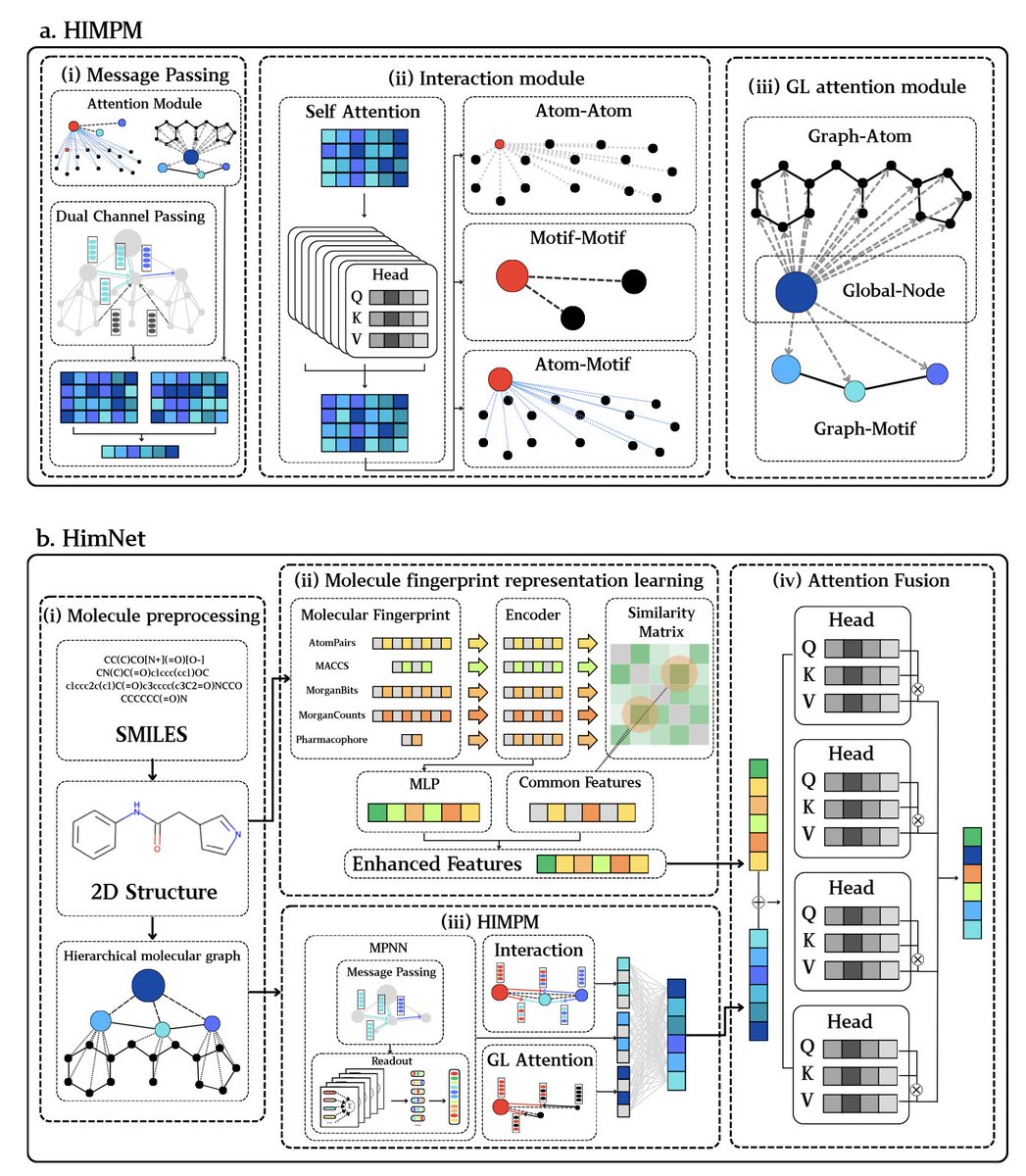
Learning Hierarchical Interaction for Accurate Molecular Property Prediction
1. This paper introduces HimNet, a hierarchical graph neural network that models multi-level molecular interactions—from atoms to functional motifs to whole molecules—using a dual-pathway message passing and cross-level attention mechanism.
2. A key innovation is the Hierarchical Interaction Message Passing (HIMPM) module, which fuses directed edge-centric propagation (D-MPNN) with cross-scale attention to explicitly capture non-additive interactions like hydrogen bonding, π–π stacking, and polar-hydrophobic competition.
3. HimNet operates on a structured hierarchical graph, where atoms, motifs (via BRICS decomposition), and a global node are connected through multi-relational edges, enabling rich information flow across chemical contexts.
4. The model also integrates a novel fingerprint fusion module that combines AtomPairs, MACCS, Morgan, and Pharmacophore fingerprints using similarity-based feature extraction and contrastive alignment, enriching the representations with global chemical priors.
5. A multi-head attention fusion module adaptively aligns fingerprint and graph-based features, capturing diverse interaction patterns across scales and yielding interpretable, expressive molecular embeddings for property prediction.
6. HimNet outperforms leading baselines—including Graphormer, C-MPNN, and fragment-aware GNNs—on eight benchmark datasets for both classification (e.g., BBBP, Tox21, ClinTox) and regression tasks (e.g., ESOL, FreeSolv, Lipophilicity), achieving state-of-the-art accuracy and robustness.
7. Interpretability is a central feature: attention maps from HimNet align well with chemical intuition, identifying permeability-promoting motifs and highlighting cross-motif interactions that modulate ADMET properties.
8. Ablation studies confirm that removing any of the core modules—HIMPM, global-local attention, fingerprint fusion, or multi-head attention—leads to notable performance degradation, validating their complementary roles.
9. Visual analyses on blood–brain barrier permeability show that HimNet can differentiate structurally similar motifs based on context, highlighting the importance of motif–motif and motif–atom interactions that simpler models cannot resolve.
10. HimNet offers a scalable, interpretable, and accurate solution for molecular property prediction, paving the way for more chemically grounded AI systems in drug discovery—particularly in early-stage filtering of ADMET liabilities.
📜Paper: https://t.co/CmUXS3XYAN
#MolecularProperty #DrugDiscovery #GraphNeuralNetworks #ADMET #ChemicalAI #HierarchicalLearning #Bioinformatics #ComputationalBiology #AI4Science
Last Seen Hashtags on Sotwe
Trends for you
Most Popular Users

Elon Musk 
@elonmusk
239.8M followers

Barack Obama
@barackobama
118.6M followers

Cristiano Ronaldo
@cristiano
114.3M followers

Donald J. Trump
@realdonaldtrump
111.7M followers

Narendra Modi
@narendramodi
106.9M followers

Rihanna
@rihanna
98.6M followers

NASA
@nasa
92.1M followers

Justin Bieber
@justinbieber
91.7M followers

KATY PERRY
@katyperry
89.9M followers

Taylor Swift
@taylorswift13
83.9M followers

Lady Gaga
@ladygaga
75.4M followers

Virat Kohli
@imvkohli
73.3M followers

Kim Kardashian
@kimkardashian
70.8M followers

YouTube
@youtube
68.6M followers

Neymar Jr
@neymarjr
66.3M followers

Bill Gates
@billgates
65.1M followers

Selena Gomez
@selenagomez
63M followers

The Ellen Show
@theellenshow
62.1M followers

CNN
@cnn
61.7M followers

X
@x
60.6M followers