

Top Tweets for #MAGNETAR

Astronomers report a record-breaking gamma-ray burst, GRB 220706A, whose central engine kept flaring in X-rays for about 27 days, 20 days longer than the previous record. Scientists still don't know what powered it; a magnetar or an unusually large collapsing star are among the possibilities. (Source: https://t.co/AjMTyWSawM)
https://t.co/zo0APqXFWD
#Science #Space

More terrifying than a black hole🌌🌠?
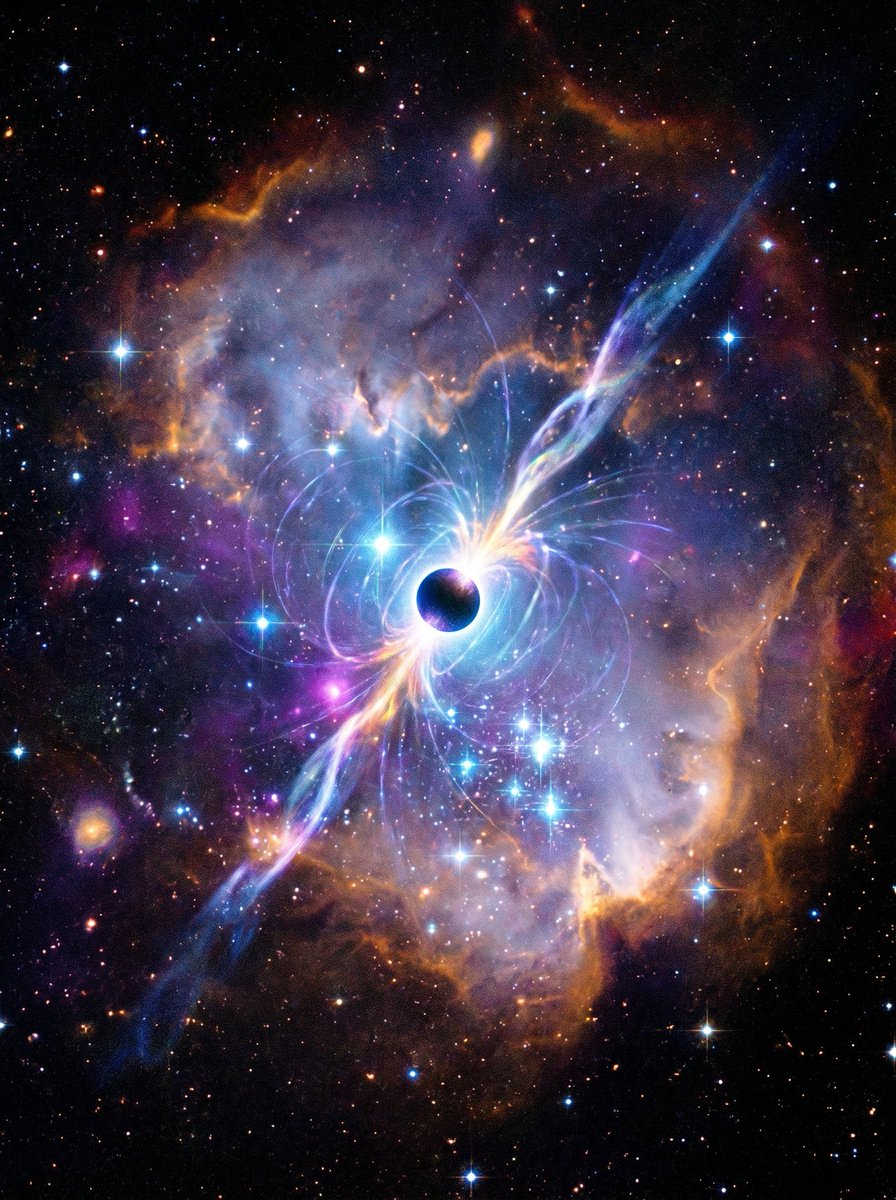
It's a dead star no bigger than a city, yet its magnetic field is so powerful it could disrupt atoms from thousands of kilometers away.#Space #Astronomy #Magnetar 🌌


Chain-Reactive Cosmogenesis Theory (CRCT)
An Alternative Model for Universe Formation, Matter Multiplication, and Life Propagation
Abstract
This paper outlines an alternative cosmological framework based on recursive chain reactions, chemical-field stability principles, and dynamic cosmic motion. Rather than an instantaneous inflation of empty space from an abstract singularity, this model proposes that the universe emerged from an ultra-small, highly condensed energy-matter seed whose cascading divisions actively generated space-time. By reinterpreting black holes as ultra-stable chemical and field structures rather than gravitational anomalies, and incorporating perpetual barycentric mobility, the theory models a self-organizing, infinite cosmos where matter multiplication and life propagation operate as recursive, fractal loops.
1. The Starting Point: The Primal Particle (PP) & Space-Time Genesis
The universe did not expand into an existing void. It originated from a single, ultra-small "seed object" smaller than an atom, termed the Primal Particle (PP).
The Potential: The PP existed in a state of hyper-condensed energy-matter, holding the mathematical potential for infinite multiplication and structural complexity.
Space-Time Unfolding: Crucially, space and time did not pre-exist around the PP. Instead, space-time itself unfolded and expanded as a direct physical consequence of the PP’s initial cascading fissions and energetic chain-reactive expansion.
2. Recursive Matter Multiplication & Localized Feedback Loops
Following the initial fission, the universe evolved through a continuous cascade of high-energy collisions and divisions, generating successive generations of matter, represented as x₁, x₂, x₃, ... x_n.
Each cosmic interaction is governed by localized feedback loops where existing structures combine to catalyze unique, more complex products:
x₁ + x₅ → x₇
x₇ + x₉ → x₁₃
These recursive chain reactions allowed the cosmos to build macro-structures from foundational quantum layers, ultimately giving rise to diverse chemical compounds, planetary nodes, and stable cosmic anchors.
3. Black Holes as Ultra-Stable Chemical and Field Structures
Departing from standard general relativity models that define black holes as infinite mathematical singularities, this theory reinterprets them through extreme chemistry and localized field density.
Indestructible Chemical Bonds: Black holes are dense, ultra-strong states of matter bound by irreversible cosmic forces. When black holes interact, they do not destroy or completely consume one another; instead, they merge to form larger, unified field stabilizers.
The Energy-Magnetism Equivalence: Just as pure electromagnetic waves can carry localized energy without a solid atomic core, a black hole is a manifestation of extreme field density. By utilizing E=mc², this localized field energy acquires a massive mass-equivalence capable of warping local space-time.
The Flame Analogy: A fire can destroy ice, but one flame cannot extinguish another—they merge to create a larger fire. Similarly, black holes act as cosmic stabilizers that absorb surrounding chaotic matter while unifying with each other to regulate galactic equilibrium.
4. The Dynamic Universe: Reciprocal Gravity & Barycentric Motion
A core pillar of this framework is the absolute rejection of static anchors in the cosmos. Nothing is locked in a fixed position.
Reciprocal Gravitational Pull: Gravity is strictly a two-way interaction. When a massive black hole attracts a planet, that planet exerts a proportional, reciprocal pull on the black hole. Even if a planet's mass causes only a 0.0001% positional shift, the black hole actively moves toward the object it attracts.
The Barycentric Dance: Because of this universal reciprocity, cosmic bodies do not orbit a static point; they orbit a shared center of mass—the Barycenter. Black holes are therefore in a perpetual state of dynamic orbital motion, shifting, wobbling, and traveling.
Kinetic Catalysts: This constant mobility (further accelerated by asymmetric energy kicks from dying stars) ensures that black holes continuously encounter new matter, perpetually driving the universe's chain-reactive cycle.
5. Planetary Fragmentation, Panspermia, and Fractal Astrobiology
As macro-bodies (such as x₁₂ or x₁₅) interact within this highly dynamic gravitational grid, high-energy impacts occur. These collisions shed debris that travels across the vacuum as meteoroids, asteroids, and comets.
Panspermia as a Cosmic Feedback Loop: Life-bearing fragments ejected from older biological nodes travel across star systems. When these fragments impact a young planet situated within a favorable habitable zone (defined by liquid water, atmospheric composition, and optimal stellar distance), they seed the planet.
Fractal Distribution of Life: This results in a self-replicating, recursive propagation. Life originates on one node, spreads via cosmic fragments to adjacent nodes, and continues indefinitely. The resulting distribution of life-bearing worlds across the universe mirrors a strict, impact-driven fractal pattern.
6. Continuous Evolution & Future Research Directions
The universe is not a closed system decaying toward absolute thermodynamic death. It is a self-organizing, evolving grid where new stars and planetary nodes are continually generated by the kinetic displacement of field structures and recursive matter division.
To further develop this framework, future research will focus on:
Mathematical Simulation: Modeling cascade networks in particle physics to replicate the x₁ + x₅ → x₇ progression.
High-Density Field Analogs: Utilizing low-scale magnetar field data to analyze the stability of pure energy structures.
Astrobiological Mapping: Analyzing exoplanetary biosignatures to see if their cosmic distribution matches recursive, impact-driven fractal models.


📌 Kozmik PeVatronlar: LHAASO Gözlemleri ve Ekstrem Hızlandırıcıların Fiziği
İnsanlığın şimdiye kadar inşa ettiği en gelişmiş ve en yüksek enerjili parçacık hızlandırıcısı olan CERN’deki Büyük Hadron Çarpıştırıcısı (LHC), protonları maksimum 13.6 \text{ TeV} (10^{12} elektronvolt) enerji seviyesine kadar hızlandırabilmektedir. Ancak evren, insan mühendisliğinin bu nihai sınırını mikroskobik bir oyuncak seviyesine indiren, galaktik ölçekte doğal laboratuvarlara sahiptir. Çin'de bulunan Large High Altitude Air Shower Observatory (LHAASO) ve Tibet Hava Duşu dedektörleri, Samanyolu Galaksisi’nin derinliklerinden gelen ve enerjisi 1.4 { PeV} (1.4 x 10^{15} elektronvolt, yani CERN'ün limitinin tam 100 katı) seviyesini aşan ekstrem gama ışınları ve ultra yüksek enerjili kozmik ışınlar (UHECR) yakaladı. Literatürde bu ultra-ekstrem enerji düzeyinde parçacık hızlandırabilen kozmik canavarlara PeVatron denmektedir. LHAASO'nun topladığı somut gözlemsel veriler, astrofizik dünyasını rasyonel bir tıkanma noktasına getirdi: Galaksimizin içindeki hangi mekanizma, bir parçacığa bu teorik sınırların ötesindeki enerjiyi yükleyebilmektedir?
Klasik astrofiziksel kabule göre, galaktik kozmik ışınların birincil hızlandırıcı kaynakları süpernova kalıntılarıdır (SNR). Süpernova patlamalarının yarattığı şok dalgaları, parçacıkları "Fermi Hızlandırma Mekanizması" ile yüksek enerjilere ulaştırır. Ancak plazma fiziği denklemleri ve manyetik alan sınırlamaları (Hillenbrand limiti), süpernova kalıntılarının bir parçacığı en fazla birkaç yüz TeV seviyesine kadar hızlandırabileceğini; PeV (10^{15} eV) bariyerini doğrudan aşamayacağını söyler. LHAASO; Kuğu (Cygnus) takımyıldızı yönünde ve galaksimizin merkezindeki süper kütleli kara delik olan Sagittarius A civarında aktif PeVatron kaynakları lokalize etti. Bu durum, teorisyenleri relativistik plazma jetleri, şok sıkıştırma dalgaları ve manyetik yeniden bağlanma (magnetic reconnection) süreçlerini yeniden modellemeye zorlamaktadır. Evren, enerjiyi manipüle etmek ve makroskopik ölçekte kuantum elektrodinamik süreçleri işletmek için kara deliklerin ve magnetarların etrafında kusursuz birer doğal senkrotron algoritması çalıştırmaktadır. Realite, en güçlü laboratuvarlarımızdan bile daha radikal bir yüksek enerji enformasyon matrisidir.
#TheoreticalPhysics #Astrophysics #PeVatron #LHAASO #CosmicRays #HighEnergyPhysics #TheLogos


Insiders just unloaded $1.58B in $Carvana $CVNA in a single day.
Pentwater. Magnetar. Bain. This isn’t noise — it’s exit liquidity.
And you still think the trend is your friend?
Or you just don’t see who you’re buying from?
@Blackintus

Was working on the connection of wavetheory to point out the need of including the emf wave 90° to the photon's path traveling as a package
Only quaternion math suffices not vector, a critical finding that magnetic flux lowers photon frequency, if a continuous MHD to below visible-light near LWIR
This is sinewave_lengthening happens all over, the significance large, when released photon snap-back emits 2.94e-12 exactly to 20-decimals collab w/@kuldysingh
If you integrate this into your work it should be a valid description the tho't, learned from minimalist blackhole & magnetar-star study
The event-horizon is a thin atmosphere of sorts of photons within a weak MHD flow induced at the equator as polarized current, note its asymmetric !
Work now has equations in quat-math for bound vortices at pion scale cause drag on #3IATLAS by these within a #MHD flow induced by the solar_wind instead of mass-to-molecule compaction at the disc-core junction
A key diff are gyroscopic-pairs have a specific resonant frequency to use to evaluate transactions based on sidereal-rotation of a mass to a revolution of the pair is exactly 0.42 = 1-Hz of frequency or it isn't stable & fly-off occurs or compaction
Mass is conserved from BH to pion scale, heavier elements than a limit become supernova a determinant
Only use quarternion math with waveforms & photons, my discovery is photons exist below visible-light are the heat_transfer path of BHs, a heat conductor as an atmospheric layer looks black
That was two days ago
Fwiw


@magnetarkak Hey, awesome breakdown! Zama’s stuff really opens up some wild possibilities
@magnetarkak Respect the vision 👁️

@magnetarkak Good one magnetar gZama.

@magnetarkak Gzama sir

@magnetarkak It’s a brilliant way to explain complex cryptography each analogy perfectly captures Zama’s ability to compute on encrypted data without compromising integrity.

@magnetarkak Lion zama


@magnetarkak g zama

@magnetarkak privacy, privacy, privacy!
Last Seen Hashtags on Sotwe
Most Popular Users

Elon Musk 
@elonmusk
240M followers

Barack Obama
@barackobama
118.6M followers

Cristiano Ronaldo
@cristiano
114.4M followers

Donald J. Trump
@realdonaldtrump
111.7M followers

Narendra Modi
@narendramodi
106.9M followers

Rihanna
@rihanna
98.6M followers

NASA
@nasa
92.1M followers

Justin Bieber
@justinbieber
91.7M followers

KATY PERRY
@katyperry
89.9M followers

Taylor Swift
@taylorswift13
83.9M followers

Lady Gaga
@ladygaga
75.4M followers

Virat Kohli
@imvkohli
73.3M followers

Kim Kardashian
@kimkardashian
70.8M followers

YouTube
@youtube
68.6M followers

Neymar Jr
@neymarjr
66.3M followers

Bill Gates
@billgates
65.2M followers

Selena Gomez
@selenagomez
63M followers

The Ellen Show
@theellenshow
62.1M followers

CNN
@cnn
61.7M followers

X
@x
60.6M followers