

Top Tweets for #Memsync

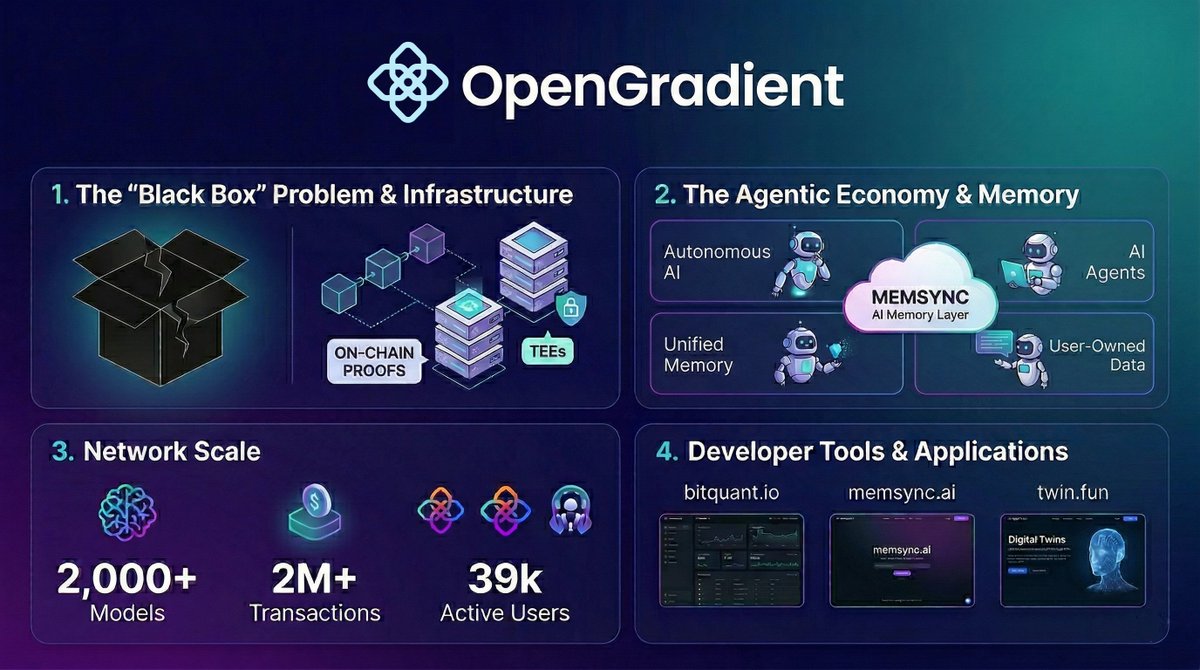
Here is a recap summarizing main topics discussed during the insightful AMA session hosted by @decasonic, @abdulalali with @advait_jayant talkibg abou the intersection of Web3 & AI, and how OpenGradient uses on-chain proofs and smart memory layers to build an open, verifiable future for autonomous agents and decentralized AI solutions.
The Shift to Agentic Web3
The industry is pivoting from simple AI parts to autonomous agents capable of performing complex functions.
This evolution requires verifiable infrastructure to handle autonomous agent payments and interactions. Durable adoption will depend on AI systems that are transparent and reliable on-chain.
Solving the AI "Black Box" problem
Current AI models are "black boxes" with no cryptographic proof of their internal processes. OpenGradient acts as an AI co-processor, generating on-chain execution traces and proofs for every job. This infrastructure brings full auditability and transparency to AI decision-making.
Advait Path to OpenGradient
Drawing on his computer science background, Advait identified systemic inefficiencies in querying cumbersome blockchain data during his PhD, leading him to develop @supersightxyz—an early AI co-pilot for on-chain analysis. While the project was ahead of its time, its failure revealed critical frictions in AI regarding trust, privacy, and verifiable execution. This realization led him directly to OpenGradient to solve the industry’s "black box" problem.
OpenGradient’s Infrastructure
OpenGradient is built as a fork of Cosmos EVM and Comet BFT consensus engine, to host the largest decentralized model repository with 2,000+ models, The network has already scaled to 2 million transactions and over 263,000 wallets. Its architecture combines specialized GPU nodes with an immutable on-chain attestation registry.
Open Source and Privacy
Fear of private data being used to train "God models" is pushing users toward open-source and local AI. People are becoming "agent-native," deploying personal twins to manage finances and daily tasks privately OpenGradient supports this shift by ensuring open-source models run in tamper-proof environments.
MemSync and AI Memory
One of the biggest products of OpenGradient, MemSync provides agents with persistent, cross-app memory while keeping user data confidential. By integrating the memory and context layers, you can essentially create digital twins, which are agents can be guided toward specific successful outcomes, which is essential for a world of specialized, user-owned intelligence.
Also as an option, you can explore could literally take the twins that exist on the https://t.co/0fu8CsP4MZ platform, communicate with them and utilize their knowledge in creating your own solutions.
OpenGradient Tools and Applications
Developers and new users can start by exploring https://t.co/s509JGVD77 and start building their verifiable AI solutions using OpenGradient infrastructure.
Users can also interact with the verifiable AI today through https://t.co/fYAQrF6SSY (Personal Quant Agent for on-chain analysis), https://t.co/ozQpQk8D5F, and https://t.co/pqQ8QU4c4i (platform for creating digital minds).
Advait recommended starting with something small (simple bots or agents) and basically get your feet by building applications.
The ultimate goal is to make the entire infrastructure more agent-friendly for custom automations.

Expertly 现已进入最终冲刺阶段!
它是 https://t.co/YmeJcrrCTY 与 @memsync_ai 的深度融合,
打造真正上下文感知、任务专精的 AI 专家,而非普通泛用型聊天机器人。
你的私人分析师、私人研究员、私人运营官……未来都可以由你自定义!
产品定型在即,现面向社区公开征集建议:
你最希望 Expertly 首批上线哪些专家能力?
欢迎点击下方引用推文里的链接,参与反馈。
@OpenGradient

We’re approaching the final stages of Expertly.
Designed as a combination of https://t.co/0Grv98aQ1h and @memsync_ai, it focuses on building AI experts that are context-aware and task-specific by design.
As we finalize the product, we’re gathering input to guide what should be built first.
Share your feedback:
https://t.co/0sOJARaliY

Spent some time today exploring what OpenGradient is building, and I’ll say this it’s one of those projects that quietly makes you rethink how Ai should actually work.
Right now, most of us interact with Ai like it’s magic. You give input, you get output, and that’s it. But there’s always that missing layer trust.
Where did the result come from? Can it be verified? Can anyone else reproduce it?
OpenGradient is trying to solve exactly that.
Instead of treating AI like a black box, they’re turning it into something transparent and provable.
You can host models, run inference, and even deploy Ai agents all on-chain with verifiability built in. That’s a big shift from how things are usually done.
What stood out to me is the scale they’re already reaching. Thousands of models, millions of verified inferences, and a growing ecosystem of developers building directly on top of it.
It doesn’t feel theoretical it feels like real infrastructure taking shape.
Also interesting is how they’re approaching memory and personalization with tools like MemSync.
AI that actually remembers context across apps? That opens up a lot of possibilities beyond simple prompts.
We’ve heard a lot about decentralization in the past few years, but combining it with Ai in a practical, usable way is still rare.
This feels like one of the few serious attempts at making that vision real.
If the future of Ai is going to matter, it can’t just be powerful it has to be open, verifiable and trustworthy.
Projects like this are pushing in that direction.
Worth keeping on your radar.
@OpenGradient
#AI #Web3 #FutureOfAI

Been checking out @OpenGradient and their $OPG token lately
This one actually feels different from the usual AI hype. They're building a proper EVM-compatible network for verifiable on-chain AI compute. You can host models, run secure inference with TEE + zkML proofs, and deploy agents straight onchain. Full transparency and no single point of failure.
Their Model Hub is already live at https://t.co/4sOMNekC3d. 1500+ models, over 2 million verifiable inferences, and 500k+ cryptographic proofs. Python SDK makes it dead simple to integrate AI into smart contracts and Web3 agents. They've also got stuff like MemSync for agent memory, BitQuant, and Digital Twins rolling out. Real products shipping, not just slides.
Team is solid. Matthew Wang (CEO) and Adam Balogh (CTO) leading it, backed by a16z Crypto, Balaji Srinivasan, Illia Polosukhin from NEAR, Sandeep Nailwal from Polygon, and others. They pulled in $8.5M seed last year and are heads down building.
On the $OPG token itself, the utility looks strong. It's designed for paying inference fees, staking, and governance. Total supply 1B with clean splits and real demand tied to actual compute usage. Not just another governance token. With the network already live on testnet and usage growing, this feels like one of the better AI infra plays out there.
Quick note: $OPG is already listed on CoinMarketCap too (even pre full launch) another nice early box ticked.
Quietly impressive project. I'm watching closely and testing the SDK myself. Early conviction on $OPG for anyone bullish on verifiable on-chain AI.
What do you think? 👀 #OpenGradient $OPG


I've shared my issues with "AI amnesia" before - where agents lose relevance because their memory is tied to a centralized server
But what about the execution itself? If your model runs on a black-box API, you have zero sovereign control. I’m looking at @OpenGradient as the co-processor that solves this
They treat models as executable components, not just static files, using a network of GPU and TEE nodes to verify every output
For my own MemSync workflows, this is the missing piece: you own the memory, and now you own the verifiable execution of the model that reads it
No more "off buttons" from centralized providers
Read the deep dive on the compute network here:
https://t.co/dY5SUgIqII

@Tensixluxe @OpenGradient @0xDeltaHedged @0xape_me @0xTraiano @aafaq_vaani @Chidimm06 @dvorahfr @justicenwokedi5 @memsync_ai Opg
@Golldyck @OpenGradient @0xDeltaHedged @0xape_me @0xTraiano @aafaq_vaani @Chidimm06 @dvorahfr @justicenwokedi5 @memsync_ai Perfect

@Johnson31188447 @OpenGradient @0xDeltaHedged @0xape_me @0xTraiano @aafaq_vaani @Chidimm06 @dvorahfr @justicenwokedi5 @memsync_ai The models from hub are a perfect example of Open Gradient's openness

@Johnson31188447 @OpenGradient @0xDeltaHedged @0xape_me @0xTraiano @aafaq_vaani @Chidimm06 @dvorahfr @justicenwokedi5 @memsync_ai What's the word?

gm guys... a lot of folks still ask what role is memesyc playing in AI architecture...
i'd simply just say that its the layer..
A long-term memory layer for AI built on @OpenGradient and its advent changes everything..
Most AI today is stateless.
It forgets:
• Who you are
• What you said yesterday
• What you actually care about
Every session starting from zero.
MemSync fixes this.
MemSync turns AI from stateless → stateful.
It gives AI:
• Memory
• Context
• Personalization
So instead of just responding…
It understands you over time.
think of it as your go to best friend who knows what you are looking for before you even utter the word...
How it works (simple breakdown):
~ Memory Extraction
MemSync listens to interactions and pulls out meaningful facts automatically.
Example:
“I’m a designer and I love Afrobeat”
Becomes:
• Job → Designer
• Interest → Afrobeat
No manual tagging needed.
pretty simple yeah..
Context Injection
The retrieved memories are injected into the AI prompt.
Result:
• Smarter responses
• Personalized outputs
• Continuity across sessions
No more repeating yourself.
and that is the power memesyc is integrating to already existing ai inferences..
yo...happy new week, i hope we have a profitable one...
i was jus reading through some of the projected inferences that determines a flow of a typical x402 compute network...i couldnt help but share a thought again perhaps you'd be amazed as i am..
~ Client sends an inference request through HTTP
~ The request includes payment verification
~ The compute node receives and validates the payment
~ The model runs inside a Trusted Execution Environment
~ The output is generated
~ Cryptographic proof of the computation is returned
This creates a new design pattern for AI infrastructure:
Pay → Compute → Verify
Instead of:
Request → Trust
The future internet will likely involve autonomous AI agents interacting with services and infrastructure.
For that world to function safely, AI outputs must be:
• verifiable
• auditable
• programmatically trusted
Protocols like x402 by @OpenGradient are building that foundation.
i am super bullish.

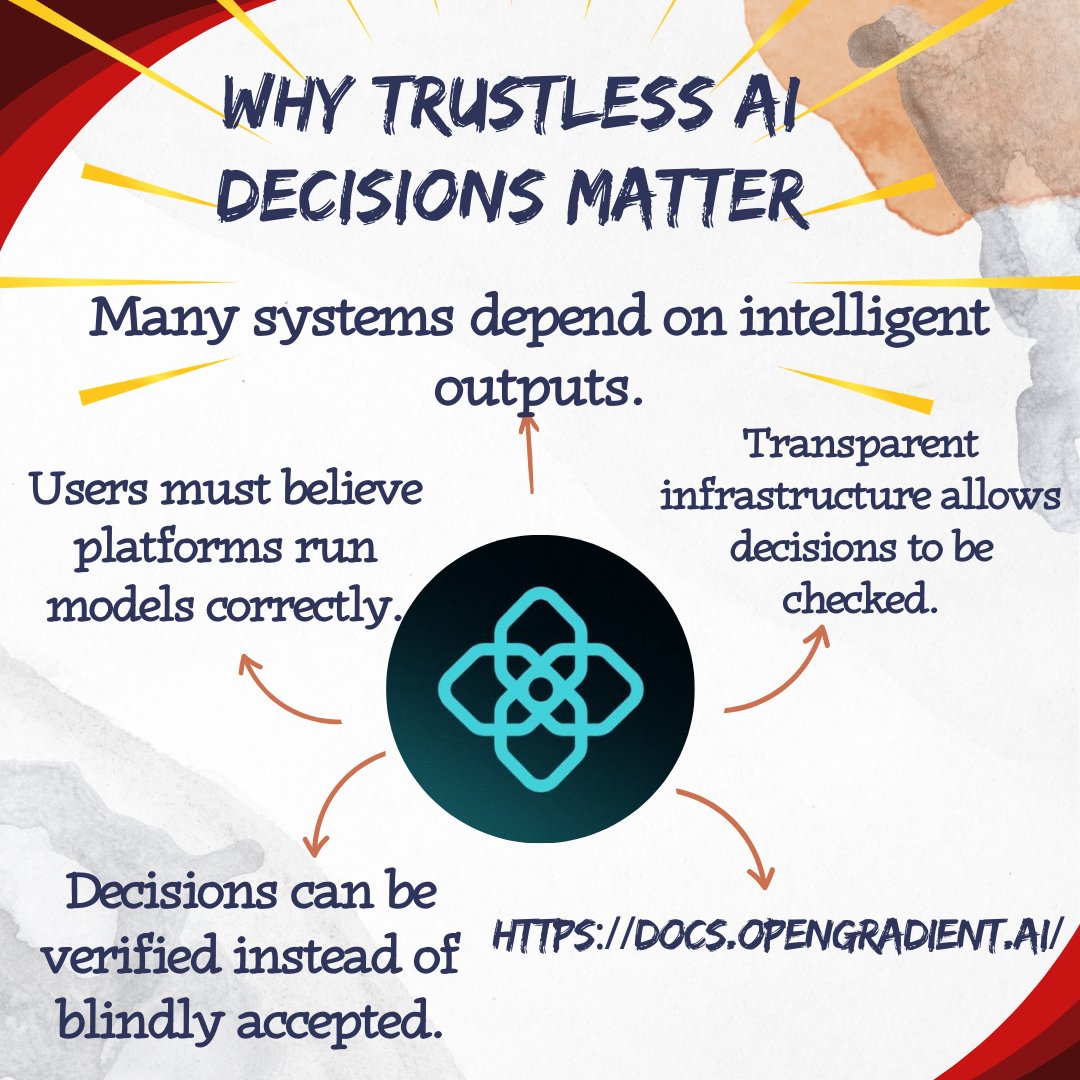
Why Trustless AI Decisions Matter for the Future @OpenGradient
@memsync_ai @SheTalksCrypto
Artificial intelligence is becoming a decision engine for many systems.
▪️It helps allocate resources, automate actions, and analyze complex data. As these systems grow more influential, the reliability of their decisions becomes critical.
But most current AI systems are built around trust.
▪️Users trust that the platform runs the model correctly. They trust that results are not manipulated or filtered. Yet they rarely have the tools to confirm these assumptions.
▪️This creates a structural weakness.
If AI decisions shape real-world outcomes, people need more than promises. They need systems where decisions can be verified.
@OpenGradient explores how decentralized and transparent infrastructure can support this idea.
▪️Instead of keeping intelligence locked inside private servers, OpenGradient focuses on environments where AI actions leave verifiable traces.
This makes it easier to confirm how decisions were produced.
▪️Trustless AI decision systems do not eliminate intelligence or human judgment. Instead, they strengthen the reliability of the system behind those decisions.
▪️As AI becomes more integrated into critical systems, moving toward trustless decision infrastructure may become essential.
@OpenGradient is exploring how that future could look.
Hope you like it 💞 @josephweb3 @advait_jayant @0x_Nate1

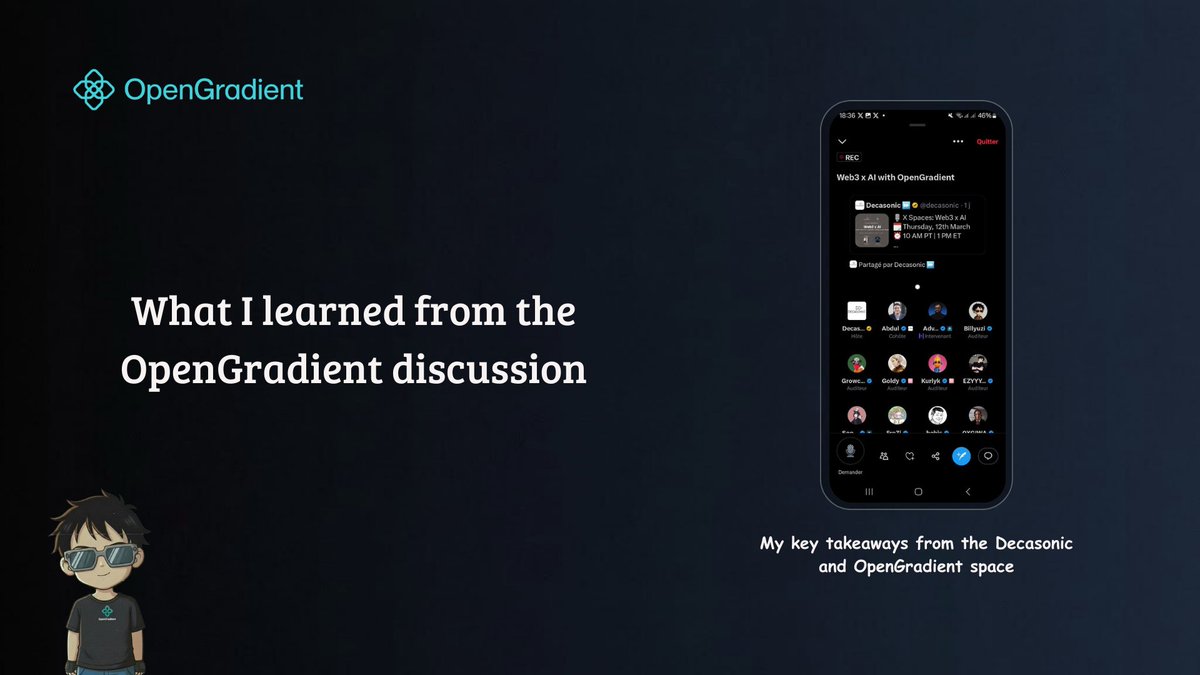
I listened to the space hosted by @decasonic with @OpenGradient and it gave me a clearer view of where AI infrastructure is going
One big problem in AI today is the black box. When an AI gives an answer, we usually cannot prove which model was used or if the process was correct
Open Gradient is trying to fix this by using cryptographic proofs verified on chain
The numbers also show real activity: 2M+ transactions, 263K wallets, and more than 2,000 models hosted, all running in Trusted Execution Environments to help keep data secure
They also talked about Memsync, an AI memory layer that lets AI agents remember things across apps while keeping user data private
Another interesting idea is digital twins. You can simulate the thinking style of investors and ask their AI version to help write things like pitch decks
My main takeaway is simple: AI infrastructure is getting stronger, especially with Web3 tools like on chain identity and autonomous agents
The tech is already being built. Now the challenge is to create useful apps on top of it.
@SheTalksCrypto @josephweb3 @0xChainWiz @0x_Nate1
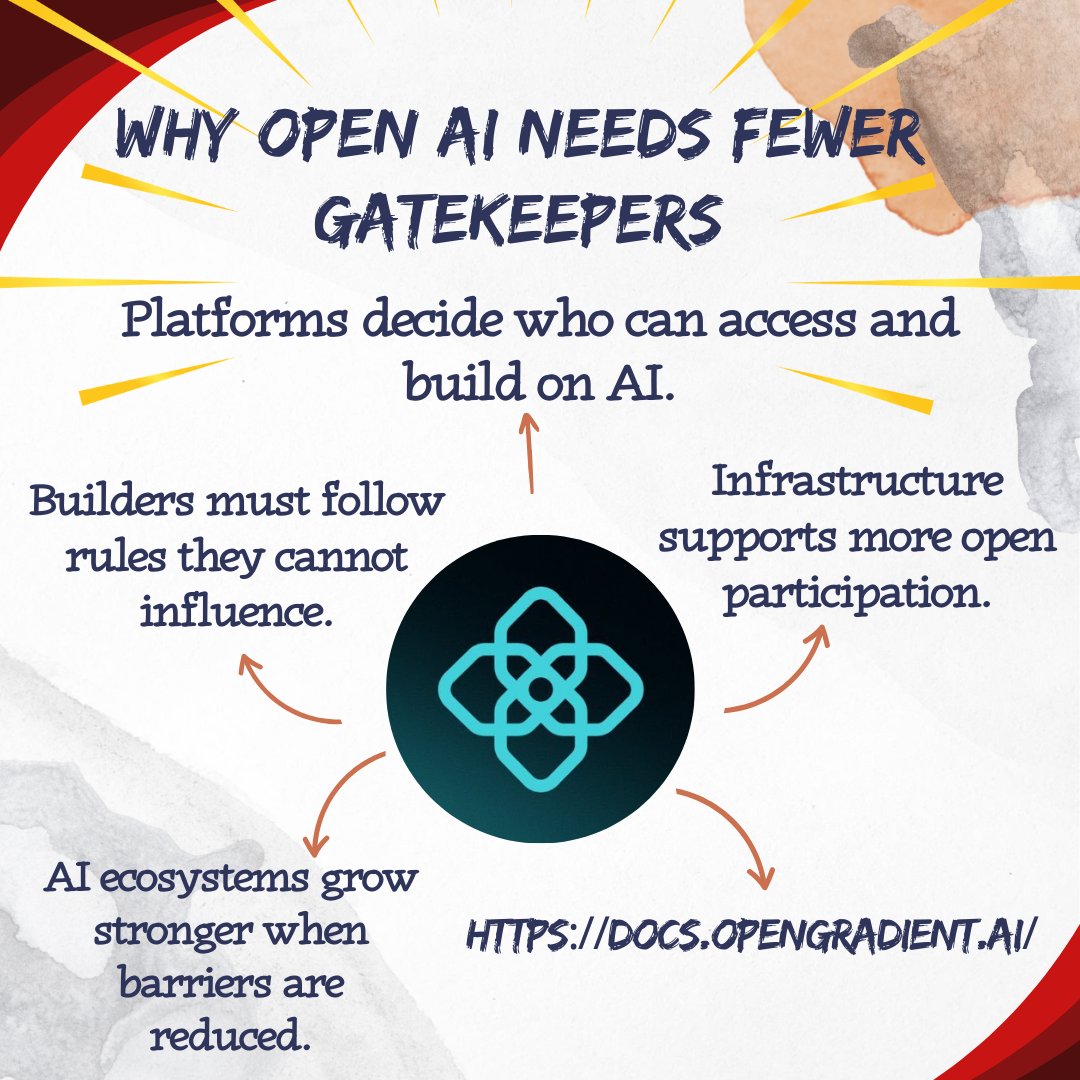
Why Open AI Needs Fewer Gatekeepers @OpenGradient
@memsync_ai
🔹Technology evolves faster when access is open. But many modern AI systems are built in ways that concentrate power. The companies that run the infrastructure decide how models operate, who can build on them, and how the systems change over time.
🔹This creates a gatekeeping structure.
Developers depend on permission.
Users depend on policies.
🔹Innovation moves only within the limits of the platform.
@OpenGradient explores a different path.
🔹Instead of placing intelligence behind centralized control points, the project focuses on building infrastructure that allows AI systems to operate in a more transparent and decentralized environment.
🔹When gatekeeping is reduced, experimentation becomes easier. Builders can interact with intelligence without relying entirely on one platform.
🔹This approach does not remove responsibility. But it does reduce unnecessary barriers.
🔹OpenGradient’s philosophy is simple: AI should grow through open systems, not through tightly controlled gates.
🔹By avoiding centralized gatekeeping by design, OpenGradient aims to create an ecosystem where intelligence can evolve more freely.
How's this boss @advait_jayant @SheTalksCrypto @josephweb3 @0x_Nate1

AI industry is building the agentic economy on a massive vulnerability. When you use a standard, centralized AI provider, you are forced to blindly trust a "black box". You send your data to an opaque server and just assume the model ran correctly and your information wasn't tampered with.
If an autonomous agent is making financial decisions based on that data, assumption is a critical security flaw.
@OpenGradient is the solution. It is a foundational, EVM-compatible Layer 1 blockchain engineered specifically to make artificial intelligence an open, verifiable, and user-owned utility. It shifts the baseline of the internet from trust-based execution to mathematically trustless AI systems.
Here is a deep dive into what OpenGradient is building and why it is the missing infrastructure for Web3 AI.
1. The HACA Engine: Redefining AI Compute
Standard blockchains cannot handle the massive computational weight of machine learning. OpenGradient solves this with its proprietary Hybrid AI Compute Architecture (HACA).
HACA separates the execution of the AI model from the verification of the ledger by splitting the network into specialized node types:
* The Sprinter (Inference Nodes): Stateless GPU workers dedicated solely to executing the AI models.
* The Judge (Full Nodes): Lightweight validators that never run the heavy models; they only verify the cryptographic proofs of execution and maintain consensus.
* The Scout (Data Nodes) & The Librarian (Storage): Nodes dedicated to secure external data access and decentralized model storage via networks like Walrus.
2. The x402 Upgrade: Verifiable Inference & Native Payments
The era of renting opaque SaaS tools is over. OpenGradient recently launched its x402-native inference upgrade, which merges computation integrity directly with internet-native payments.
* Trusted Execution Environments (TEEs): Your AI inference runs inside a sealed hardware enclave. The host operating system cannot peek inside, ensuring end-to-end data privacy and generating a cryptographic proof that the specific model ran exactly as requested.
* No Middleware: The x402 payment protocol is embedded directly into these TEE enclaves. Agents pay instantly for their compute per request on Base Sepolia using $OPG tokens, without needing any centralized billing proxies.
3. MemSync: Curing "AI Amnesia"
If TEEs are the brain, MemSync is the long-term memory. Currently, your context is fragmented across different apps.
MemSync is a protocol built on OpenGradient that extracts facts from your conversations, organizes them via semantic vector search, and builds evolving user profiles. This allows your AI agents to remember your preferences and past interactions across any platform, enabling highly personalized, persistent experiences.
4. Real-World Applications: https://t.co/UA3ADVya5X
This infrastructure is already powering consumer applications like https://t.co/UA3ADVya5X. This is an on-chain marketplace where users can trade access to verifiable AI "Digital Twins" of real creators and thought leaders.
Powered by @memsync_ai, these twins actually remember your past debates and interactions, providing a persistent and deeply personalized AI counterpart.
OpenGradient is treating computation integrity as core AI infrastructure rather than an optional service layer. From their Python SDK to the Claude Code plugin, they are giving developers the tools to build apps where execution is provable and outputs are auditable.
Stop building on blind faith. Stop trusting outputs and start verifying how computation actually occurred.
Validate at the protocol level.
Go build.
The OpenGradient Model Hub has now crossed 2,000+ verifiable models.
Each model runs with cryptographic verification, enabling inference that can be proven rather than simply trusted.
What this enables:
• Permissionless hosting of AI models
• Secure inference inside TEE / ZKML environments
• Onchain verification of model execution
• Private data that never needs to be exposed to operators
A growing ecosystem of models built around verifiable AI infrastructure.



The AI industry is currently facing a massive structural problem: blind trust. Every time you interact with a centralized AI model, you are forced to assume the provider is running the model they claim, keeping your data private and not tampering with the output. For the emerging agentic economy, where AI makes real-world decisions and handles financial transactions, "trust" simply isn't a high enough standard.
@OpenGradient is changing the baseline from trust-based execution to verifiable computation.
The Power of Verifiable Inference
Through the recent x402 upgrade, OpenGradient has moved the entire AI stack into Trusted Execution Environments (TEEs). This creates a secure, hardware-level "enclave" where code runs in isolation, protected even from the host machine's own operating system.
This architecture solves the core vulnerabilities of modern AI:
Provable Execution: You no longer have to guess if your model ran correctly; you get a cryptographic receipt that proves it did.
End-to-End Privacy: Security is enforced via enclave-terminated TLS connections, ensuring no intermediary can snoop on your data.
Integrated Payments: By embedding the x402 payment protocol directly into the computation layer, OpenGradient removes the need for centralized middleware, allowing agents to pay for inference as they go.
Memory That Belongs to You
Beyond just computation, the MemSync protocol addresses "AI amnesia." Instead of your context being trapped in different app silos, MemSync allows you to own your memory. It synthesizes your context into a secure, encrypted "Memory Vault" that you control, enabling true AI Digital Twins that actually remember your logic and preferences across platforms.
The New Standard for Developers
Whether it is through https://t.co/UA3ADVya5X the marketplace for verifiable AI minds or the Claude Code Plugin, OpenGradient is making it easier than ever to build on infrastructure that is trustless by design.
Stop treating your AI stack like a rented service layer. It’s time to build on core infrastructure where integrity is a protocol-level guarantee.
Stop trusting. Start verifying.
@josephweb3 @SheTalksCrypto
The OpenGradient network reimagines how blockchains can work.
With node specialization, powerful GPU + TEE nodes handle tasks like AI inference, while the rest of the network validates their work.
This creates a balance between scalability and decentralization.
@0xDeltaHedged explains ↓
Last Seen Hashtags on Sotwe
Most Popular Users

Elon Musk 
@elonmusk
239.7M followers

Barack Obama
@barackobama
118.6M followers

Cristiano Ronaldo
@cristiano
114.3M followers

Donald J. Trump
@realdonaldtrump
111.7M followers

Narendra Modi
@narendramodi
106.9M followers

Rihanna
@rihanna
98.6M followers

NASA
@nasa
92.1M followers

Justin Bieber
@justinbieber
91.7M followers

KATY PERRY
@katyperry
89.9M followers

Taylor Swift
@taylorswift13
83.9M followers

Lady Gaga
@ladygaga
75.4M followers

Virat Kohli
@imvkohli
73.3M followers

Kim Kardashian
@kimkardashian
70.8M followers

YouTube
@youtube
68.6M followers

Neymar Jr
@neymarjr
66.3M followers

Bill Gates
@billgates
65.1M followers

Selena Gomez
@selenagomez
63M followers

The Ellen Show
@theellenshow
62.1M followers

CNN
@cnn
61.7M followers

X
@x
60.6M followers