

Top Tweets for #Missforest

If you always fill missing values with zero/mean, read this:
The imputation strategy for missing data largely depends on the type of missingness, which can be of three types:
- Missing completely at random (MCAR): Data is genuinely missing at random and has no relation to any observed or unobserved variables.
- Missing at random (MAR): The missingness of one feature can be explained by other observed features in the dataset.
- Missing not at random (MNAR): Missingness is either attributed to the missing value itself or the feature(s) that we didn’t collect data for.
I have observed missing at random (MAR) appearing relatively much more in practical situations than the other two.
That is why imputing missing values with zero/mean isn't optimal all the time, and we can do better.
There are two imputation strategies I typically prefer to use if data is missing at random (MAR).
1) kNN imputation: Missing features are imputed by running a kNN on non-missing feature values.
Here's how it works:
- Step 1: Select a row (r) with a missing value.
- Step 2: Find its k nearest neighbors using the non-missing feature values.
- Step 3: Impute the missing feature of the row (r) using the corresponding non-missing values of k nearest neighbor rows.
- Step 4: Repeat for all rows with missing values.
2) MissForest: Some issues with kNN imputation are:
- It has a high run-time for imputation — especially for high-dimensional datasets.
- Does not support categorical features.
MissForest imputer is another reliable choice for missing value imputation when data is missing at random (MAR).
As the name suggests, it imputes missing values using the Random Forest algorithm.
Here's how it works:
- Step 1: To begin, impute the missing feature with a random guess — Mean, Median, etc.
- Step 2: Model the missing feature using Random Forest.
- Step 3: Impute ONLY originally missing values using Random Forest’s prediction.
- Step 4: Back to Step 2. Use the imputed dataset from Step 3 to train the next Random Forest model.
- Step 5: Repeat until convergence (or max iterations).
In case of multiple missing features, we impute features sequentially in increasing order missingness — features with fewer missing values are imputed first.
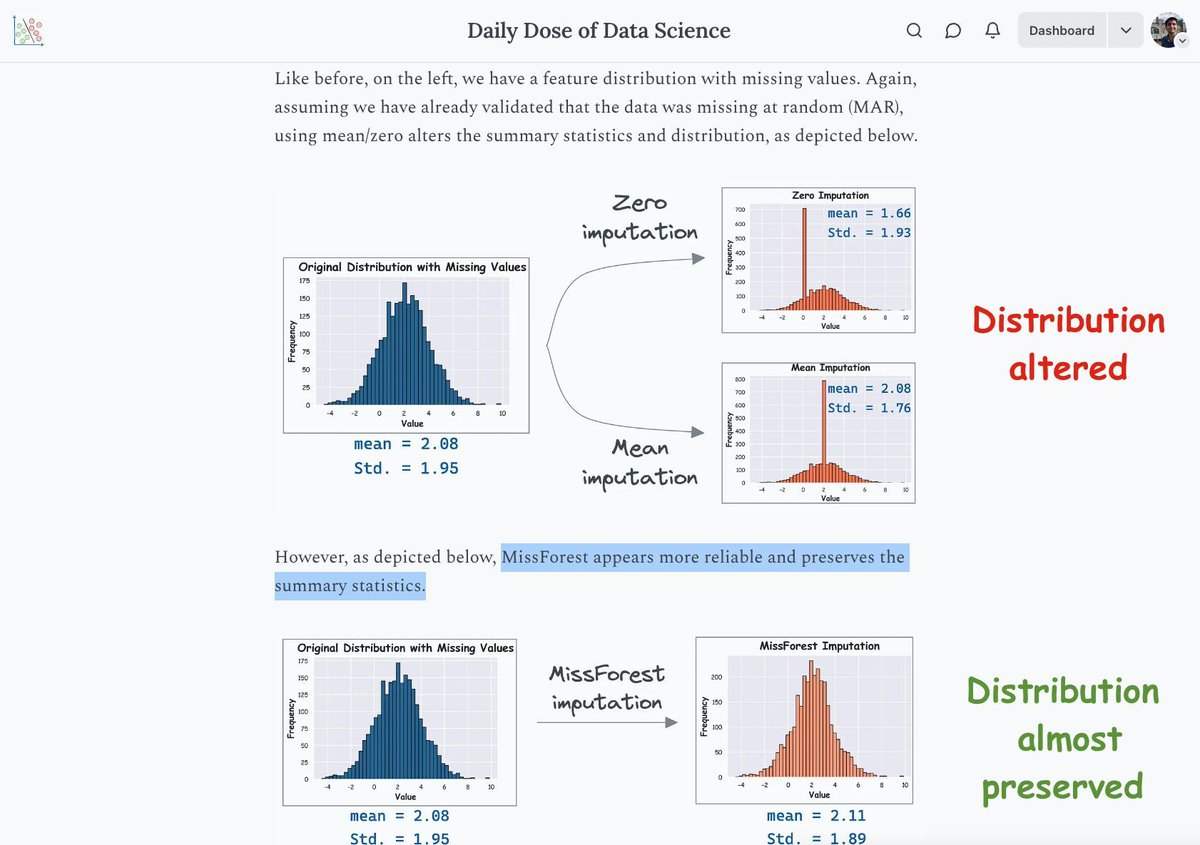
Its effectiveness over mean/zero imputation is evident from the demo below.
- using mean/zero alters the summary statistics and distribution
- MissForest appears more reliable and preserves the summary statistics.
👉 Over to you: What are some other better ways to impute missing values when data is missing at random (MAR)?
Code-related details are available in the subsequent post.
If you always fill missing values with zero/mean, read this:
The imputation strategy for missing data largely depends on the type of missingness, which can be of three types:
- Missing completely at random (MCAR): Data is genuinely missing at random and has no relation to any observed or unobserved variables.
- Missing at random (MAR): The missingness of one feature can be explained by other observed features in the dataset.
- Missing not at random (MNAR): Missingness is either attributed to the missing value itself or the feature(s) that we didn’t collect data for.
I have observed missing at random (MAR) appearing relatively much more in practical situations than the other two.
That is why imputing missing values with zero/mean isn't optimal all the time, and we can do better.
There are two imputation strategies I typically prefer to use if data is missing at random (MAR).
1) kNN imputation: Missing features are imputed by running a kNN on non-missing feature values.
Here's how it works:
- Step 1: Select a row (r) with a missing value.
- Step 2: Find its k nearest neighbors using the non-missing feature values.
- Step 3: Impute the missing feature of the row (r) using the corresponding non-missing values of k nearest neighbor rows.
- Step 4: Repeat for all rows with missing values.
2) MissForest: Some issues with kNN imputation are:
- It has a high run-time for imputation — especially for high-dimensional datasets.
- Does not support categorical features.
MissForest imputer is another reliable choice for missing value imputation when data is missing at random (MAR).
As the name suggests, it imputes missing values using the Random Forest algorithm.
Here's how it works:
- Step 1: To begin, impute the missing feature with a random guess — Mean, Median, etc.
- Step 2: Model the missing feature using Random Forest.
- Step 3: Impute ONLY originally missing values using Random Forest’s prediction.
- Step 4: Back to Step 2. Use the imputed dataset from Step 3 to train the next Random Forest model.
- Step 5: Repeat until convergence (or max iterations).
In case of multiple missing features, we impute features sequentially in increasing order missingness — features with fewer missing values are imputed first.
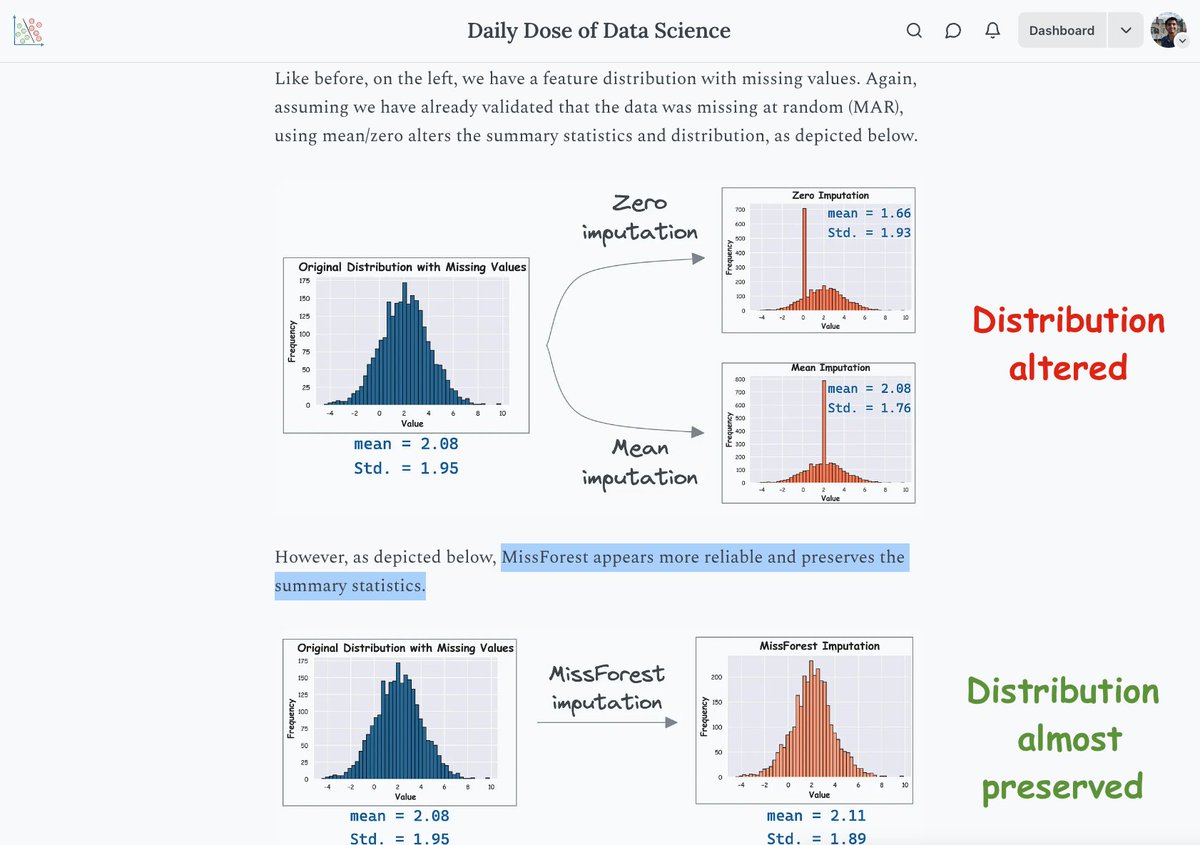
Its effectiveness over mean/zero imputation is evident from the demo below.
- using mean/zero alters the summary statistics and distribution
- MissForest appears more reliable and preserves the summary statistics.
We discussed the code and other technical details of both strategies in a recent issue of Daily Dose of Data Science newsletter: https://t.co/liozk4W6WR
--
👉 Join 78k+ data scientists and get a Free data science PDF (550+ pages) with 320+ posts by subscribing to my daily newsletter: https://t.co/nUXYgMx84B
--
👉 Over to you: What are some other better ways to impute missing values when data is missing at random (MAR)?
The overlooked issue with zero (or mean) imputation.
Here's what happens when you use it:
Replacing (imputing) missing values with mean or zero or any other fixed value:
- alters summary statistics
- changes the distribution
- inflates the presence of a specific value
This can lead to:
- inaccurate modeling
- incorrect conclusions, and more.
Instead, always try to impute missing values with more precision.
MissForest imputer is a reliable choice for missing value imputation.
As the name suggests, it imputes missing values using the Random Forest algorithm.
Step 1) To begin, impute the missing feature with a random guess — Mean, Median, etc.
Step 2) Model the missing feature using Random Forest.
Step 3) Impute ONLY originally missing values using the model's prediction.
Step 4) Back to Step 2. Use the imputed dataset from Step 3 to train the next Random Forest model.
Step 5) Repeat until convergence (or max iterations).
Its effectiveness over Mean/Zero imputation is evident from the image below.
As shown:
- Mean/Zero alters the summary statistics and distribution.
- MissForest preserves them.
--
👉 Get a Free Data Science PDF (550+ pages) with 320+ tips by subscribing to my daily newsletter today: https://t.co/xILUKooE4I.
--
👉 Over to you: What are some other better ways to impute missing values?

The overlooked issue with zero (or mean) imputation.
Here's what happens when you use it.
Replacing (imputing) missing values with mean or zero or any other fixed value:
- alters summary statistics
- changes the distribution
- inflates the presence of a specific value
This can lead to:
- inaccurate modeling
- incorrect conclusions, and more.
Instead, always try to impute missing values with more precision.
MissForest imputer is a reliable choice for missing value imputation.
As the name suggests, it imputes missing values using the Random Forest algorithm.
Step 1) To begin, impute the missing feature with a random guess — Mean, Median, etc.
Step 2) Model the missing feature using Random Forest.
Step 3) Impute ONLY originally missing values using the model's prediction.
Step 4) Back to Step 2. Use the imputed dataset from Step 3 to train the next Random Forest model.
Step 5) Repeat until convergence (or max iterations).
Its effectiveness over Mean/Zero imputation is evident from the image below.
As shown:
- Mean/Zero alters the summary statistics and distribution.
- MissForest preserves them.
--
👉 Get a Free Data Science PDF (550+ pages) with 320+ tips by subscribing to my daily newsletter today: https://t.co/xILUKooE4I.
--
👉 Over to you: What are some other better ways to impute missing values?

The overlooked issue with zero (or mean) imputation.
Here's what happens when you use it:
.
.
Replacing (imputing) missing values with mean or zero or any other fixed value:
- alters summary statistics
- changes the distribution
- inflates the presence of a specific value
This can lead to:
- inaccurate modeling
- incorrect conclusions, and more.
Instead, always try to impute missing values with more precision.
MissForest imputer is a reliable choice for missing value imputation.
As the name suggests, it imputes missing values using the Random Forest algorithm.
Step 1) To begin, impute the missing feature with a random guess — Mean, Median, etc.
Step 2) Model the missing feature using Random Forest.
Step 3) Impute ONLY originally missing values using the model's prediction.
Step 4) Back to Step 2. Use the imputed dataset from Step 3 to train the next Random Forest model.
Step 5) Repeat until convergence (or max iterations).
Its effectiveness over Mean/Zero imputation is evident from the image below.
As shown:
- Mean/Zero alters the summary statistics and distribution.
- MissForest preserves them.
--
👉 Get a Free Data Science PDF (550+ pages) with 320+ tips by subscribing to my daily newsletter today: https://t.co/xILUKopbUg.
--
👉 Over to you: What are some other better ways to impute missing values?
The overlooked issue with zero (or mean) imputation.
Here's what happens when you use it:
.
.
Replacing (imputing) missing values with mean or zero or any other fixed value:
- alters summary statistics
- changes the distribution
- inflates the presence of a specific value
This can lead to:
- inaccurate modeling
- incorrect conclusions, and more.
Instead, always try to impute missing values with more precision.
MissForest imputer is a reliable choice for missing value imputation.
As the name suggests, it imputes missing values using the Random Forest algorithm.
Step 1) To begin, impute the missing feature with a random guess — Mean, Median, etc.
Step 2) Model the missing feature using Random Forest.
Step 3) Impute ONLY originally missing values using the model's prediction.
Step 4) Back to Step 2. Use the imputed dataset from Step 3 to train the next Random Forest model.
Step 5) Repeat until convergence (or max iterations).
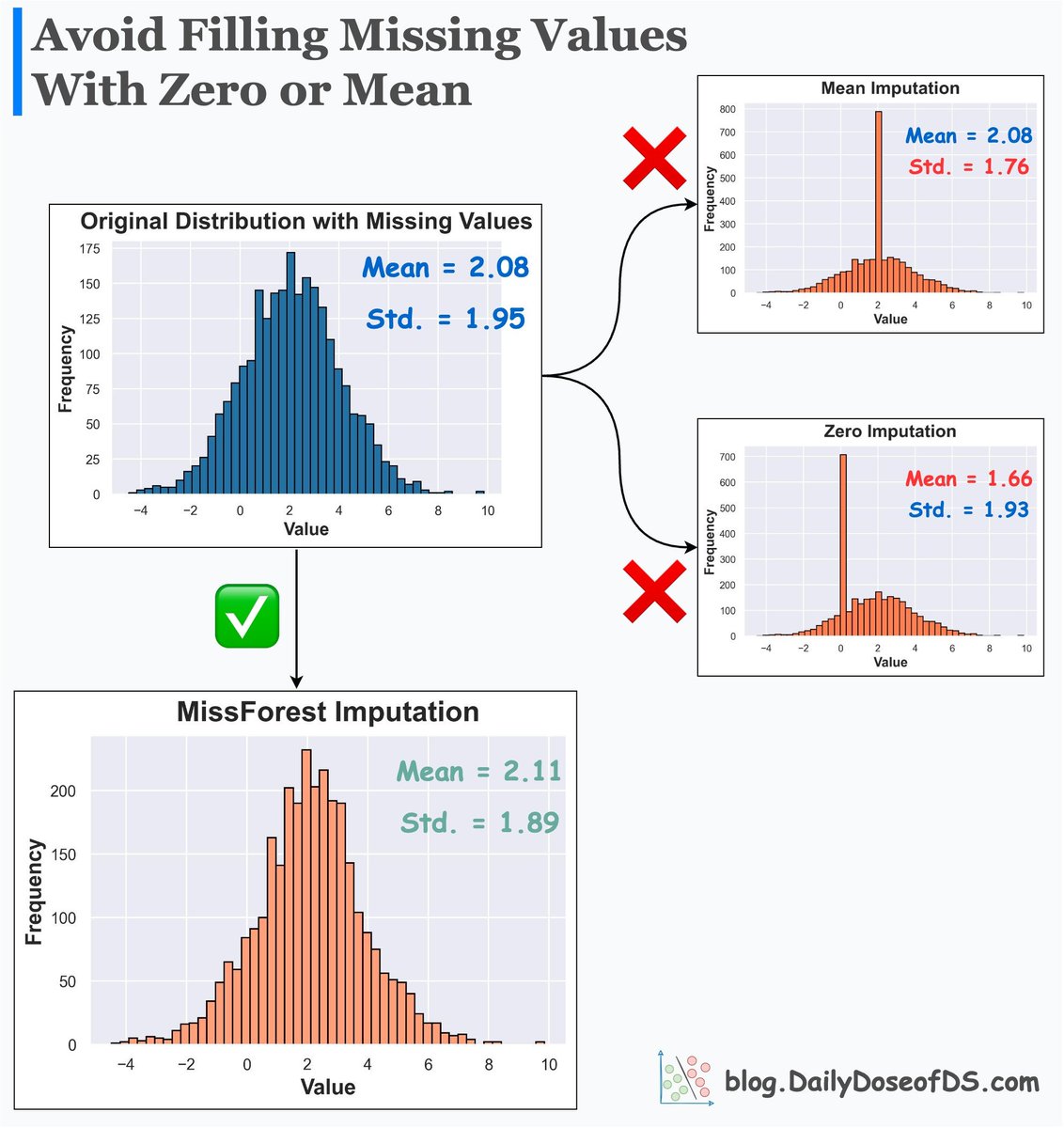
Its effectiveness over Mean/Zero imputation is evident from the image below.
As shown:
- Mean/Zero alters the summary statistics and distribution.
- MissForest preserves them.
--
👉 Get a Free Data Science PDF (550+ pages) with 320+ tips by subscribing to my daily newsletter today: https://t.co/xILUKopbUg.
--
👉 Over to you: What are some other better ways to impute missing values?

Last Seen Hashtags on Sotwe
Trends for you
Most Popular Users

Elon Musk 
@elonmusk
239.7M followers

Barack Obama
@barackobama
118.6M followers

Cristiano Ronaldo
@cristiano
114.3M followers

Donald J. Trump
@realdonaldtrump
111.7M followers

Narendra Modi
@narendramodi
106.9M followers

Rihanna
@rihanna
98.6M followers

NASA
@nasa
92.1M followers

Justin Bieber
@justinbieber
91.7M followers

KATY PERRY
@katyperry
89.9M followers

Taylor Swift
@taylorswift13
83.9M followers

Lady Gaga
@ladygaga
75.4M followers

Virat Kohli
@imvkohli
73.3M followers

Kim Kardashian
@kimkardashian
70.8M followers

YouTube
@youtube
68.6M followers

Neymar Jr
@neymarjr
66.3M followers

Bill Gates
@billgates
65.1M followers

Selena Gomez
@selenagomez
63M followers

The Ellen Show
@theellenshow
62.1M followers

CNN
@cnn
61.7M followers

X
@x
60.6M followers