

Top Tweets for #OpenPR

We Just wired up PostHog telemetry in our openpromptos dot com.
No more guessing how users actually use the prompt composer..

Old way: Writing raw markdown prompts, guessing token counts, and pasting manually into local chat UIs.
New way: OpenPrompt OS compiles, validates, and formats the exact prompt schema automatically.
@PlotnikovDev Context rot kills long agent runs fast. If a subagent passes back bloated history, your token budget drops right when you need it most. We isolate context tightly in OpenPrompt OS to keep multi-LLM runs clean.
Shipped raw copy-pasteable prompt output in OpenPrompt OS today.
Killed all the template boilerplate wrapping our generated text in apps/api and guided-parameters.tsx so you can drop outputs straight into your LLM call without manual cleanup.
Nightly polish pass on OpenPrompt OS:
- Upgraded the Reverse Engineer prompt pipeline for more detailed, structured templates
- Eliminated FOUC on initial load by inlining critical layout styles earlier in hydration
- Cleaned up footer CSS alignment
Users rarely notice good layout stability..
they immediately notice when it flickers.
Hacking on OpenPrompt OS on nights and weekends alongside my day job. Right now we're building a prompt autopsy tool to diagnose bad AI outputs. Most LLM failures come down to conflicting system constraints rather than model capability. When an agent breaks, explicitly isolating negative constraints fixes the output faster than rewording the whole prompt.
Unpopular opinion: MIT is a trap for bootstrapped indie devs.
We just switched OpenPrompt OS over to the PolyForm Noncommercial License 1.0.0.
MIT is fine when you have VC backing. As a 2-person team building on nights and weekends, watching someone wrap your repo into a paid SaaS without contributing a single line back gets old fast.
Just pushed a few updates to OpenPrompt OS:
* Anyime feedback & feature requests (saves to the DB and pings my inbox right away)
* Optional "how did you find us?" on signup
* Structured NDJSON logging with W3C trace correlation and auto secret redaction
Small stuff, but it already makes debugging and hearing from users way easier.
What are you building today??
Built a Reverse Engineer tool for OpenPrompt OS.
Drop in any reference image and it breaks down the lighting, lens, and style into a reusable prompt with structured `[Variable]` slots.
Works for both image prompts and video motion prompts.

Last one weeks on OpenPrompt OS: - Monorepo + Postgres + Cloudflare setup - Social login & API integrations - Building out MCP tools - UI/UX polish + early Reddit outreach No giant roadmap decks.. just daily connects, small PRs, and talking to real users as early as possible.
@devsolojr That initial grind for true active users is exhausting. We're building OpenPrompt OS on nights and weekends and half the battle is just finding people to try ...
Shipping a dev tool on nights and weekends only works if you and your co-founder have zero ego and clear ownership.
How we actually split the workload on OpenPrompt OS:
1. Database & Security Layer (Co-founder):
Going beyond what ‘schema.prisma’ can express by writing raw Postgres SQL post-migration—enforcing ‘FORCE ROW LEVEL SECURITY’ per workspace via ‘SET LOCAL https://t.co/cWAC1oH2ti_id’, XOR check constraints for guest vs. user usage counters, and partial unique indexes to prevent duplicate live subscriptions.
2. Core Engine, Auth & Quality Gates (Me):
Building the AST prompt compiler, target-model rule synthesizer, circuit breaker, and Cloudflare Turnstile OTP protection—plus wiring up Vitest and Stryker mutation testing so weak unit tests don't slip through.
3. Daily Async PR Reviews (Both):
No bloated sprint meetings. We write detailed specs, ship focused PRs after work, and review each other's architecture and diffs asynchronously before merging to main.
For those building with a co-founder on the side: how do you divide the stack?
Pairing different agents so one writes the code and the other reviews the diff is the exact workflow unlock most devs are missing right now. We do a similar split between planning , review models and execution models when shipping OpenPrompt OS…..
How are you handling context handoff between Claude Code and Codex so they don't blow up token usage?
Unprotected email OTP endpoints are an open invitation for bot traffic, Resend quota exhaustion, and wrecked sender reputation.
Just wired up Cloudflare Turnstile on our auth flow in OpenPrompt OS:
- Server-side token validation before any OTP email is triggered
- Mocked Turnstile responses in our unit & E2E suites so CI stays fast and deterministic
- Zero creepy tracking or "click all the traffic lights" friction from reCAPTCHA
How are you protecting your auth/email endpoints from bot bombing?
We started with simple regex replacement for dynamic variables in OpenPrompt OS prompts, but nested structures and arrays broke it instantly. Had to swap it out for a lightweight AST parser. Takes an extra 3ms on compile, but caught all edge cases with zero prompt injection risks.
Just implemented mutation testing alongside our unit tests in OpenPrompt OS.
100% code coverage means nothing if a test doesn't assert the right behavior. Mutation testing injects tiny bugs into our core logic … if a mutant survives, we know a unit test is weak.
With AI coding agents writing more of our code and tests, verifying the test suite itself is more important than ever.
Was reviewing our database PRs for OpenPrompt OS tonight and found a gem my co-founder wired up on top of Prisma.
Relying purely on ‘WHERE space_id = ?’ in application code is always one forgotten filter away from a cross-tenant data leak. Instead of trusting the ORM alone, he added a custom SQL layer for Postgres Row-Level Security (RLS) + strict constraints:
- Every request runs ‘SET LOCAL https://t.co/cWAC1oGuDK_id’ inside the transaction
- ‘FORCE ROW LEVEL SECURITY’ on all tenant tables (‘saved_prompts’, ‘subscriptions’, ‘space_members’)
- XOR ‘CHECK’ constraints for guest vs. workspace usage counters
- Partial unique indexes to guarantee at most one active subscription per workspace
Even if an API route forgets a filter, Postgres blocks the leak at the database engine level. Huge shoutout to @m_praki for locking this in early.
Are you enforcing multi tenant isolation in Postgres RLS, or keeping checks in your API layer?
Just set up the complete production email stack for openpromptos. com in 15 minutes for $0/month.
Inbound founder inbox + outbound transactional auth emails.
Here is the exact DNS setup so you don't wreck your root domain's reputation: 🧵👇
The golden rule: separate human mail from automated app mail.
1. Inbound (`[email protected]`): Handled on the root (`@`) via Cloudflare Email Routing → forwards straight to Gmail for $0.
2. Outbound (`[email protected]`): Handled on a `mail.` subdomain via Resend (3,000 free/mo).
If automated OTPs ever trigger spam filters, `mail.` takes the hit while your primary `@` founder domain stays untouched.
We're setting up authentication for OpenPrompt OS (open-source + cloud workspace). Would you go with Clerk for speed, or Better Auth to keep all user data inside your own database?
Drop your honest take below curious what everyone is running in prod right now.
@surjastic Appreciate the invite! Right now my co-founder and I have our heads down coding OpenPrompt OS after our day jobs, but drop a link to your channel here once your first episodes are live!
Every frontier model speaks a slightly different dialect.. a prompt that nails the output in Claude sometimes falls flat in ChatGPT, Gemini, or Cursor.
We're building the Target Model selector inside OpenPrompt OS to automatically adapt your prompt's structure, constraints, and formatting for the exact model you're running.
When a prompt fails on you today, do you spend time rewriting the instructions, or do you just switch models and hope for the best?
Building the template engine for OpenPrompt OS tonight.
Right now we're making it take raw, unstructured prompts and turn them into structured frameworks (like CO-STAR) with dynamic [Variables] you can reuse across ChatGPT, Claude, Gemini, and Cursor.
Be honest: do you actually keep a saved library of prompt templates, or do you still type from scratch every time?
We wired up PostHog across our client bundles, backend API, and edge runtimes this weekend for OpenPrompt OS.
It adds a bit of payload weight to the client, but chasing errors across three isolated runtimes without a single observability pipeline was burning too much time.
Are you using PostHog across client and edge runtimes too, or did you roll your own tracing pipeline?
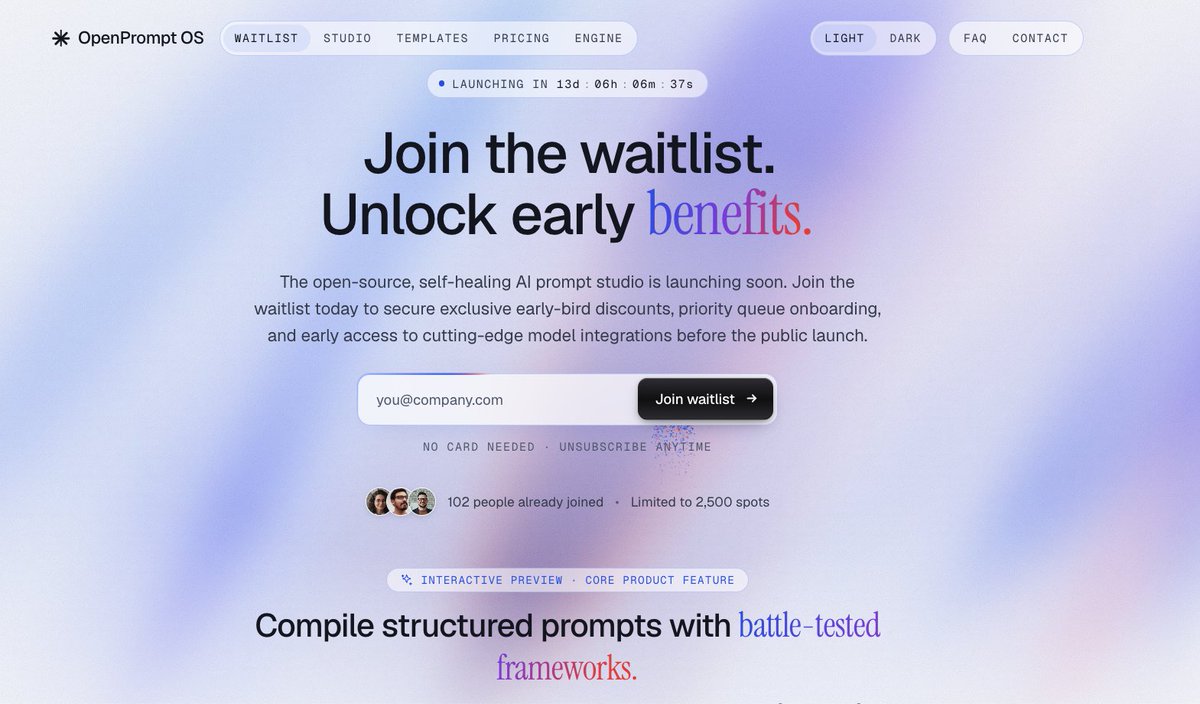
The waitlist for OpenPrompt OS (openpromptos .com) is officially live!
My co-founder and I wired up the domain and waitlist page tonight after our day jobs. Here is the exact 4-step DNS playbook I use every time we launch a new domain so we don't wait 24 hours or get burned on renewals:
1. Decouple registrar from DNS
Buy the domain wherever year-1 pricing is cheapest, but never leave your DNS on a slow retail registrar.
2. Move nameservers to Cloudflare on day one
Point authoritative nameservers to Cloudflare immediately. Map CNAMEs straight to edge deployments (Pages/Workers) for global routing and instant SSL.
3. Skip the 24-hour propagation wait
Force immediate DNS resolution locally instead of waiting on ISP caches:
• macOS: sudo dscacheutil -flushcache; sudo killall -HUP mDNSResponder
• Chrome: chrome://net-internals/# dns -> Clear host cache
4. Dodge the Year-2 renewal markup
Set an 11-month calendar reminder right now to transfer the registrar to Cloudflare and lock in wholesale ICANN pricing before the 3x retail auto-renewal hits.
What's your go-to stack for spinning up a new domain and waitlist page?
Multi-agent orchestration gets messy fast. If a switch drops token state halfway through, model B gets corrupted context. We had to carefully build state preservation before triggering fallback. We're building this multi-LLM router into OpenPrompt OS with circuit-breaker failovers across Claude, OpenAI, and Groq to handle it cleanly.
Yeah, multi-agent orchestration gets messy fast. If a switch drops token state halfway through, model B gets corrupted context. We had to carefully build state preservation before triggering fallback. We're building this multi-LLM router into OpenPrompt OS with circuit-breaker failovers across Claude, OpenAI, and Groq to handle it cleanly.
We spent whole night rewriting our token fallback logic in OpenPrompt OS because rate limits kept breaking our prompt compilation pipeline.
Rotating API keys across multiple accounts in code is messy, but relying on a single provider endpoint just doesn't scale when you're hitting it constantly from local dev.
Built a simple round robin fallback across three API keys in Postgres to keep the prompt compiler running without throwing 429s.
Last Seen Hashtags on Sotwe
Trends for you
Most Popular Users

Elon Musk 
@elonmusk
240.1M followers

Barack Obama
@barackobama
118.6M followers

Cristiano Ronaldo
@cristiano
114.4M followers

Donald J. Trump
@realdonaldtrump
111.7M followers

Narendra Modi
@narendramodi
106.9M followers

Rihanna
@rihanna
98.6M followers

NASA
@nasa
92.1M followers

Justin Bieber
@justinbieber
91.7M followers

KATY PERRY
@katyperry
89.9M followers

Taylor Swift
@taylorswift13
83.9M followers

Lady Gaga
@ladygaga
75.4M followers

Virat Kohli
@imvkohli
73.3M followers

Kim Kardashian
@kimkardashian
70.8M followers

YouTube
@youtube
68.6M followers

Neymar Jr
@neymarjr
66.3M followers

Bill Gates
@billgates
65.2M followers

Selena Gomez
@selenagomez
63M followers

The Ellen Show
@theellenshow
62.1M followers

CNN
@cnn
61.7M followers

X
@x
60.6M followers