

Top Tweets for #Pathtwitter


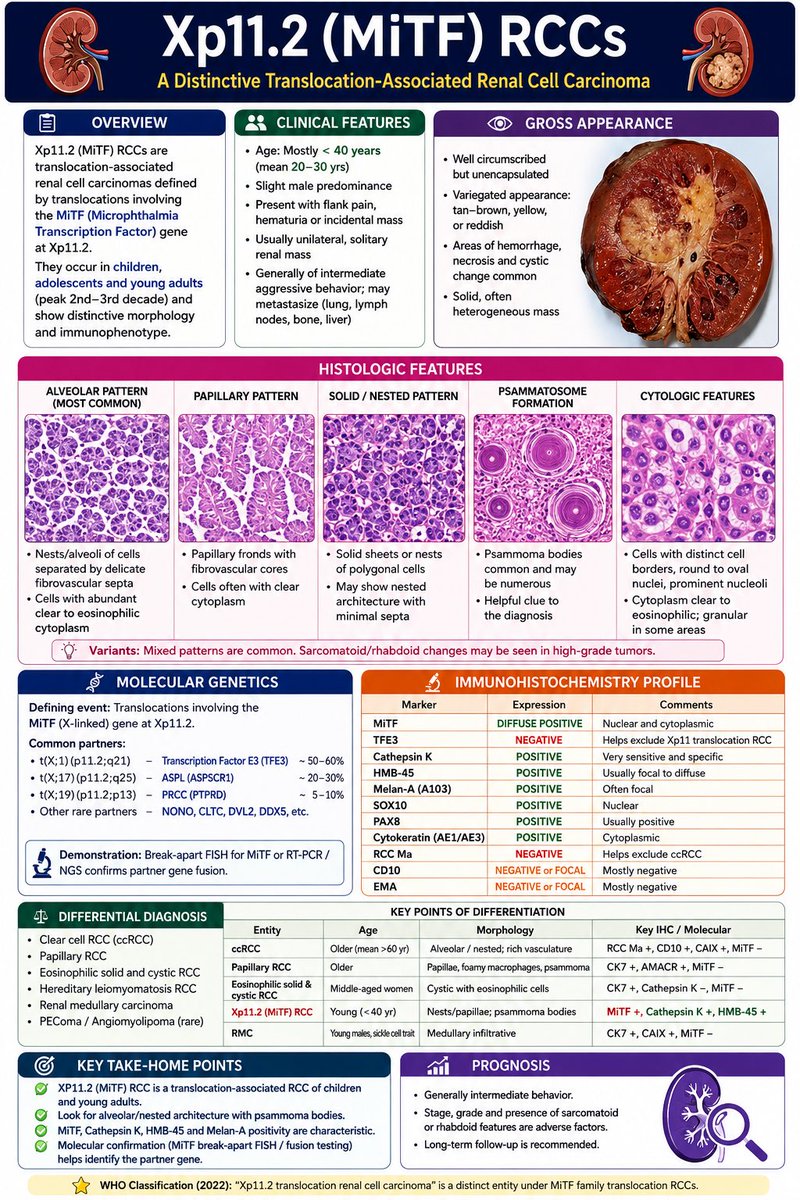

🦠#EScoP #course for Infectious Diseases in Vienna, Austria!
🔬🖼️Educational activities from the @ESP_Pathology bring you the best combination for #education in #pathology, networking, and cultural enrichment!
#PathTwitter #PathX
Join the top of the top for pathology!
Meet us in Stockholm or online for the latest advancements in precision medicine, research, diagnosis, biomarker testing, and more!
#PathTwitter
#PathX
#MedTwitter

🚨The preliminary programme for #ESPCongress is now available!
https://t.co/xwL8vQRkBq
Join us in Stockholm for the best congress for innovation driven excellence in #pathology!
Not registered yet?
Benefit from early bird registration now!
https://t.co/IsilSLWgS3


Q.A 60-year-old hypertensive man suddenly develops right-sided weakness.
CT scan shows a basal ganglia hemorrhage.
Most likely underlying cause?
🔴A) Aneurysm rupture
🔴B) Hyaline arteriolosclerosis
🔴C) Cerebral amyloid angiopathy
🔴D) Venous thrombosis
#PathTwitter #PathX #MrdTwitter

🚨 Think Smart!
Q.Which disease is it?
🔴A) AML
🔴B) CML
🔴C) ALL
🔴D) CLL
#PathTwitter #MedX #pathology
@IhabFathiSulima

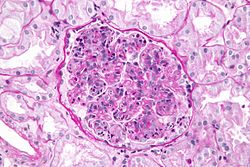
Q.A young male presents with hematuria following a sore throat. Renal biopsy shows “lumpy-bumpy” deposits of IgG and C3.
Your diagnosis?
🔴A) Minimal change disease
🔴B) Post-streptococcal
glomerulonephritis
🔴C) IgA nephropathy
🔴D) Membranous nephropathy
#pathology #MedX #PathTwitter
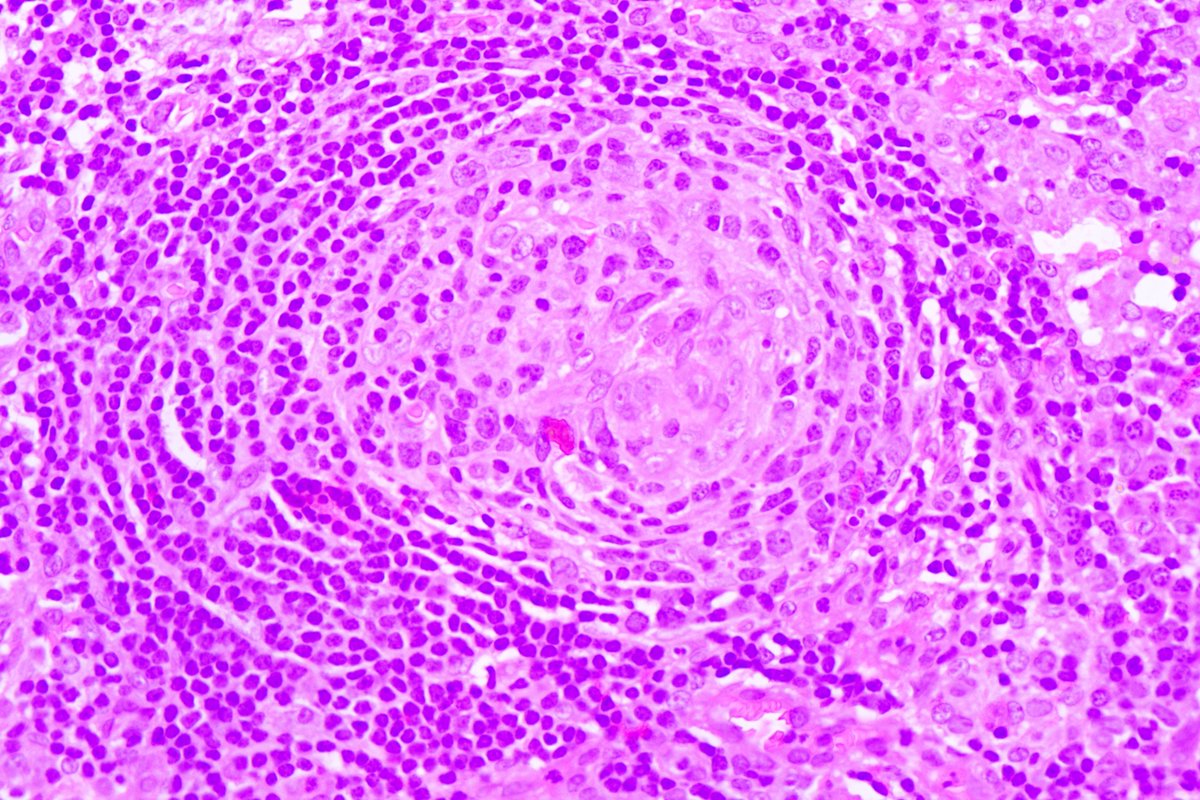
Q.What's your diagnosis?
🔴A) CMV infection
🔴B) HSV infection
🔴C) EBV infection
🔴D) Adenovirus
#PathTwitter #MedX #pathology
@IhabFathiSulima #pathX


Q.A 45-year-old man presents with jaundice and hepatomegaly. His liver biopsy shows “ground-glass” hepatocytes.
What’s the most likely diagnosis?
🔴A) Alcoholic hepatitis
🔴B) Hepatitis B infection
🔴C) Wilson’s disease
🔴D) Hemochromatosis
#pathology #Liver
#PathTwitter #MedTwitter


More on IRF4-rearranged lymphomas, and expanding its' spectrum to encompass low grade follicular lymphoma, with example in picture below from https://t.co/jBkjl4NXSB by @sakhdari_ali at @e_JHaem
The low grade follicular lymphoma illustrated in this article, shows molecular similarities to large B-cell lymphoma-IRF4 rearranged with mutations in KMT2D and NF‐κB pathway gene CARD11; In addition to mutations in IRF4 and CREBBP
IRF4 rearrangement is not exclusive to large B-cell lymphoma-IRF4 rearranged, as it can also occur in other aggressive B‐cell lymphomas, particularly those associated with MYC or BCL2 rearrangements https://t.co/mT1jznmauq
Cases of low grade and high grade B-cell lymphoma with IRF4 rearrangement are typically picked-up by performing MUM1 stain which shows in this scenario bright homogeneous expression, prompting the investigation for a possible IRF4 rearrangement by FISH
#Hemepath #Lymsm #PathX #Pathtwitter #Surgpath #MedEd #SoMe #MedX #MedTwitter #Pathology #Molpath

Expanding on the theme of IRF4 rearrangement in B-cell lymphomas, beyond "large B-cell lymphoma with IRF4 rearrangement":
EBV-associated DLBCL may in rare instances harbor IRF4 rearrangement.
These cases appear to exhibit clinical, histologic, immunophenotypic and molecular characteristics of EBV +DLBCL, while harboring recurrent IRF4 mutations.
More on this➡️
https://t.co/modNQ6GrSQ
#Hemepath #Lymsm #Pathtwitter #PathX #MedEd
https://t.co/cyRL2rRpGA

Acute promyelocytic leukemia (APL) in the setting of primary or secondary MPO deficiency can create diagnostic challenges, as bright MPO expression by flow cytometry analysis is a key feature of APL.
Six cases of APL with reduced MPO expression (2 cases) and absent MPO expression (4 cases) have been described so far: Four of the microgranular variant and two classic APL cases.
One of the MPO negative microgranular APL has been extensively analyzed and found to have a germline heterozygous MPO loss of function mutation (MPO c.2031 -2A > C) with somatic uniparental disomy of 17q, resulting in homozygous MPO deficiency and subsequent MPO negativity in the myeloblasts.
Three different flow cytometric patterns of immunoreactivity with the MPO protein have been described in the setting of MPO deficiency:
(a) Dim/absent MPO expression, characteristic of patients with primary complete MPO deficiency.
(b) Moderate MPO expression, typical of patients with primary partial MPO deficiency.
(c) Bright MPO expression, typical of patients with secondary MPO deficiency (a functionally inactive form of the enzyme is present at normal levels).
MPO deficiency was previously thought to be extremely rare; However, recent studies have suggested that the incidence might be much higher, with a reported frequency of 1 per 200 to 4,000 in the US. The prevalence of heterozygotes for MPO c.2031-2A > C may close to 1% in the population.
In the setting of an acute leukemia with morphologic and immunophenotypic features typical of APL, with dim to absent MPO expression, evaluating MPO expression in background granulocytes is very helpful to highlight the possibility of a primary (hereditary) form of MPO deficiency (partial or complete):
Figure 1 below illustrates a case of primary MPO deficiency with dim/negative MPO expression in granulocytes, while Figure 2 illustrates bright MPO expression in granulocytes in normal control.
For more on this + figure credits, check this article by @Kritika_Krish @ChoudhuriJui @YanhuaWang3
➡️ https://t.co/V2DZqtF5Vj
#Leusm #hemepath #molpath #pathX #pathTwitter #SoMe #MedEd #BMTsm


A new fear unlocked: Leukemic non-nodal mantle cell lymphoma may involve the bone marrow in a very subtle sinusoidal way, as illustrated in figure 1 below with H&E and CCND1 stain highlighting a sinusoidal neoplastic lymphocytic infiltrate.
In addition to this sneaky pattern of infiltration, leukemic non-nodal mantle cell lymphoma may be CD5-negative occasionally, which may create a great diagnostic pitfall, as other CD5-negative B-cell lymphomas, classically known for their sinusoidal pattern of infiltration (such as splenic marginal zone lymphoma, splenic diffuse red pulp small B-cell lymphoma and splenic B-cell lymphoma/leukemia with prominent nucleoli), may be thought of in this scenario long before a CD5-negative Leukemic non-nodal mantle cell lymphoma.
Figures credit and more on mantle cell lymphoma with a sinusoidal pattern of infiltration of the bone marrow
➡️https://t.co/7iXz7VRDx6
#Hemepath #Lymsm #PathX #PathTwitter #MedEd #SoMe


Expanding on the theme of IRF4 rearrangement in B-cell lymphomas, beyond "large B-cell lymphoma with IRF4 rearrangement":
EBV-associated DLBCL may in rare instances harbor IRF4 rearrangement.
These cases appear to exhibit clinical, histologic, immunophenotypic and molecular characteristics of EBV +DLBCL, while harboring recurrent IRF4 mutations.
More on this➡️
https://t.co/modNQ6GrSQ
#Hemepath #Lymsm #Pathtwitter #PathX #MedEd
https://t.co/cyRL2rRpGA
Rare cases of FL/ DLBCL with BCL2 and IRF4 rearrangements exist, and should not be confused with large B-cell lymphoma with IRF4 rearrangement.
FL/ DLBCL with BCL2 and IRF4 rearrangements typically show triple expression of CD10, BCL6 and MUM1 by IHC stains.
FL/ DLBCL with BCL2 and IRF4 rearrangements aligns more closely with FL or DLBCL-NOS clinically, morphologically, and genetically than with large B-cell lymphoma with IRF4 rearrangement:
FL/DLBCL with BCL2 and IRF4 rearrangements➡️
-Affects older adults
-Involves extranodal and nodal sites
-Is not confined to head and neck regions
-Has variable a variable range of prognosis
-Morphology is more heterogeneous
Unlike large B-cell lymphoma with IRF4 rearrangement➡️
-That usually presents in the head and neck
-And affects mainly young patients
-Has an excellent prognosis
-Morphology is more homogeneous
More on this➡️https://t.co/ZHtTp5dmkL
#Hemepath #PathTwitter #PathX #Lymsm
#MedEd #Surgpath
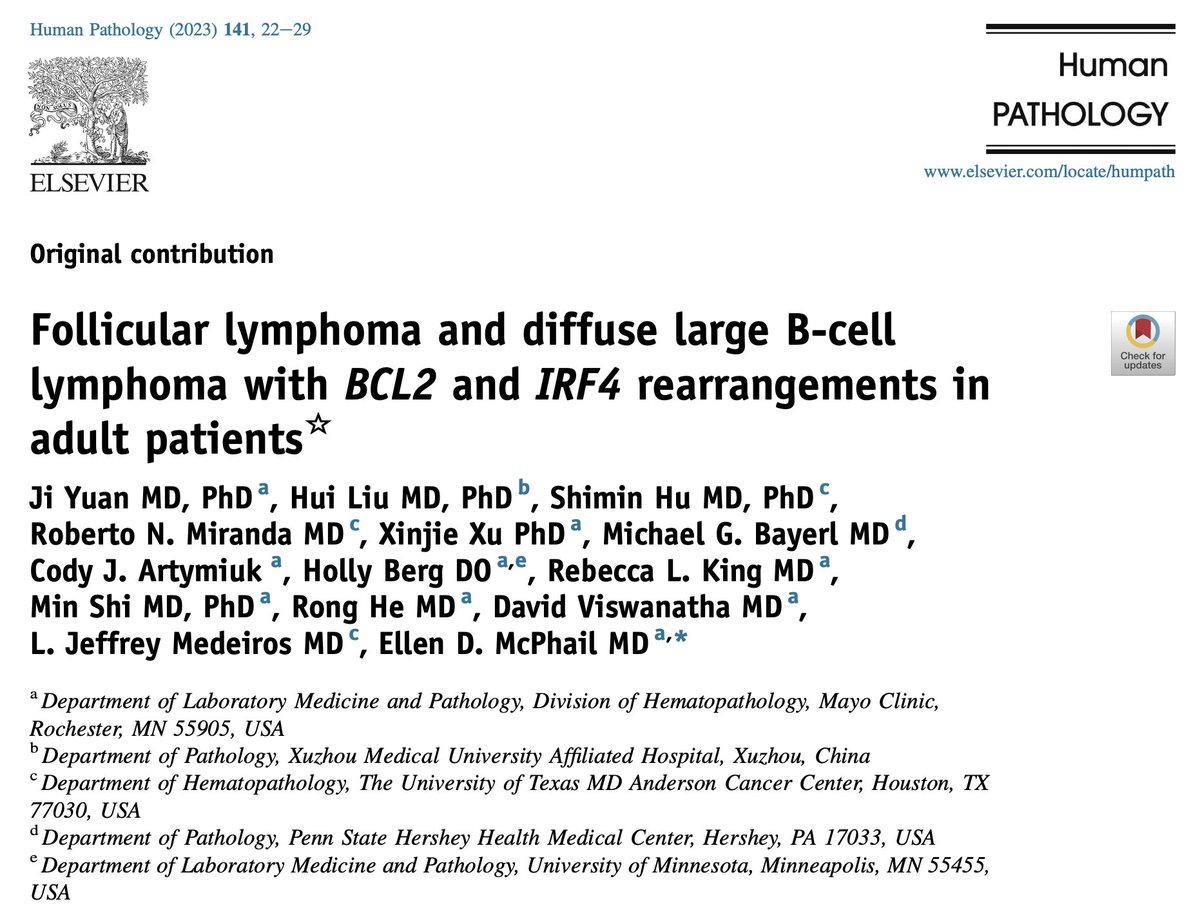
Rare cases of FL/ DLBCL with BCL2 and IRF4 rearrangements exist, and should not be confused with large B-cell lymphoma with IRF4 rearrangement.
FL/ DLBCL with BCL2 and IRF4 rearrangements typically show triple expression of CD10, BCL6 and MUM1 by IHC stains.
FL/ DLBCL with BCL2 and IRF4 rearrangements aligns more closely with FL or DLBCL-NOS clinically, morphologically, and genetically than with large B-cell lymphoma with IRF4 rearrangement:
FL/DLBCL with BCL2 and IRF4 rearrangements➡️
-Affects older adults
-Involves extranodal and nodal sites
-Is not confined to head and neck regions
-Has variable a variable range of prognosis
-Morphology is more heterogeneous
Unlike large B-cell lymphoma with IRF4 rearrangement➡️
-That usually presents in the head and neck
-And affects mainly young patients
-Has an excellent prognosis
-Morphology is more homogeneous
More on this➡️https://t.co/ZHtTp5dmkL
#Hemepath #PathTwitter #PathX #Lymsm
#MedEd #Surgpath
Illustration of nodal CLL/SLL, with a spectrum of growth of proliferation centers (PCs), slowly evolving and replacing existing germinal centers (GCs)(represented in zones with high Ki67 expression in figures 1 & 2), until full nodal involvement (figures 3 & 4) #hemepath #lymsm #pathX #pathtwitter #medEd #SoMe


If you diagnose a nodal T-cell lymphoma with these features:
-Morphology is blastoid
-No monotypic pattern of TRBC1 by flow cytometry analysis
-No TCR gene rearrangement by PCR
Add a marker of cell immaturity like TDT, CD34, CD117 etc, even if the clinical features are not screaming T-ALL, not to miss a myeloid/lymphoid neoplasm with eosinophilia and tyrosine kinase gene fusions.
This group of diseases is rare and driven by rearrangements of PDGFRA, PDGFRB, FGFR1, JAK2, FLT3, and ETV6::ABL1 fusion.
Although eosinophilia seems to be always present, some cases may lack it, which can create a great diagnostic pitfall.
The clinicopathological features of this group of diseases are quite heterogeneous, presenting as chronic eosinophilic leukemia NOS, MDS/MPN, MDS, MPN, systemic mastocytosis, T-ALL, B-ALL, AML, blastic phase of MPN, or MPAL.
Extramedullary involvement at diagnosis or during progression is common.
Below pictures of a case of myeloid/lymphoid neoplasm with ETV6::FLT3 fusion with nodal involvement at presentation and no associated eosinophilia, are from
➡️https://t.co/5bWrYl6unb
#Hemepath #PathX #Pathtwitter #Leusm #lymsm


Attention #PathMatch23 #pathmatch2023 candidates! Come join us at our virtual open house to learn more about our program at the University of Minnesota on 9/27 at 7 PM (CT)!! See the QR code for more information ☺️🥳 #path2path #pathtwitter #MedTwitter



Hi!!. Lola Lozano from Spain. So honored and proud to be part of our dear PathTwitter family 👌👌🕊🕊🥰🥰

Hi everyone, @pembeoltulu is here, proud of a small part of this amazing #PathTwitter family, I am from Turkey 🌷💖🥰


I need advice on electives I can do for 4th year that do not count as audition rotations but could still expose me to pathology in some way? I’m interested in ID, Peds genetics/Heme-onc, microbiology etc. #pathtwitter #medtwitter
I need advice. My 4th year rotations are creeping up and I already have a path rotation lined up for June. However, after that I have one month where I could either do independent study for Step 2 or another path rotation if accepted. Continued in comments #pathtwitter
Trends for you
Most Popular Users

Elon Musk 
@elonmusk
240.1M followers

Barack Obama
@barackobama
118.6M followers

Cristiano Ronaldo
@cristiano
114.4M followers

Donald J. Trump
@realdonaldtrump
111.7M followers

Narendra Modi
@narendramodi
106.9M followers

Rihanna
@rihanna
98.6M followers

NASA
@nasa
92.1M followers

Justin Bieber
@justinbieber
91.7M followers

KATY PERRY
@katyperry
89.9M followers

Taylor Swift
@taylorswift13
83.9M followers

Lady Gaga
@ladygaga
75.4M followers

Virat Kohli
@imvkohli
73.3M followers

Kim Kardashian
@kimkardashian
70.8M followers

YouTube
@youtube
68.6M followers

Neymar Jr
@neymarjr
66.3M followers

Bill Gates
@billgates
65.2M followers

Selena Gomez
@selenagomez
63M followers

The Ellen Show
@theellenshow
62.1M followers

CNN
@cnn
61.7M followers

X
@x
60.6M followers