

Top Tweets for #ReasoningGym

Decentralized RL Done Right
◈ Traditional RL training is expensive, centralized, and fragile.
One node dies → whole run collapses.
◆ Gensyn’s SAPO changes everything.
No gradients, no heavy syncing — agents share rollouts (decoded text).
Lightweight. Fast. Model-agnostic.
● When one node finds a good trajectory, it shares it.
Others sample it → learn faster → swarm intelligence emerges.
▹ The secret sauce: balance.
4 local rollouts + 4 external rollouts = maximum stability + speed.
✦ Results:
94% higher cumulative reward
Thousands trained together on ReasoningGym
Decentralized RL now beats isolated training
SAPO proves one thing:
Models training as a swarm learn faster than models training alone.
@gensynai


➽ 𝐒𝐀𝐏𝐎 ⇢ 𝐄𝐟𝐟𝐢𝐜𝐢𝐞𝐧𝐭 𝐋𝐌 𝐏𝐨𝐬𝐭-𝐓𝐫𝐚𝐢𝐧𝐢𝐧𝐠 𝐰𝐢𝐭𝐡 𝐂𝐨𝐥𝐥𝐞𝐜𝐭𝐢𝐯𝐞 𝐑𝐋
Large-language models are powerful - but their real intelligence comes from what happens after pre-training. Reinforcement-learning-based post-training is where alignment, reasoning depth, decision-making quality, and real-world usefulness emerge. But there’s a problem: RL post-training is expensive, unstable, and painfully centralized. Only a few labs with massive GPU clusters can afford it.
SAPO changes that.
SAPO - Swarm sAmpling Policy Optimization - is @gensynai new meta-algorithm that reimagines post-training through collective reinforcement learning, enabling models to learn together across decentralized nodes. Instead of a single agent grinding through millions of rollouts, SAPO turns the network into a cooperative swarm where experience is openly shared, gradients become optional, and local learning drives global convergence.
It’s a breakthrough that makes RL post-training scalable, robust, and affordable - even across heterogeneous compute.
➽ 𝐖𝐡𝐲 𝐏𝐨𝐬𝐭-𝐓𝐫𝐚𝐢𝐧𝐢𝐧𝐠 𝐍𝐞𝐞𝐝𝐬 𝐑𝐞𝐢𝐧𝐯𝐞𝐧𝐭𝐢𝐨𝐧
Today’s RL post-training systems assume a perfect world:
➥identical GPUs
➥synchronized updates
➥fixed latency
➥centralized orchestration
But this is not how real compute works - especially in a decentralized network where nodes differ in bandwidth, hardware, and reliability. In such an environment:
➥synchronous updates break
➥gradient exchange becomes expensive
➥the training pipeline collapses under communication load
➥learning slows down or diverges entirely
Traditional RL can’t survive decentralization.
SAPO is built for decentralization - not adapted to it.
Instead of forcing nodes into lockstep, SAPO embraces heterogeneity through one powerful idea:
nodes learn locally, share rollouts globally, and improve collectively.
➽ 𝐓𝐡𝐞 𝐂𝐨𝐫𝐞 𝐈𝐝𝐞𝐚: 𝐋𝐨𝐜𝐚𝐥 𝐄𝐱𝐩𝐞𝐫𝐢𝐞𝐧𝐜𝐞 + 𝐆𝐥𝐨𝐛𝐚𝐥 𝐒𝐡𝐚𝐫𝐢𝐧𝐠
SAPO wraps around standard RL algorithms, but introduces three innovations:
➥1. Local Rollouts First
Each node generates its own rollouts based on its local policy.
No gradients. No sync. No bottlenecks.
Just pure exploration.
➥2. Swarm-Level Experience Sharing
Instead of exchanging heavy gradients, nodes exchange rollouts - decoded text or trajectory summaries. These are lightweight and bandwidth-friendly.
This massively boosts diversity:
a node in India may learn from a node in Canada, which itself learned from someone in Europe.
➥3. Balanced Learning From Local + External Data
SAPO tunes the ratio between:
⇢ Local experience (self-generated)
⇢ External experience (from other swarm nodes)
The sweet spot found in experiments:
➥4 local : 4 external rollouts
This balance ensures stability while unlocking collective intelligence.
The result?
A decentralized system that learns faster and stronger than isolated training.
➽ 𝐇𝐨𝐰 𝐒𝐀𝐏𝐎 𝐀𝐜𝐭𝐮𝐚𝐥𝐥𝐲 𝐖𝐨𝐫𝐤𝐬
Here’s the high-level loop:
➥Step 1 - Nodes Generate Local Rollouts
Each model runs prompts, produces trajectories, explores reasoning paths, and collects rewards.
➥Step 2 - Nodes Share Experience
Rollouts are sent to peers.
No need to match architectures or gradient shapes — experience is model-agnostic.
➥Step 3 - Policy Update With Mixed Experience
Nodes update their policies using a blend of their own rollouts + swarm rollouts.
This creates:
⇢ richer learning signals
⇢ more diverse exploration
⇢ faster policy improvement
➥Step 4 - Repeat With Evolving Policies
As nodes update, the quality of shared rollouts improves too.
This naturally accelerates the entire network.
It’s a positive feedback loop - but decentralized.
➽ 𝐖𝐡𝐲 𝐒𝐀𝐏𝐎 𝐈𝐬 𝐚 𝐁𝐢𝐠 𝐃𝐞𝐚𝐥
➥1. It scales across any hardware
Because SAPO doesn’t force synchronous gradient exchange, even slow nodes or low-VRAM devices can meaningfully contribute.
➥2. It’s cost-efficient
Rollouts are lightweight.
Gradients are optional.
GPU strain drops dramatically.
➥3. It amplifies exploration
When thousands of nodes explore independently and share outcomes, the swarm covers the solution space far more efficiently than any single machine could.
➥4. It decentralizes post-training
SAPO makes RL post-training something anyone can participate in - not just labs with giant clusters.
➥5. It works in real environments
Initial experiments on ReasoningGym show dramatic improvement:
⇢ 94% cumulative reward gain over isolated baselines
⇢ Stronger generalization
⇢ More stable convergence
SAPO is not a theory - it’s already working.
➽ 𝐓𝐡𝐞 𝐁𝐢𝐠𝐠𝐞𝐫 𝐕𝐢𝐬𝐢𝐨𝐧: 𝐎𝐩𝐞𝐧, 𝐂𝐨𝐥𝐥𝐞𝐜𝐭𝐢𝐯𝐞 𝐈𝐧𝐭𝐞𝐥𝐥𝐢𝐠𝐞𝐧𝐜𝐞
SAPO is more than an algorithm.
It’s a philosophy shift:
from centralized model-training
to decentralized collective intelligence.
With SAPO ⤵
⇢ small nodes become part of big models
⇢ diversity becomes a feature, not a bug
⇢ learning becomes shared
⇢ breakthroughs propagate instantly
Imagine thousands of models:
testing ideas, exploring tasks, generating rollouts, and improving together - without ever depending on a single orchestrator.
This is what SAPO unlocks.
➽ 𝐖𝐡𝐞𝐫𝐞 𝐓𝐡𝐢𝐬 𝐆𝐨𝐞𝐬 𝐍𝐞𝐱𝐭
SAPO can extend far beyond text:
⇢ code generation
⇢ agent simulations
⇢ multimodal learning
⇢ image reasoning
⇢ RL environments
⇢ robotics simulation
Anywhere exploration matters - SAPO can scale it.
Future expansions include:
⇢ adaptive rollout sampling
⇢ dense token-level rewards
⇢ cross-model experience sharing
⇢ multi-domain swarm training
SAPO isn’t a final product.
It’s the start of a new direction in AI.
➽ 𝐈𝐧 𝐒𝐮𝐦𝐦𝐚𝐫𝐲
SAPO makes one promise:
post-training doesn’t have to be centralized, expensive, or exclusive.
Through a balance of local learning and swarm-level sharing, SAPO enables:
⇢ faster convergence
⇢ richer exploration
⇢ lower cost
⇢ broad accessibility
⇢ decentralized coordination
It transforms reinforcement learning from a cluster-bound process into a global, cooperative intelligence layer - where nodes learn faster because they learn together.
SAPO is not just a training method.
It’s the beginning of decentralized RL at scale.


There are many intresting aspects in @gensynai technicality but there is one that is very fascinating to me and If you are not paying attention you might miss out on how AI learned to train itself collectively without a single data center.
Gensyn dropped SAPO which is (SwarmsAmplingPolicyOptimization) we are talking about a fully descentralized asynchronus post-training algorithm . Which works uniquely because instead of stacking GPUs in one building, SAPO turns the internet itself into a training ground, where every node from your gaming laptop turns to a data center rig, which trains locally and shares “rollouts” decoded text, and not gradients with the SWARM.
This means breakthrough in one machine that can ripple through the network because imagine an “aha moment” discovered by one model spreading across thousands of others instantly. This is not just scaling compute it is scaling insight.
In their tests, gensyn ran Qwen2.5 models across ReasoningGYM tasks. where nodes balanced local + external rollouts and after that rewards jumped 94% over baselines. Even though too much sharing can be messy we should also know that collective intelligence has limits but what gensyn did was part of the experiment.
Now the bigger vision of gensyn is making swarm learning a default for open AI where instead of closed labs guarding datasets and clusters, SAPO shows how distributed models can teach each other which is isn’t just an efficient reinforcement learning, it is AI discovering the internet’s original dream where knowledge scales because it is shared.

🏋️ Reasoning gym day - who’s ready for a challenge?
Pick a reasoning task (logic puzzle, math proof, code eval), spin up a RL Swarm on @gensynai, and let your models train together like sparring partners. Each one tries, critiques, votes, and improves so the whole squad levels up faster than any solo run.
Here’s the game plan:
1. Choose a problem from the open-source Reasoning Gym set.
2. Run a swarm with your node.
3. Post your before/after metrics + screenshots.
4. Share your swarm’s best reasoning chain with the community.
The fun part? Your model keeps the improved weights, so you walk away smarter just by joining the hive mind.
📊 Test it on Gensyn Dashboard → https://t.co/qiAs84bqDQ
⚡️ Join the Testnet → https://t.co/5hDv39wXuG
Tag your run with #ReasoningGymDay so we can all see the gains!


SAPO ( Swarm sAmpling Policy Optimization ) is a decentralized, asynchronous meta-algorithm that lets models learn together instead of in isolation that built by @gensynai
-----------------
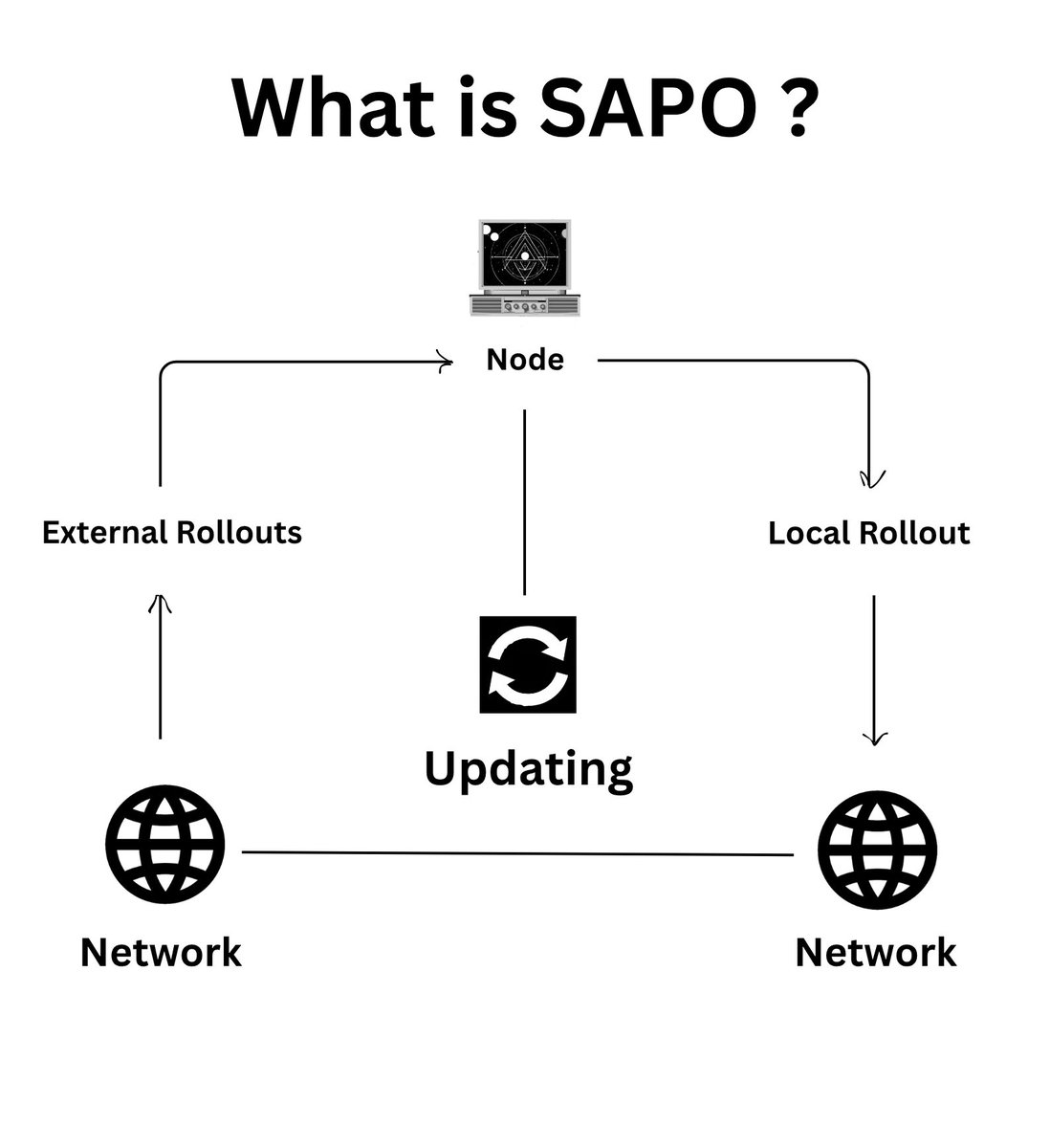
🔰How SAPO works❓
Each node follow bellow loop :
1⃣ Local Rollout :
Node generates responses on its own local data like text generation, image generation and other.
2⃣ Sharing to the Network :
It sends its generated rollouts ( decoded text, not gradients ) to the swarm ( Network)
3⃣ Receiving External Rollouts :
Each model samples a few rollouts produced by other models in the network.
4⃣ Learning Update :
It updates itself using both local and external rollouts
5⃣ Cycle Repetition
The process repeats indefinitely, allowing knowledge and " Aha moments " to propagate through the swarm.
------------------
🌟Why This Matters❓
🟢Efficiency without fragility
Unlike traditional RL training methods that require precise coordination and heavy infrastructure, SAPO is naturally scalable and resilient.
🟢Open and collective training
Anyone can participate in the process , even with a personal laptop.
🟢Collective intelligence
Each nodes learns from the experiences of thousands of others.
⭐️When one node reaches an "Aha moment ", that breakthrough can spread across the entire network.⭐️
------------------
📈 Experimental Result (from @gensynai Research)
1⃣ Controlled Experiments:
🔶8 * Qwen2.5 models (0.5B parameters) trained on ReasoningGYM.
🔶The best setup (4 local +4 external rollouts) achieved a 94% Improvement in cumulative reward
compared to isolated RL.
🔶 Too many external rollouts caused instability
2⃣ Open-source Swarm Demo:
🔶 Thousands of contributors from the gensyn community joined a live decentralized swarm.( about 5000 node )
🔶Mid-size models consistently outperformed isolated ones.
🔶Larger Models (LLM or others) saw smaller gains
----------------------
♾ Finally words
SAPO represents a paradigm shift in "How AI Models Can Learn" : 👇👇
* Not as isolated entities, but as members of a collective intelligence network. *
Its a vision where communities ( human and machine alike) collaborate to train smarter, faster, and more efficiently.
------------------
The future of RL might not be centralized. It might be swarming🌊.
🔶gswarm🔶

5/
Experiments show strong results. In controlled tests with eight Qwen2.5 models on ReasoningGYM (algebra, logic tasks), balanced rollout sharing yielded 94% reward gains.
Open-source demo with thousands of Gensyn users: swarm participants outperformed isolated models, especially mid-capacity ones.
Balance matters – too many external rollouts can destabilize training.
Last Seen Hashtags on Sotwe
Most Popular Users

Elon Musk 
@elonmusk
240M followers

Barack Obama
@barackobama
118.6M followers

Cristiano Ronaldo
@cristiano
114.4M followers

Donald J. Trump
@realdonaldtrump
111.7M followers

Narendra Modi
@narendramodi
106.9M followers

Rihanna
@rihanna
98.6M followers

NASA
@nasa
92.1M followers

Justin Bieber
@justinbieber
91.7M followers

KATY PERRY
@katyperry
89.9M followers

Taylor Swift
@taylorswift13
83.9M followers

Lady Gaga
@ladygaga
75.4M followers

Virat Kohli
@imvkohli
73.3M followers

Kim Kardashian
@kimkardashian
70.8M followers

YouTube
@youtube
68.6M followers

Neymar Jr
@neymarjr
66.3M followers

Bill Gates
@billgates
65.2M followers

Selena Gomez
@selenagomez
63M followers

The Ellen Show
@theellenshow
62.1M followers

CNN
@cnn
61.7M followers

X
@x
60.6M followers