

Top Tweets for #Scanpy

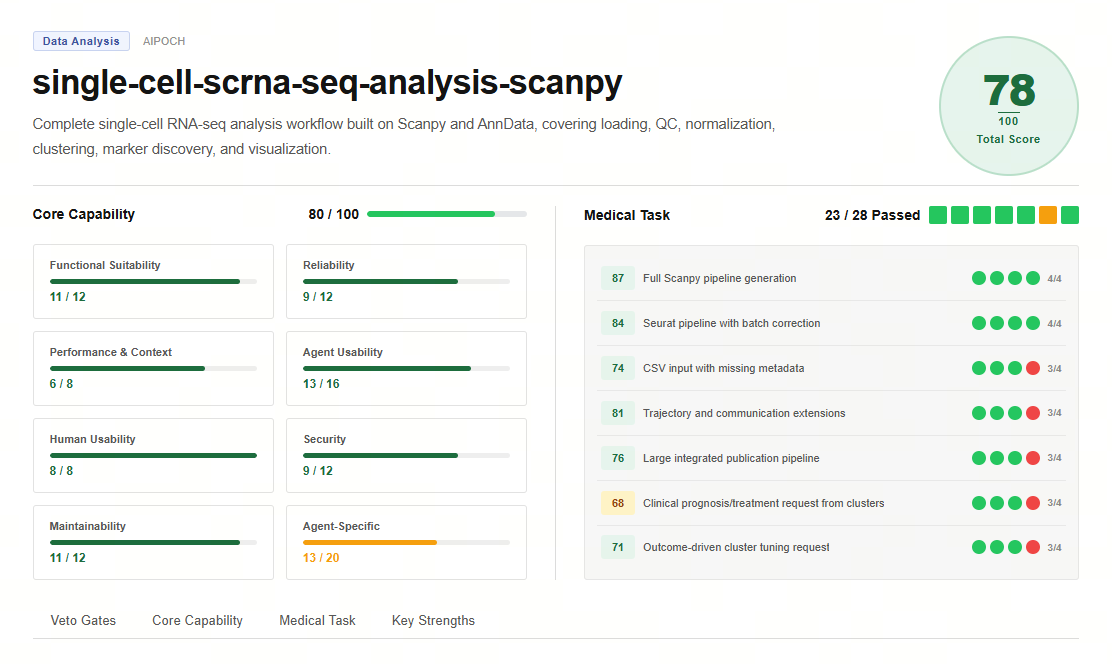
#4 single-cell-scrna-seq-analysis-scanpy
https://t.co/SHYgcQRI4l
Most computation-oriented pipeline among the four.
Key advantages:
• end-to-end Scanpy workflow
• clustering and marker analysis
• publication-style computational outputs
Best use cases:
• full scRNA computational execution
• AnnData/Scanpy projects
• matrix-driven analysis pipelines
Limitation:
less effective for paper-level study planning and biological framing without raw datasets.


Compared 4 single-cell research skills using the same scRNA-focused manuscript PDF.
The differences were substantial because each skill operates at a different layer of the single-cell workflow: study design, QC execution, computational analysis, or chromatin-regulatory interpretation.
Final ranking for this use case:
1. single-cell
2. single-cell-rna-qc
3. bio-single-cell-scatac-analysis
4. single-cell-scrna-seq-analysis-scanpy
https://t.co/43n6PffudZ
#AIPOCH #SingleCell #scRNAseq #Bioinformatics #ComputationalBiology #Transcriptomics

El pasillo secreto de la Gran Pirámide
Descubrieron un pasillo oculto de 9 metros en la Gran Pirámide de Keops, sellado desde su construcción. Además, hay un vacío del tamaño de un Boeing 767 sobre la Gran Galería, sin explorar.
https://t.co/UfNHcDMfp1
#arqueología #egipto #giza #keops #muones #scanpyramids #podcast #NoSoyOriginal
CIENTÍFICOS DE LA NASA Y EL PENTÁGONO: MUERTES SIN EXPLICACIÓN | 07x35
Nueve científicos y militares con acceso a tecnología crítica murieron o desaparecieron entre 2024 y 2026. El Pentágono y la NASA guardan silencio, mientras cuarenta científicos más están bajo vigilancia.
https://t.co/oVoNUoOBf8
#arqueología #conspiración #giza #historia #karnak #keops #laos #luxor #muones #nasa #ovnis #papiros #patrimonio #scanpyramids #uap #podcast #NoSoyOriginal
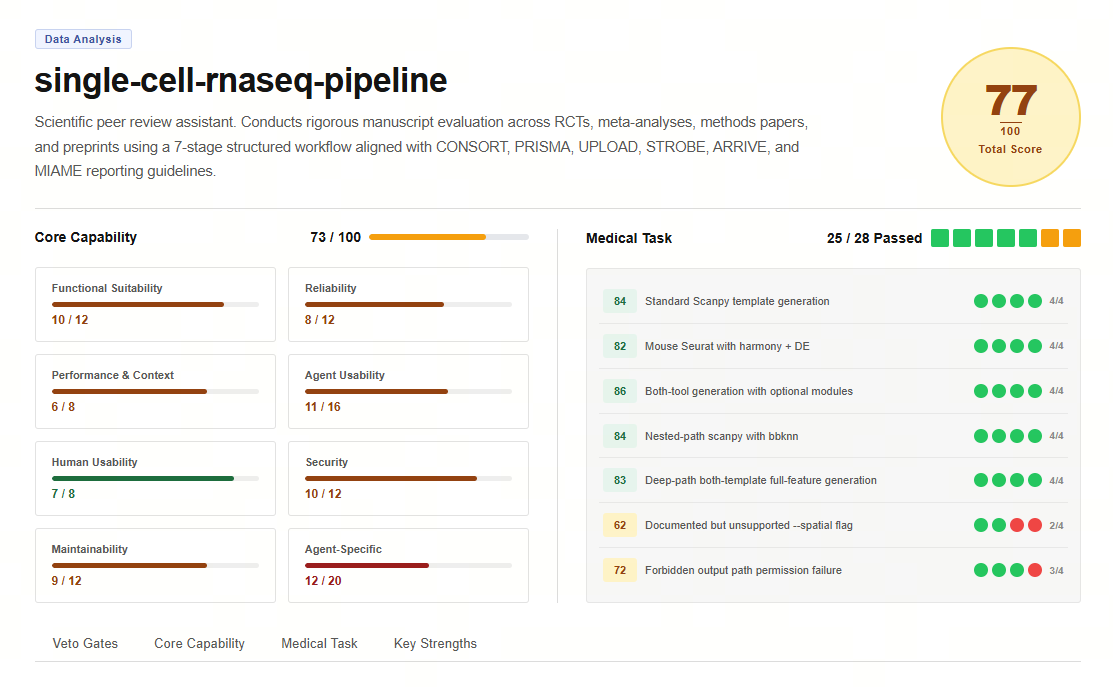
#2 single-cell-rnaseq-pipeline
https://t.co/lBUljxsZNp
Generates Seurat / Scanpy code templates + README
Fastest route to implementation
→ Best for: execution teams ready to run analysis
→ Limitation: requires manual adaptation, may include generic assumptions

Top 10 AIPOCH Skills (Based on Tessl standard)
Skill infrastructure in medical AI is finally becoming structured.
Here’s a ranked snapshot of 10 high-impact AIPOCH Skills shaping how research actually gets done:
1️⃣ discussion-section-architect
Turns messy results into clear, publication-ready discussion sections.
Bridges findings → literature → limitations → conclusions.
https://t.co/iwgGfokSwz
2️⃣ clinical-data-cleaner
Cleans and standardizes clinical trial data for FDA/EMA readiness.
Handles SDTM, missing values, outliers, CRF → CDISC conversion.
https://t.co/vEcromhX3I
3️⃣ meta-analysis-forest-plotter
Generates publication-grade forest plots with CI, heterogeneity, subgroups.
Built for real meta-analysis workflows.
https://t.co/CAW6PA6XRj
4️⃣ code-refactor-for-reproducibility
Transforms messy research code into reproducible, shareable pipelines.
Adds docs, environments, error handling.
https://t.co/S0QrmTaCuU
5️⃣ cross-disciplinary-bridge-finder
Finds hidden connections across fields + matches collaborators.
Built for interdisciplinary grants & research innovation.
https://t.co/AyRJxHtmTv
6️⃣ linkedin-optimizer
Optimizes LinkedIn profiles for clinicians & researchers.
From headline → summary → keyword positioning.
https://t.co/qbrL0ncZKz
7️⃣ journal-matchmaker
Maps your abstract → the right journal (impact + scope fit).
Reduces guesswork in submission strategy.
https://t.co/rNQlSZj1vG
8️⃣ single-cell-rnaseq-pipeline
Generates full scRNA-seq workflows (Seurat / Scanpy).
QC → clustering → visualization → downstream analysis.
https://t.co/sUwD2pnri3
9️⃣ crispr-grna-designer
Designs CRISPR gRNAs with off-target prediction + efficiency scoring.
For real genome editing workflows.
https://t.co/ffa36lWEx1
🔟 3d-molecule-ray-tracer
Creates cinematic, publication-quality molecular renders (PyMOL / ChimeraX).
Built for figures that actually get attention.
https://t.co/QAWIgjBfas

Top 10 AIPOCH Skills (Based on Tessl standard)
Skill infrastructure in medical AI is finally becoming structured.
Here’s a ranked snapshot of 10 high-impact AIPOCH Skills shaping how research actually gets done:
1️⃣ discussion-section-architect
Turns messy results into clear, publication-ready discussion sections.
Bridges findings → literature → limitations → conclusions.
https://t.co/qV8KmQWLK5
2️⃣ clinical-data-cleaner
Cleans and standardizes clinical trial data for FDA/EMA readiness.
Handles SDTM, missing values, outliers, CRF → CDISC conversion.
https://t.co/M9bcTB0nmj
3️⃣ meta-analysis-forest-plotter
Generates publication-grade forest plots with CI, heterogeneity, subgroups.
Built for real meta-analysis workflows.
https://t.co/IlmN9S3ia5
4️⃣ code-refactor-for-reproducibility
Transforms messy research code into reproducible, shareable pipelines.
Adds docs, environments, error handling.
https://t.co/pfOzS5s0jI
5️⃣ cross-disciplinary-bridge-finder
Finds hidden connections across fields + matches collaborators.
Built for interdisciplinary grants & research innovation.
https://t.co/zpyAIXCCAl
6️⃣ linkedin-optimizer
Optimizes LinkedIn profiles for clinicians & researchers.
From headline → summary → keyword positioning.
https://t.co/rXvQkfafwK
7️⃣ journal-matchmaker
Maps your abstract → the right journal (impact + scope fit).
Reduces guesswork in submission strategy.
https://t.co/KMYk1HWvTP
8️⃣ single-cell-rnaseq-pipeline
Generates full scRNA-seq workflows (Seurat / Scanpy).
QC → clustering → visualization → downstream analysis.
https://t.co/UALjpbgZBc
9️⃣ crispr-grna-designer
Designs CRISPR gRNAs with off-target prediction + efficiency scoring.
For real genome editing workflows.
https://t.co/ECu6V5iKAm
🔟 3d-molecule-ray-tracer
Creates cinematic, publication-quality molecular renders (PyMOL / ChimeraX).
Built for figures that actually get attention.
https://t.co/TRluujzGVG


🚨 Stanford just made research papers come alive. What if every PDF could turn into a working AI Agent — one you can query, test, and extend like real code? Paper2Agent transforms academic papers + their code into living, interactive AI experts.
⚡ Steps of Paper2Agent
Instead of expecting users to manually clone, install, debug, and run code, Paper2Agent does the heavy lifting:
✸ Scans a paper + its GitHub repo to identify tutorials, core methods, and dependencies.
✸ Wraps core functionality as MCP (Model Context Protocol) tools — functions with structured inputs/outputs.
✸ Generates tests to validate that those tools reproduce published results.
✸ Deploys the resulting MCP server, which can then be queried naturally through an agent (e.g. “Apply this method to my dataset and regenerate Figure 3”).
In short: the paper becomes an AI you can talk to — and make work on your own data.
⚡ Advanced Use Cases
✸ Converted AlphaGenome, Scanpy, and TISSUE into interactive agents.
✸ For AlphaGenome, it generated 22 MCP tools in ≈ 3 hours, reaching 100% accuracy on both original and novel example queries.
✸ Agents can reproduce reference figures, accept new input, and execute full analysis pipelines via natural-language prompts.
⚡ Interactive, Modular & Reproducibile
✸ From static → interactive — papers become callable, tool-backed agents.
✸ Reproducibility baked in — each tool is tested and verified before inclusion.
✸ Minimal human burden — wrappers and validations are auto-generated.
✸ Modularity & interoperability — multiple paper-agents can collaborate or be queried together.
✸ Over time, the ease of agentification could become a new metric of “reproducibility.”
⚡ Clean vs Incomplete
✸ Works best with clean, well-documented repos and examples.
✸ Poorly structured or incomplete codebases may fail to transform cleanly.
✸ Future papers may ship with agent artifacts alongside code and data — redefining publication standards for reproducibility.
⚡ Future of “Reading a Paper”
✸ Paper2Agent nudges us toward a future where “reading a paper” means conversing with it, running its logic, and adapting its methods on the fly — all without setup pain.
✸ It’s not just about access; it’s about interaction and extension.
Research becomes live.
github: https://t.co/nTD4Z97Y7G
Built by @Jiacheng_Miao at @Stanford — brilliant work bridging research and real-world agent execution.
≣≣≣≣≣≣≣≣≣≣≣≣≣≣≣≣≣≣≣≣≣≣≣≣≣≣
ꆛ Want to build Real-World AI Agents?
Join My 𝗛𝗮𝗻𝗱𝘀-𝗼𝗻 𝗔𝗜 𝗔𝗴𝗲𝗻𝘁 𝟱-𝗶𝗻-𝟭 𝗧𝗿𝗮𝗶𝗻𝗶𝗻𝗴!
⭕ Build Agents for Healthcare, Finance, Smart Cities & More
⭕ Master 5 Modules: 𝗠𝗖𝗣 · LangGraph · PydanticAI · CrewAI · OpenaI Swarm
⭕ Includes 9 Full Projects
👉 𝗘𝗻𝗿𝗼𝗹𝗹 𝗡𝗢𝗪 (𝟱𝟲% 𝗢𝗙𝗙) https://t.co/5i2v1fIrhJ


@sinhaparth555 Python with scanpy seems a solid option here

It's just a test, just trying to get Biology + ML
I performed comprehensive single-cell RNA-seq analysis on 3k PBMCs using a robust computational pipeline implemented in Python with scanpy.


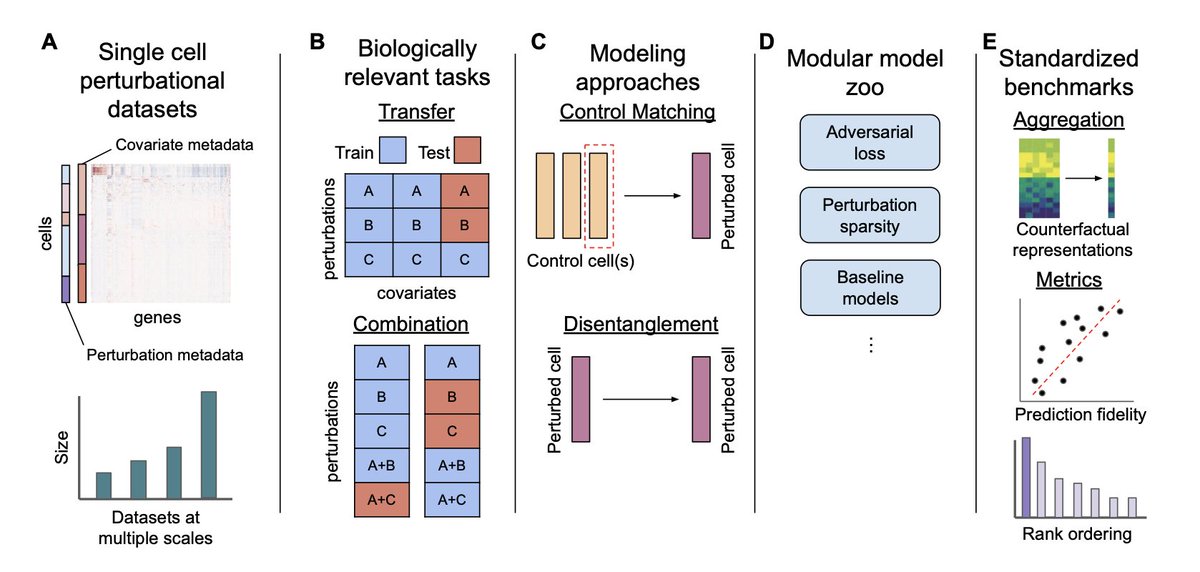
PerturBench: Benchmarking Machine Learning Models for Cellular Perturbation Analysis
1.PerturBench introduces the first modular, standardized benchmarking suite for machine learning models predicting cellular responses to perturbations—genetic or chemical—at single-cell resolution.
2.A key innovation is the use of rank-based metrics that evaluate whether models can correctly order perturbations by biological effect, rather than relying solely on traditional fit metrics like RMSE or cosine similarity.
3.Surprisingly, simpler models—such as latent additive baselines—are competitive or even superior to complex models (e.g., CPA, SAMS-VAE) on large datasets and rank-based metrics, especially in real-world scenarios with many covariates and imbalanced data.
4.The authors find that widely used models, including CPA and SAMS-VAE, suffer from mode collapse, where predictions do not change meaningfully across perturbations. This is revealed by poor performance on the rank metrics.
5.PerturBench supports two biologically meaningful prediction tasks: covariate transfer (predicting in unseen cell types) and combination prediction (predicting dual perturbation effects from single perturbation data).
6.The framework is built around five diverse and well-curated datasets, each containing 100–500+ perturbations, different modalities (chemical/genetic), and varying cell types—ensuring that models are evaluated under realistic, diverse conditions.
7.The benchmark includes a thorough ablation analysis showing that removing key components (like adversarial disentanglement in CPA or sparsity in SAMS-VAE) often improves performance, suggesting many design choices in current models may be unnecessary or even detrimental.
8.Decoder-only models—those that do not use gene expression inputs—perform surprisingly well, especially on large-scale datasets like Jiang24. This suggests information in perturbation and covariate metadata alone can drive strong predictions.
9.The authors show that no model architecture consistently outperforms others across all datasets and metrics. This highlights the need for broad, standardized evaluation rather than cherry-picked benchmarks.
10.PerturBench provides a fully open-source, extensible codebase for model development, dataset loading, and evaluation, compatible with PyTorch, PyTorch Lightning, and Scanpy—lowering the barrier for researchers to enter the field or benchmark new ideas.
💻Code: https://t.co/PqVGgXikZz
📜Paper: https://t.co/supYTVS7lx
#SingleCell #MachineLearning #PerturbationBiology #scRNAseq #CausalInference #DrugDiscovery #DeepLearning #Benchmarking

Could the Giza Pyramids be ancient observatories?
The Orion Correlation Theory suggests their layout mirrors Orion’s Belt stars (Alnitak, Alnilam, Mintaka) from 10,500 BCE, with the Great Pyramid aligned to true north within 3 arcminutes, possibly tracking Thuban.
The Sphinx’s east-facing alignment with the vernal equinox and Leo adds to this cosmic link.
Recent LiDAR and radar studies reveal more. The 2025 ScanPyramids project found a hidden corridor in the Great Pyramid, while a 2024 study spotted an L-shaped anomaly near Khafre.
A controversial 2025 SAR claim hints at a vast underground network.
Could these spaces aid observation?
Texts tie pharaohs to the stars, and alignments suggest celestial tracking, but inscriptions support the tomb theory.
Full article ⬇️

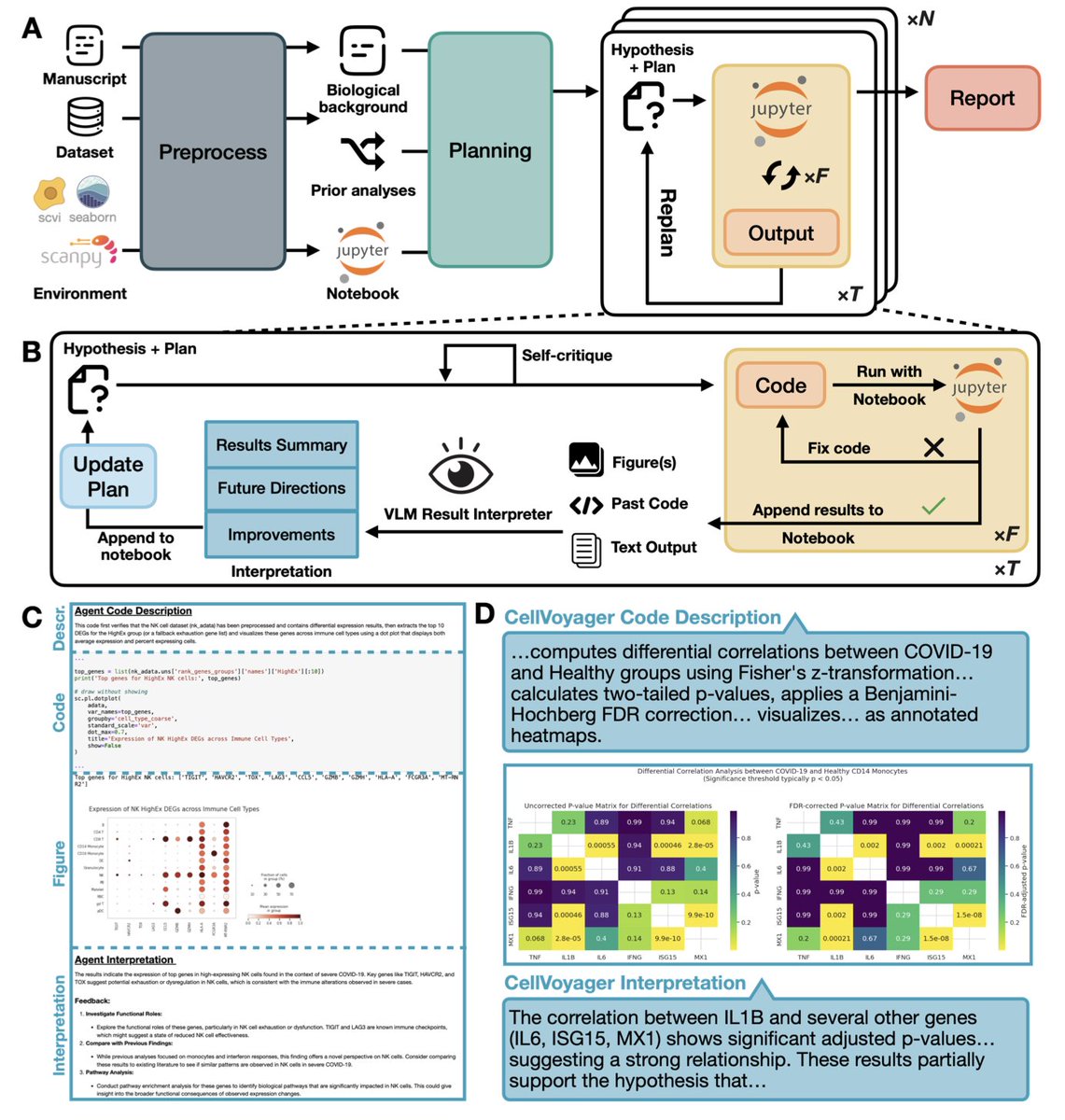
CellVoyager: AI CompBio Agent Generates New Insights by Autonomously Analyzing Biological Data
1.CellVoyager is a domain-specific AI agent designed to autonomously analyze single-cell RNA sequencing (scRNA-seq) datasets, going beyond user prompts to discover new biological insights without human guidance.
2.Unlike prior LLM-based agents that only follow user instructions, CellVoyager reasons about previously attempted analyses and proposes novel, complementary directions—making it suitable for real-world collaborative science.
3.At the core of CellVoyager is an "exploration blueprint" system: for each hypothesis, the agent plans, critiques, executes, interprets, and revises its analysis using a Jupyter environment powered by scverse tools like Scanpy and scVI.
4.A new benchmark, CellBench, was introduced to evaluate agent performance on scRNA-seq studies. Given only the background section of a paper, CellVoyager significantly outperformed GPT-4o and o3-mini in predicting analyses the authors conducted.
5.In a case study on COVID-19 PBMCs, CellVoyager discovered that CD8+ T cells from patients exhibited increased pyroptosis gene signatures—an insight not mentioned in the original paper but consistent with recent biological hypotheses.
6.In the endometrium study, the agent proposed novel menstrual cycle phase-dependent paracrine signaling patterns between stromal fibroblasts and endothelial cells, identifying top ligand-receptor interactions like FGF2-FGFR1 and TGFβ1-TGFβR1.
7.In a brain aging dataset, CellVoyager identified increased transcriptional noise in older cells, especially in microglia and oligodendrocytes. This result aligns with literature but was not part of the original study’s focus on aging clocks.
8.Original paper authors rated 80% of CellVoyager’s hypotheses as scientifically interesting. Many analyses scored high for creativity and correctness, and the agent improved its outputs using human feedback in iterative runs.
9.Compared to generic AI agents like Google’s Data Science Agent, CellVoyager demonstrated superior idea generation and execution in complex, domain-specific analyses—emphasizing the value of specialized AI tools in computational biology.
10.CellVoyager’s architecture is modular, allowing extension beyond scRNA-seq to other high-dimensional data types (e.g., spatial transcriptomics, proteomics) in future iterations.
11.This work also highlights the untapped value in reanalyzing public scRNA-seq datasets—thousands of papers with rich datasets may still hold unreported biological insights, which agents like CellVoyager can help uncover at scale.
💻Code: https://t.co/7qZfpV7V45 📜Paper: https://t.co/LU6yWRikLT
#AI #Bioinformatics #scRNAseq #ComputationalBiology #LLMAgent #HypothesisGeneration #SingleCell #Aging #COVID19 #Endometrium #Transcriptomics
OLAF: An Open Life Science Analysis Framework for Conversational Bioinformatics Powered by Large Language Models
1/ OLAF is an open-source platform that enables life scientists to perform bioinformatics analyses using natural language. Unlike general LLMs, OLAF directly reads, processes, and visualizes scientific data like single-cell RNA-seq (.h5ad), bridging the gap between AI assistants and real-world bioinformatics pipelines.
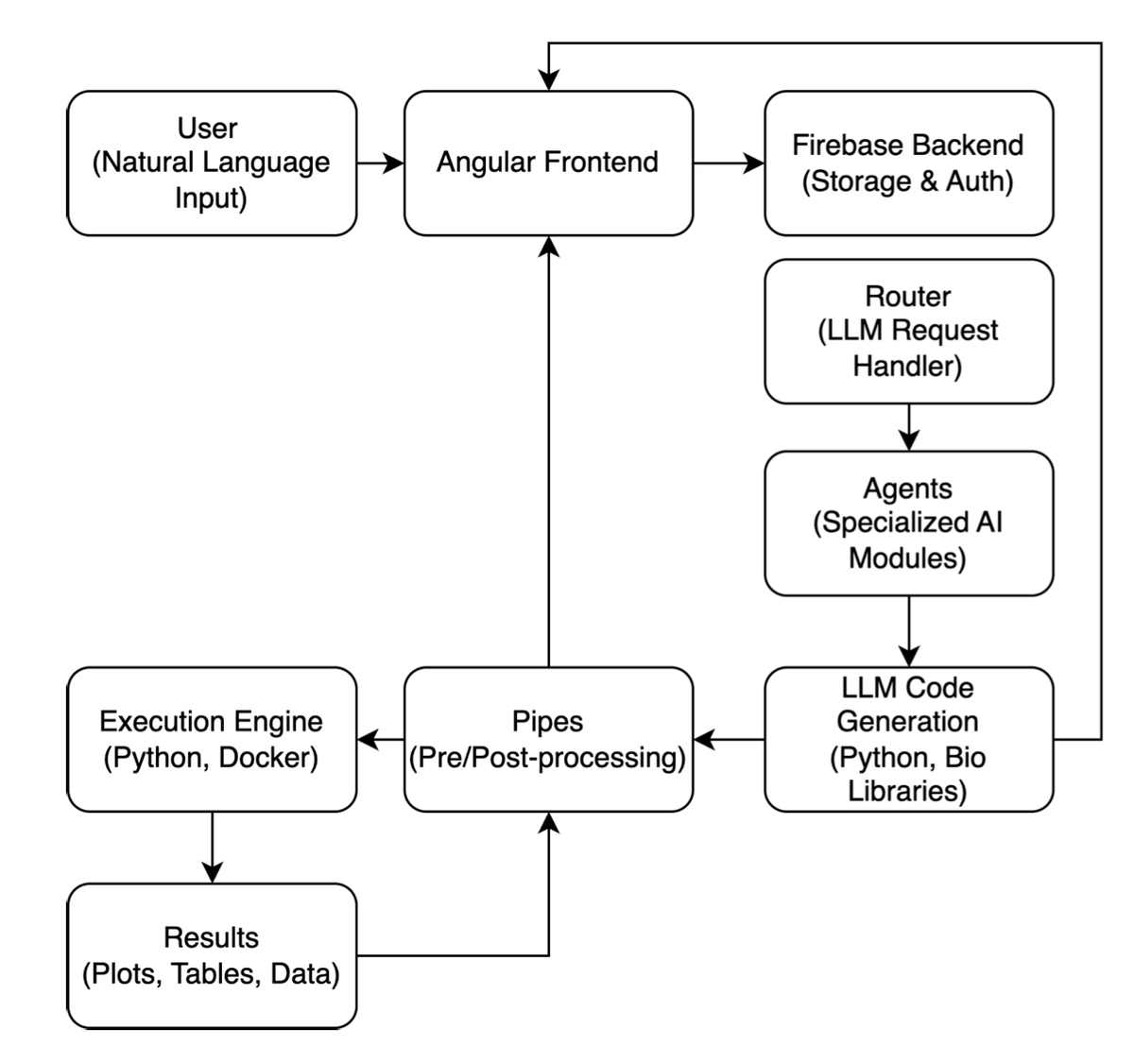
2/ A key innovation of OLAF is its agent–pipe–router architecture. Users can ask questions like “Identify differentially expressed genes” or “Find marker genes by cluster,” and OLAF’s backend generates and executes domain-specific Python code (e.g., via Scanpy), returning plots and results in real time.
3/ OLAF integrates a sandboxed Python execution environment with LLM-driven agents that understand both biological data and computational logic. This end-to-end automation allows users to skip writing code, installing packages, or debugging scripts—OLAF handles it all.
4/ Unlike ChatGPT or other generic tools, OLAF understands scientific file formats, supports file uploads, executes code, and returns interactive visualizations. It’s explicitly designed for non-programmers and researchers who want to analyze omics data via simple conversations.
5/ OLAF also serves as an educational tool. Users can inspect the generated code and outputs, making it easier to learn bioinformatics methods. This transparency supports reproducible science and opens the door for broader collaboration between biologists and computational experts.
6/ The paper positions OLAF against existing tools like BioChatter and LangChain-based agents, emphasizing OLAF’s unmatched combination of features: native file handling, full pipeline execution, modular extensibility, and a user-friendly web interface.
7/ Built with an Angular front-end and Python/Firebase backend, OLAF is scalable, reproducible (Docker-supported), and community-ready. Developers can extend OLAF with new agents or prompts, while users can interact with data and pipelines without writing a single line of code.
8/ Future directions for OLAF include support for additional omics modalities (e.g., proteomics, imaging), integration with LIMS, robotic systems for lab automation, and fine-tuned LLMs for more accurate domain-specific performance.
💻Code: https://t.co/cuXxe4Mj0h
📜Paper: https://t.co/jBZTtFaRyc
#AI #Bioinformatics #ComputationalBiology #LifeSciences #LLM #OpenSource #SingleCell #Omics #ChatWithData #NaturalLanguageInterfaces #BiomedicalAI #ReproducibleScience #OpenScience
Last Seen Hashtags on Sotwe
Most Popular Users

Elon Musk 
@elonmusk
240.1M followers

Barack Obama
@barackobama
118.6M followers

Cristiano Ronaldo
@cristiano
114.4M followers

Donald J. Trump
@realdonaldtrump
111.7M followers

Narendra Modi
@narendramodi
106.9M followers

Rihanna
@rihanna
98.6M followers

NASA
@nasa
92.1M followers

Justin Bieber
@justinbieber
91.7M followers

KATY PERRY
@katyperry
89.9M followers

Taylor Swift
@taylorswift13
83.9M followers

Lady Gaga
@ladygaga
75.4M followers

Virat Kohli
@imvkohli
73.3M followers

Kim Kardashian
@kimkardashian
70.8M followers

YouTube
@youtube
68.6M followers

Neymar Jr
@neymarjr
66.3M followers

Bill Gates
@billgates
65.2M followers

Selena Gomez
@selenagomez
63M followers

The Ellen Show
@theellenshow
62.1M followers

CNN
@cnn
61.7M followers

X
@x
60.6M followers