

Top Tweets for #SharedService

Why Government Digital Projects Fail More Often Than They Succeed
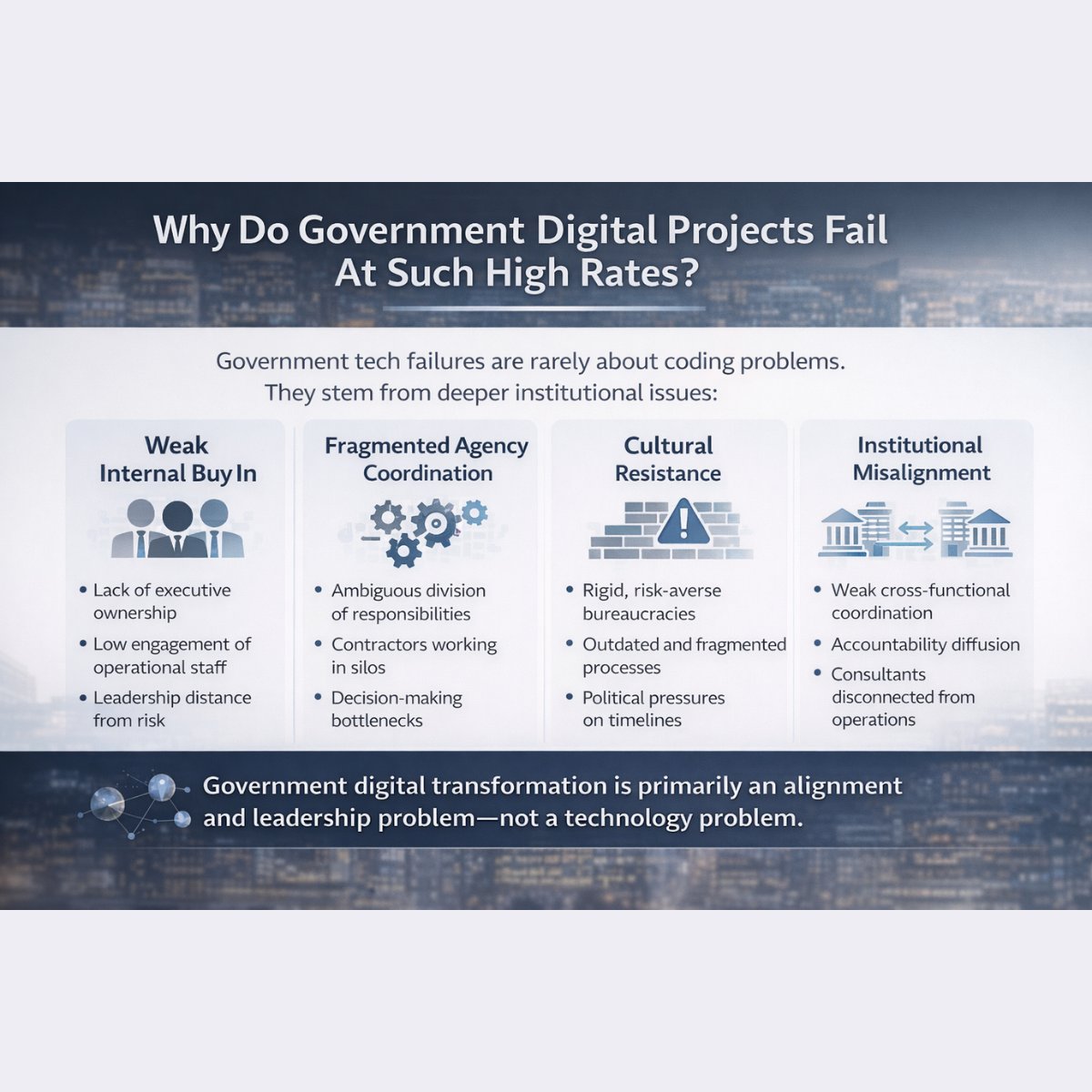
Summary: Government digital projects fail at disproportionately high rates despite major investment and political support. The causes are rarely technical. Failures stem from weak executive ownership, fragmented coordination, cultural resistance, and political pressure. Digital transformation in government is fundamentally an alignment challenge, not a technology challenge.
Digital transformation has become central to modern governance. Governments are investing heavily in portals, identity systems, analytics platforms, and automation tools to improve service delivery. Yet success rates remain uneven. Delays, cost overruns, vendor disputes, and operational breakdowns are common. Postmortems follow, recommendations are issued, and the cycle repeats.
The COVID-19 pandemic exposed these structural weaknesses. As millions sought benefits simultaneously, many public systems buckled under demand. Digital failures quickly translated into trust failures. Citizens judge government competence through the reliability of its digital services.
Standard remedies are familiar: centralized digital strategies, stronger governance, agile methods, stakeholder consultation, pilot programs, and improved leadership engagement. These are necessary, but they do not address the core issue.
Government digital projects operate within rigid regulatory environments, formal hierarchies, legacy systems, and political scrutiny. Timelines are often influenced by electoral cycles rather than operational readiness. Agencies guard jurisdictional boundaries. In this setting, transformation is not simply technical—it is institutional.
Most large-scale failures are not caused by defective code. They arise from ambiguous executive ownership, unclear division of responsibilities across agencies, weak cross-functional coordination, insufficient engagement of operational staff, and political pressure that compresses realistic timelines. Consultants may deliver technically sound systems that fail because they were not grounded in operational reality.
Digital transformation demands alignment across political leadership, agency executives, project teams, and frontline staff. Without sustained internal buy-in, leadership distances itself from risk, staff resist process changes, and accountability diffuses. When that happens, failure becomes predictable.
Where internal alignment is strong, complex projects succeed. Where it is weak, even well-funded initiatives struggle.
Digital government transformation is not primarily a technology problem. It is an alignment and leadership problem. Recognizing this distinction is the first step toward improving outcomes and restoring public trust.
#GovTech #DigitalGovernment #PublicSectorInnovation #CitizenExperience
#SharedServices
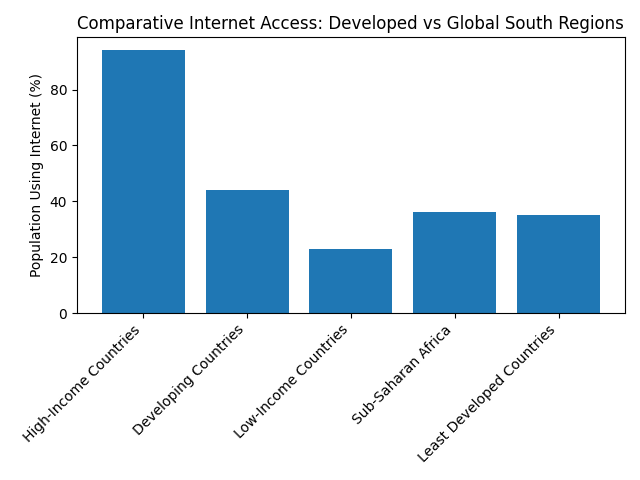
Broadband Is Democratic Access — And the World Is Unequal
We talk about digital government. But digital government cannot exist without digital access.
Globally, the disparity is stark:
~94% of citizens in high-income countries are online
~23% in low-income countries are online
Sub-Saharan Africa averages roughly ~36% connectivity
This is not just a technology gap. It is inequality — between nations and within nations.
Digital access now determines access to:
Public services
Education
Healthcare
Financial systems
Economic mobility
When unemployment benefits, tax systems, telehealth, and citizen services move online, broadband becomes a gatekeeper.
A well-designed citizen portal means little if large segments of the population cannot reliably connect.
Digital inequality mirrors — and amplifies — existing inequalities:
Rural vs urban
Wealthy vs low-income households
Digitally literate vs digitally excluded groups
Digital government strategy must therefore include:
Broadband expansion as core infrastructure
Affordable access policies
Device accessibility programs
Digital literacy initiatives
Mobile-first service design
Broadband is no longer telecom policy.
It is social equity policy.
It is economic competitiveness policy.
It is governance policy.
Digital transformation without universal access risks becoming digital exclusion.
Connectivity is no longer optional infrastructure.
It is democratic infrastructure.
#GovTech
#SharedServices
#DigitalGovernment
#PublicSectorInnovation
#CitizenExperience
Most Popular Users

Elon Musk 
@elonmusk
240.1M followers

Barack Obama
@barackobama
118.6M followers

Cristiano Ronaldo
@cristiano
114.4M followers

Donald J. Trump
@realdonaldtrump
111.7M followers

Narendra Modi
@narendramodi
106.9M followers

Rihanna
@rihanna
98.6M followers

NASA
@nasa
92.1M followers

Justin Bieber
@justinbieber
91.7M followers

KATY PERRY
@katyperry
89.9M followers

Taylor Swift
@taylorswift13
83.9M followers

Lady Gaga
@ladygaga
75.4M followers

Virat Kohli
@imvkohli
73.3M followers

Kim Kardashian
@kimkardashian
70.8M followers

YouTube
@youtube
68.6M followers

Neymar Jr
@neymarjr
66.3M followers

Bill Gates
@billgates
65.2M followers

Selena Gomez
@selenagomez
63M followers

The Ellen Show
@theellenshow
62.1M followers

CNN
@cnn
61.7M followers

X
@x
60.6M followers