

Top Tweets for #SingleParticleAnalysis

CryoROLE: Describing large inter-domain rotation in single particle cryo-EM
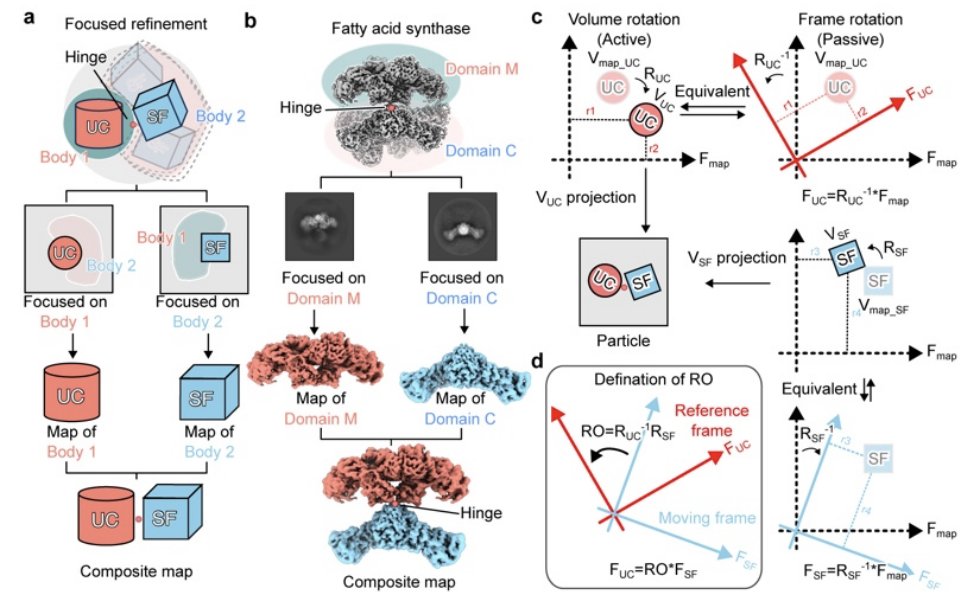
1. CryoROLE is a lightweight, math-based tool to recover continuous inter-domain motions that are otherwise “lost” when cryo-EM workflows produce high-resolution composite maps via focused refinement of separate rigid bodies.
2. Key idea: each particle already has multiple pose assignments (one per focused-refined domain). CryoROLE computes per-particle relative orientation (RO) between domains directly from these orientations, making the motion observable without deep learning or PCA.
3. The output is an RO “landscape”: a point cloud where each point is a particle and its coordinates encode the relative rotation between domains. Local point density reports how populated particular poses are, enabling an intuitive view of motion range + preferred orientations.
4. The method is designed for large rigid-body-like motions where consensus-map-based continuous-heterogeneity methods (e.g., latent-space or perturbation models) struggle, and where classic classification discretizes a continuum into a few bins.
5. Implementation details that matter in practice: CryoROLE does statistics in rotation-vector space (avoids Euler-angle singularities), visualizes in fixed-axis Euler space for interpretability, and can “canonicalize” axes so α/β/γ align with primary/secondary/tertiary motion directions.
6. Validation on human fatty acid synthase (hFASN): with ~2.2M particles, the RO landscape accurately predicts reconstructions from particles sampled at chosen landscape coordinates, confirming that landscape coordinates correspond to real inter-wing orientations.
7. INO80–hexasome application: merging particles from 3 previously classified states reveals a continuous ~110° trajectory of INO80 rotating around the hexasome, with multiple preferred orientations. CryoROLE recovers a low-occupancy state placing the ATPase near SHL −1 that was missed by discrete classification.
8. Ribosome application (thermo-annealing): by computing RO landscapes for LSU vs SSU-body (ratchet), SSU-head vs SSU-body (swivel), and SSU-head vs LSU, CryoROLE shows annealing contracts the motion distributions and shifts population toward a preferred, low-motion basin.
9. Functional anchoring: published translocation-related 70S structures map onto the RO landscape along a plausible trajectory; particle density differences across mapped states suggest the landscape approximates thermodynamic preference. Additionally, E-site tRNA-bound particles occupy a narrower RO region, indicating tRNA restricts global ribosome motions.
💻Code: https://t.co/b0ZHxz20Oj
📜Paper: https://t.co/tpKyLlW4xW
#cryoEM #structuralbiology #computationalbiology #proteinDynamics #singleParticleAnalysis #openSource #bioinformatics
Learning Latent Conformational Landscapes Encoded in Cryo-EM
1. The paper argues that single-particle cryo-EM already contains a continuous, probabilistic “conformational landscape” (not just a few discrete classes), where the latent-space density reflects state occupancy and can be interpreted as a relative free-energy surface via Boltzmann statistics.
2. Core method: CryoUNI, a universal cryo-EM particle-image encoder pretrained on CryoCRAB-Particle-22M (22M particles; 746 species; broad SCOP2 diversity and molecular-weight range). Pretraining is self-supervised and explicitly designed to separate structural signal from noise using odd/even half-image denoising supervision.
3. Downstream heterogeneity modeling: CryoUNI is adapted with a VAE-style framework (CryoDRGN-like) where a lightweight projector maps encoder features to latent variables, and an implicit neural volume decoder reconstructs densities (in the frequency/Hartley domain) conditioned on the latent code.
4. Landscape analysis: WAVE (Watershed Analysis of Variational Embeddings) converts particle embeddings into a density field (KDE), detects density peaks as conformational states, partitions basins via marker-controlled watershed, and traces transition pathways through high-density regions by solving an Eikonal/Fast-Marching problem on a cost field defined by negative log-density.
5. A key conceptual claim is made operational: relative energies between states are inferred directly from density ratios, ΔGr = −kBT ln(ρA/ρB). This yields energy profiles along WAVE-traced pathways and provides a quantitative way to discuss barriers and intermediates from cryo-EM data.
6. Physical grounding test (integrin αvβ8, EMPIAR-10345): independent 20 µs all-atom MD simulations define a thermodynamic landscape of leg motion in spherical coordinates (θ, ϕ). CryoUNI’s learned latent axes align strongly with these physical coordinates (PC1–θ r=0.982; PC2–ϕ r=0.963), and CryoUNI volumes sampled across the landscape match MD snapshots in leg orientation and structural details.
7. Benchmarking on heterogeneous mixtures: on CryoBench Ribosembly (16 discrete assembly states), WAVE on CryoUNI embeddings automatically recovers all 16 states with 99.4% accuracy, and pairwise distances between latent peaks correlate with true structural similarity (Mantel r = −0.887). On Tomotwin-100, CryoUNI yields near-perfect separation (~99.96–99.98% accuracy across clustering methods), highlighting representation quality as the main driver.
8. Continuous heterogeneity case: on IgG-1D (a conformational continuum), CryoUNI captures a continuous manifold and improves per-particle reconstruction fidelity (highest mean AUC-FSC with low variance), suggesting the approach is not limited to discrete classification problems.
9. Biological discovery example (LIS1-mediated dynein activation, EMPIAR-12715): a global landscape organizes particles into three major basins (open-bent, open-straight, motor-bound), while local/hierarchical landscapes reveal sub-states, including a low-population open-straight intermediate with distinct LIS1 stoichiometry (Straight/2x) that would be attenuated in consensus reconstructions; overall, 12 sub-states are resolved with reconstructions spanning ~2.75–6.44 Å.
10. Experimental “closing the loop” (KCTD5/CUL3NTD/Gβγ, EMPIAR-11734): latent-density-derived energy thresholds guide particle selection to improve reconstruction consistency/resolution; WAVE also extracts continuous transition trajectories connecting four known basins (A→D→C and A→B→C), providing experimentally derived pathways consistent with prior simulation/morphing interpretations.
💻Code: https://t.co/G56C7eRaQx
📜Paper: https://t.co/X85uOFK13V
#cryoEM #StructuralBiology #ComputationalBiology #MachineLearning #DeepLearning #ProteinDynamics #VariationalAutoencoder #MolecularDynamics #RepresentationLearning #SingleParticleAnalysis

Last Seen Hashtags on Sotwe
Most Popular Users

Elon Musk 
@elonmusk
240.1M followers

Barack Obama
@barackobama
118.6M followers

Cristiano Ronaldo
@cristiano
114.4M followers

Donald J. Trump
@realdonaldtrump
111.8M followers

Narendra Modi
@narendramodi
106.9M followers

Rihanna
@rihanna
98.6M followers

NASA
@nasa
92.1M followers

Justin Bieber
@justinbieber
91.7M followers

KATY PERRY
@katyperry
89.9M followers

Taylor Swift
@taylorswift13
83.9M followers

Lady Gaga
@ladygaga
75.4M followers

Virat Kohli
@imvkohli
73.3M followers

Kim Kardashian
@kimkardashian
70.8M followers

YouTube
@youtube
68.6M followers

Neymar Jr
@neymarjr
66.3M followers

Bill Gates
@billgates
65.2M followers

Selena Gomez
@selenagomez
63M followers

The Ellen Show
@theellenshow
62.1M followers

CNN
@cnn
61.7M followers

X
@x
60.6M followers