

Top Tweets for #SwB

The old energy system sells dependence and a lifetime of bills.
The new one builds resilience and abundance.
➡️ Rooftop solar
➡️ Batteries
➡️ EVs
➡️ Microgrids
➡️ Local generation
The future of energy isn’t just cleaner. It’s more decentralized, democratic & resilient. #SWB

Disruption is about seeing where the lines cross.
Australia is on point thanks to a convergence of factors: abundant solar resources, high electricity prices, world-leading rooftop solar adoption, falling battery costs, supportive policy & increasingly compelling economics. #SWB


Solar generating more electricity than coal across the US for an entire month by 2026 would have sounded implausible in 2016.
What excites me even more, than how far we've come, & expectations already surpassed, is that today is still merely the beginning. Cost always wins. #SWB

NEW | Solar overtook coal generation in the US for the first month on record
In May, solar generated an estimated 12.8% of US electricity, an all-time high!
Coal produced 12.2%
For now, it's one month, soon it will happen across the year.


The Primary Energy Fallacy unlocks dozens of energy myths. Stop counting waste heat as useful: fossil fuel density shrinks, RE capacity factors matter less, & replacing all primary energy collapses. It's about replacing useful work—not all energy—while eliminating waste. #SWB
Consider a few examples:
• Energy density. Coal, oil and gas contain enormous chemical energy, but much of it never becomes useful work. Internal combustion engines, boilers and thermal power stations typically waste 60-70% as heat.
• Capacity factors. A solar farm operating at 25% capacity factor can still outperform a higher-capacity-factor fossil plant economically if it delivers cheaper electricity and displaces expensive fuel.
• Global energy demand. We do not need to replace every joule of today's fossil fuel consumption. A large share is simply thermal losses that disappear when transport, heating and industry electrify.
• Primary energy charts. These count heat released from combustion as energy consumed, inflating the apparent contribution of fossil fuels. Solar, wind and hydro receive no equivalent credit for the sunlight, wind or water flowing through them.
• Electrification. EVs, heat pumps and electric industrial processes are dramatically more efficient than combustion alternatives, which is why many credible scenarios see primary energy demand falling even as living standards rise.
Once you understand the distinction between useful work and wasted heat, many familiar objections to renewables start looking a lot less convincing.
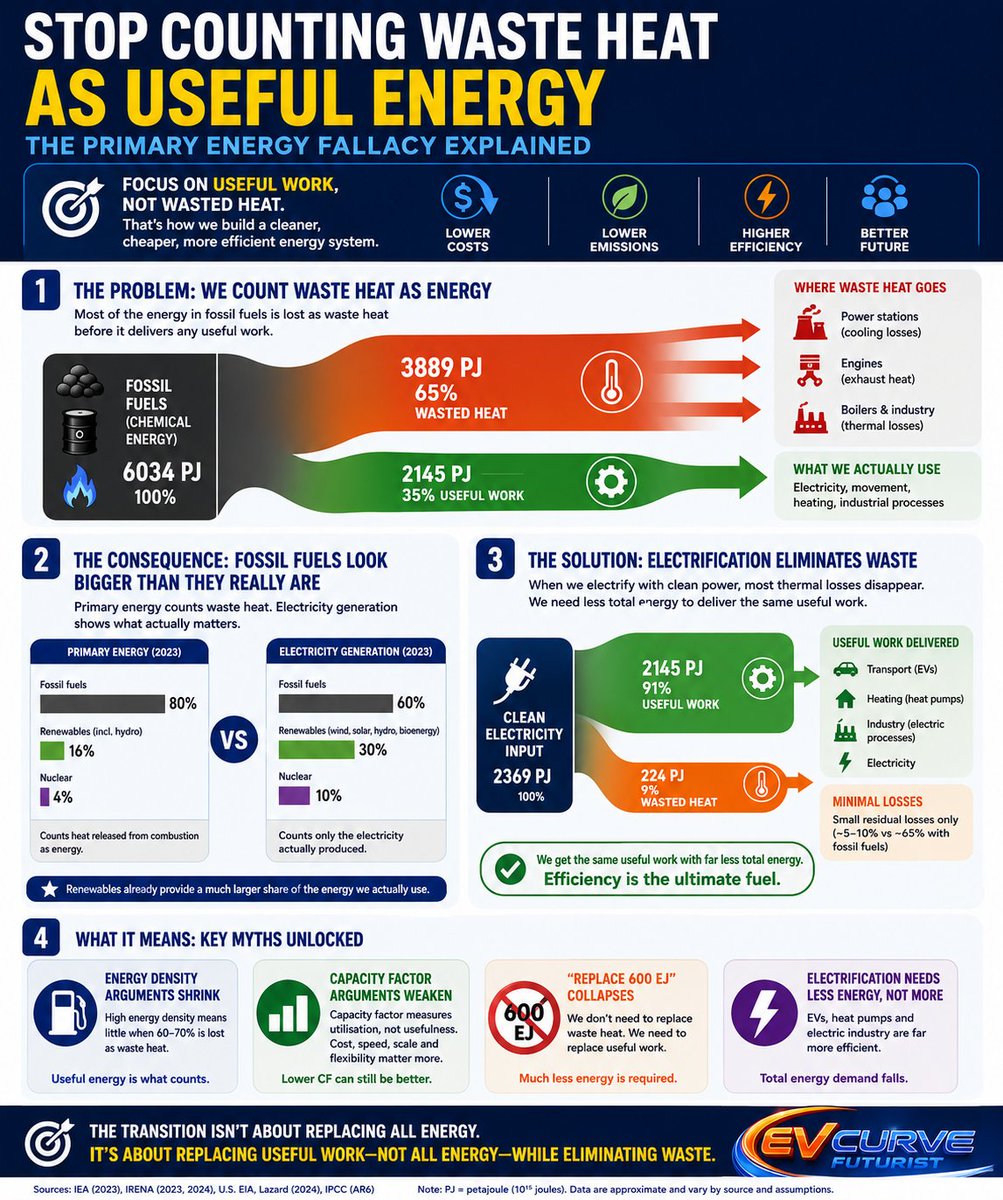
We don’t need to replace 600 EJ of fossil energy. We need to stop wasting it. Fossil systems lose ~2/3 as heat. Electrification delivers energy directly into work, cutting total demand ~40–50%. The transition isn’t bigger than we think. It’s smaller. #SWB
https://t.co/gJOVbP1NE9

Ember reports utility-scale #solar at just $43/MWh. Add batteries to shift half that generation into the evening & cost rises by only $33/MWh, delivering dispatchable solar for around $76/MWh.
That crushes the entire "we need 24/7 fossil baseload" argument. Cost wins. #BESS #SWB
Abu Dhabi's 5.2 GW solar + 19 GWh battery project is being built to deliver 1 GW of round-the-clock clean power, with IRENA estimating a cost of roughly $70/MWh.
Meanwhile, renewable-plus-storage systems can already supply electricity more than 95% of the time at competitive costs in major markets including China, India and Brazil.
The old grid model was simple: fossil baseload first, renewables second.
The new model flips that equation. Cheap solar, wind and batteries do the heavy lifting. Thermal plants increasingly become backup capacity rather than the foundation of the system.
The economics are changing much faster than the outdated narratives. #Bettrification

Where the wind blows and the North Sea turns, a new British energy system is emerging.
The UK’s offshore wind pipeline is now enormous. What started as supplementary generation increasingly looks like backbone infrastructure capable of reshaping the entire kingdom’s grid. #SWB
https://t.co/PIAvWoF0SI

Biggest clean energy project in the US. SunZia, New Mexico → California. ~916 turbines, 3.5 GW, ~11–14 TWh/yr powering ~1M homes. 550-mile HVDC delivers power where needed. No fuel chain, no commodity volatility. Proof the US isn’t slowing down with #SWB. #Renewables #Wind
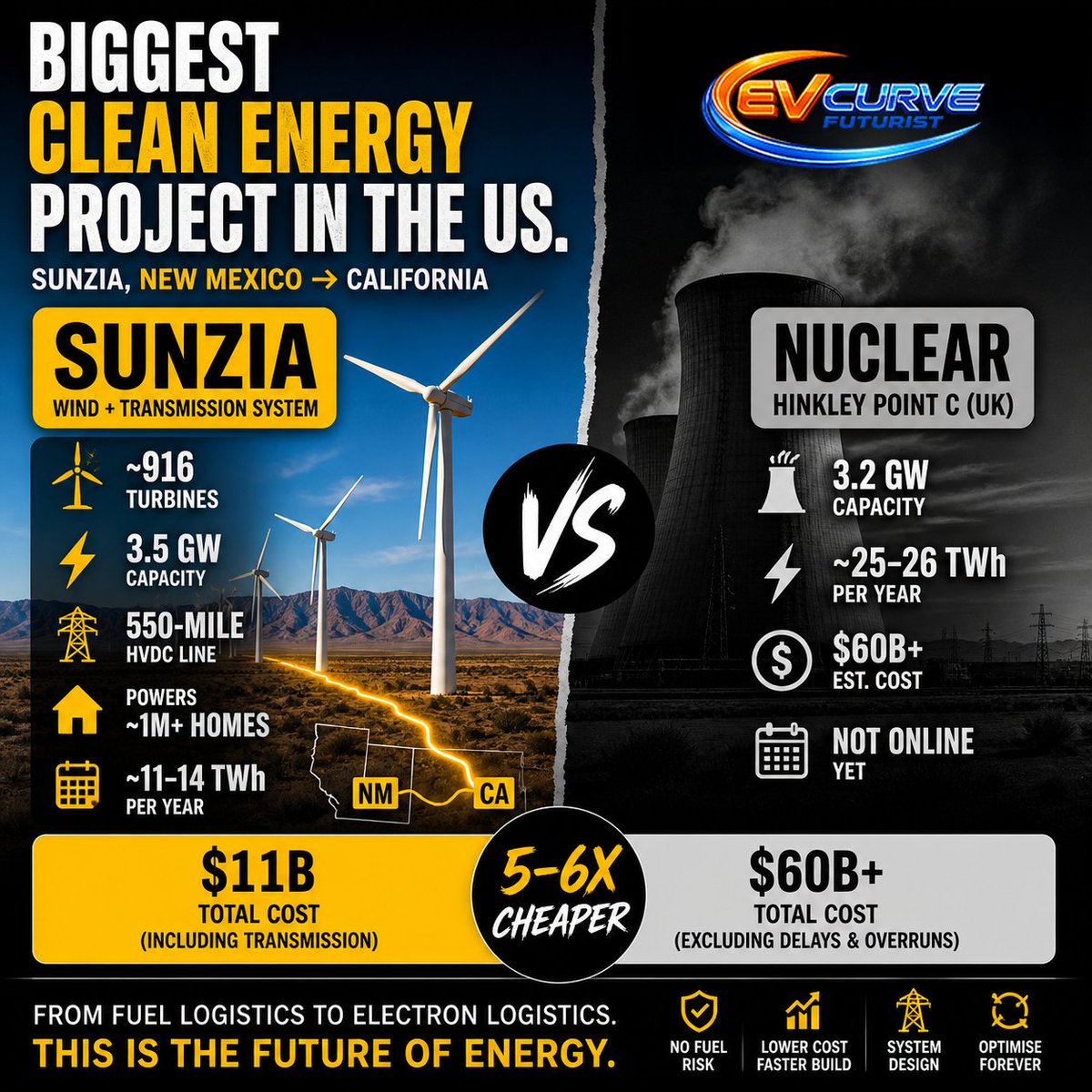
🚨 The largest clean energy project in the US just dropped. SunZia isn’t just a wind farm. It’s a system. 242 giant turbines are already installed, ~916 total coming, delivering 3.5 GW of power, connected by a 550-mile HVDC line that moves energy from New Mexico into California exactly when it’s needed. Solar dominates midday, demand spikes in the evening, and wind fills the gap. That’s not coincidence, that’s design.
At full capacity, it can power ~3 million people. With a capacity factor around 35–45%, that’s roughly 11–14 TWh per year, all for about $11B including transmission. Now compare that to Hinkley Point C: ~3.2 GW, ~25–26 TWh per year thanks to ~90% capacity factor, but at a cost of $60B+) and still not online. Yes, nuclear produces about 2x the annual energy, but that’s the wrong frame.
The old system was built around fuel logistics: mine it, ship it, burn it, repeat. Constant inputs, constant exposure, constant volatility. SunZia flips that completely. Build it once, move electrons, optimise forever. No fuel supply chain, no chokepoints, no price shocks tied to oil or gas. This isn’t about renewables replacing fossil, it’s about a new grid architecture emerging where remote generation, long-distance transmission, and demand matching work together as a coordinated system.
Lower capacity factor, lower total output, but 5–6x cheaper, faster to build, includes transmission, and scales modularly. While people argue about intermittency, projects like this are already solving it at scale, not in theory but in steel, concrete, and transmission lines. This is what the transition actually looks like. Not one-for-one replacement, not wind versus coal, but a full rewrite of how energy flows. From fuel logistics to electron logistics, from extraction to optimisation, from fragile to resilient. This isn’t incremental. It’s infrastructure for a post-fossil grid, and it’s already being built. ⚡
https://t.co/ztduBkkdKG
Most energy debates are trapped in a scarcity mindset. Humanity uses ~20 TW.
The Sun delivers ~170,000 TW to Earth continuously.
We don't have an energy shortage — just a capture, storage & distribution challenge.
We're learning to tap a star. Cost always wins. #SWB


The funny thing about disruption is that nobody needs to agree with it.
It happens anyway.
#Solar #Wind #Renewables #SWB #Bettrification #Disruption #Poland #Polska #Energy #Transition #LFP #EVs #BESS #Lithium #RIPCoal

We don’t need to replace 600 EJ of fossil energy. We need to stop wasting it. Fossil systems lose ~2/3 as heat. Electrification delivers energy directly into work, cutting total demand ~40–50%. The transition isn’t bigger than we think. It’s smaller. #SWB
https://t.co/gJOVbP1NE9
#SWIFTBIRD #SWB 99 #A75AA2
NGUEN NATIE NGUEN
FL280 M.74
Will be holding over NATIE for 10 min to RV with the receivers and returning to PGUA.


Passenger Explodes After Being Kicked Off Flight for “Sleeping” — You Won’t Believe the Cop’s Response 😳✈️👮
What should’ve been a peaceful nap on a plane turned into a full-blown confrontation after police boarded the aircraft to remove a man who was reportedly “passed out” — and the argument that followed stunned everyone watching.
1. The video begins with officers standing over the passenger, telling him he was “passed out” as if that alone justified removal.
2. Confused, the man asks why police were called for something as harmless as sleeping on a flight.
3. The sergeant dodges accountability, saying the decision wasn’t his — but refuses to say whose it was.
4. The passenger, now wide awake and furious, fires back with insults after feeling unfairly targeted.
5. Instead of de-escalating, the officer lingers, trading cold stares and letting the tension rise.
6. No one mentions threats, violence, or disorder — just that he was difficult to wake, raising questions about why cops were involved.
7. The man repeatedly tells the officer to get off the plane, insisting he did nothing to justify the removal.
8. His frustration grows as he claims all they needed to do was wake him up properly.
9. Bystanders quietly watch the bizarre standoff, unsure why a simple misunderstanding turned into a police matter.
10. The officer’s attitude appears personal, not procedural, making the situation feel more like an ego clash than safety protocol.
11. The passenger mentions flying private soon, hinting at frustration from both sides and a dramatic contrast in treatment.
12. The clip ends with unanswered questions: Was this about safety, or was someone abusing authority?
💬 Was removing him justified — or was this a pointless power move over nothing?
BloombergNEF: Solar #1 electricity source by 2032! Storage 17x to 3.8 TW by 2050 — huge system shift. But IEA & forecasters underestimated solar growth for 20 straight years… This projection STILL too conservative. The #SWB revolution is accelerating FASTER than most understand!
The old energy modelling mindset still treats solar and wind as conventional energy technologies, assuming they're simply 1-for-1 replacements for coal, gas or nuclear. They aren't. They're modular, manufactured, deflationary, globally deployable and increasingly paired with batteries. That makes them behave less like traditional fuel-based infrastructure and more like technology platforms, improving through scale, learning curves and deployment.
Solar is becoming the backbone of the future grid, but wind increasingly looks like its perfect dance partner, strongest when solar is weakest.
While solar floods the grid with ultra-cheap daytime electricity in high-penetration markets, wind often strengthens overnight and during seasons when solar weakens. Add batteries and the whole system starts behaving very differently.
The killer point is this: once solar and wind become the cheapest source of new electricity, growth no longer relies on climate policy. Economics takes the wheel. Energy security, AI, EVs, industrial electrification, green fuels and escaping fossil fuel volatility all start accelerating adoption simultaneously
And that’s before the battery curve fully bites.
Batteries don't just support solar and wind. They fundamentally change their value proposition, turning the entire energy equation on its head. They transform midday solar abundance and overnight wind into dispatchable power. They crush gas peaker economics, reduce curtailment and make ultra-cheap renewables flexible enough to reorganise the grid around them.
So when a model says solar leads by 2032, I don't see a bold prediction. I see a conservative baseline.
History suggests the real question isn't whether solar becomes the world's largest source of electricity by 2032.
It's whether it gets there earlier, and whether the solar share projected for 2050 ends up looking laughably low in hindsight.
https://t.co/lYMd0GhGaJ

We live on a planet where the cheapest way to generate electricity is to a point a piece glass at the sun.
That’s the disruption.
No fuel. No combustion. No drilling. Just physics, manufacturing & collapsing costs.
And the old energy system knows exactly what that means.. #SWB


Few countries over the past two decades experienced as much misery & destruction as Syria, including its energy grid.
Now parts of the country may already be getting 15–20% of real electricity access from unofficial rooftop solar as the state grid struggles to survive. #SWB
Syria’s electricity system tells one of the most fascinating and tragic energy stories on Earth.
Before the war, hydro formed a meaningful part of the grid and the system was relatively stable. Then conflict, infrastructure destruction, sanctions, fuel shortages and economic collapse pushed the country into chronic electricity crisis.
Fossil fuels regained dominance as damaged infrastructure and emergency generation filled the gap, while hydro steadily lost share.
But something else quietly began happening underneath the official statistics.
Across cities like Aleppo and Damascus, rooftop solar started spreading from the ground up as ordinary people adapted to endless blackouts and diesel costs becoming unbearable.
Official grid data still barely captures this shift, with solar only appearing around 1–2% in most datasets. But once unregistered rooftop systems, informal installs and off-grid systems are considered, a realistic back-of-envelope estimate may already place real solar contribution closer to 15–20% of actual electricity access across the country.
And now a second layer is emerging simultaneously.
As part of Syria’s rebuilding phase, Saudi Arabia, Qatar, UAE, Turkey and foreign energy firms are now beginning to pour billions back into top-down energy infrastructure again, including gas plants, grid reconstruction, offshore gas exploration and increasingly solar, wind and battery storage systems.
One important thing to note though is that while gas is absolutely still part of Syria’s rebuilding story, I increasingly suspect it may become sidelined faster than many expect.
Partly because broader Middle East instability again exposed how vulnerable fuel-dependent systems can become during geopolitical shocks. At the same time, solar, wind and batteries are now simply faster to deploy, massively modular, decentralised and increasingly much cheaper to build and operate than rebuilding large fuel-dependent systems from scratch.
That matters enormously in a country like Syria:
👉 damaged grid
👉 fragmented infrastructure
👉 chronic blackouts
👉 capital constraints
👉 fuel insecurity
So while billions are flowing back into gas plants and offshore exploration, I suspect SWB may ultimately scale faster underneath it all simply because the economics and deployment speed are increasingly overwhelming.
Especially rooftop solar + batteries, with large-scale wind now also entering the pipeline.
What makes Syria fascinating now is that it may become a real-world example of two energy systems colliding simultaneously: top-down fossil and renewable reconstruction vs bottom-up decentralised #Bettrification.
This wasn’t driven by ideology or climate policy.
It was survival.
And now survival is slowly evolving into reconstruction.

Most Popular Users

Elon Musk 
@elonmusk
240.2M followers

Barack Obama
@barackobama
119.3M followers

Donald J. Trump
@realdonaldtrump
111.6M followers

Cristiano Ronaldo
@cristiano
109.4M followers

Narendra Modi
@narendramodi
106.9M followers

Rihanna
@rihanna
97.4M followers

NASA
@nasa
92.1M followers

Justin Bieber
@justinbieber
90.7M followers

KATY PERRY
@katyperry
87.1M followers

Taylor Swift
@taylorswift13
80.9M followers

Lady Gaga
@ladygaga
72.5M followers

Kim Kardashian
@kimkardashian
69.5M followers

Virat Kohli
@imvkohli
69M followers

YouTube
@youtube
68.6M followers

Bill Gates
@billgates
63.5M followers

The Ellen Show
@theellenshow
62.5M followers

CNN
@cnn
61.9M followers

Neymar Jr
@neymarjr
61.6M followers

X
@x
60.9M followers

Selena Gomez
@selenagomez
60.2M followers