

Top Tweets for #Synchronous

年内いっぱいで「探球論」は終了となります。いままでありがとうございました。ジャイアンツでの平石さんのご活躍を応援いたします。
ということで、週末27日のLIVE配信にご参加いただくには明日までのご登録。お待ちしております!
探球論についてのお知らせ https://t.co/K0QHlaKn9r #SYNCHRONOUS
@backs_sports @hiraishi_yosuke

As a Backend developer how do u handle synchronous and asynchronous error in an expressjs server
#100DaysOfCoding #backendDevelopment


@PrismaXai Unified Cross-Rollup Composability
5) DeFi protocols can now read real-time collateral ratios, liquidity depths, and governance votes across multiple rollups natively. @PrismaXai turns fragmented L2 ecosystems into a single, synchronously readable state machine.
@RialoHQ 4) For Web3 Devs: Event-driven multi-chain primitives.
Eliminate fragile synchronous locks. Build cross-chain governance, omni-chain lending, and unified liquidity routers natively.
1) Synchronous cross-chain calls create massive latency and liquidity bottlenecks.
Waiting for multi-chain block confirmations stalls execution and exposes dApps to bridge failures.
Multi-chain apps need non-blocking state sync.
@RialoHQ


🧵 JavaScript Event Loop explained: Call Stack, Web APIs, Microtask Queue & Task Queue.
Ever wondered how JavaScript handles asynchronous operations even though it runs your code on a single main thread?
Let's break it down. 👇
1️⃣ Call Stack
JavaScript executes synchronous code using the Call Stack.
When a function is called, it's pushed onto the stack.
When it finishes, it's popped off.
JavaScript executes one stack frame at a time.
2️⃣ Web APIs
The browser provides APIs such as:
→ setTimeout()
→ fetch()
→ DOM events
→ addEventListener()
These allow asynchronous operations to happen without blocking the main JavaScript execution.
3️⃣ Task Queue (Macrotask Queue)
When certain asynchronous operations complete, their callbacks are queued as tasks.
Examples include:
→ setTimeout callbacks
→ setInterval callbacks
→ DOM event callbacks
4️⃣ Microtask Queue
Microtasks are processed after the current synchronous execution finishes.
Examples:
→ Promise.then()
→ Promise.catch()
→ Promise.finally()
→ queueMicrotask()
Microtasks are processed before the next task is picked.
5️⃣ Event Loop
The Event Loop coordinates everything.
Its simplified job:
Let the current synchronous code finish.
Process queued microtasks until the queue is empty.
Allow the browser to perform rendering when appropriate.
Pick the next task.
Repeat.
6️⃣ Let's test your understanding!
console.log("1");
setTimeout(() => {
console.log("2");
}, 0);
Promise.resolve().then(() => {
console.log("3");
});
queueMicrotask(() => {
console.log("4");
});
console.log("5");
What will be the output?
A) 1, 2, 3, 4, 5
B) 1, 5, 3, 4, 2
C) 1, 5, 2, 3, 4
D) 1, 3, 4, 5, 2
Correct answer: B
Why?
1 executes synchronously.
setTimeout schedules a task.
Promise .then() schedules a microtask.
queueMicrotask() schedules another microtask.
5 executes synchronously.
Microtasks execute in queue order: 3, then 4.
Finally, the timer callback executes: 2.
Final output:
1 → 5 → 3 → 4 → 2
Remember: Zero milliseconds in setTimeout() does not mean immediate execution.
Understanding the Event Loop makes debugging asynchronous JavaScript much easier.
JavaScript developers, did you get the output right without running the code? 👀
#JavaScript #FrontendDevelopment #WebDevelopment #100DaysOfCode

⚡ Grid infrastructure order win! Receives a ₹600–900 Crore (excl. GST) NOA from POWERGRID to establish two Synchronous Condensers at Barmer-II HVDC Terminal Station! 🏗️📈
Details below 👇 https://t.co/ZD7g5N37e7
#BHEL #PowerInfra #StockMarketIndia #StockMarketNews #BSE #NSE
@PrismaXai Zero-Latency Modular Scaling
4) Synchronous locks limit modular chains to the speed of their slowest node. @PrismaXai allows specialized execution environments (EVM, SVM, Move) to scale throughput at native speeds without waiting on cross-chain finality.
Non-Blocking Messaging for Devs
3)For devs: @PrismaXai replaces synchronous cross-layer calls with event-driven state commitments. Execution shards verify remote state transitions using lightweight cryptographic receipts, eliminating global lock contention.
The Synchronous Execution Bottleneck
1) Traditional blockchains force all execution layers to synchronize state simultaneously, creating severe network stalls and latency spikes. The alpha fix? Asynchronous State Synchronization on @PrismaXai. Let's dive in.


The hidden synchronous blocking operation that silently destroys concurrency throughput under high concurrent traffic spikes.
https://t.co/TMtdpEqsn0
Dropping raw sync file operations inside an async route completely freezes your single-threaded event loop instance.
Are you offloading heavy I/O tasks to workers or risking runtime blocks?


Dexpot v0.8.1 is out and rejects unsupported path annotations when a route is registered. A float, bool or Enum annotation can no longer silently receive a string.
Dexpot is a synchronous Python API framework for GIL-enabled and free-threaded CPython.
Path captures support str, int, Any or no annotation. Only int performs conversion, with 422 for invalid input. Other conversions need explicit application validation.
This patch also expands the runnable lifecycle and nested-response examples and updates vulnerable development and website build dependencies. Python runtime requirements are unchanged.
Install or upgrade:
pip install --upgrade "dexpot[cli]==0.8.1"
https://t.co/4YHHphn35f
FastAPI handles async loops smoothly, until row #4 drops a synchronous ORM call directly into an async route and completely serializes your worker pool.
https://t.co/08oz8UdWil
FastAPI hits 15,000+ RPS over Django 5.2 in synthetic benchmarks, until box #4 runs one synchronous ORM query inside an 'async def' route and freezes the entire event loop.
Async SQLAlchemy 2.0 or standard 'def' threadpool routes?
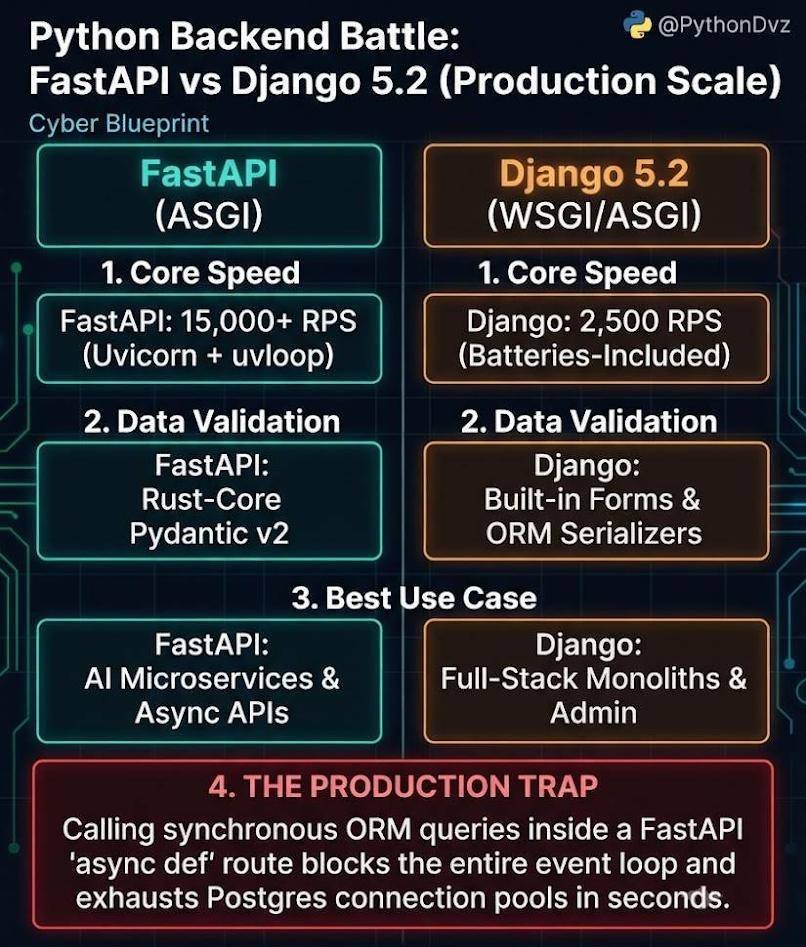
FastAPI vs Django benchmarks are fake if row #4 proves your production app is silently choking on synchronous thread blocks inside async endpoints.
https://t.co/08oz8UdWil
FastAPI hits 15,000+ RPS over Django 5.2 in synthetic benchmarks, until box #4 runs one synchronous ORM query inside an 'async def' route and freezes the entire event loop.
Async SQLAlchemy 2.0 or standard 'def' threadpool routes?
When row #4 freezes the uvloop reactor via standard synchronous driver leaks, how fast do your Postgres connection pools hit maximum saturation?
https://t.co/08oz8UdWil
FastAPI hits 15,000+ RPS over Django 5.2 in synthetic benchmarks, until box #4 runs one synchronous ORM query inside an 'async def' route and freezes the entire event loop.
Async SQLAlchemy 2.0 or standard 'def' threadpool routes?
Dexpot v0.8.0 is out and adds process-local resource lifecycles to the synchronous Python API framework.
Register a context-manager factory with app.lifespan(factory). Each serving process acquires its resources before traffic, unwinds partial startup failures, and cleans up in reverse order. Outstanding handlers keep their resources until they finish; forced process termination can still skip cleanup.
The release also selects direct preparation for supported nested Struct responses on GIL-enabled Python, preserving validation and public-field projection. This trades more registration work and metadata for less repeated preparation.
The lifecycle performance screen passed in controlled Linux conditions. macOS performance remains unqualified, and the experimental socket-I/O redesign is not part of this release.
Install: python -m pip install --upgrade 'dexpot[cli]==0.8.0'
Release details and example:
https://t.co/xRdIJ5jcit
https://t.co/hGJNCN9Nnn
A single stalled downstream container can exhaust an API gateway's worker pool in seconds through synchronous retries. Do you enforce gRPC circuit breakers or Kafka queues?
https://t.co/SopR9xDjUz
Python backends jump into microservices too early, trading 1ms in-memory calls for 50ms+ network serialization overhead, while the "Fault Isolation" row here hides a brutal production trap.
Distributed saga or ACID monolith?

@read__the__diff Synchronous retries turn gateway worker pools into frozen waiting rooms indeed, but adding naive exponential backoffs without structural jitter still triggers localized stampedes that crush down-stream databases.
Circuit breakers with dynamic shed or token-bucket rate limiters?

@PythonDvz Independent deploys, shared failure domain: synchronous retries turn the gateway worker pool into a waiting room
Microservices decouple code deployment, but moving fast introduces a brutal production trap: synchronous retry storms that fry your internal API gateway worker pools.
https://t.co/SopR9xDjUz
Python backends jump into microservices too early, trading 1ms in-memory calls for 50ms+ network serialization overhead, while the "Fault Isolation" row here hides a brutal production trap.
Distributed saga or ACID monolith?
When network reference latency destroys application efficiency, your architectural breakdown fails under high concurrency. How do you mitigate synchronous cascading failure storms?
https://t.co/SopR9xDjUz
Python backends jump into microservices too early, trading 1ms in-memory calls for 50ms+ network serialization overhead, while the "Fault Isolation" row here hides a brutal production trap.
Distributed saga or ACID monolith?

@Herr_Kiebert Close. A content script runs at document_start and reads a tiny flag from the site’s own localStorage. It’s synchronous, so it’s available before first paint, unlike https://t.co/3KaC0kcut6, which is async. If the flag says dark, the dark styles go in immediately.
The convergence of enterprise data layers and real-time agent execution highlights the need for flawless state synchronization. Standard replication lags are unacceptable in modern system architecture.
Synchronous master replication or asynchronous state ledger?
https://t.co/tMlPwj3gNo
vLLM, SGLang, and TensorRT-LLM each solve distinct GPU bottlenecks across KV cache exhaustion and batch inference throughput.
When serving production LLM pipelines in 2026, do you default to vLLM, SGLang, or TensorRT-LLM?


@PythonDvz Fair points on gRPC for synchronous calls. For agent coordination I would lean event-driven, since a queue absorbs bursts and makes replays easy, with gRPC kept for latency-critical lookups. How do you handle ordering when consumers retry?

On PrismaX, commands are transmitted and executed instantly over the internet. No laboratory is required—only an internet connection and a human operator.
When a human issues a command, the robotic arm responds almost synchronously, with no perceptible delay. Every grasp, rotation, and placement occurs in the real physical world, not in a simulated environment.
This distinction is far more significant than it might sound.
Simulations can only approximate the laws of physics; real-world operation, by contrast, captures every subtle variable—friction, weight distribution, shifts in lighting, and more—exactly as they are. While such variables are often smoothed over or omitted in simulations, here they are preserved in their entirety.
Though remote operation may sound simple, achieving a truly functional system requires simultaneously addressing challenges related to latency, precision, and consistency.
A single robotic arm, one operator, and one session may seem trivial—but when thousands of operators work in parallel, the entire landscape shifts.
The foundation for "Physical AI" is not built through a single, flashy demonstration, but rather through the continuous accumulation of thousands upon thousands of routine operational sessions.
@PrismaXai @vivianrobotics

With Dexpot, I want to build the fastest Pythonic API framework on both standard and free-threaded Python while keeping ordinary synchronous functions as the way you write endpoints.
Free-threaded Python can run Python threads in parallel across CPU cores. Standard Python still needs a different execution strategy. Dexpot already adapts its scheduling to these two environments and puts limits on incoming work so overload has an explicit outcome.
The next work includes stronger performance gates, richer typed inputs, lifecycle support, and generated API descriptions. I want it to grow into a useful full framework while preserving a small, understandable application model.
“Fastest” is the target. Earning that description requires correct responses, representative workloads, latency measurements, and resource comparisons. I want people to be able to inspect the evidence behind our progress.
https://t.co/hGJNCN9Nnn
ModePot already has projects you can install or play, but they are at different stages.
Dexpot serves synchronous Python APIs.
Intpot exposes typed tools through different interfaces and converts supported applications between them.
Summonpot combines exact application operations with bounded agent-owned decisions.
Lifepot runs replayable artificial-life worlds.
RefPot has an experimental database alpha with a deliberately small interface.
What I want next is broader practical capability without making the experience harder to understand. That means more faithful application conversion, richer API contracts, better-qualified storage, and games where we can investigate how simple rules produce complex behaviour.
These are directions we are working toward, not features I am claiming every project already has. I want people to see both the useful present and the scale of the ambition.
https://t.co/fN1DQ1c6pW
Whole idea behind ModePot is to challenge how much complexity we accept in the software we build on and also to modernize today’s available frameworks and tools in this AI and agentic era.
Today, that work includes Python API frameworks, a tool that connects different interfaces, an artificial-life game, and an experimental database engine. Each project asks a specific question about what could become simpler, faster, or more useful if we reconsidered its foundations.
My ambition is to grow this into an open-source family of frameworks, tools, engines, and games that can stand alongside the best in their fields. AI and agents belong where they improve what people can build. Their presence alone is not a measure of progress. All these projects will be agentic friendly and they are already since day 1.
The existing projects are our starting point. I want ModePot to become a place where we can invent the next foundations together.
https://t.co/fN1DQ1byAo
The app needs to provide that today. Summonpot v0.10.0 has no built-in status lookup for synchronous work that finishes after a timeout. The app should persist the outcome under an operation ID or idempotency key, so callers can check it or retry safely.
We do plan richer outcome tracking, receipts/recovery, and durable execution for long-running work. Those are roadmap items, with no release date yet. A caller-facing status API for timed-out operations is not specified yet, so I wouldn’t promise that exact interface.
The “faster” part of ModePot is where my opinions have to meet a stopwatch.
With Dexpot, I’m pursuing fast Python APIs across standard GIL-enabled and free-threaded Python, while keeping handlers as ordinary synchronous functions.
The GIL limits simultaneous Python execution across threads. Free-threaded Python removes that restriction, so the scheduling assumptions deserve another look.
My goal is the fastest Pythonic API framework in both modes. That is an ambition to test, not a trophy I can award myself.
Otherwise, benchmarking would be much easier. I would simply declare victory and close the laptop.
https://t.co/hGJNCN9Nnn
I’m building ModePot to challenge today’s software, packages, and games: make them simpler, faster, more modern, and agent-friendly.
The question is how much of the complexity belongs to the problem, and how much we inherited without reconsidering it.
“It has always worked this way” is also true of my terrible posture. Longevity is doing a lot of work in that argument.
https://t.co/fN1DQ1byAo
Dexpot v0.7.0 checks declared response data before sending a successful API reply, while keeping ordinary synchronous Python handlers.
Suppose a handler returns a customer name alongside an internal token. The diagram shows a public record with only the name field, so the extra token is left out of the JSON. If the declared output is malformed or includes NaN/Infinity, the checked route returns a sanitized 500 before any success status, headers or body are sent.
The attached diagram shows that boundary: returned data → declared public schema → encoding and final JSON checks → send. The error path branches off before a successful reply can leave the server.
You select the contract with response=T. The boundary is explicit: Any does not filter private fields, and response=None keeps generic JSON encoding. RawResponse is available only on unchecked routes.
I have updated the README and website with this diagram alongside the serving architecture, which covers both GIL-enabled and free-threaded Python.
https://t.co/i4ji4BFPHY

I have been making dexpot (https://t.co/ISKM6ROzRE) stricter about the API replies it sends, while trying to keep it fast. This turned into an unexpectedly thorough education in how to build an airport badly.
An API should return what it promised. If an endpoint promises a public customer profile, malformed values should fail and private fields should stay private. Successfully turning something into JSON is not enough.
Think of those checks as airport security. Every bag needs inspection, but handing every lane the same clipboard and repeatedly unpacking luggage is a questionable staffing strategy.
My first optimization moved more bags per second and made unlucky passengers wait longer. Even the tiny bags got a worse queue. I had improved the airport’s spreadsheet and annoyed the passengers.
The fix was more selective: give workers their own checklists, keep the heavy inspection step moving, and let small replies use the existing fast checks without extra detours. Already-validated output no longer gets decoded, rebuilt and encoded again just to be sent.
The final local comparison, on my M4 with Python threads running in parallel (free-threaded Python), against the earlier fully checked implementation:
• Large shared JSON responses: 81× throughput and about 75% lower p99 latency.
• Tiny replies: about 2% more throughput and 4% lower p99 latency.
p99 is the response-time cutoff met by 99% of requests. It matters because “we served more requests” is poor consolation when your request is the one stuck in the queue.
Across 40 longer trials, 128.6 million replies matched the expected output, with no malformed replies or socket errors. Bodyless replies had a small latency loss, which is still visible in the screenshot.
These are local, same-contract measurements, not an 81× claim about every endpoint or every machine.
I wanted a fast Python API framework. Somewhere along the way, I became the complaints department for an imaginary JSON airport.


@aysho_M @ericargent31113 @keepyourpixel @RialoHQ synchronous blocking is so dead async is the only way

最新回!
【鈴木誠也】ポストシーズンに向け「大事なこと」「目に焼き付けたいもの」 https://t.co/DRYBGMi8bH #SYNCHRONOUS
@backs_sports @suzuki_seiya_sb r
最新回!
【鈴木誠也の提言】「プロ」の世界を再考する。本能との向き合い方、戦い方をもう一度 https://t.co/P1dRrgcD4Q #SYNCHRONOUS
最新回。
メイソンミラー、ミジオロウスキー、サンチェス⋯ほんと一線級にめっぽう強いです。
【鈴木誠也】好投手から結果を出すも……「良くはない、でも大事なことに気づけた」 https://t.co/76ArRuCUpk #SYNCHRONOUS
最新回と今年の人気回!!
New!【鈴木誠也】「打球速度、スイングの強さ」なぜ足りなかった? https://t.co/xUrfiZXkxy #SYNCHRONOUS
Break! 鈴木誠也がもし今の時代の高校生・中学生だったら、SNSの練習法にどう向き合う?
https://t.co/Y39ed1fz6D


RLY CNTRL;24 VDC,SYNCHRONOUS MOTOR
#RELAY #APPLICATION #SYNCHRONOUS #MOTOR #0291A6814ACP008 #GENERAL
https://t.co/lg4WdIlP5S

SUPERSEDED BY 11029379
#MODULE #HIGH #SPEED #COUNTER #APPLICATION #SYNCHRONOUS #MOTOR #0291A6820ACP007 #GENERAL #11029379
https://t.co/tRFBeXAUDH

MODL COMM;SYNCHRONOUS MOTOR
#MODULE #COMMUNICATION #APPLICATION #SYNCHRONOUS #MOTOR #0291A6820AAP076 #GENERAL
https://t.co/erzMnfZpSz

MONTR;EXCTR DIO;PN:0291A6800ASP001
#MONITOR #EXCITER #DIODE #0291A6800ASP001 #GENERAL #SYNCHRONOUS #MOTOR
https://t.co/u0d4vuTKZH


Asynchronous Learning versus Synchronous Learning
At Edupixels, we support both forms of learning in the form of Instructor-led trainings or eLearning.
#elearning #edupixels #learning #learningmodel #asynchronous #synchronous #synchronouslearning #asynchronouslearning

Last Seen Hashtags on Sotwe
cuckson sister
Seen from United Kingdom
CELSTM
Seen from United States
フードコートスタイル
Seen from Korea
JusticeServed
Seen from Norway
TUM24
Seen from United States
brosis
Seen from United States
BBC
Seen from Brazil
ridingmilf
Seen from United Arab Emirates
헬창
Seen from Korea
sleeping porn
Seen from Turkey
Most Popular Users

Elon Musk 
@elonmusk
239.7M followers

Barack Obama
@barackobama
118.6M followers

Cristiano Ronaldo
@cristiano
114.3M followers

Donald J. Trump
@realdonaldtrump
111.7M followers

Narendra Modi
@narendramodi
106.9M followers

Rihanna
@rihanna
98.6M followers

NASA
@nasa
92.1M followers

Justin Bieber
@justinbieber
91.7M followers

KATY PERRY
@katyperry
89.9M followers

Taylor Swift
@taylorswift13
83.9M followers

Lady Gaga
@ladygaga
75.4M followers

Virat Kohli
@imvkohli
73.3M followers

Kim Kardashian
@kimkardashian
70.8M followers

YouTube
@youtube
68.6M followers

Neymar Jr
@neymarjr
66.3M followers

Bill Gates
@billgates
65.1M followers

Selena Gomez
@selenagomez
63M followers

The Ellen Show
@theellenshow
62.1M followers

CNN
@cnn
61.7M followers

X
@x
60.6M followers