

Top Tweets for #TAWHID


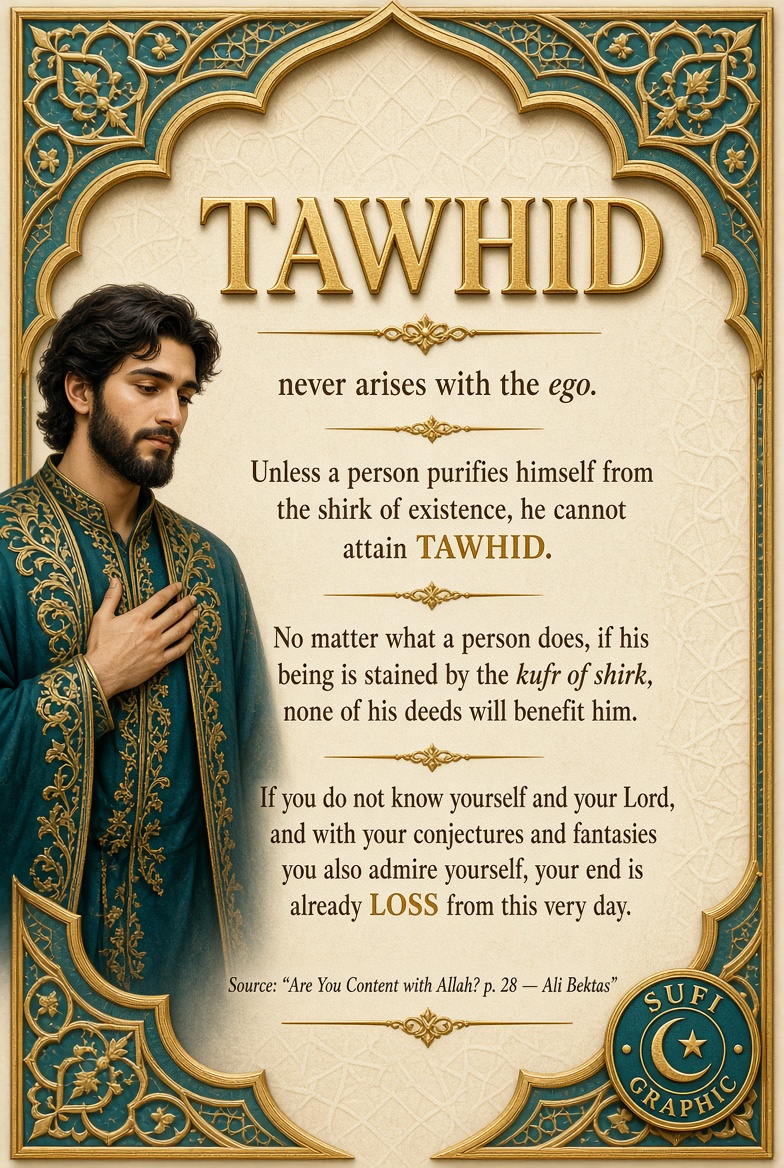
#Tawhid #Shirk #Disbelief #Conjecture #Islam #Faith #Believer #Sufi #AliBektaş #Existence #Selfhood #Ego #Ene #Narcissist TAWHID / SHIRK / SELFHOOD

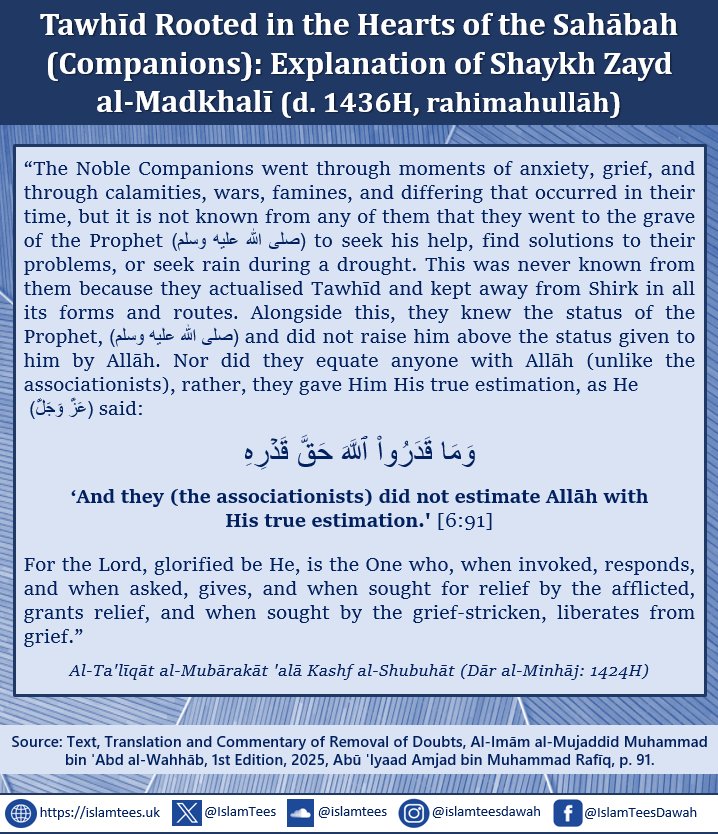
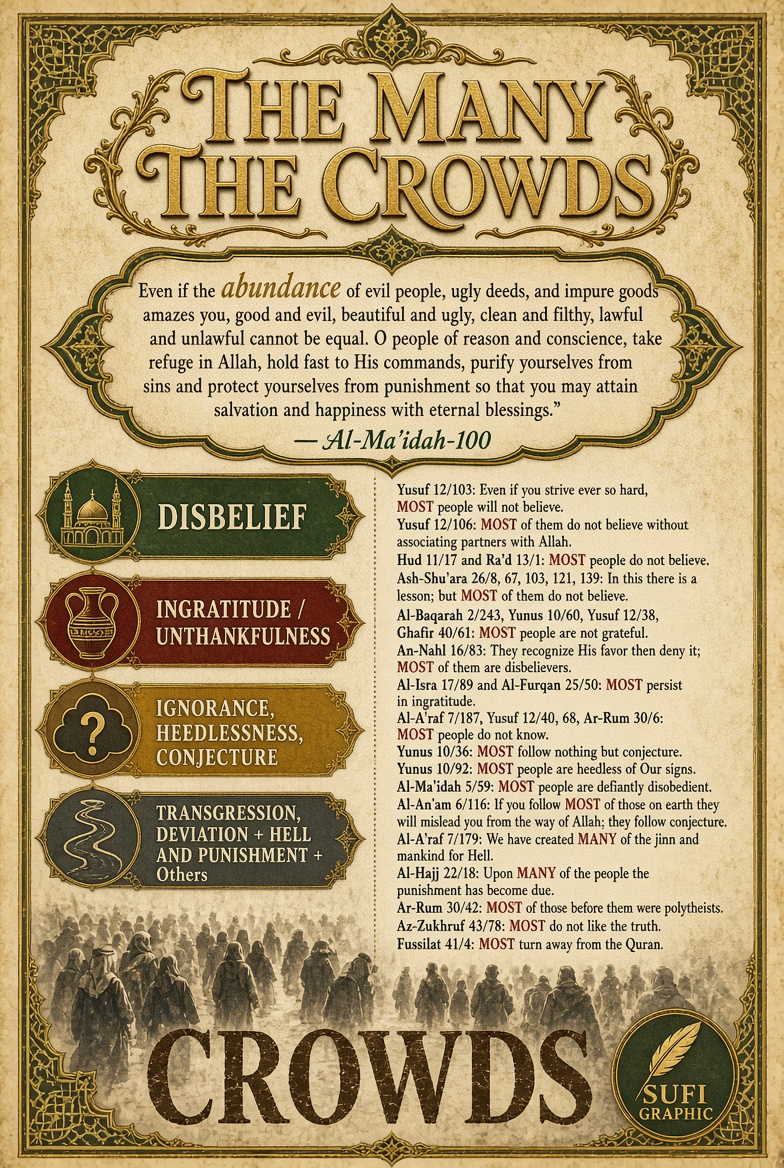
The Call Of The Messengers To Tawhīd & Nature Of Shirk They Warned Against: Clarification of Shaykh Bin Bāz (d. 1419H, rahimahullāh)
#dawah #invitation #call #messengers #Nuh #Noah #Abraham #Ibrahim #Jesus #Eesa #Musa #Moses #Muhammad #deen #islam #religion #Tawheed #tawhid #shirk #intercession #intermediaries

#ProphetMuhammad #Prophet #Salawat #Paradise #Tawhid #Islam #Faith #Bediuzzaman #RisaleiNur Who is Prophet Muhammad (A.S.M.)?
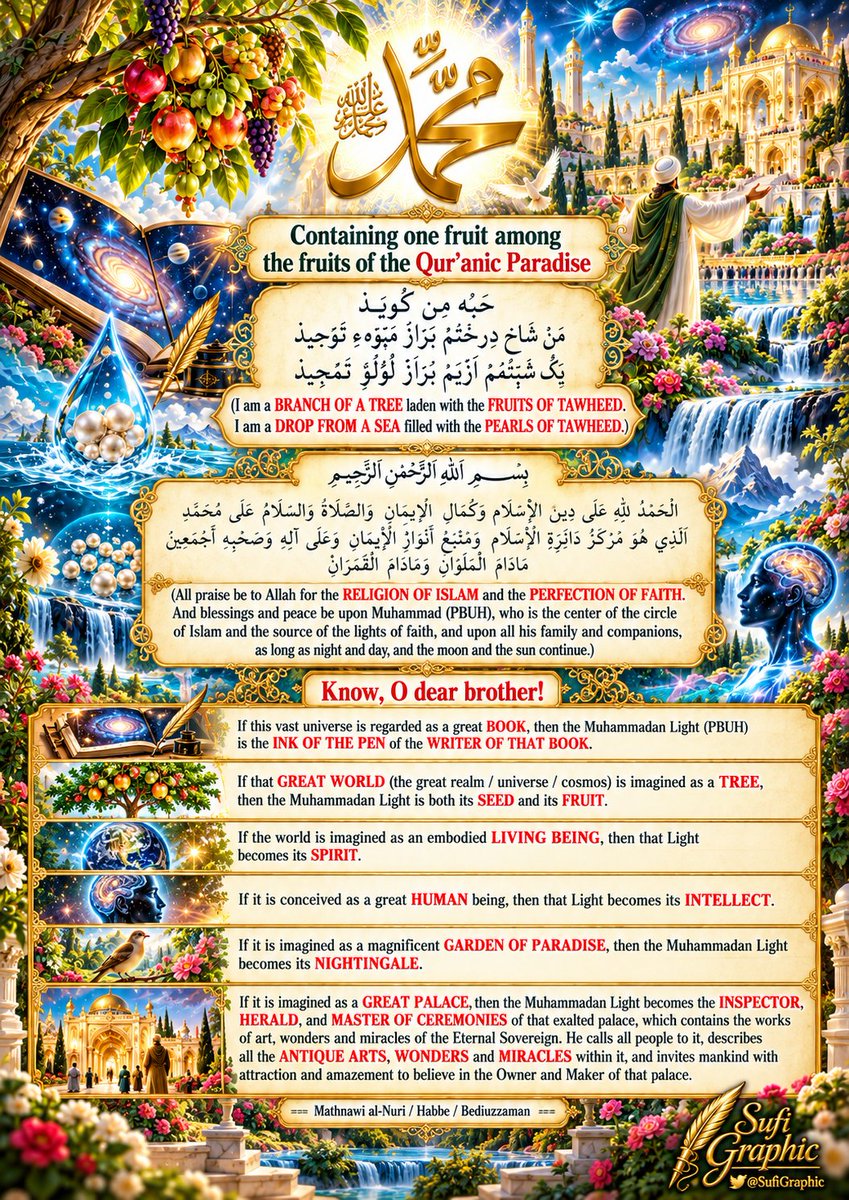

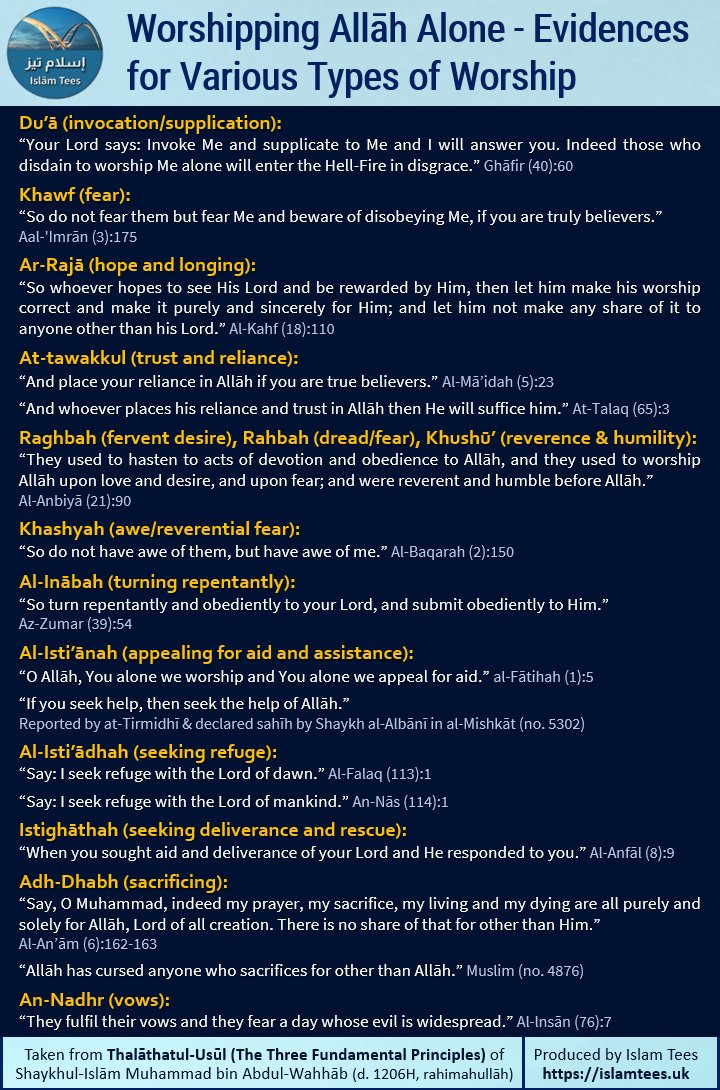




https://t.co/kQdq9ZOqp5
Do Muslims worship Prophet Muhammad?
No. Muslims love and follow him, but worship belongs to God alone. Muhammad is regarded as a human messenger—not divine.
Respect is not worship.
#ProphetMuhammad #Islam #Tawhid #LearnIslam
معنى لا إله إلا الله | العلامة عبدالعزيز الراجحي حفظه الله ورعاه
Meaning of La ilaha illa Allah
Shaykh Abdul Aziz al Rajihi
#الشيخ_الراجحي #الشيخ_عبدالعزيز_الراجحي #السعودية #الرياض #البكيرية #القصيم
#fawaidalrajihi #shaykhalrajihi #islam #tawhid
#Allah #God #Spinoza #Philosophy #Bediüzzaman #RisaleiNur #Faith #Tawhid #Pantheism #Monism #Shirk #Faith #Theology #Creation
SPINOZA AND B.S. NURSI ON THE CONCEPT OF THE UNIVERSE AND GOD
At first glance, Spinoza and Bediüzzaman Said Nursî appear close to each other in their contemplation of God starting from the universe; however, the metaphysical conclusions they reach are quite different.
The most fundamental distinction can be summarized as follows:
In Spinoza, the universe is not a created realm of existence separate or independent from God.
In Nursî, the universe is absolutely not God; it is a "BOOK OF VERSES/SIGNS" created by God that displays His names and attributes.
The center of Spinoza's metaphysics lies in Ethics I. According to him, there is only one substance. This infinite substance is "GOD or NATURE", and thought and extension, as known by humans, are its attributes. Individual entities are not independent substances, but finite modes of this single infinite reality. As summarized by the Stanford Encyclopedia of Philosophy, in Spinoza, "GOD or NATURE" is an infinite and indivisible reality; singular things are understood as specific modes of God's attributes.
Bediüzzaman's system departs sharply here. In the Risale-i Nur, the cosmos is not a part, mode, or necessary unfolding of God. The cosmos is the created (mahlûk); God is the Creator (Hâlık). However, the created universe is not entirely independent of God or self-sufficient either. Every entity depends on God's power, will, and knowledge. Along the lines of Mesnevî-i Nuriye, the order, needs, purpose (hikmet), and measure of beings are read as proofs for the existence and unity of God.
1. Spinoza: "Deus sive Natura"
Spinoza's famous expression is: Deus sive Natura — God or Nature.
However, understanding this simply as "stone, tree, human = God" would be incomplete. Spinoza uses two concepts:
Natura naturans: "Naturenaturing/producing nature"; the infinite substance and its attributes.
Natura naturata: All modes and the order of existence that follow from the necessity of God's nature.
Therefore, God is not like a monarch outside the universe who subsequently brings the universe into being. All reality is within the necessary order of a single infinite substance. For this reason, Spinoza is commonly called a "PANTHEIST"; however, in contemporary Spinoza interpretations, there is a debate over whether God should be considered identical with the whole of Natura naturata.
For Nursî, a serious metaphysical problem arises precisely at this point.
One of the fundamental principles of the Risale-i Nur can be expressed as:
-Work/ Maker
-Art / Artist
-Book / Author
-Cosmos / God
The cosmos points to God's names but does not turn into God.
2. Nursî: "The Universe is not God; it Points to God"
One of the very important concepts in Bediüzzaman's thought is mânâ-yı harfî (signitive/referential meaning).
A letter points to something far beyond itself. For example, the sun is visible in a mirror. The light in the mirror shows the sun; however: the mirror is not the sun.
According to Nursî, the condition of beings is just like this. A flower can show the name Cemîl (The Beautiful) through its beauty, the name Musavvir (The Fashioner) through its shape, the name Hayy (The Living) through its life, and the names Hakîm (The Wise) and Adl (The Just) through its proportion. But the flower itself is not Divine.
In Risale-i Nur sources, this approach is expressed as beings being mirrors that display the manifestations (tezahürler/tecelliler) of Divine names and attributes.
Here, the difference between Spinoza and Nursî is extremely important:
Spinoza: Ontological Immanence — Beings are modes of the single infinite substance.
Nursî: Manifestation (Tecellî) and Signification (Delâlet) — Beings are the works of God's names and point to them; yet they are not parts or modes of God's essence.
3. An Interesting Proximity: Both Oppose "Disconnecting God from the Universe"
Despite the vast ontological difference between them, there is a striking common ground: Neither thinks of God as a distant entity who created the universe and stepped aside, having no further relation to it.
However, they construct different solutions for this:
Spinoza: God is already the immanent cause of existence. The universe is not outside of God.
Nursî: God is ontologically separate from the cosmos, but: in terms of knowledge, will, power, lordship (rububiyet), and constant sustenance (kayyûmiyet), every entity is continuously dependent on God.
Therefore, Nursî's model is not deism. In his understanding, God is not merely "the One who created the universe in the beginning." At every moment, He is the active agent (fail) who creates, sustains, orders, alters, causes to die, and recreates. For this reason, the order of the cosmos is evaluated in the Risale as a field where Divine names and actions can be continuously read.
4. Necessity and Will: One of the Greatest Differences
For Spinoza, everything in reality occurs with necessity. God is not conceived as an anthropomorphic will choosing among alternatives by saying, "I could have created otherwise." Everything follows necessarily from God's nature. Therefore, in the Spinozistic universe, the relationship of:
necessity=>order of nature=>existence
dominates. The SEP states that Spinoza viewed singular things as modes determined both by universal laws of nature and other singular causes.
Bediüzzaman's system is the reverse. The cosmos is not a necessary emanation, but a willed creation. In the terminology of the Risale, God's attributes of:
knowledge=>will=>power=>wisdom
work together. Particularly in Mesnevî-i Nuriye, the fact that beings are chosen with specific measures out of countless possible forms is read as proof of the Divine will.
Thus:
Spinoza: God=>necessity=>universe
Nursî:God=>knowledge=>will=>power=>creation=>universe
5. Nearly Opposite Directions Regarding Nature
This point is especially important regarding the Treatise on Nature (Tabiat Risalesi). While Spinoza says Deus sive Natura, Nursî's Treatise on Nature is built almost entirely upon the claim: "Nature is not a creator."
The fundamental distinction used by Nursî is: Nature is a law, not power. It is art, not the artist. It is embroidery, not the embroiderer. In the Risale-i Nur literature, nature is explained as the sum of laws expressing the created order; the power of creation is not given to it.
Therefore, Spinoza's Natura is metaphysically extremely potent, whereas Nursî's nature possesses no independent power ontologically. Consequently, despite using the same word "nature/tabiat," they do not mean the same thing.
6. The Issue of Causes
A sharp difference exists here as well:
In Spinoza: The cause-and-effect order is the necessary structure of reality. Every event is determined by other causes.
In Nursî: Causes exist, but they are not creators. For instance, the scientific explanation of:
soil=>water=>sun=>genetic structure=>flower
is not rejected by Nursî. However, the metaphysical question is: Which of these possesses the knowledge and power to create the flower's color, scent, cells, DNA, measure, and entire organization? The answer: None of them. Therefore, a cause may be the condition/veil of creation, but it is not the actual agent (fail) of creation.
7. Is the Universe a "Book"?
Here, the two thinkers converge in an interesting way once again. For Spinoza, understanding nature is a way of understanding God, because understanding the necessary laws of nature is understanding the order of infinite reality.
In Nursî, this idea takes on a much more symbolic and theological form: The Book of the Cosmos. As emphasized by Şükran Vahide in her study on Nursî's thought, a parallelism is established in the Risale-i Nur between the Quran and the cosmos:
Quran = The book of the attribute of speech (kelâm)
Cosmos = The book of power and will
Consider a tree. For Nursî, the tree's roots, trunk, leaves, flowers, fruit, and seed are simultaneously a biological system and a text that recites Divine names. Therefore, scientific observation and theological reflection are not alternatives to one another.
8. But Their Methods of "Reading the Book" Differ
Spinoza reads the universe through mathematical-rational necessity. It is no coincidence that he wrote his Ethics using the geometrical method:
Definitions =>Axioms=>Propositions=>Proofs. The universe is a necessary order resembling this.
Nursî reads the universe through a chain of:
verse=>art=>name=>attribute=>named object
For example:
beauty in a flower=>beauty cannot be its own agent=>points to the attribute of Cemâl=>to the name Cemîl=>and that name to God.
This is the main contour of the method of Marifetullah (knowledge of God) in the Risale.
9. Teleology: A Major Divergence
Spinoza strongly rejects classical teleology. He criticizes the human notion that "everything was created for us." Explaining events occurring in nature through human purposes is misleading to him.
Bediüzzaman, quite the opposite, considers wisdom, utility, order, measure, and purpose in the universe as proofs for the existence of God, especially His name Hakîm. In Mesnevî-i Nuriye, it is argued that the pervasive wisdom and purposeful design in the universe point to a conscious and willed Hakîm.
Thus:
Spinoza: Mechanism/necessity-weighted cosmology.
Nursî: Wisdom and purpose-weighted cosmology.
10. They Also Diverge Regarding Miracles
In Spinoza's Tractatus Theologico-Politicus, because there is no separation between God and the laws of nature, the concept of miracles as "the violation of natural laws" becomes problematic. Spinoza interprets prophetic narratives and miracles within a rational/naturalistic framework.
Nursî, however, states that natural laws are laws created by God; thus, a miracle poses no ontological problem because the One who established the law is not bound by it. The analogy can be set up as follows: A programmer who writes the normal operating rules of software can externally intervene in the routines within the software. For Nursî, a miracle is not chaos or causelessness, but the exceptional modification of Adetullah (God's habitual way of acting).
11. The Issue of God's "Personality"
Here lies another very fundamental divergence:
Spinoza's God is not an entity who decides like a human, gets angry, regrets, or changes plans. Spinoza rejects the traditional anthropomorphic conception of God.
Bediüzzaman also rejects conceiving God like a human, aligning with the principle "There is nothing like unto Him" (Şûrâ, 42:11), meaning God does not resemble creation. However, at the same time, God:
Alîm — Knows
Mürîd — Wills
Kadîr — Possesses power
Rahîm — Shows mercy
Hakîm — Acts with wisdom
Semi‘ — Hears
Basîr — Sees
Therefore, Divine will and consciousness are central in Nursî. In Spinoza, the classical meaning of the concept of a "personal God possessing will" largely disappears.
12. A Very Important Similarity: The Thought of Unity
Unity behind multiplicity is very important in both thinkers:
Spinoza: Beneath an infinite number of apparent things, there is only one substance.
Nursî: Behind an infinite number of different beings, there is only one Creator. However, these are not the same kind of unity.
We can illustrate this as follows:
SPINOZA: ONE SUBSTANCE=>infinite attributes=>modes=>beings in the universe
NURSÎ: ONE GOD=>manifestations of names and attributes=>Divine acts=>created beings
The first is largely ontological MONISM. The second is TEWHID (Divine Unity). This distinction is the key to the entire comparison.
13. The Sentence "Everything is in God" Does Not Mean the Same Thing in Both Thinkers
Spinoza's thought, along the lines of Ethics I, Proposition 15: Everything is in God, and nothing can exist or be conceived without God. This is central to Spinoza's doctrine of a single substance.
Nursî also defends the absolute dependence of beings on God. However, saying "nothing is independent except God" is not the same as saying "everything is an ontological mode of God." Nursî accepts the first; he does not accept the second. This distinction preserves the classical Islamic thought of the Creator (Hâlık) / created (mahlûk) separation.
14. An Interesting Consequence Regarding Vahdet-i Vücûd (Unity of Being)
This comparison becomes even more interesting when considered alongside the Ibn Arabî tradition. Spinoza is sometimes directly described as a "pantheist." Nursî, while explaining certain expressions of vahdet-i vücûd in Sufism, accepts that statements like "There is no existent save Him" (Lâ mevcûde illâ Hû) can be the expression of a high spiritual state; however, he does not deem it appropriate to turn this into an ontological theory for everyone.
The Risale's more characteristic formula is: "There is no creator save Him" (Lâ Hâlıka illâ Hû). Therefore, Nursî's understanding of the universe is very different from Spinoza's:
Spinoza: Unity in existence.
Nursî: Unity in creativeness and divinity (ulûhiyet).
15. Consequences Regarding Humanity
For Spinoza, the human being is also a part of nature. Humans believing themselves to be absolutely free stems from knowing their desires while remaining ignorant of the causes determining them. True freedom is understanding necessity; humans escape being slaves to passions by understanding causes.
In Bediüzzaman, the human being holds the status of servant (abd) + addressee + trustee + tested entity. Humans possess a limited will (cüz'î irade), and this small will is the foundation of moral responsibility.
Thus, their ethical systems stem from their views of the universe:
Spinoza: God/Nature=>necessity=>knowing causes=>overcoming passions=>rational freedom
Nursî: God=>creation=>human's partial will=>test=>faith and servitude (*ubudiyet*)=>moral responsibility
16. The Most Striking Common Point: The Universe is Not MeaninglessA profound intellectual kinship is visible here between the two philosophers: Neither views the universe as a random, disconnected, chaotic heap of entities.
In Spinoza: The universe is a necessary and intelligible/rational whole.
In Nursî: The universe is a wise and readable whole.
However:
Spinoza's keyword=> NECESSITY
Nursî's keyword =>WISDOM (HİKMET)
17. How to Distinguish the Two Systems in a Single Sentence?
According to Spinoza: To understand the universe is to understand the necessary order of God/Nature.
According to Bediüzzaman: To understand the universe is to transcend the universe itself and read the names, attributes, and acts of its Creator.
Therefore, Spinoza's movement is mostly: Universe=>Immanence of God/Nature
Nursî's movement is: Universe=>work=>art=>act=>name=>attribute
=>God
Conclusion
The most intriguing aspect of Spinoza and Bediüzzaman's thought is that they look at the same universe, arrive at the idea of unity, but explain that "unity" through entirely different metaphysical models.
In Spinoza's Ethics, multiplicity becomes modes of the single infinite substance. Consequently, the God-nature distinction loses its form in classical theism. In Bediüzzaman's line (The Words, Mesnevî-i Nuriye, The Flashes, and especially The Treatise on Nature / Ayetü'l-Kübra), multiplicity is not eliminated; on the contrary, the distinctness of each entity is preserved, but all of them become verses pointing to the single Creator. The universe is a "book," beings are its words, but the book is not the Author.
Thus, in their most condensed formulas:
SPINOZA: GOD-NATURE=>SINGLE SUBSTANCE=>NECESSITY=>MODES
BEDİÜZZAMAN: GOD=>KNOWLEDGE-WILL-POWER=>CREATION=>COSMOS=>MANIFESTATIONS OF NAMES (*ESMA TECELİLERİ*)
Perhaps the finest yet most decisive difference between the two thinkers is this:
In Spinoza, beings "exist" within God/Nature;
In Bediüzzaman, beings "are brought into existence" by God's power.
This seemingly minor difference of "existing" versus "being brought into existence" determines almost all debates between the two systems regarding pantheism vs. tewhid (divine unity), necessity vs. will, nature vs. creation, and human freedom.
Which specific aspect of their comparison—such as their view on nature or their concept of necessity versus divine will—would you like to explore further?
=SufiGraphic=



توحید کی سر بلندی اور شرک کے خاتمے کے لیے صحابہ کرام رضی اللہ عنہم نے جو عظیم قربانیاں دیں، وہ تاریخ کا ایک سنہرا باب ہیں۔ حضور اکرم ﷺ کے 23 سالہ دورِ نبوت میں 259 صحابہ کرام نے اسی عظیم مقصد کی خاطر جامِ شہادت نوش فرمایا۔ #Sahaba #Tawhid #Islam #IslamicHistory

Last Seen Hashtags on Sotwe
seasonsgameings
Seen from United States
DharmaKiShaan
Seen from United States
minichat()**filter:native_video()**filter:native_video()**filter:native_video()**filter:native_video
snapchat
Seen from United States
ChinesischeBeeinflussung
Seen from United States
anxiouspanda
Seen from Brazil
travestisafada
Seen from Chile
淫蕩人妻
Seen from United States
约拍
Seen from France
kajal agarwal
Seen from India
Most Popular Users

Elon Musk 
@elonmusk
241.7M followers

Barack Obama
@barackobama
119M followers

Cristiano Ronaldo
@cristiano
114.4M followers

Donald J. Trump
@realdonaldtrump
111.9M followers

Narendra Modi
@narendramodi
107.2M followers

Rihanna
@rihanna
98.7M followers

NASA
@nasa
92.4M followers

Justin Bieber
@justinbieber
91.8M followers

KATY PERRY
@katyperry
90M followers

Taylor Swift
@taylorswift13
83.9M followers

Lady Gaga
@ladygaga
75.4M followers

Virat Kohli
@imvkohli
73.4M followers

Kim Kardashian
@kimkardashian
70.9M followers

YouTube
@youtube
68.8M followers

Neymar Jr
@neymarjr
66.4M followers

Bill Gates
@billgates
65.2M followers

Selena Gomez
@selenagomez
63.1M followers

The Ellen Show
@theellenshow
62.3M followers

CNN
@cnn
61.8M followers

X
@x
60.7M followers