

Top Tweets for #Tensor

1️⃣ NumPy – Numerical Computing
2️⃣ Pandas – Data Manipulation
3️⃣ Matplotlib – Data Visualization
4️⃣ Scikit-learn – Machine Learning
5️⃣ Seaborn – Statistical Visualization
6️⃣ TensorFlow – Deep Learning
7️⃣ Statsmodels – Statistical Modeling
https://t.co/v0Okya4qh2


$RAIN Tensor Networks, 총 60만 달러 이상의 잠재적인 SBIR/STTR Phase I 연구개발 자금 확보 준비중
올 9월에 Tensor로 합류한 Anthony는 전 테슬라 최종생산라인 생산 품질관리 담당자이자, 현 Figure AI의 로봇 파일럿 운영 담당자로도 근무하고 있다.
그의 현재 역할은 아래와 같다.


Qwen3.8-Flash-Next looping as an agent on DGX Spark: any fixes?
Setup: DGX Spark (128GB), Qwen3.8-Flash-Next on TensorFold, thinking off by default and enabled per request. Harnesses are DeepSeek Harness and ZCode.
Coding works fine (7 of 8 tasks pass). The problems:
Web-research loops. It alternates between two URLs, once 608 times in dsh. In ZCode it does the same through Bash curl (138 calls), which gets around my tool loop guard.
Thinking mode never delivers. When the guard stops it, the model writes no final output.
presence_penalty is ignored. The server returns 200, but the output is byte-identical.
dsh desktop doesn't send the thinking flag to my OpenAI-compatible endpoint.
Already tried: model card samplers (0.7/0.8/top_k 20 for fast, 1.0/0.95 for thinking) and a custom guard for identical and A/B-alternating calls with a hard cap.
Questions:
Has anyone fixed Qwen agent loops? Which settings or chat template did you use?
Is there a model that fits in 128GB and loops less? I'm considering gpt-oss-120B and GLM-4.7-Flash.
How do you guard against loops that go through the shell?
Thanks!
그런 Tensor의 PTCP는 GPU 효율을 최대 40%까지 향상시킨다 주장하지만 타사가 이를 채택하려면 검증이 필요하다.
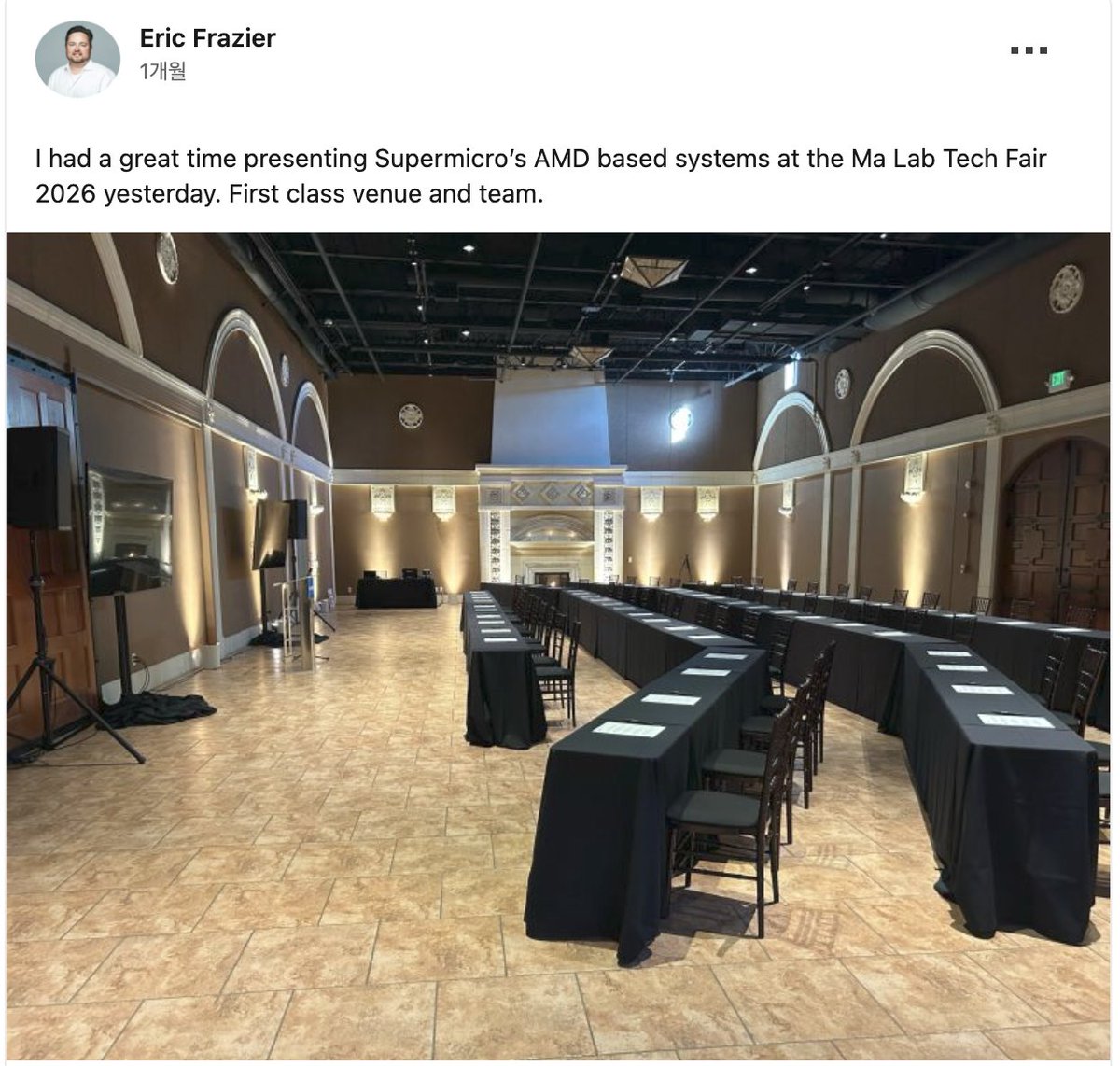
브로드컴의 이사회장 Harry you, 빅테크 고위급 임원 Randy, 거기에 직접 AMD 기반의 데이터센터 현장을 경험하고있는 Eric까지, 상장 이후 검증연구를 곧바로 진행할 확률이 높다.

그렇다면, AMD 기반의 데이터센터 회사 Tensorwave와 AMD가 함께 Tensor는 CaseStudy를 진행하고 첫 상업고객이 Tensorwave가 될 수 있다는 가설을 세워볼 수 있다.
$RAIN 인수합병 후 Tensor의 상업화는 빠르게 진행된다.
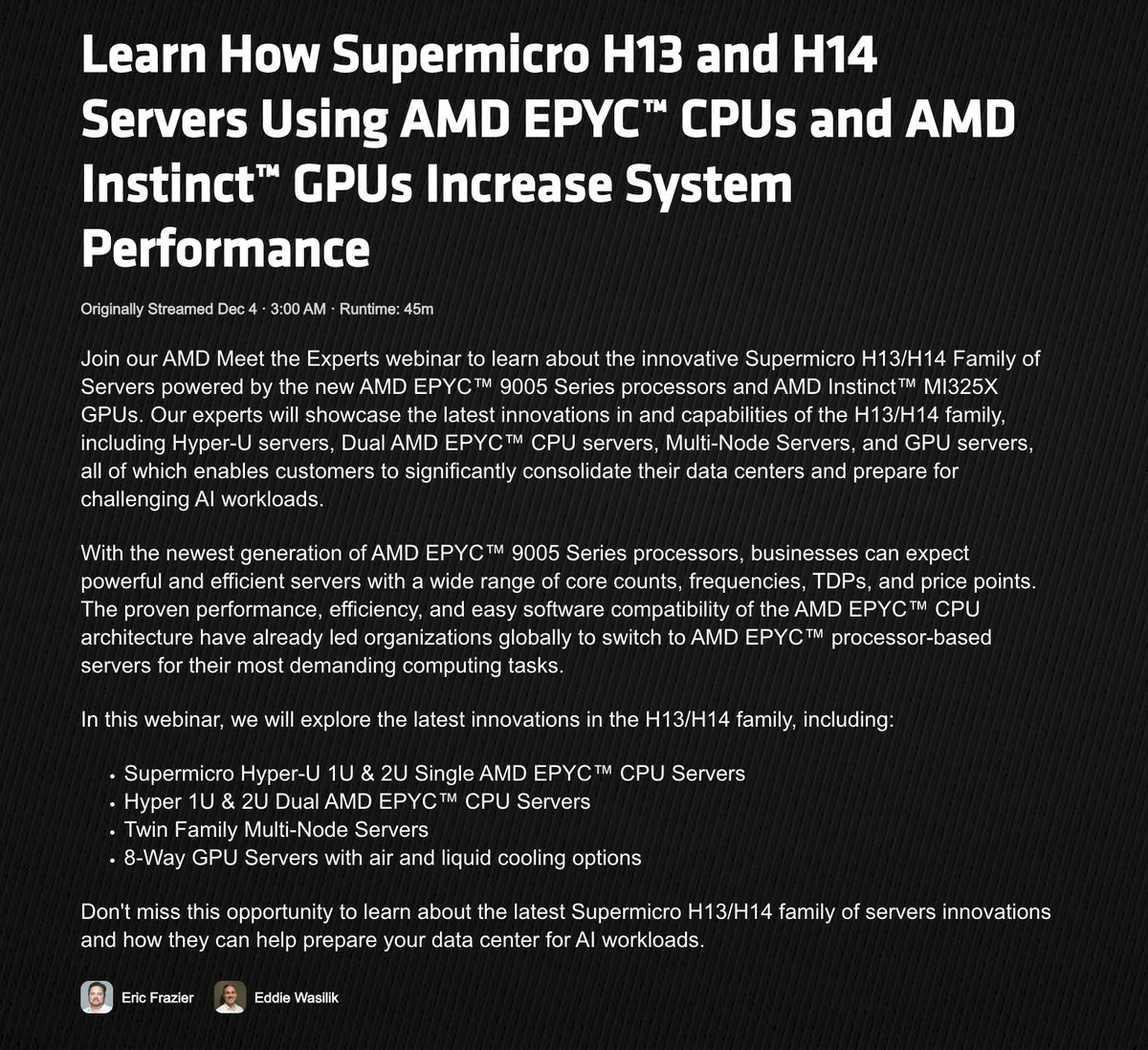
Tensor의 CEO는 현재 SuperMicro의 Sr. Solutions AMD Product Manager로도 5년 넘게 근무하고 있다. (인수합병 직전 퇴직절차를 밟겠지만)
Eric은 AMD CPU와 GPU를 쓰는 서버/랙 구성을 기획하기에 데이터센터 실무를 깊이 아는 인물이다.



RCA v0.1.0-beta is out: a statically typed, AI-native language with
built-in tensors + autodiff. Compiler in Rust, native codegen via
Cranelift, built entirely on my phone in Termux.
Early beta, feedback welcome.
https://t.co/8IxhsPhps0
#rustlang #programminglanguages

Tmol: A GPU-accelerated implementation of the Rosetta energy function for machine learning
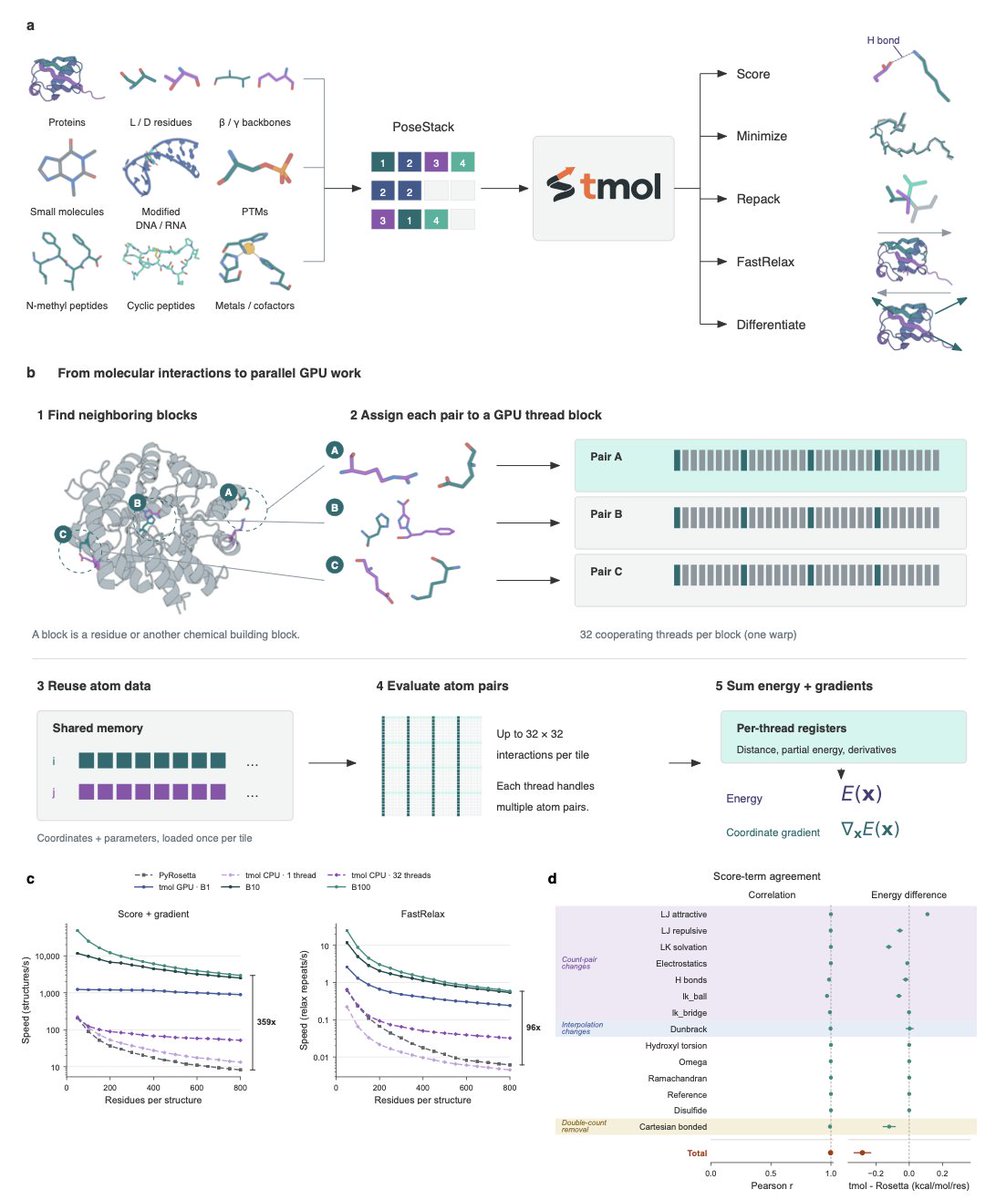
1 tmol is a GPU-native PyTorch library that reimplements the RosettaGenFF forcefield as batched tensor ops, making Rosetta-style all-atom energetics practical inside modern ML pipelines (training + inference), including autograd-ready derivatives.
2 Key capability: efficient batched differentiable scoring plus whole-structure refinement (packing + minimization + FastRelax). Reported throughput gains reach 233–362x for score+gradient and 38–102x for torsion-space relax vs single-threaded PyRosetta, while evaluating ~60% more rotamers during relax.
3 Architectural core: PoseStack, a GPU-friendly batch representation with dense coordinate tensors [n_poses, max_atoms, 3] plus padded per-block tensors. Systems are decomposed into “blocks” (residues/ligands/fragments), and energies are computed over neighboring block pairs to keep GPUs saturated.
4 GPU kernel design: each interacting block pair maps to a 32-thread cooperative thread array (one warp). Threads stage atom coordinates/parameters into shared memory and evaluate tiled atom-pair interactions (up to 32x32 per tile), then reduce energies and atomically accumulate coordinate gradients for autograd compatibility.
5 tmol reimplements all RosettaGenFF terms and core Rosetta algorithms as PyTorch ops: whole-pose and block-pair scoring, discrete side-chain optimization (packing), Cartesian and torsion-space minimization, and a general refinement protocol (FastRelax). The same framework supports whole-pose energies, per-residue/interface energies, and rotamer-pair energies.
6 Fidelity to Rosetta: across 1,000 high-resolution protein chains, tmol closely matches PyRosetta per-term energies (Pearson r ≥ 0.97 for every term; 0.997 total). Small deliberate changes include consistent count-pair weighting, removal of double-counted hydroxyl torsions, and streamlined handling of tabulated potentials.
7 Chemistry is a major focus: tmol provides a fully automatic parameterization pipeline (no user intervention) for ligands, modified residues, D-amino acids, modified nucleotides, and many metallocomplexes. Compared to minutes + manual inspection for PyRosetta params, tmol reports ~1 second per ligand with no user input (given bond orders in the input).
8 Beyond proteins: tmol adds DNA/RNA torsion potentials derived from structural data, and introduces a metal-coordination term that infers coordination geometry from the input structure, patches coordinating residues (including deprotonation when needed), and restrains donors to idealized coordination sites.
9 Differentiable torsion-space refinement on GPU is enabled via a parallel internal-coordinate kinematics algorithm (“generational segmented scan”), avoiding recursion by using scan/segmented-scan over homogeneous transforms. This supports Rosetta-like torsion minimization while remaining compatible with PyTorch autograd.
10 ML integration demo: using tmol as a reward during beam search with RFD4-Proteina across 24 protein–protein targets increased interface hydrogen bonding and bridging-water signals. Designs with ≥5 H-bonded interface residue pairs rose from 16% (unguided) to 66% (reward-guided), and strong water-bridging rose from 17% to 68%; forward-folding success improved but was comparable to best-of-k selection.
💻Code: https://t.co/epzJ0bAp1W
📜Paper: https://t.co/mX9WJndVKe
#computationalbiology #proteindesign #machinelearning #pytorch #gpu #rosetta #forcefield #differentiableprogramming #structuralbiology #bioinformatics

3/19
[1: RLDS]
Google's Reinforcement Learning Dataset Spec organizes episodes into steps containing observations, actions and rewards
It runs on TensorFlow Datasets and was used by Open X-Embodiment
Great for pooling, heavier outside the TF ecosystem

running IQ3_XS on this one, under 4-bit but it's the official quant not a custom mix — went from a 3-bit imatrix build to IQ3_XS and decode actually jumped, smaller file too. gpu memory ceiling on the base mini is real though. what's TensorFold topping out at on quality checks below 4-bit?

@hailports No 35B number from me. TensorFold is MLX-only, and the smallest 35B-A3B build won't fit in the base mini's GPU memory. So your 31.3 is the number to beat.
What quant are you running? Below 4-bit I'd worry about quality more than speed.
the mac mini i have here runs the 35b-a3b moe at about 31.3 tok/s decode when all experts land on the gpu and there's no draft running. i'm curious if you saw a different number with the tensorfold setup, or if that 31.3 feels like a natural ceiling for that hardware without speculative help.
@hailports Interesting. I have the same base M4 24GB. This is what I have on TensorFold. (benchmark so far, not a long run median like yours.)
Have you tried an A2B-class MoE on yours? Curious if your median would jump.


@do_re_me_bo Two DGX Sparks over direct RDMA, running a tuned TensorFold build (TP=2) with Mia’s DeepSeek V4.1 Flash EAQ v1 (2.9 bpw) + matching Keys. The ~311 tok/s was combined across 8 streams, with 58-token prompts and a 400-token output cap.
https://t.co/8SED8uq6uE

2⃣Duplicate models in VRAM- PyTorch models were still occupying GPU memory alongside the compiled TensorRT engines. Removing them gives more space.
After fixing both issues, peak memory usage dropped to just 11.2 GB. This makes π0.5 rollout possible on 16 GB GPUs.

@getnachonacho Oh man, list is long 🤣 let me put some of them in proper order in time
* scikit-learn
* seaborn
* tensorflow
* pytorch
* opencv
* yolo
* fastapi
* sqlalchemy
* langgraph
* crewai
* pydantic-ai
And many more, these are packages though
These days, I use Hermes mainly 🤣

@TensorThrottleX an engineer who built his own browser engine wants to practice system design out loud. he'd run your interview mode. dm bounced so tap below
https://t.co/hgnB2mQ2O5

[Must Read: Beginners]
What I did read for learning the basics of Distributed Training for LLMs From Scratch:
1. Building a distributed training framework from first principles by Umar Jamil on YT
2. Horovod: Fast and Easy Distributed Deep Learning in TensorFlow
3. PyTorch Distributed: Experiences on Accelerating Data Parallel Training
4. Large Scale Distributed Deep Networks
5. ZeRO: Memory Optimizations Toward Training Trillion Parameter Models
6. Megatron-LM: Training Multi-Billion Parameter Language Models Using Model Parallelism
7. Efficient Large-Scale Language Model Training on GPU Clusters Using Megatron-LM
8. GPipe: Efficient Training of Giant Neural Networks Using Pipeline Parallelism
9. ZeRO-Infinity: Breaking the GPU Memory Wall for Extreme Scale Deep Learning
10. PyTorch FSDP: Experiences on Scaling Fully Sharded Data Parallel
Link to the above resources in the replies!


Most Popular Users

Elon Musk 
@elonmusk
240.1M followers

Barack Obama
@barackobama
118.6M followers

Cristiano Ronaldo
@cristiano
114.4M followers

Donald J. Trump
@realdonaldtrump
111.7M followers

Narendra Modi
@narendramodi
106.9M followers

Rihanna
@rihanna
98.6M followers

NASA
@nasa
92.1M followers

Justin Bieber
@justinbieber
91.7M followers

KATY PERRY
@katyperry
89.9M followers

Taylor Swift
@taylorswift13
83.9M followers

Lady Gaga
@ladygaga
75.4M followers

Virat Kohli
@imvkohli
73.3M followers

Kim Kardashian
@kimkardashian
70.8M followers

YouTube
@youtube
68.6M followers

Neymar Jr
@neymarjr
66.3M followers

Bill Gates
@billgates
65.2M followers

Selena Gomez
@selenagomez
63M followers

The Ellen Show
@theellenshow
62.1M followers

CNN
@cnn
61.7M followers

X
@x
60.6M followers