

Top Tweets for #VANDEGRIFT


President Obama fired a total of 197 military officers during his time in office, particularly between 2010 and 2013.
Here is the list of our military elite who have been purged or fired under Obama:
Commanding Generals fired:
· General John R. Allen-U.S. Marines Commander International Security Assistance Force [ISAF] (Nov 2012)
· Major General Ralph Baker (2 Star)-U.S. Army Commander of the Combined Joint Task Force Horn in Africa (April 2013)
· Major General Michael Carey (2 Star)-U.S. Air Force Commander of the 20th US Air Force in charge of 9,600 people and 450 Intercontinental Ballistic Missiles (Oct 2013)
· Colonel James Christmas-U.S. Marines Commander 22nd Marine Expeditionary Unit & Commander Special-Purpose Marine Air-Ground Task Force Crisis Response Unit (July 2013)
· Major General Peter Fuller-U.S. Army Commander in Afghanistan (May 2011)
· Major General Charles M.M. Gurganus-U.S. Marine Corps Regional Commander of SW and I Marine Expeditionary Force in Afghanistan (Oct 2013)
· General Carter F. Ham-U.S. Army African Command (Oct 2013)
· Lieutenant General David H. Huntoon (3 Star), Jr.-U.S. Army 58th Superintendent of the US Military Academy at West Point, NY (2013)
· Command Sergeant Major Don B Jordan-U.S. Army 143rd Expeditionary Sustainment Command (suspended Oct 2013)
· General James Mattis-U.S. Marines Chief of CentCom (May 2013)
· Colonel Daren Margolin-U.S. Marine in charge of Quantico's Security Battalion (Oct 2013)
· General Stanley McChrystal-U.S. Army Commander Afghanistan (June 2010)
· General David D. McKiernan-U.S. Army Commander Afghanistan (2009)
· General David Petraeus-Director of CIA from September 2011 to November 2012 & U.S. Army Commander International Security Assistance Force [ISAF] and Commander U.S. Forces Afghanistan [USFOR-A] (Nov 2012)
· Brigadier General Bryan Roberts-U.S. Army Commander 2nd Brigade (May 2013)
· Major General Gregg A. Sturdevant-U.S. Marine Corps Director of Strategic Planning and Policy for the U.S. Pacific Command & Commander of Aviation Wing at Camp Bastion, Afghanistan (Sept 2013)
· Colonel Eric Tilley-U.S. Army Commander of Garrison Japan (Nov 2013)
· Brigadier General Bryan Wampler-U.S. Army Commanding General of 143rd Expeditionary Sustainment Command of the 1st Theater Sustainment Command [TSC] (suspended Oct 2013)
Commanding Admirals fired:
· Rear Admiral Charles Gaouette-U.S. Navy Commander John C. Stennis Carrier Strike Group Three (Oct 2012)
· Vice Admiral Tim Giardina(3 Star, demoted to 2 Star)-U.S. Navy Deputy Commander of the US Strategic Command, Commander of the Submarine Group Trident, Submarine Group 9 and Submarine Group 10 (Oct 2013)
Naval Officers fired: (All in 2011)
· Captain David Geisler-U.S. Navy Commander Task Force 53 in Bahrain (Oct 2011)
· Commander Laredo Bell-U.S. Navy Commander Naval Support Activity Saratoga Springs, NY (Aug 2011)
· Lieutenant Commander Kurt Boenisch-Executive Officer amphibious transport dock Ponce (Apr 2011)
· Commander Nathan Borchers-U.S. Navy Commander destroyer Stout (Mar 2011)
· Commander Robert Brown-U.S. Navy Commander Beachmaster Unit 2 Fort Story, VA (Aug 2011)
· Commander Andrew Crowe-Executive Officer Navy Region Center Singapore (Apr 2011)
· Captain Robert Gamberg-Executive Officer carrier Dwight D. Eisenhower (Jun 2011)
· Captain Rex Guinn-U.S. Navy Commander Navy Legal Service office Japan (Feb 2011)
· Commander Kevin Harms- U.S. Navy Commander Strike Fighter Squadron 137 aboard the aircraft carrier Abraham Lincoln (Mar 2011)
· Lieutenant Commander Martin Holguin-U.S. Navy Commander mine countermeasures Fearless (Oct 2011)
· Captain Owen Honors-U.S. Navy Commander aircraft carrier USS Enterprise (Jan 2011)
· Captain Donald Hornbeck-U.S. Navy Commander Destroyer Squadron 1 San Diego
(Apr 2011)
· Rear Admiral Ron Horton-U.S. Navy Commander Logistics Group, Western Pacific
(Mar 2011)
· Commander Etta Jones-U.S. Navy Commander amphibious transport dock Ponce (Apr 2011)
· Commander Ralph Jones-Executive Officer amphibious transport dock Green Bay (Jul 2011)
· Commander Jonathan Jackson-U.S. Navy Commander Electronic Attack Squadron 134, deployed aboard carrier Carl Vinson (Dec 2011)
· Captain Eric Merrill-U.S. Navy Commander submarine Emory S. Land (Jul 2011)
· Captain William Mosk-U.S. Navy Commander Naval Station Rota, U.S. Navy Commander Naval Activities Spain (Apr 2011)
· Commander Timothy Murphy-U.S. Navy Commander Electronic Attack Squadron 129 at Naval Air Station Whidbey Island, WA (Apr 2011)
· Commander Joseph Nosse-U.S. Navy Commander ballistic-missile submarine Kentucky (Oct 2011)
· Commander Mark Olson-U.S. Navy Commander destroyer The Sullivans FL (Sep 2011)
· Commander John Pethel-Executive Officer amphibious transport dock New York (Dec 2011)
· Commander Karl Pugh-U.S. Navy Commander Electronic Attack Squadron 141 Whidbey Island, WA (Jul 2011)
· Commander Jason Strength-U.S. Navy Commander of Navy Recruiting District Nashville, TN (Jul 2011)
· Captain Greg Thomas-U.S. Navy Commander Norfolk Naval Shipyard (May 2011)
· Commander Mike Varney-U.S. Navy Commander attack submarine Connecticut (Jun 2011)
· Commander Jay Wylie-U.S. Navy Commander destroyer Momsen (Apr 2011)
Naval Officers fired: (All in 2012):
· Commander Alan C. Aber-Executive Officer Helicopter Maritime Strike Squadron 71 (July 2012)
· Commander Derick Armstrong- U.S. Navy Commander missile destroyer USS The Sullivans (May 2012)
· Commander Martin Arriola- U.S. Navy Commander destroyer USS Porter (Aug 2012)
· Captain Antonio Cardoso- U.S. Navy Commander Training Support Center San Diego (Sep 2012)
· Captain James CoBell- U.S. Navy Commander Oceana Naval Air Station's Fleet Readiness Center Mid-Atlantic (Sep 2012)
· Captain Joseph E. Darlak- U.S. Navy Commander frigate USS Vandegrift (Nov 2012)
· Captain Daniel Dusek-U.S. Navy Commander USS Bonhomme
· Commander David Faught-Executive Officer destroyer Chung-Hoon (Sep 2012)
· Commander Franklin Fernandez- U.S. Navy Commander Naval Mobile Construction Battalion 24 (Aug 2012)
· Commander Ray Hartman- U.S. Navy Commander Amphibious dock-landing ship Fort McHenry (Nov 2012)
· Commander Shelly Hakspiel-Executive Officer Navy Drug Screening Lab San Diego (May 2012)
· Commander Jon Haydel- U.S. Navy Commander USS San Diego (Mar 2012)
· Commander Diego Hernandez- U.S. Navy Commander ballistic-missile submarine USS Wyoming (Feb 2012)
· Commander Lee Hoey- U.S. Navy Commander Drug Screening Laboratory, San Diego (May 2012)
· Commander Ivan Jimenez-Executive Officer frigate Vandegrift (Nov 2012)
· Commander Dennis Klein- U.S. Navy Commander submarine USS Columbia (May 2012)
· Captain Chuck Litchfield- U.S. Navy Commander assault ship USS Essex (Jun 2012)
· Captain Marcia Kim Lyons- U.S. Navy Commander Naval Health Clinic New England (Apr 2012)
· Captain Robert Marin- U.S. Navy Commander cruiser USS Cowpens (Feb 2012)
· Captain Sean McDonell- U.S. Navy Commander Seabee reserve unit Naval Mobile Construction Battalion 14 FL (Nov 2012)
· Commander Corrine Parker- U.S. Navy Commander Fleet Logistics Support Squadron 1 (Apr 2012)
· Captain Liza Raimondo- U.S. Navy Commander Naval Health Clinic Patuxent River, MD (Jun 2012)
· Captain Jeffrey Riedel- Program manager, Littoral Combat Ship program (Jan 2012)
· Commander Sara Santoski- U.S. Navy Commander Helicopter Mine Countermeasures Squadron 15 (Sep 2012)
· Commander Kyle G. Strudthoff-Executive Officer Helicopter Sea Combat Squadron 25 (Sep 2012)
· Commander Sheryl Tannahill- U.S. Navy Commander Navy Operational Support Center [NOSC] Nashville, TN (Sep 2012)
· Commander Michael Ward- U.S. Navy Commander submarine USS Pittsburgh (Aug 2012)
· Captain Michael Wiegand- U.S. Navy Commander Southwest Regional Maintenance Center (Nov 2012)
· Captain Ted Williams- U.S. Navy Commander amphibious command ship Mount Whitney (Nov 2012)
· Commander Jeffrey Wissel- U.S. Navy Commander of Fleet Air Reconnaissance Squadron 1 (Feb 2012)
Naval Officers fired: (All in 2013):
· Lieutenant Commander Lauren Allen-Executive Officer submarine Jacksonville (Feb 2013)
· Reserve Captain Jay Bowman-U.S. Navy Commander Navy Operational Support Center [NOSC] Fort Dix, NJ (Mar 2013)
· Captain William Cogar-U.S. Navy Commander hospital ship Mercy's medical treatment facility (Sept 2013)
· Commander Steve Fuller-Executive Officer frigate Kauffman (Mar 2013)
· Captain Shawn Hendricks-Program Manager for naval enterprise IT networks (June 2013)
· Captain David Hunter-U.S. Navy Commander of Maritime Expeditionary Security Squadron 12 & Coastal Riverine Group 2 (Feb 2013)
· Captain Eric Johnson-U.S. Navy Chief of Military Entrance Processing Command at Great Lakes Naval Training Center, IL (2013)
· Captain Devon Jones-U.S. Navy Commander Naval Air Facility El Centro, CA (July 2013)
· Captain Kevin Knoop-U.S. Navy Commander hospital ship Comfort's medical treatment facility (Aug 2013)
· Lieutenant Commander Jack O'Neill-U.S. Navy Commander Operational Support Center Rock Island, IL (Mar 2013)
· Commander Allen Maestas-Executive Officer Beachmaster Unit 1 (May 2013)
· Commander Luis Molina-U.S. Navy Commander submarine Pasadena (Jan 2013)
· Commander James Pickens-Executive Officer frigate Gary (Feb 2013)
· Lieutenant Commander Mark Rice-U.S. Navy Commander Mine Countermeasures ship Guardian (Apr 2013)
· Commander Michael Runkle-U.S. Navy Commander of Mobile Diving and Salvage Unit 2 (May 2013)
· Commander Jason Stapleton-Executive Office Patrol Squadron 4 in Hawaii (Mar 2013)
· Commander Nathan Sukols-U.S. Navy Commander submarine Jacksonville (Feb 2013)
· Lieutenant Daniel Tyler-Executive Officer Mine Countermeasures ship Guardian (Apr 2013)
· Commander Edward White-U.S. Navy Commander Strike Fighter Squadron 106 (Aug 2013)
· Captain Jeffrey Winter-U.S. Navy Commander of Carrier Air Wing 17 (Sept 2013)
· Commander Thomas Winter-U.S. Navy Commander submarine Montpelier (Jan 2013)
· Commander Corey Wofford- U.S. Navy Commander frigate Kauffman (Feb 2013)
Receipt: https://t.co/HDhoMhUS2M

Run it back to playoffs 🎦
Our first scrimmage of the year is Saturday, & the full scrimmage schedule is set:
1/31/26 – vs Warren, 1:00 PM
2/3/26 – @ Lake Belton, 4:30 PM
2/7/26 – @ Lake Travis, 11:00 AM
2/10/26 – vs Hays, 5:00 PM
2/13/26 – vs Vandegrift, 1:00 PM
@_JaguarBaseball -> @CoachYager

The main attack came after midnight on the 26th when the 16th Infantry Regiment, Japanese losses were heavy. The only success the Japanese enjoyed during the second round of night attacks was a limited penetration of American lines, but this was cleaned up by units from Vandegrift's reserve battalion.
The assault is thwarted by the difficult terrain and Marine firepower. The last Japanese bid to gain victory ends in heavy losses.

By late October the Japanese had some 20,000 troops on the island. The Americans had 23,088.
The Marines on the island believed they could hold the island against whatever the Japanese could throw at them. The Japanese believed they had the forces necessary for victory on the island. They underestimated the Marine garrison on the island had only 10,000 men.
Pictured below is a view of a column of Marines moving across a river. Whenever possible, General Alexander Vandegrift, commander of the U.S. 1st Marine Division, kept up the pressure on the Japanese by moving outside the perimeter to mount a series of spoiling attacks.

To finish the Japanese off, Vandegrift released his reserve battalion, the 1st Battalion, 1st Marines, and sent them across Alligator Creek at a point inland to encircle and annihilate the remaining Japanese.
By 0950hrs the Marines had crossed the creek and turned north toward the coast.
The Japanese resisted, usually by a pointless bayonet charge, but the Marines compressed them into a small area and began the business of annihilation.
The end was hastened by four light tanks, which crossed the sandbar at 1500hrs and waded into the Japanese position, causing great carnage.
The official Japanese history indicates that Ichiki burned his regiment’s colors and committed suicide at about 1630hrs.
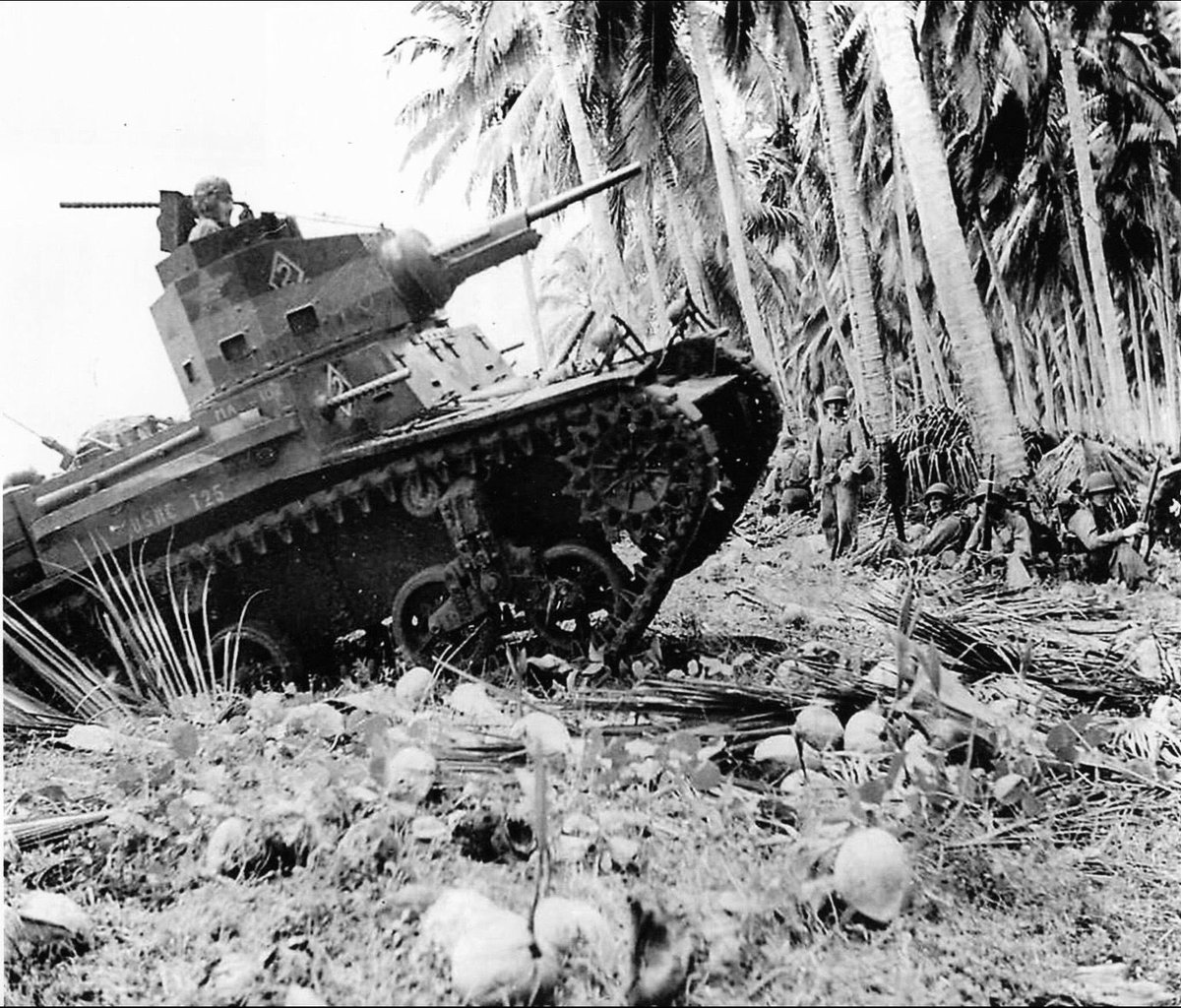


Vandegrift was aware of the arrival of the Japanese, but was unaware of their location. This seemed to be confirmed on the 19th when Ichiki’s lead elements and a Marine patrol clashed west of the perimeter, which killed 33 Imperial Japanese Army men in fresh uniforms.
Underestimating the size of the American force on shore and perhaps seduced by his own country’s propaganda that one Japanese soldier could defeat five Americans. Ichiki decided to attack at once. It was a catastrophic mistake.


The decision depended in part on what the Marines needed ashore. The Marines were commanded by Major General Alexander A. Vandegrift (pictured below left).
Rather than call Vandegrift on the radio, he summoned him to a meeting that night on board his flagship USS McCawley to talk about it.
Turner also invited British Rear Admiral Victor Crutchley (pictured below on right) who commanded the cruiser-destroyer force that was guarding the transports. Crutchley commanded a surface force of eight cruisers, five American and three Australian, plus a handful of destroyers.


Since Major General Alexander Vandegrift expected a tough fight on these islands with their cornered Japanese garrisons, he allocated his best units to this part of the operation. The 1st Raider Battalion and the 2nd Battalion, 5th Marines. Along with the 1st Parachute Battalion, supported by the 2nd Marines.

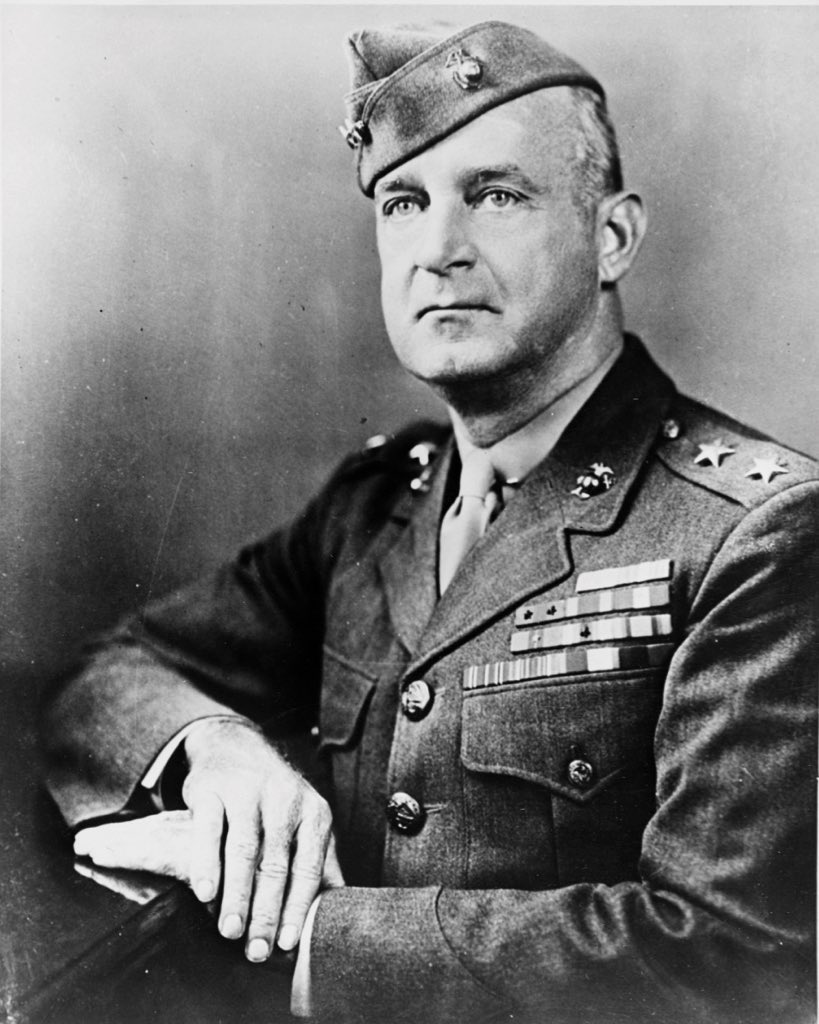
The second day on Guadalcanal, Vandegrift gave orders to continue the advance to the west to take the airfield and set up a perimeter along the Lunga River.
Any attempt to take Mount Austen was forgotten. The 5th Marines advanced very cautiously along the shore. Urged on by Vandegrift himself, the Marines crossed the Lunga River and approached the settlement at Kukum where some resistance was encountered.


The landing on Guadalcanal on the morning of August 7, 1942, came as a complete surprise to the Japanese. However, Intelligence on the numbers and disposition of Japanese forces on the island was spotty.
At the end of the first day, Vandegrift had all five of his infantry battalions ashore.
The 1st Marines made it only one mile inland before stopping for the night to dig in. The 1st Battalion, 5th Marines reached Alligator Creek some two miles west of the beachhead and dug in there. The eastern flank was covered by 3rd Battalion, 5th Marines.


For his part, Fletcher appreciated the importance of covering the Guadalcanal beachhead. But in his view, that mission was secondary to the security of his aircraft carriers.
He worried that tying his big warships to the Guadalcanal beachhead for an extended period made them vulnerable to Japanese land based aircraft. Navy doctrine held that it was unwise to the point of foolishness for a carrier to accept a dual with land based bombers.
In consideration of that, Fletcher told Turner and Vandegrift that he planned to keep his carriers near the Guadalcanal beachhead for only two days.
Both men immediately protested. Turner insisted that he needed five days just to unload his transports. And Vandegrift wanted air cover for his Marines until the airfield was captured and made operational.
Fletcher eventually agreed to stay a third day, though he made it clear that if Japanese carriers entered the theater, they would become his primary concern. Turner and Vandegrift didn’t like it, but there was little they could do about it.


Air cover would be provided by three aircraft carriers, the USS Enterprise (CV-6), the USS Saratoga (CV-3), and the smaller USS Wasp (CV-7). All three carriers were under the command of Admiral Frank Jack Fletcher.
King was satisfied with both Vandegrift and Turner, but he was not so sure about Fletcher.
During the battle of the coral Sea in May, 1942, King had been disappointed, even annoyed that Fletcher had not, in his view, been aggressive enough against the Japanese.
Fletcher had been in command for the spectacular American victory at Midway, but King tended to give most of the credit for that victory to Rear Admiral Raymond Spruance.
King asked Chester Nimitz, Commander of the US Pacific Fleet, “Are you sure that Fletcher is the right man to command the carriers for the Guadalcanal operation?” Nimitz defended Fletcher, and so with some misgivings, King agreed.

The American assault force consisted of just over 11,000 marines commanded by Major General Alexander A. Vandegrift.
To carry Vandegrift’s men to the beach, the Navy scraped together 22 transport and supply ships under the command of Rear Admiral Richmond Kelly Turner.
Kelly Turner would command the amphibious flotilla for the Guadalcanal operation. He expressed confidence that he could effect a successful landing there as long as he achieved surprise and the carriers could provide air cover over the beach.
The question was how long would air cover be needed.
Nimitz told Turner that it should take “about three days” to land the men and supplies, and Turner expressed satisfaction with that.
Vandegrift and Turner did not make light of the difficulties. They stated, “We must expect and be able to afford disproportionate losses in gaining our objective.” And there was a hint of caution, even a warning, in the observation that “if we are not prepared to lose ships and men yet, then the time is not ripe.”
Ripe or not, King set a target date of August 1, 1942, for the invasion. That was only three weeks away.


Naval Battles and October Offensive
7/ October saw intense naval clashes: Cape Esperance (October 11–12) and Santa Cruz (October 25–27) cost 529 U.S., 400 Japanese sailors. On land, Hyakutake’s 20,000 troops launched a major assault on Henderson Field (October 23–26). Maruyama’s division attacked through jungles, repelled by Vandegrift’s 23,000 Marines. Japan lost ~3,500; U.S., 86 dead. Naval Battle of Guadalcanal (November 12–15) sank 2 U.S., 7 Japanese ships, killing 1,732 U.S., 2,000 Japanese. Henderson held, wearing Japan down.

Background and Strategic Context
2/ By 1942, Japan’s Pacific conquests threatened Allied supply lines to Australia. Guadalcanal’s airfield, under Japanese construction, was a key target. Maj. Gen. Alexander Vandegrift’s 1st Marine Division (19,000) prepared to invade, supported by Adm. Frank Fletcher’s naval forces. Japan’s 36,000 troops, under Lt. Gen. Harukichi Hyakutake, aimed to fortify the Solomons. The U.S. sought to seize Henderson Field to disrupt Japan’s expansion. Operation Watchtower launched August 7, 1942, with 11,000 Marines landing, setting a fierce campaign in motion.


Rich kid takeover of TXHSB this year
Southlake Carroll beats Longview
Austin Westlake beats North Shore
Highland Park beats Denton Ryan
Austin Vandegrift beats Summer Creek
And no Duncanville, DeSoto, or North Shore in the state championship for the first time in forever. Wild

@Zach_Torres23 @alexx5_7 Hope they win. Vandegrift beat DSHS who beat my school (transitive property)

‘23 DL @DaemianWimberly Receives His 9th FBS Offer From @CUBuffsFootball
PrepStar Verified ‘23 DL @DaemianWimberly | Vandegrift HS
📏6’6” 257
🎓3.4 GPA
⏱4.90 40 | 4.4 Shuttle
🧰35” Vertical
💪295 Bench | 445 Squat
Verified Profile & 🎥: https://t.co/WLctLzbAN6
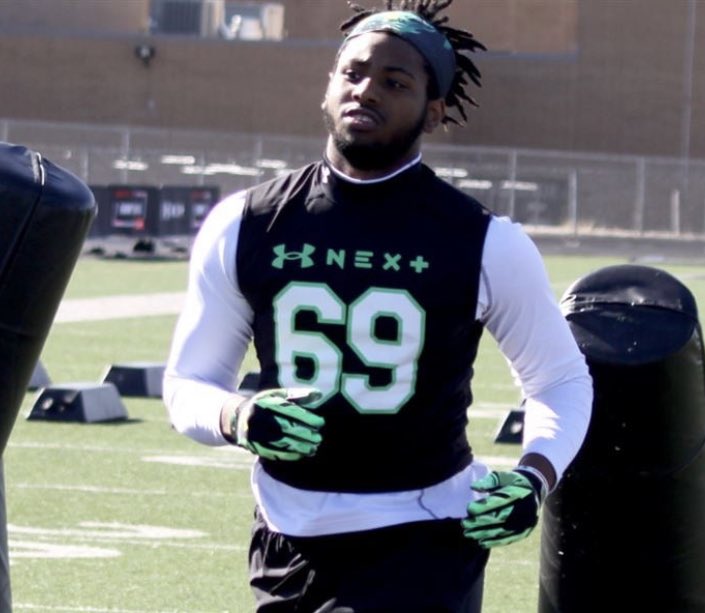
🚨‘23 DL Picks Up His 6th FBS Offer From @HerdFB 👇
PrepStar Verified ‘23 DL @DaemianWimberly | Vandegrift HS
📏6’6” 257
🎓3.4 GPA
⏱4.90 40 | 4.4 Shuttle
🧰35” Vertical
💪260 Bench | 405 Squat
Verified Profile & 🎥: https://t.co/WLctLzbAN6

Last Seen Hashtags on Sotwe
Most Popular Users

Elon Musk 
@elonmusk
240M followers

Barack Obama
@barackobama
118.6M followers

Cristiano Ronaldo
@cristiano
114.4M followers

Donald J. Trump
@realdonaldtrump
111.7M followers

Narendra Modi
@narendramodi
106.9M followers

Rihanna
@rihanna
98.6M followers

NASA
@nasa
92.1M followers

Justin Bieber
@justinbieber
91.7M followers

KATY PERRY
@katyperry
89.9M followers

Taylor Swift
@taylorswift13
83.9M followers

Lady Gaga
@ladygaga
75.4M followers

Virat Kohli
@imvkohli
73.3M followers

Kim Kardashian
@kimkardashian
70.8M followers

YouTube
@youtube
68.6M followers

Neymar Jr
@neymarjr
66.3M followers

Bill Gates
@billgates
65.2M followers

Selena Gomez
@selenagomez
63M followers

The Ellen Show
@theellenshow
62.1M followers

CNN
@cnn
61.7M followers

X
@x
60.6M followers