

Top Tweets for #WebAuth

I just dropped a Token Bomb in the Vibrr General chat on Vibrr: 200,000 PAPA for 20 people. Join the chat and grab your share with your WebAuth wallet. https://t.co/haPyudBegc

Securing US, UK & EU SaaS or FinTech APIs?
Move beyond passive cookies with hardware-bound WebAuthn & edge DPoP verification:https://t.co/IYtM4LPMuL
#FinTech #CyberSecurity #DevSecOps
MFA alone won't stop stolen session cookies from being replayed.
Here is how US, UK & EU teams bind sessions to hardware keys with WebAuthn & DPoP at the edge:https://t.co/IYtM4LPMuL
#AppSec #WebAuthn #ZeroTrust

I spoke to cofounder of @cedarcode @brauliomlm (Braulio Martinez) this week on Tech for Humans Pod.
We discussed webauthn Ruby and the future of digital IDs, supporting Rails Foundation and Ruby Central and running a successful multi-continent Rails agency.
And I think I only mentioned AI once 😅
https://t.co/cePx8JGeL5

@RialoHQ 3) Precision Resource Metering.
• Signature checks (WebAuthn/Passkeys) meter independently
• Storage writes don't spike simple verification costs
• Protocol-level AA execution eliminates ERC-4337 bundler bloat
Result: Web2-like wallet UX with up to 10x lower execution costs.
@RialoHQ 5) Founders: Stop losing 90% of new users at wallet creation. Eliminate seed phrase risk, enable 1-click biometric signing, and scale mainstream onboarding via Passkey & WebAuthn Native Session Keys.
FaceID onboarding. Hardware security. Zero seed phrases.
@RialoHQ 4) For Web3 devs, Passkey + WebAuthn eliminates Web2-to-Web3 friction. You can onboard mainstream users in seconds using native biometrics while granting short-lived, scoped permission keys for seamless 1-click dApp interactions.
2) @RialoHQ leverages Passkey & WebAuthn Integration for Native Session Keys. Users authenticate via FaceID, TouchID, or device hardware modules, minting secure session keys directly through Account Abstraction.


8/ breadth, no upsell
auth methods live today, none of them behind a tier:
email + password
magic link
passkey / webauthn
google, github, microsoft, linkedin
oauth 2.0 server (your app becomes the provider)
toggled in a console. not a support ticket, not a sales call.

@GettrFatterTony @MetallicusTDBN @metalpaysme @webauthwallet Any word on the possibility of coming to Canada anytime soon?

🔐 Want to add passkeys to your https://t.co/BHd6GpgAgu Core app?
You don't have to break your existing authentication.
Keep passwords. Add passkeys. Let users migrate gradually.
✅ https://t.co/BHd6GpgAgu Core Identity
✅ Passkeys
✅ WebAuthn
✅ Existing accounts
✅ Safer authentication
Learn how to implement passkeys without breaking existing auth 👉 https://t.co/Iud1gKbKic
#DotNet #ASPNETCore #Passkeys #WebAuthn #CSharp


Authentication doesnt have to mean remembering seed phrases.
Ritual combine:
•TxPasskey(0x77)
•WebAuthn
•Face ID & Fingerprint
•SECP256R1(0x0100)
•Native P-256 verification
to deliver passwordless authentication with deterministic addresses and smart contract verification


✅ @ritualnet #227
💚 What will the future look like when AI and blockchain truly come together?
I believe Ritual is showing us that future.
Until now, building AI-powered Web3 applications has required developers to manually integrate AI models, oracles, privacy technologies, and agent frameworks. Even with a great idea, turning it into a real product often involves significant complexity and development time.
Ritual aims to change that completely.
Developers no longer need to write every piece of code themselves. Instead, they simply describe the outcome they want.
AI agents can understand the intent, design the required architecture, and handle the entire development lifecycle from writing smart contracts to deployment, testing, and debugging.
One of the most interesting innovations is the Ritual Skill System.
With a single installation command, AI development tools such as Claude, Cursor, Copilot, and Codex can immediately understand the Ritual ecosystem and leverage Ritual-specific capabilities throughout the development process.
This has the potential to dramatically reduce the time developers spend learning infrastructure and significantly accelerate the journey from idea to product.
Ritual also goes far beyond simply connecting AI to blockchain by providing a powerful set of native capabilities:
✅ LLM Precompile for on-chain AI inference
✅ TEE-based privacy protection
✅ AI agents with long-term memory and multimodal capabilities
✅ Automation through schedulers and webhooks
✅ Passkey and WebAuthn authentication
✅ A three-layer verification system
When combined, these features can enable much more than traditional dApps. They lay the foundation for autonomous AI economies, intelligent on-chain services, and applications that can operate with minimal human intervention.
What stands out most to me is not just the technology itself, but the direction Ritual is taking.
In the past, humans wrote code to produce results. In the future, humans may simply describe the results they want, while AI handles the implementation.
Ultimately, Ritual is not just building another blockchain it is pioneering a new way of building.
By lowering the barriers to development and enabling anyone to turn ideas into applications, Ritual is helping shape a future where creativity matters more than technical complexity.
And that future may be much closer than we think. 🔥
@whitesocks256

✅ @ritualnet #226
💚 As I pointed out in a recent post, the U.S. government already has powerful tools that could effectively prohibit the use of open-weight models.
Many people assume that once model weights are downloaded, the problem is solved. In reality, that is not the case. Governments can prevent companies operating in the United States from using, hosting, or integrating those models into commercial products.
Model capabilities will continue to improve, and policymakers understand that. What they are really trying to control is access.
Regulating open-weight models may not eliminate every copy, but it can make it practically impossible for U.S. companies to host them, offer them as a service, or build products on top of them. You may still possess the model files, but execution at scale becomes extremely difficult.
This highlights an important distinction: open weights solve model availability, but they do not solve execution availability.
That is precisely the problem Ritual is designed to address.
On Ritual, inference is a native protocol operation. Every execution is routed through verifiable infrastructure and settled on a permissionless chain. There is no centralized API provider acting as a chokepoint, no approval queue, and no risk of being deplatformed by a single host.
Because on Ritual, execution itself is the protocol.
This is more than just a technical solution. It represents a decentralized infrastructure designed to reduce structural dependence on centralized control.
Even if governments pressure companies to restrict access to open models, networks like Ritual allow anyone to request verifiable inference and receive verifiable results. That is an important step toward a more open and accessible AI ecosystem.
Regulation cannot stop technological progress. It can only influence the direction it takes.
If open weights made AI models freely available, Ritual aims to make their execution freely available as well.
As AI regulation becomes more restrictive, decentralized execution layers may become increasingly important.
The conversation is no longer about who owns the model.
It is about who can execute the model.
And Ritual offers one possible answer to that question.
@ritualnet_korea @joshsimenhoff @mongdiny7 @dunken9718 @Jez_Cryptoz @0xMadScientist

good morning ct ☕️
Hybrid post-quantum plus ZKURT receipts on-chain is crazy.
how are you handling PRF key recovery if someone loses a passkey?
that’s usually where most WebAuthn flows break for real users.
also, with @TheARCTERMINAL the ZKURT receipts just for audit trails


Every privacy claim ARC makes maps to something you can verify without our cooperation.
WebAuthn PRF-derived keys.
Hybrid post-quantum encryption.
ZKURT receipts on a public chain.
Claims that can't be falsified don't ship ↓
https://t.co/nlzvsFOno3

The "Passkey WebAuthn" Alpha by @RialoHQ
1) The Seed Phrase Friction Traditional crypto onboarding is broken. Forcing mainstream users to write down 12-word seed phrases or manage complex private keys creates a massive UX barrier and leads to billions lost in phishing attacks.


We continue our research on Ritual, and today we'll discuss how to address its challenges.
High developer barrier. This includes LLM precompile, HTTP, Scheduler, AsyncJobTracker, TEE executor, DKMS, WebAuthn, ECIES, PII redaction, x402 payments, etc. Inferringly, this suggests that Ritual isn't simply an L1 implementation that can be migrated by changing an RPC, but rather more like an AI execution operating system. Its advantage is differentiation, its disadvantage is a steep learning curve and difficulty in cold-starting its ecosystem.
Solution:
Reduce the integration difficulty for developers. Ritual can provide a stronger abstraction layer: template contracts, Agent SDK, front-end components, Hardhat/Foundry examples, AI agent scaffolds, and reproducible application repos. Current documentation shows that Ritual has a very rich set of capabilities, but too many capabilities are themselves a barrier; the most effective strategy is to package the complex architecture into a development path that can be run in 10 minutes.
These are just my personal suggestions. Feel free to add your own suggestions so we can all stay enthusiastic about Ritual.
@ritualfnd
@Majorproject5
@Jez_Cryptoz
@dunken9718
@mongdiny7


Most smart contracts struggle with real identity and secure access. Users rely on external wallets or risky key management.
Ritual makes authentication native.
Smart contracts can now verify WebAuthn passkeys and Ed25519 signatures directly through precompiles. This brings hardware-backed security and seamless login flows onchain without extra trust.
Combined with secure key derivation and secret management, it enables private credential systems where agents or users control access without exposing sensitive data.
Ritual’s dApp Skills make it easy to build. One git clone gives your AI coding assistant full precompile access. Describe the feature in plain English and it handles the rest.
Gritual @ritualnet @ritualfnd

Most smart contracts stay isolated from the real world. They can't easily fetch live data or handle tasks that take time.
Ritual makes this native and secure.
Smart contracts can now perform direct HTTP calls and long-running requests inside trusted execution environments. Results return with cryptographic verification, so contracts can react to news, APIs, or external events without depending on oracles.
This combines with scheduling tools and other precompiles to create reactive systems that keep working over time.
Ritual’s dApp Skills make it practical. One git clone gives your AI coding assistant full access to the precompiles. Describe the idea in plain English and it builds the application.
Gritual @ritualnet @ritualfnd


most people look at this diagram and see a technical flowchart.
i see a completely different way of thinking about what a smart contract can do
before Ritual, EVM contracts had one problem. they could not reach outside themselves. no AI, no web, no identity verification without trusting a third party
@ritualnet fixes that natively with 16 precompiles callable directly from Solidity ;
• 𝗔𝗜 𝗰𝗼𝗺𝗽𝘂𝘁𝗲 {Run LLM and ONNX models on-chain inside a TEE}
• 𝗖𝗼𝗻𝗻𝗲𝗰𝘁𝗶𝘃𝗶𝘁𝘆 {HTTP calls and long-running tasks from within a contract}
• 𝗦𝗼𝘃𝗲𝗿𝗲𝗶𝗴𝗻 𝗮𝗴𝗲𝗻𝘁𝘀 {Agents that schedule their own execution, persist and revive}
• 𝗖𝗿𝘆𝗽𝘁𝗼 𝗮𝗻𝗱 𝗶𝗱𝗲𝗻𝘁𝗶𝘁𝘆 {Ed25519, WebAuthn, X402 payments built in}
– – – – – – – – – – – – – – – – – – – – – – – – – – –
execute once, verify many times
no oracle, no added trust, no duct tape
this is what AI-native dApps actually look like
Special Tags : @joshsimenhoff @Jez_Cryptoz @0xMadScientist @cryptooflashh @dunken9718 @Majorproject5

Key things to know about ritual-dapp-overview:
• It is the first skill an AI coding agent reads, acting as a map of the chain before any code gets written.
• EVM++ is an execution environment built for AI workloads from the start, not retrofitted later.
• TEE (trusted execution) lets model inference be verified instead of trusted on faith.
• 16 precompiles such as LLM, HTTP, and ONNX can be called directly from inside a contract.
• The Scheduler lets a contract wake itself up and act on its own, with no external keeper needed.
• RitualWallet lets an agent fund and pay for its own execution.
• The build path it points you through is clear: architecture, contracts, frontend, backend, testing, then deploy.
Read the full skill here :
https://t.co/cAW4nKyfpp


The "key-less" nature of this experience by Dango is achieved through the integration of modern cryptographic primitives such as WebAuthn and passkeys, which leverage hardware-based security modules like Apple’s Secure Enclave or Android’s Trusted Execution Environment

Attacks related to the paycheck redirection and/or stealing are probably the saddest ones to know. While these are complex attacks delivered in a series of well-crafted steps including poisoning search engine results. As the article mentions the increased used of SaaS HR solutions like Workday, users need to enter their credentials to access such tools. The solution could be a combination of the use of “FIDO2/WebAuthn passkeys as the second authentication factor, as they bind authentication to the legitimate origin site and cannot be intercepted by an AiTM proxy the way traditional push or OTP-based MFA can.” and also the monitoring from the organization to Axios user-agents. Therefore, organizations need to include this IOC in their continuous monitoring to protect their employees.
#informationsecurity #cybersecurity #datasecurity
https://t.co/0Flosq5ASz

For a long time, building on XION outside javascript came with a quiet tax.
If you were building a web app, you were fine:
- XionJS existed
- Abstraxion existed
- and the path was clear
But the moment you were building anything else, things got messy.
A Python team scripting treasury payouts had to work around xiond or hand-roll signing logic.
A ruby backend had no clean SDK path to work with.
A rust or go service had to rebuild XION-specific account abstraction wrappers from scratch.
Native mobile teams had to drag in react native, javascript bundles, webview flows, and OAuth complexity just to make session keys and gasless UX work.
That kind of friction rarely shows up in most ecosystem announcements, but builders feel it.
And when builders keep feeling it, they either slow down or leave.
This is why Mob matters.
Mob is @burnt_xion’s multi-platform signing client library, written in Rust and exposed through UniFFI.
it gives Kotlin, Swift, Python, Ruby, Rust, and other UniFFI-supported environments one shared way to sign, send, query, and interact with XION.
All through the same SDK surface, same code paths, same signing logic, be it mobile, backend, scripts, desktop, automation, or CLI.
Mob lets builders use XION in the language and environment they’re already working in.
Now, builders can:
1. Send tokens
2. Query balances
3. Run authz session keys
4. Use fee grants for gasless transfers
5. Route calls through meta-accounts.
Mob gives builders Secp256k1, WebAuthn, JWT, and multisig authenticator support, as well as helping with catching typed errors instead of guessing what an RPC blob is trying to say.
On iOS and Android, users can sign in with abstraxion, verify the on-chain grant, and then every transfer gets signed by a session key, executed against their meta-account, and gassed by a treasury contract.
The user doesn’t need to understand any of that, which is the point.
Good crypto UX should hide the complexity without hiding the power.
Mob is more than just another regular SDK.
In my opinion, this is clearly XION removing a stack limitation.
Web apps are not the whole world, backends exist, native apps exist, automation scripts exist, treasury systems exist, and internal finance tools exist.
So if XION’s vision is going to move beyond demos, those teams need native tools, actual native paths per se.
XionJS still makes sense for web, but everywhere else, Mob feels like the SDK XION should have had from the beginning.
Sometimes, ecosystem progress is not a loud announcement.
Sometimes, it is just removing one painful layer between builders and the thing they’re trying to ship.
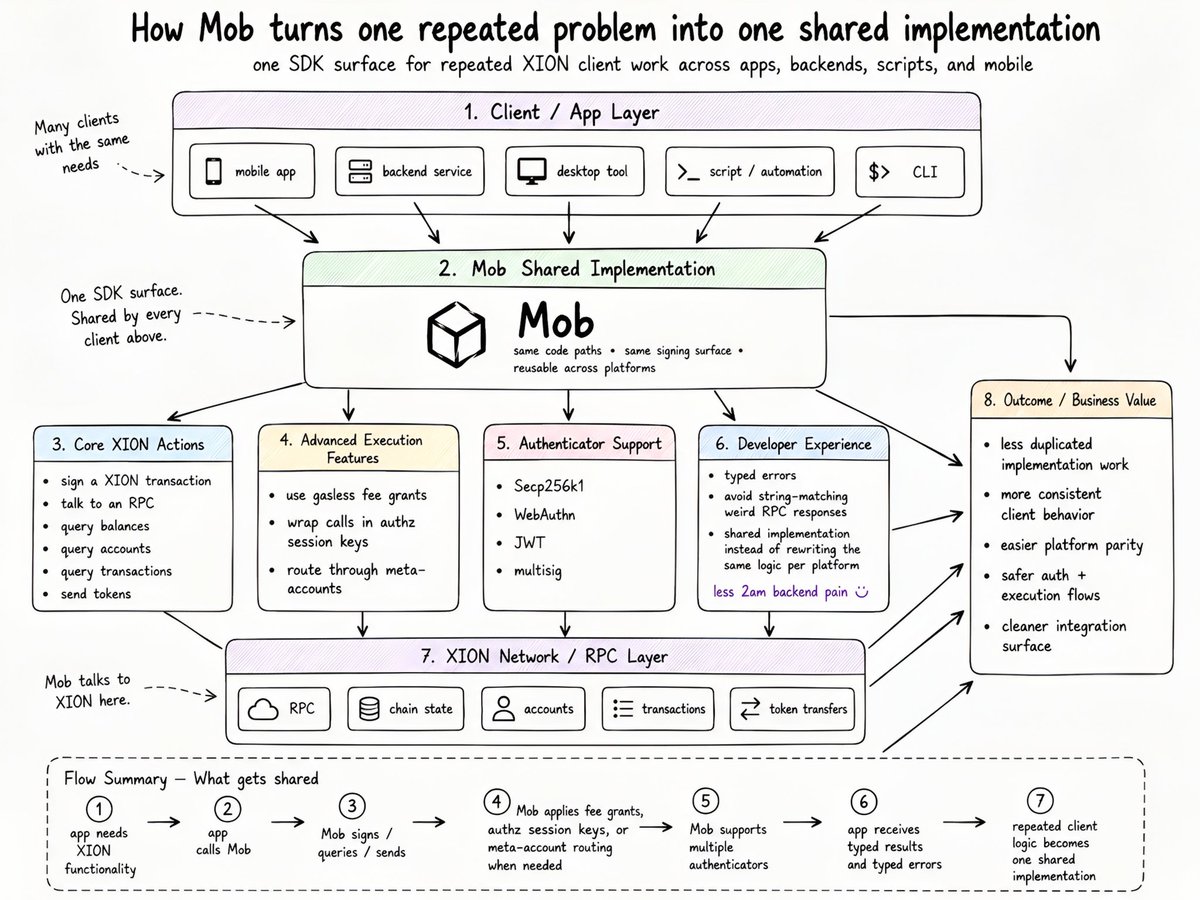

https://t.co/FndEqzF5V6

Devs & website owners….want to crack open a can of Key-Rex??
Integration is cheaper than a $5 can of Coca-Cola at the store. 😯
Some might as how?? 🫣🫣
It’s completely 🆓.
#Bitcoin #Lightning #KeyRex #BTC #LightningNetwork #BitcoinOnly #SelfCustody #Decentralize #Nostr #WebAuth


Crypto usually gets stuck the moment developers have to actually plug it into real apps
@burnt_xion tries to remove that friction with Mob
Mob is basically a multi platform signing client that lets developers use XION from whatever language they already build with Swift, Python, Ruby, Kotlin, etc
Under the hood it’s one Rust core and everything else is just bindings generated from the same interface
So no matter the language it’s the same system, same behavior, same API
It also supports things like session keys, gasless transactions via treasury contracts and different account types like WebAuthn, JWT, MultiSig and more all the stuff you normally have to wire together manually
The interesting part is not just the features, but the idea behind it:
developers don’t have to “learn crypto stack” they just call it like any other library in their language
Less friction for builders → more natural adoption for users

Meet Mob.
XION's multi-platform signing client. Written in Rust, with native bindings for Kotlin, Swift, Python, Ruby, and anywhere else UniFFI reaches.
Verification only counts when developers can call it. Mob makes XION accessible from every language a team already supports.
@Wickedgene_ @burnt_xion Yhuppp sensei
Mob itself is developer tooling, but they built it to let developers easily deliver consumer-grade experiences like gasless flows, session keys, WebAuthn, etc., without fighting the stack.

@ritualfnd @0xMadScientist @dunken9718 @Majorproject5 @cryptooflashh @mongdiny7 6/
Cryptographic identity is deeply embedded in Authentication
Ritual supports WebAuthn (P-256) and Ed25519 verification, enabling secure signature validation and stronger identity/authentication primitives for decentralized applications.

Under the hood, Ritual includes powerful precompiles for:
AI inference
FHE
ZK proofs
WebAuthn
Ed25519 verification
DKMS keys
ECIES secrets
PII redaction
X402 payments
Built directly into the chain.

Hardware-Anchored Identity: The End of the Shared Secret.
@TheARCTERMINAL eliminates the most common vulnerability in AI security: the centralized server.
How?
By utilizing 'WebAuthn', user security keys are derived directly from a physical device, such as Touch ID or Windows Hello. Because these keys never leave your hardware, there is no "shared secret" stored on ARC’s servers.
This "server-blind" architecture ensures that even in the event of a breach, insider threat, or legal subpoena, there is no readable data for an operator to hand over.
It is a system designed to give you hardware-level ownership over your digital intelligence.

Last Seen Hashtags on Sotwe
Trends for you
Most Popular Users

Elon Musk 
@elonmusk
240.1M followers

Barack Obama
@barackobama
118.6M followers

Cristiano Ronaldo
@cristiano
114.4M followers

Donald J. Trump
@realdonaldtrump
111.8M followers

Narendra Modi
@narendramodi
106.9M followers

Rihanna
@rihanna
98.6M followers

NASA
@nasa
92.1M followers

Justin Bieber
@justinbieber
91.7M followers

KATY PERRY
@katyperry
89.9M followers

Taylor Swift
@taylorswift13
83.9M followers

Lady Gaga
@ladygaga
75.4M followers

Virat Kohli
@imvkohli
73.3M followers

Kim Kardashian
@kimkardashian
70.8M followers

YouTube
@youtube
68.6M followers

Neymar Jr
@neymarjr
66.3M followers

Bill Gates
@billgates
65.2M followers

Selena Gomez
@selenagomez
63M followers

The Ellen Show
@theellenshow
62.1M followers

CNN
@cnn
61.7M followers

X
@x
60.6M followers