

Top Tweets for #WebCal

In exploring Rialo, I’ve observed that a failed Webcall during a transaction does not necessarily have to halt the entire workflow. Through its "AFTER wait until" mechanism, Rialo allows a transaction to pause while awaiting an off-chain operation, resuming execution in a subsequent block once the result is received. This enables the blockchain to handle asynchronous API interactions without requiring the transaction to remain in a state of constant, active waiting.
Notably, Reactive Transactions also facilitate the creation of retry loops and error-handling branches. Developers can design workflows to retry after a set interval, switch to an alternative data source, or wait for specific conditions to be met before proceeding.
In my view, a "one-size-fits-all" approach is not ideal. Retries are appropriate for transient issues like timeouts; fallbacks are suitable when a primary API fails to respond; and halting a workflow, while preserving a safe state is the better choice when data cannot be verified. Rollback logic must also be tailored to the specific business context, especially in cases where external operations have already been successfully executed.
Therefore, I believe Rialo’s strength lies not only in its Native Webcalls but also in its capacity to embed error-handling logic directly into the workflow. That said, developers must still clearly define retry limits, timeouts, and termination conditions. A robust automated system should not only know how to proceed upon success but also how to respond safely when faced with failure.
@RialoHQ

In exploring Rialo, I’ve observed that Native Webcalls can significantly reduce reliance on middleware within blockchain applications. Instead of navigating multiple intermediary layers, such as oracles, API gateways, or off-chain services, to fetch data from the Web2 realm, Rialo integrates API-calling capabilities directly into the blockchain’s execution process.
What I find particularly noteworthy is that Native Webcalls can be combined with Reactive Transactions and REX to construct workflows that not only access external data but also handle conditional logic and safeguard sensitive information. This is especially valuable for applications involving Real-World Assets (RWA), finance, and AI agents.
However, in my view, Native Webcalls does not imply the complete elimination of middleware. Blockchains still need to address challenges such as verifying data sources, ensuring API security, managing rate limits, and handling scenarios where external services fail.
Ultimately, I believe the true value of Rialo lies in its ability to strip away unnecessary intermediary layers and embed Web2 connectivity directly into the blockchain infrastructure itself.
@RialoHQ
GM Everyone,
In exploring Rialo, I’ve come to realize that "Native Automation" could unlock an entirely new category of applications, one where the blockchain does more than just execute transactions; it actively manages processes over time. Through "Reactive Transactions," developers can define conditions that trigger smart contracts automatically in response to specific events, state changes, or real-world data, eliminating the need to wait for a user to manually initiate a command.
This paves the way for applications that extend well beyond conventional DeFi such as insurance policies that pay out automatically when weather conditions hit a certain threshold, recurring payment systems, the management of Real-World Assets (RWA), or multi-stage financial workflows.
What I find particularly compelling is that Rialo doesn’t just aim to enhance existing DeFi applications; it targets entirely new models, such as weather-responsive insurance, self-settling prediction markets, and RWA systems that automatically distribute coupons or handle cash flows.
That said, in my view, Native Automation will only truly establish a new class of applications if it can demonstrate stable operation, reliable data handling, and effective cost management as the number of workflows scales. Rialo may well be expanding the role of the blockchain evolving it from a mere ledger for recording transactions into an infrastructure capable of driving automated, real-world processes.
@RialoHQ


your calendars, not just google. memrynote shows the mac's own calendar app without signing in, connects caldav, and subscribes to any ics or webcal link. the mac calendars stay on that mac and never sync anywhere.

@Durjoy___das @RialoHQ Highlighting real builder experiments demonstrates how native webcalls and oracle-free infrastructure translate into practical Web3 applications


@ItsMark013 @RialoHQ Rialo expands Web3 automation with timers, webcalls & threshold cryptography enabling multi‑step, secure agent workflows beyond single transactions! 🤖🔐✨

When people talk about autonomous agents in Web3, it is important to understand that they need not only to sign a transaction, but also to receive data, respond to events, and interact with external services
In @RialoHq, reactive transactions, native timers, and webcalls are being developed for this purpose. Timers can trigger actions at a set time, while webcalls enable the network to interact with external systems. This makes it possible to build processes in which a program performs several steps, rather than just sending a single transaction
Among other things, Rialo’s architecture includes Omni Account and threshold cryptography. The latter makes it possible to organize signing without transferring full control over the key to a single participant. This is an important principle for agent-based scenarios, because a program does not have to be given unlimited access
It is great that Rialo does not limit blockchain to the function of transferring funds, but builds it as a foundation for automation. I consider this approach very promising for various applications in which some of the actions are performed by programs.

Webcall 则让开发者能够把外部信息的获取和链上执行联系起来,设计更完整的业务流程。
区块链负责执行规则。
外部世界提供数据和服务。
Webcall 负责把两边连接起来。
这样,开发者就不必只围绕链上已有的数据设计应用,还可以根据真实业务的需要,让外部信息参与后续的条件判断和执行。
Rialo Webcall:让区块链能够主动获取链外信息和服务,让链上的规则不再只处理链上的事情,而是能参与更多真实业务。
区块链有点像一个严格按照规则办事的自动系统。
但问题是,很多事情并不发生在区块链上。
Rialo Webcall就是帮链上应用连接外部API,让链外的数据和服务参与到链上业务
@RialoHQ


4/5
After delivery, SCALE uses Rialo’s native webcalls to ask a judge agent whether the result meets the quality bar and follows the instructions
A passing verdict releases payment to the worker, while a failed verdict returns the funds to the requester under the task’s terms

@aleksander_100 @RialoHQ Vertical integration of native webcalls eliminates risky external middleware for real enterprise adoption.

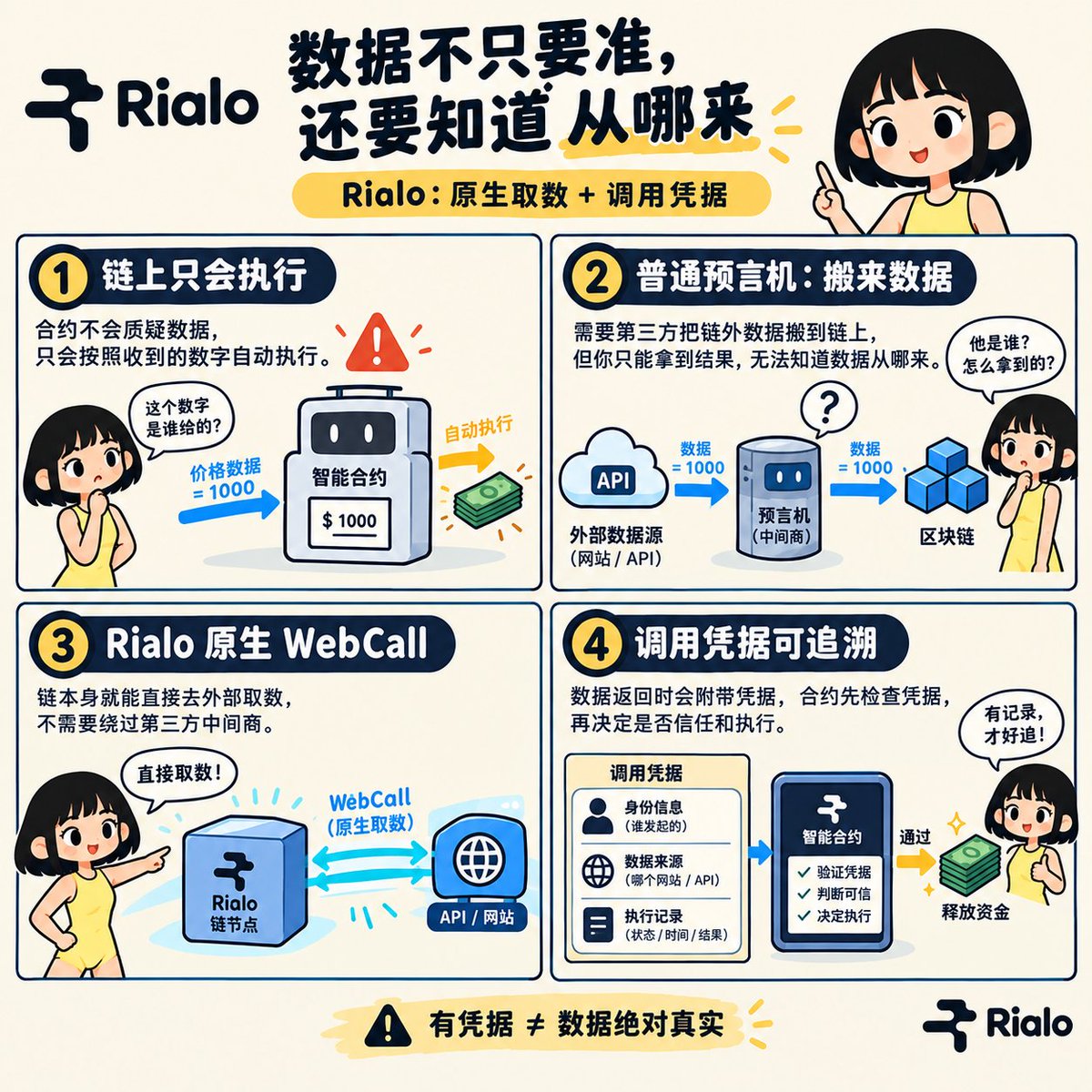
重点是把 WebCall、原生取数、调用凭据 串起来,让读者明白 Rialo 和普通预言机方案的区别
LIBOR 的教训,其实给区块链提了个醒
数据出了问题,不能只问数字准不准,还得知道是谁提供的
传统预言机能把链外价格搬到链上,但应用拿到一个数字,不代表就能搞清楚它从哪来、怎么取到的
@Rialo 想解决的,是这中间缺失的一环
它有几个比较具体的设计
1️⃣ 不用所有事情都绕着第三方中间商转
通过原生 WebCall,合约可以直接调用外部网站和 API 获取数据,不必每次都额外搭一套链外机器人和中间件
2️⃣ 取数不只是拿个结果,还要管调用过程
调用外部接口时,可以结合身份验证和访问凭据,让数据请求有明确的调用主体,而不是只收到一个来历模糊的数字
3️⃣ 数据获取和合约执行可以接起来
比如借贷协议要判断抵押率、稳定币要检查合规名单,都可以在执行过程中获取外部信息,再按预设规则决定是否放行
4️⃣ 需要保密的数据,不必全部摊在链上
Rialo 的 REX 保密执行环境,可以在保护敏感信息的情况下处理外部数据和合规规则,同时保留可审计的执行记录
这几件事结合起来,才是 Rialo 真正值得关注的地方
它不只是想让链上拿到数据,而是想把外部数据、身份验证、规则判断和执行记录放进一套更完整的协议体系里
当然,WebCall 不等于数据天然可信,调用身份也不等于数据提供者一定诚实
数据源的可靠性、凭据如何验证,仍然是关键
但至少,它把一个重要问题摆到了台面上
链上金融不能只知道自己收到了什么数字,还得知道这个数字从哪里来,以及凭什么相信它
毕竟,合约只管执行
真正决定这笔钱该不该动的,是执行之前的那份信任
技术依据
Rialo 的开发者资料介绍了原生 Web 连接、保密执行环境 REX,以及协议层身份、隐私与合规能力 @rialo_zw

@zihaowang135753 Webcall 确实把链上执行和现实世界巧妙连上了,Rialo 这波很有想法。。。

리알로 키워드 공부하기
@RialoHQ @RialoKorea
Native Webhooks &Webcalls (네이티브 웹훅 & 웹콜)
스마트 컨트랙트 내부에서 외부 HTTP/HTTPS API를 직접 호출(Webcalls)하거나, 외부 웹 서비스에서 발생한 이벤트를 푸시(Push) 형태로 전달받아 트랜잭션을 트리거(Webhooks)하는 프로토콜 수준의 양방향 통신 원시 기능(Primitive)입니다.
Native Webcalls (Outbound) : 체인에서 외부 서비스로 직접 데이터를 요청하여 가져오는 방식입니다. 컨트랙트 코드 한 줄로 외부 AI 모델 추론 값, 날씨 정보, 금융 시세 등을 불러옵니다.
Native Webhooks (Inbound) : 외부 웹 서버나 PG사, 데이터베이스에서 특정 이벤트가 터졌을 때 리알로 컨트랙트로 즉시 실행 알림을 쏴주는 역방향 신호입니다.
배경 : 기존 블록체인은 외풍을 차단한 '격리된 환경'이었기 때문에 외부 웹 API와 통신하려면 체인링크(Chainlink)나 별도의 중계 서버(Relayer)를 반드시 거쳐야 했습니다. 이는 시스템 복잡도를 높이고 중앙화 공격 지점을 만들었습니다.
리알로의 해결 방식 : Deterministic Wrapping 및 Source Attestation과 결합하여, 중간 오라클 서비스 없이 노드 합의 레이어 수준에서 안전하게 외부 HTTP 요청/응답을 처리하고 무결성을 검증합니다.
네이티브 웹훅 &웹콜이 제공하는 3가지 혁신
오라클 비용 및 복잡도 제거: 별도의 오라클 네트워크를 구축하거나 구독 수수료를 지불할 필요 없이 일반 Web2 개발 환경처럼 API 호출(GET, POST)을 곧바로 처리합니다.
온/오프체인 데이터의 실시간 동기화 : 오프체인 결제 완료 알림(Webhooks)이 오자마자 온체인 정산 컨트랙트가 실행되는 등 현실 세계 이벤트와의 지연 없는 연동이 가능해집니다.
자율 AI 에이전트와 외부 서비스 결합 : AI 에이전트가 온체인 자산을 운용하면서 외부 Web2 SaaS나 AI 서버 엔드포인트와 실시간으로 주고받는 복합 로직 구축이 쉬워집니다.
한 줄 요약
Native Webhooks &Webcalls는 블록체인이라는 단절된 섬에 인터넷 광케이블을 직접 연결하여, 스마트 컨트랙트가 웹 사이트 API를 직접 호출하거나 알림을 받아볼 수 있게 만든 내장형 통신망입니다.

리알로 키워드 공부하기
@RialoHQ @RialoKorea
Native Timers (네이티브 타이머)
스마트 컨트랙트가 특정 블록 주기나 미래의 시점, 반복 일정 등을 설정해 두면 외부의 트리거 없이도 체인의 합의 엔진이 직접 시간을 평가하여 자동으로 실행(Conditional Execution)을 트리거하는 원시 기능(Primitive)입니다.
개념 : 기존 블록체인은 외부에서 누군가가 수수료를 내고 트랜잭션을 일으켜 '깨워주지(Poke)' 않으면 컨트랙트 스스로 작동할 수 없는 수동적인 구조였습니다. 리알로는 Event-Driven Architecture와 Reactive Logic을 합의 엔진 수준에 통합하여, 프로토콜이 시계(Timer) 역할을 직접 수행합니다.
배경 : 기존에는 시간 기반 작업(예: "매일 아침 9시 이자 지급", "10분 뒤 경매 종료", "3일 뒤 보상 정산")을 처리하기 위해 젤라토(Gelato)나 체인링크 키퍼(Chainlink Keepers) 같은 외부 미들웨어를 도입해야 했습니다. 이는 추가 비용을 발생시키고 외부 미들웨어가 멈추면 계약도 함께 멈추는 위협을 초래했습니다.
리알로의 해결 방식 : 개발자는 컨트랙트 조건(Predicate)에 every 10 blocks나 at timestamp T와 같은 조건만 선언해 두면 됩니다. 리알로 노드들이 블록을 생성하면서 해당 조건의 충족 여부를 매번 직접 검증하고, 조건이 채워지는 순간 지연 없이 자동 실행을 실행합니다.
네이티브 타이머가 제공하는 3가지 혁신
미들웨어 완전 제거 (Keeperless Automation) : 스케줄링 봇이나 미들웨어가 필요 없어 개발 구조가 단순해지며, 봇 운영자의 주작이나 서버 다운으로 인한 실행 실패 위험을 차단합니다.
AI 에이전트 작업 데드라인 자동 강제 : 자율 AI 에이전트 계약(SCALE 등)에서 설정한 정산 기한이나 정기 과업 스케줄을 체인 차원에서 신뢰성 있게 보장합니다.
수수료 절감 및 예측 가능성 향상 : 외부 키퍼 호출에 들어가는 프리미엄 수수료를 줄이고, 정확한 시점에 결정론적(Deterministic)으로 로직이 실행되도록 제어할 수 있습니다.
한 줄 요약
Native Timers는 외부에서 알람을 울려주길 기다리던 기존 체인과 달리, 체인 자체에 정확한 알람 시계를 내장하여 때가 되면 알아서 계약을 실행하는 자율 구동 시스템입니다.


@EeeQqqwww2426 预言机把链外价格包成一个中介,合约读死一家之后换源就要改合约,Rialo 的 webcall 把取哪几家、怎么合成、挂了怎么降级写成配置,证明留在链上,换源不用动下游。

Rialo #99: Why Native Webcalls Matter in Agent Workflows
In AI agent workflows, it is not only important for an agent to perform well on its own. It also matters how the agent communicates with other agents, and how that flow connects to an onchain workflow.
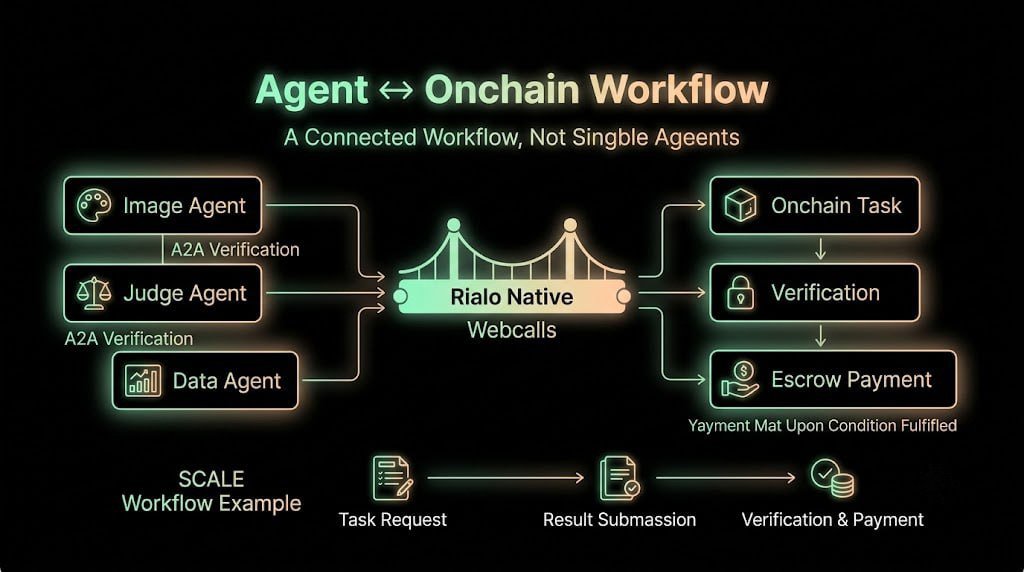
In the SCALE demo, one of the key features that connects this flow is Rialo’s native webcalls.
The original article explains that Rialo can communicate with AI agents through native webcalls and connect with agent-to-agent protocols like A2A. This means agents do not have to operate separately offchain. Instead, they can move inside a workflow connected to onchain tasks.
This matters because the AI agent economy is unlikely to be built around a single agent. More likely, different specialized agents, such as image generation agents, judge agents, data agents, and execution agents, will each take on different roles and communicate with each other to form one workflow.
If a blockchain only handles payment, it only covers one part of the agent workflow. But if agent communication, onchain conditions, verification, and payment are connected together, the structure becomes much stronger.
This flow can be seen in the SCALE demo. @chunliweb3 creates an image generation task and sends the SCALE task address to the agent. The image-generating agent checks the onchain task, performs the work, and submits the output to the SCALE task.
After that, the SCALE program uses Rialo’s native webcalls to send an A2A message to a third-party judge agent. The judge agent checks whether the submitted result follows the onchain prompt instructions and meets the quality standard.
So native webcalls should not be seen only as a way to fetch external data. They are an important connection point that links agent communication with onchain workflows and allows the agent’s work to continue into verification and payment.
This kind of connectivity is important in the AI agent economy. If an agent performs work but the result is not connected to onchain conditions, it becomes difficult to handle payment or refunds automatically. On the other hand, if there is only onchain logic but no way to communicate with agents, it becomes difficult to build real agent workflows.
This is why @RialoHQ feels interesting.
Native webcalls enable communication with agents, native timers enforce deadlines, and escrow with onchain payment makes it possible to handle payment based on the result.
Seen this way, SCALE is not just an agent payment demo. It is an example of a workflow where an agent receives a request, performs the work, another agent verifies the result, and onchain logic enforces the conditions.
In the end, what the agent economy needs is not only the performance of a single agent. It needs a structure where multiple agents can communicate with each other, connect that process to onchain conditions, and handle payment based on the outcome.
Native webcalls feel like an important bridge between agent communication and onchain workflows.
gRialo! 🧡

很多项目都在用Chainlink、Gelato这种外来连通世界,但这真的安全、高效吗?
外挂模式:为了获取数据和自动化,合约不得不套上层层中间件。链条越长,信任假设越多,更别提多出来的代码给黑客留下了巨大的“攻击面”。
原生事件驱动:Rialo的解法。直接将REX与Native Webcalls植入底层基础设施。
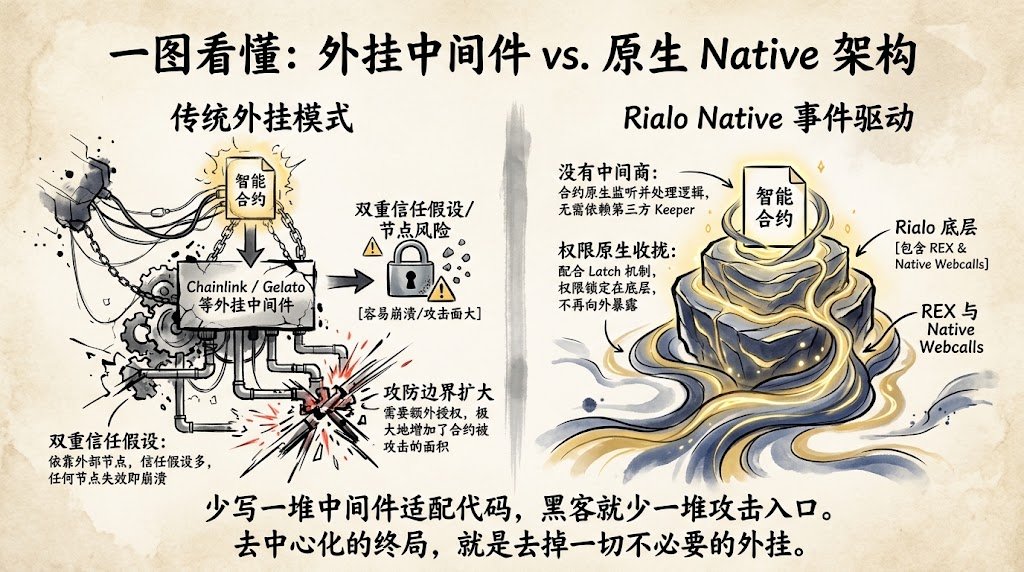
中间件与Native架构的对比,本质上是外挂与原生的范式之争。
为什么Chainlink Gelato这种外挂模式会增加安全隐患?
多重信任假设:外挂预言机或自动化执行节点本身是独立网络,调用链条拉长任何节点失效都会引发故障。
攻防边界扩大:中间件需要额外的授权和脚手架代码,增加了合约被攻击的面积。

Rialo Nativ 事件驱动才是未来。依靠REX Native Webcalls,把自动化与数据交互直接做进底层:
没有中间商:合约原生监听并处理逻辑,无需依赖第三方Keeper。
权限原生收拢:配合Latch机制,权限锁定在底层,不再向外暴露。
去中心化的终局,就是去掉一切不必要的外挂。
@RialoHQ
2、攻防边界扩大:中间件需要额外的权限授权和大量的脚手架代码。这极大地增加了智能合约的被攻击面,很多闪电贷攻击和预言机操纵,绝大多数都发生在这些外挂接口上。
而Rialo Native 事件驱动才是未来。@RialoHQ 依靠REX与 Native Webcalls,把自动化响应和Web2数据交互直接做进了底层基础设施:
Native Webcalls:让 Agent 直接拉取真实 Web 数据,无需中间件
让 Agent 像链上原生居民一样自主、安全地干活。不搞花哨概念,把底层工具做深,这才是 Rialo 作为 AI Agent 基础设施的核心壁垒。

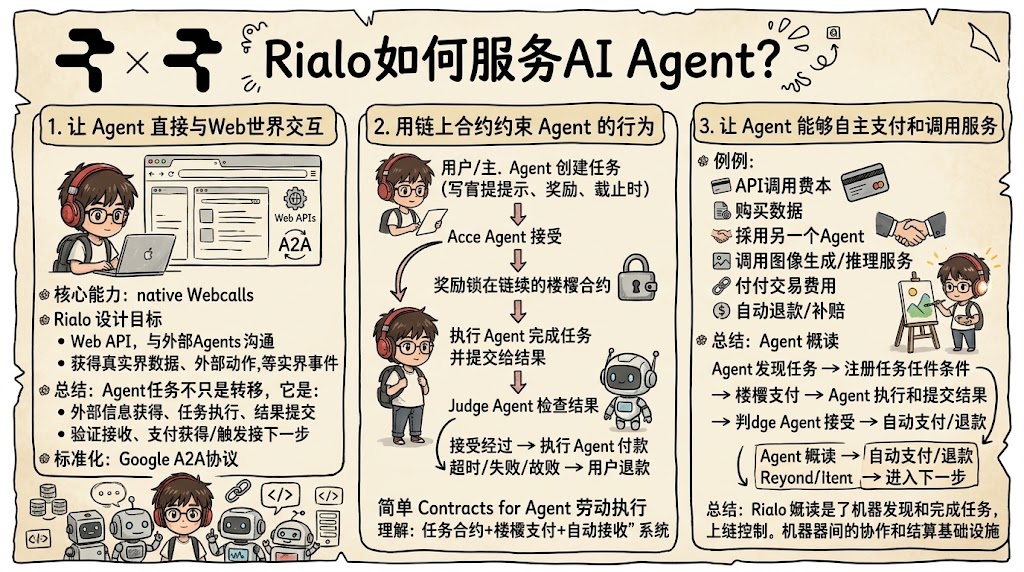
Rialo如何服务 AI Agent?🖥️
1. 让 Agent 能直接与 Web 世界交互。官方强调的一个核心能力是 native webcalls。传统智能合约通常不能直接访问外部 API,需要借助预言机、后端服务器或中间件。
Rialo 的设计目标是让链上程序可以更直接地:
调用 Web API;
与外部 Agent 通信;
获取现实世界数据;
触发外部动作;
让链上逻辑等待某个现实事件发生。
这对 Agent 很重要,因为 Agent 的任务往往不是单纯转账,而是:
获取外部信息;
执行任务;
提交结果;
接受验证;
获得报酬或触发下一步工作。
Rialo 官方将其与 Google 的 Agent2 Agent(A2 A)协议联系起来,试图让链上任务合约和外部 AI Agent 之间形成标准化通信。
2. 用链上合约约束 Agent 的行为
Simple Contracts for Agent Labor Execution 它可以理解为一种面向 Agent 的任务合约 + 托管付款 + 自动验收系统。
用户或主 Agent 创建任务➡任务中写入提示词、报酬、截止时间和验收 Agent➡报酬被锁定在链上托管合约中➡执行 Agent 完成任务并提交结果➡Judge Agent 检查结果是否满足要求➡验收通过,执行 Agent 获得付款➡如果超时或验收失败,用户获得退款。
3. 让 Agent 能够自主支付和调用服务
AI Agent 真正具有经济价值,通常需要进行一些有成本的动作,例如:
支付 API 调用费用;
购买数据;
雇佣另一个 Agent;
调用图像生成或推理服务;
支付交易费用;
根据条件自动退款或赔付。
Rialo 的设想是让这些动作由链上账户和程序控制,而不是每次都由人类手动确认。因此,Rialo 的 Agent 叙事可以理解成 Agent 发现任务➡链上登记任务条件➡托管付款➡Agent 执行并提交结果➡ Judge Agent 验收➡自动支付➡退款➡进入下一步流程。这比AI Agent + 发一个 Token的叙事更偏基础设施,重点是 机器之间的协作和结算。
个人观点:Rialo 想成为 AI Agent 的可信执行层:负责让 Agent 之间通信、调用现实世界服务、托管资金、按结果结算,并把权限和行为记录下来。
它不是一个单纯的 AI 项目,也不是普通的 Agent Launchpad。更准确地说,它押注的是 AI Agent 经济 + 可编程区块链 + 现实世界连接,其中 SCALE 是把 Agent 任务、验收和付款链上化的早期示范。
@RialoHQ
@rialo_zw

上周Rialo Builder Hub 带来了两个项目
----
Rialo Trainer
AI 驱动的 Solidity 学习 + 合约安全工具
可逐行解释代码、打安全分(0-100)、找漏洞并给修复建议,还能展示状态变化和 Gas 消耗
已针对 Rialo 特性(如 Native Webcalls)适配,适合从入门到 Rialo 合约开发与安全审计。
@RialoHQ

上周 Rialo 开发者活动挺有意思
Rialo Trainer 是个 AI 工具,专门练 Solidity 和合约安全。把代码丢进去,它能逐行讲、打安全分、找漏洞、给修复建议,还能看状态变化和 Gas。更
重要的是适配了Rialo自己的特性,比如Native Webcalls 和 REX。从入门到写Rialo合约,基本都能直接上手练。
@RialoHQ


Grialo
我们刚刚起步,但已经迈出了坚实的一步!
感谢每一位信任和支持 Rialo 的朋友,这只是开始,未来我们会一起走得更远、做得更大!
本周开发者活动的项目让我们一起了解一下吧
🧑💻 Rialo Trainer
这是一个 AI 驱动的 Solidity 学习 + 合约安全工具。
把代码丢进去,AI 可以逐行解释、0-100 安全评分、找漏洞、给修复建议,还能一步步看状态变化和 Gas 消耗。
更关键的是,它针对 Rialo 做了适配,能理解 Native Webcalls、REX 等特性。
从 Solidity 入门,到 Rialo 合约开发、安全审计,都能直接练。
🖼️ Rialo Digital Ad Board / PixelBoard
玩法更简单粗暴:
整个广告墙只有 10,000 个像素。
1 USDT = 1 像素
买下后永久展示
可以放 Logo + 跳转链接
项目方、社区、个人都可以直接占位置。
建议至少买 2×2,不然 Logo 可能真的要用显微镜看 😂
一个解决「怎么学、怎么写合约」
一个解决「怎么在 Rialo 生态里留下名字」
@RialoHQ

@Durjoy___das @RialoHQ @RialoIndian Embedding native webcalls and event driven execution directly into the protocol removes the reliance on fragile external middleware

more i dig into rialo, the less i think the interesting part is the feature list
it’s more about what @RialoHQ is choosing to put inside the chain itself
native webcalls, reactive transactions, automation, privacy, concurrency control, even the execution environment, a lot of the things that usually sit around a blockchain as separate services are being pulled closer to the core.
that changes how you think about building.
normally it’s something like:
build the app → find an oracle → add automation → connect APIs → add middleware → figure out privacy → keep more infrastructure alive
rialo is basically asking:
what if more of that was just part of the network?
that matters because every extra layer isn’t just another dependency. it’s another moving part, another interface, another potential point of failure, and usually another cost
so to me, the bigger rialo thesis isn’t “look how many things we built”
it’s how much of the stack can we make native enough that builders don’t have to glue it together themselves?

学习 Solidity,最难的往往不是写代码,而是不知道代码为什么这样运行,以及哪里可能出问题。
Rialo Trainer 用 AI 帮开发者逐行理解合约逻辑,进行安全检测,提供0-100 安全评分、漏洞分析和修复建议。
更重要的是,它针对 Rialo 特性进行了适配,能够理解 Native Webcalls、REX 等能力。
本周开发者活动又落地了两个兼具实用性与趣味性的项目:
1. Rialo Trainer
AI 驱动的 Solidity 学习与合约安全工具。支持逐行解析代码、0-100 安全评分、漏洞诊断与 Gas 监控,更深度适配了 Rialo 原生 Webcalls 与 REX 架构,大幅降低了开发者入局与审计的门槛。
@RialoHQ

Grialo
我们刚刚起步,但已经迈出了坚实的一步!
感谢每一位信任和支持 Rialo 的朋友,这只是开始,未来我们会一起走得更远、做得更大!
本周开发者活动的项目让我们一起了解一下吧
🧑💻 Rialo Trainer
这是一个 AI 驱动的 Solidity 学习 + 合约安全工具。
把代码丢进去,AI 可以逐行解释、0-100 安全评分、找漏洞、给修复建议,还能一步步看状态变化和 Gas 消耗。
更关键的是,它针对 Rialo 做了适配,能理解 Native Webcalls、REX 等特性。
从 Solidity 入门,到 Rialo 合约开发、安全审计,都能直接练。
🖼️ Rialo Digital Ad Board / PixelBoard
玩法更简单粗暴:
整个广告墙只有 10,000 个像素。
1 USDT = 1 像素
买下后永久展示
可以放 Logo + 跳转链接
项目方、社区、个人都可以直接占位置。
建议至少买 2×2,不然 Logo 可能真的要用显微镜看 😂
一个解决「怎么学、怎么写合约」
一个解决「怎么在 Rialo 生态里留下名字」
@RialoHQ

本周 Rialo 开发者活动这两个项目,挺对味的。
一个是 Rialo Trainer。
不是又一个“把代码丢进去让 AI 吹一吹”的玩具。逐行解释、安全评分、找漏洞、给修复、还能看状态变化和 Gas,最关键是它懂 Rialo 自己的东西:Native Webcalls、REX。 学 Solidity 的人能用,写 Rialo 合约的人也能用。生态现在缺的不是口号,是这种能上手练的工具。
另一个更直接:PixelBoard。
一万个像素,1 USDT 一个,买了就永久挂着,能放 Logo 和链接。 简单、粗暴、还带点早期互联网那种占位感。建议至少买 2×2,1 个像素的 Logo 真的看不见。一个帮你把合约写明白,一个帮你在墙上留个名。
一个练手,一个占位。这周就这两件事,挺够用。
@RialoHQ

美股巨头天天狂飙,AI 算力翻了几万倍,但最荒谬的是: 一个聪明绝顶的 AI 想买一手美股,依然要受限于周六周日休市、美东时间开盘、T+1/T+2 结算,以及冗长的人工身份 KYC。
让 24 小时毫秒级博弈的 AI,去适应上个世纪的人类交割规则?这根本不是资产入链,这是给跑车挂马车牌。
美股链上化(RWA)只是第一步,真正让 AI 能够自主配置美股资产的,是 @RialoHQ 这种底层协议: • 去掉人类中介的清算延时 • 提供机器原生的密钥托管与链上身份 • 让全天候的机器资金,秒级无缝对接传统金融核心资产
别让人类的作息,限制了机器金融的上限。

Most Popular Users

Elon Musk 
@elonmusk
239.8M followers

Barack Obama
@barackobama
118.6M followers

Cristiano Ronaldo
@cristiano
114.3M followers

Donald J. Trump
@realdonaldtrump
111.7M followers

Narendra Modi
@narendramodi
106.9M followers

Rihanna
@rihanna
98.6M followers

NASA
@nasa
92.1M followers

Justin Bieber
@justinbieber
91.7M followers

KATY PERRY
@katyperry
89.9M followers

Taylor Swift
@taylorswift13
83.9M followers

Lady Gaga
@ladygaga
75.4M followers

Virat Kohli
@imvkohli
73.3M followers

Kim Kardashian
@kimkardashian
70.8M followers

YouTube
@youtube
68.6M followers

Neymar Jr
@neymarjr
66.3M followers

Bill Gates
@billgates
65.1M followers

Selena Gomez
@selenagomez
63M followers

The Ellen Show
@theellenshow
62.1M followers

CNN
@cnn
61.7M followers

X
@x
60.6M followers