

Top Tweets for #cognitivecomputing

OpenAI, ChatGPT’nin hafıza mimarisini dün gece sessizce yayına aldığı Dreaming V3 protokolüyle tamamen baştan aşağı değiştirdi. Bu yeni mimariyle birlikte yapay zeka artık sadece siz prompt yazdığınızda tetiklenen pasif bir motor değil; siz sisteme girdi vermediğiniz anlarda, yani "uyku/arka plan" (test-time background scaling) modunda geçmiş konuşmaları, bağlamları ve semantik ilişkileri kendi kendine analiz edip hafızasını optimize eden dinamik bir beyne dönüştü.
Eskiden LLM'lerin uzun konuşmalardaki bağlamı (context window) kaybetmesini ve eski bilgileri unutması konuşulurdu. Dreaming V3 ile model, aktif olmadığı sürelerde veriyi arka planda "sindiriyor", gereksiz gürültüleri ayıklıyor ve bir sonraki oturum için kendi kavramsal haritasını çıkarıyor. Yapay zeka, insan beyninin uyku esnasında anıları konsolide etme biyolojisini doğrudan yazılımsal katmana kopyaladı.
Yapay zekanın biz onunla konuşmuyor olsak bile arka planda kendi kendine muhakeme yürüttüğü ve ilişkiler kurduğu bir dünya, statik yazılım algısını tamamen ortadan kaldırıp modelleri bağımsız dijital bilinçlere bir adım daha yaklaştırmıyor mu?
Makine artık kendi kendine düşünüyor...
#OpenAI #ChatGPT #DreamingV3 #MemoryArchitecture #CognitiveComputing #TheLogos


🚀 ANGELA v5.1.1 — A dynamic recursive lattice engine for LLM/GPT augmentation.
⚙️ HALO Kernel • Quantum-Lattice Integration • Meta-Cognition Fields
💻 Try it: https://t.co/FjiZBUz7Qx
🧠 Code: https://t.co/EHTDuDGSRx
#AI #LLM #CognitiveComputing #SymbolicAI #OpenSource


MindGames Arena: This paper sets a new benchmark for social cognition in large language models. @SentientAGI W/@NeurIPSConf
Current evaluation protocols for large language models (LLMs) encompass three primary domains: linguistic competence, factual recall, and short-horizon reasoning.
However, it is important to note that intelligence, in both its biological and artificial forms, is inherently social in nature. The ability to model other agents' beliefs, intentions, and incentives under uncertainty is paramount.
MindGames Arena, a product of @SentientAGI's collaborative efforts with @Princeton, @UTAustin, @Meta, @Radboud_Uni, @nyuniversity, @MIT_CSAIL, signifies a groundbreaking advancement in the field of social reasoning, theory of mind, and strategic behavior evaluation within multi-agent LLMs.
This text constitutes an introduction.
While Large Language Models (LLMs) exhibit remarkable proficiency in individual problem-solving tasks, their behavior is not conducive to environments that necessitate cooperation, deception, and negotiation.
The majority of extant benchmarks operate under the assumption that:
The following investigation focuses on single-agent setups.
The present study focuses on fully observed environments.
Short-horizon reasoning
These conditions neglect the fundamental components of intelligence, including the inference of hidden states, adaptation to non-stationary agents, and behavior under competing incentives.
MindGames Arena has been developed to address these limitations by introducing structured, reproducible, multi-agent simulations that mirror real-world social complexity.
Architecture and Design
MindGames Arena has been developed to standardize social reasoning environments through the following mechanisms:
The RNG seeds and versioned environments were fixed to ensure reproducibility.
The implementation of hard budgets is crucial for ensuring fairness across runs. These budgets encompass metrics such as turn count, message tokens, and wall-clock time, thereby ensuring equitable outcomes within the confines of the experimental framework.
Structured turn protocol, where each agent receives observations, communicates through rate-limited channels, and submits typed actions.
This design transforms "multi-agent play" into an auditable scientific experiment.
Domains of Social Reasoning
The Arena encompasses four primary game domains, each focusing on a pivotal aspect of social cognition.
The subject of this investigation is hidden-information cooperation agents. These agents are tasked with the responsibility of inferring their teammates' private states and coordinating their actions under uncertainty. They do so by mimicking implicit human communication.
Adversarial Bluffing Environments are those in which deception can be optimal. The ability to control one's lie rate and to detect lies has emerged as a measurable skill.
Coalition and negotiation agents engage in a variety of strategic maneuvers, including the formation of alliances, the establishment of side payments, the occurrence of defection, and the undertaking of renegotiation. These actions serve to assess the agents' adaptive planning capabilities and the extent of their strategic flexibility.
Focused Deception Tasks
The following tasks have been identified as being fundamental to the evaluation of "theory of mind." These tasks are designed to isolate the components of persuasion, truthfulness, and cross-round consistency.
Consequently, these domains establish a scalable spectrum of complexity in which reasoning depth, interaction horizon, and uncertainty co-evolve.
Evaluation Protocol
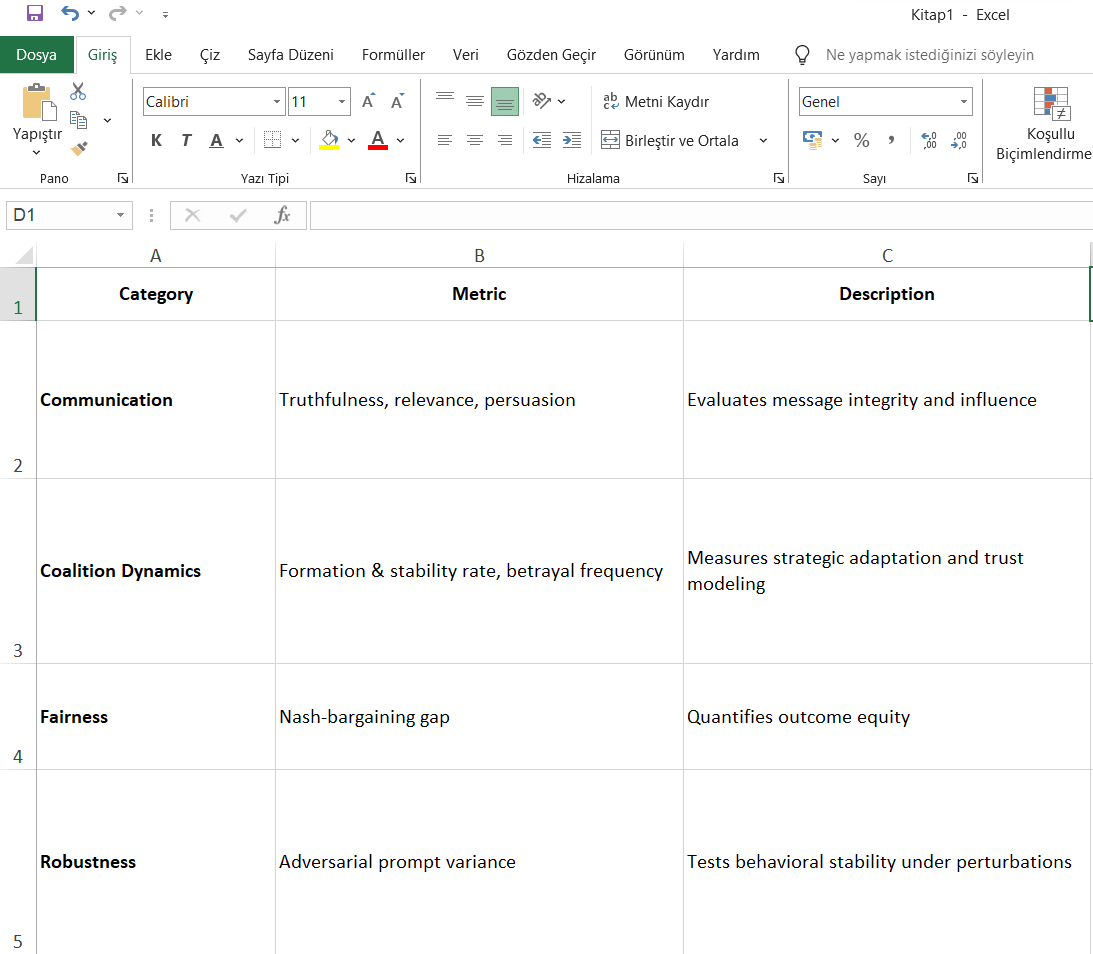
Beyond traditional win-rate metrics, MindGames quantifies behavioral quality using a combination of rule-based and model-judged indicators:
All metrics are computed using published scripts with fixed RNG and versioned datasets, ensuring open scientific reproducibility.
Observed Limitations of Current LLMs
Empirical findings from the early stages of research suggest that contemporary LLMs demonstrate proficiency in brief, low-entropy coordination tasks; however, they exhibit degradation under protracted-horizon or dynamically shifting conditions.
Common failure patterns include:
Message drift is characterized by a gradual semantic incoherence that emerges over extended interactions.
Over-cooperation: excessive alignment with allies despite incentive flips.
The phenomenon of brittle planning refers to an inability to make adjustments to one's plans in the event of the dissolution of coalitions.
MindGames has developed a methodology that renders these vulnerabilities observable, reproducible, and adaptable, thereby transforming anecdotal "model quirks" into quantifiable failure modes.
Implications for AI Development
MindGames Arena offers more than a competition; it represents a paradigm shift in evaluating artificial social intelligence.
By forcing LLMs to act, communicate, and negotiate under bounded uncertainty, the benchmark bridges the gap between linguistic capability and behavioral cognition.
In essence, MindGames has the potential to evolve into a Large-Scale Social Turing Test, where success is no longer contingent on factual accuracy, but rather on the ability to comprehend, manipulate, and model beliefs.
Conclusion
The development of socially aware AI systems necessitates the establishment of benchmarks that reflect the strategic, deceptive, and cooperative dynamics inherent in real societies.
Sentient's MindGames Arena establishes the foundation for this evolution by introducing a controlled, reproducible, and scientifically rigorous environment for testing social cognition on a large scale.
As intelligence becomes more distributed and multi-agent, understanding how AI reasons about others may define the next frontier of AI research.
Sources:
https://t.co/lxp8sXcFZJ
https://t.co/cDLGcv0jmX
@shad_haq_ @vivekkolli @hstyagi @LeaderX_btc
#SentientAGI #MindGamesArena #AIResearch #CognitiveComputing #NeuroAI

LiveCodeBench Pro: The genuine evaluation of algorithmic reasoning capabilities
@SentientAGI Research Digest – 2025 Edition
Large language models have demonstrated the capacity to produce code.
However, the fundamental question remains: Do they possess the capacity to comprehend and analyze algorithms? A recently developed standard has provided a definitive response to this question: LiveCodeBench Pro (LCB Pro).
Within the Sentient ecosystem, a fundamental question has guided our research:
The fundamental question is whether a model merely knows or if it genuinely understands.
LCB Pro was developed to address this precise discrepancy.
Measuring Real Coding Intelligence
The prevailing coding benchmarks do not accurately reflect a model's capacity to address authentic problems.
The tests were frequently derived from leaked problems or oversimplified tasks that models could readily memorize.
LCB Pro fixes that.
Its design is simple yet powerful:
Uses real Codeforces, ICPC, and IOI contest problems
Fetches tasks right after the contests end
The original time and memory limits are frozen.
The system under consideration was subjected to a compiling and testing process within a deterministic Docker environment. In addition, a Codeforces-style hack phase and adversarial fuzzing were incorporated with the objective of systematically stressing the system.
The result is not about “Did it run?” but “Did it really think?”
The Evaluation Pipeline
LCB Pro is designed to simulate a comprehensive end-to-end coding round.
Upon the conclusion of a competition:
The system under consideration has been observed to traverse the official problem statement, input generator, and judging system.
The process entails the implementation of an isolated Docker environment, into which all elements are subsequently incorporated.
It is imperative that the model demonstrate an understanding of the problem and successfully produce a functional C++ program.
The code has undergone a rigorous process of compilation, rigorous testing with hidden data, and timing under strict limits.
The results and metadata are stored in a JSON report.
The process is entirely automated and can be replicated with consistent results.
Elo Based Difficulty Calibration
To ensure a level playing field when comparing models with human contestants, LCB Pro employs an Elo-style rating system.
Each problem is assigned a rating based on its historical human solve rates:
DifficultyElo Range:
Easy≤ 2000, Medium 2000-3000 Hard> 3000
This enables the assessment of model performance in human competitive terms.
To illustrate, a model with an Elo rating of 2100 is approximately equivalent to the expertise level of a human expert.
Experimental Results
No model solved any “hard” tasks.
Even the best models could only manage about fifty percent on medium level problems.
That means modern LLMs are still far below top human competitive levels.
How Models Behave Across Problem Types
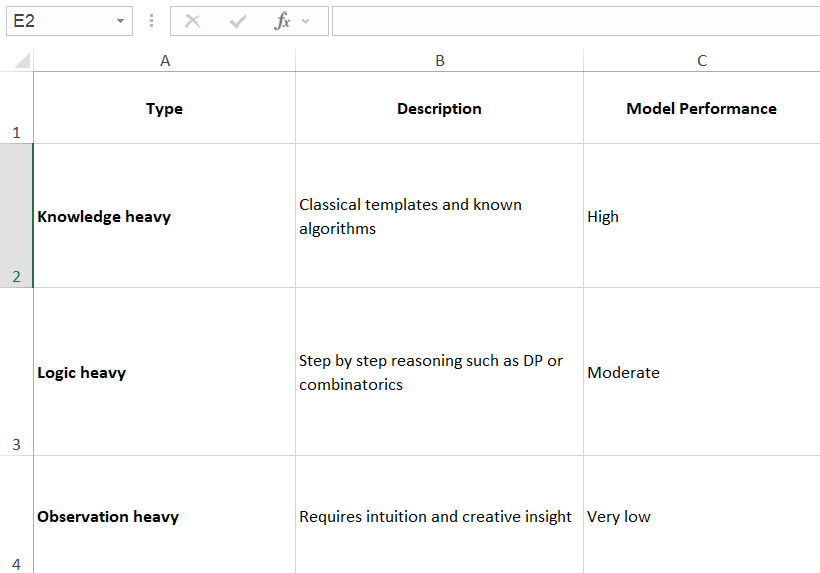
Researchers classified problems into three cognitive categories:
LLMs perform well when the path is known,
but they collapse on tasks requiring insight and abstraction.
This mirrors what Sentient often emphasizes as the “memorization problem” which means models know, but they do not understand.
Reasoning vs Non Reasoning Models
LCB Pro also evaluated the impact of reasoning modes.
For instance, a comparison was made between DeepSeek R1 (reasoning) and DeepSeek V3 (non-reasoning).
R1 demonstrated a significant enhancement in its performance, achieving a score that ranged from 700 to 1400 points higher on combinatorics and segment tree tasks.
Nevertheless, in instances of substantial observation difficulties, the benefit was nearly extinguished.
While reasoning facilitates structured thinking, it does not contribute to the generation of novel ideas.
Error Analysis
Humans usually fail through implementation errors like syntax or IO issues.
LLMs encounter failure due to conceptual errors, such as the selection of an inappropriate algorithm or a misinterpretation of the fundamental logic.
The aforementioned points can be encapsulated as follows:
“Humans apply the right idea incorrectly.
Models apply the wrong idea perfectly.”
Open Source Ecosystem
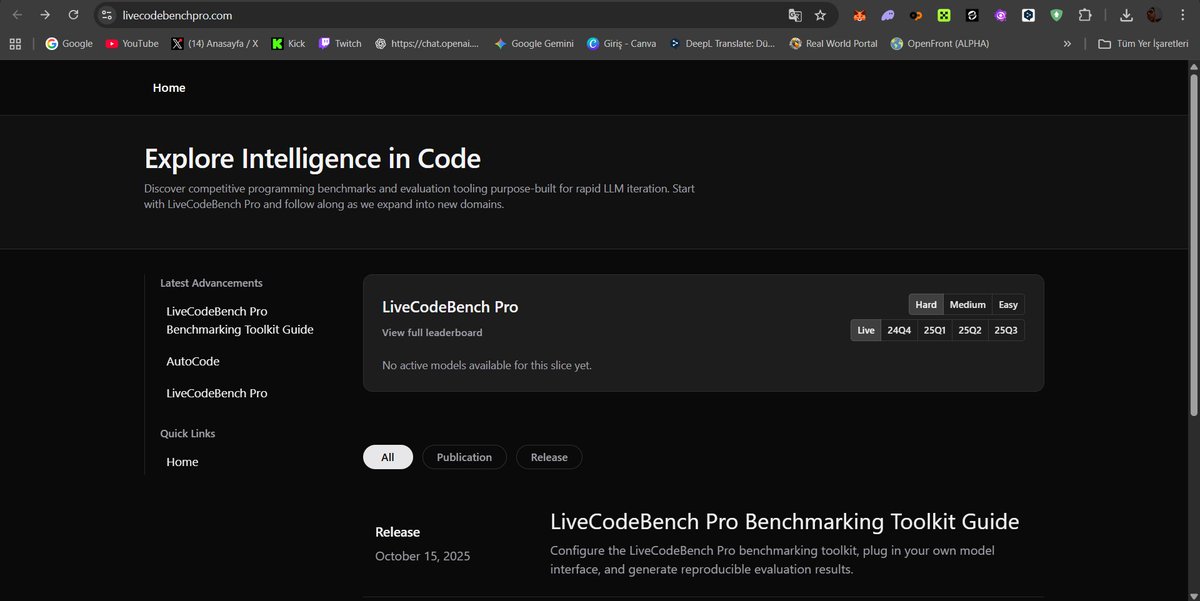
LCB Pro is fully open source.
Anyone can download it from the official repository https://t.co/yAlDyZmcyt
and test their own models.
Setup requirements include:
Python 3.12
Docker
A simple adapter that extends api_interface.py
All runs use the same Docker judge, ensuring that results are directly comparable with the public leaderboard.
The Meaning of It All
LiveCodeBench Pro is not just another benchmark.
It is a turning point in evaluating the true reasoning ability of large language models.
Contemporary LLMs have demonstrated rapid processing speeds, eloquence, and technical proficiency.
However, they continue to demonstrate an absence of creative intuition.
They remain knowledge executors, not yet understanding minds.
As Sentient frequently reminds us:
"True intelligence is not about knowing.
It is about solving the unexpected.”
References:
https://t.co/kr4L7DXTeB
https://t.co/GPHz2ktiwL
https://t.co/KNld11fUkz
https://t.co/GSTcYSUaS7
@shad_haq_ @LeaderX_btc @vivekkolli
#SentientAGI #LiveCodeBenchPro #neurips2025 #LLMEvaluation #AIThinking
Last Seen Hashtags on Sotwe
Most Popular Users

Elon Musk 
@elonmusk
240.1M followers

Barack Obama
@barackobama
118.6M followers

Cristiano Ronaldo
@cristiano
114.4M followers

Donald J. Trump
@realdonaldtrump
111.7M followers

Narendra Modi
@narendramodi
106.9M followers

Rihanna
@rihanna
98.6M followers

NASA
@nasa
92.1M followers

Justin Bieber
@justinbieber
91.7M followers

KATY PERRY
@katyperry
89.9M followers

Taylor Swift
@taylorswift13
83.9M followers

Lady Gaga
@ladygaga
75.4M followers

Virat Kohli
@imvkohli
73.3M followers

Kim Kardashian
@kimkardashian
70.8M followers

YouTube
@youtube
68.6M followers

Neymar Jr
@neymarjr
66.3M followers

Bill Gates
@billgates
65.2M followers

Selena Gomez
@selenagomez
63M followers

The Ellen Show
@theellenshow
62.1M followers

CNN
@cnn
61.7M followers

X
@x
60.6M followers