

Top Tweets for #embeddedengineer

🚀 Things I Wish I Knew Before Learning Embedded Systems
When I started learning Embedded Systems, I thought writing code was the hardest part.
After working on ESP32, Raspberry Pi, IoT, Computer Vision, and robotics projects, I realized the real challenges were somewhere else.
Here are 5 lessons I wish I knew earlier:
🔹 Master C Fundamentals
Pointers, structures, memory management, and bitwise operations matter more than most frameworks.
🔹 Communication Protocols Are Essential
Understanding UART, SPI, and I2C makes debugging hardware much easier.
🔹 Debugging Is a Core Skill
A large part of embedded development is finding and fixing issues rather than writing new code.
🔹 Learn RTOS Concepts Early
Tasks, scheduling, queues, and semaphores are used in many real-world embedded products.
🔹 Power and Timing Matter
Efficient use of memory, CPU time, and power often determines whether a system succeeds.
These lessons came from building projects, making mistakes, and spending hours debugging issues that looked impossible at first.
Every project taught me something new, and I'm still learning.
🔽 Download Best ESP32 eBooks
📕 https://t.co/yUaVkQfGM1
💡 What is one thing you wish you had known before starting Embedded Systems or Electronics?
#EmbeddedSystems #Firmware #ESP32 #IoT #Electronics #EmbeddedEngineering #RTOS #EdgeAI #ComputerVision #ArtificialIntelligence #FirmwareDevelopment #Engineering #EngineeringStudents #TechCareers #TechEducation #FirmwareDevelopment #ElectronicsEngineering #Innovation #LearningInPublic

🚀 Sign Language Translator – Embedded Systems Project
I'm excited to share my latest Embedded Systems project: Sign Language Translator, a smart glove designed to help bridge the communication gap between hearing-impaired individuals and the wider community.
🔹 Hardware Components:
• ESP32 Microcontroller
• Flex Sensors
• MPU6050 Accelerometer & Gyroscope
• DFPlayer Mini MP3 Module
• 8Ω Speaker
• Micro SD Card
💡 How It Works:
The glove uses Flex Sensors to detect finger movements and an MPU6050 sensor to track hand orientation and motion. The ESP32 processes these inputs and recognizes predefined sign language gestures. Once a gesture is identified, the corresponding voice message stored on a Micro SD card is played through the DFPlayer Mini and speaker, converting sign language into audible speech in real time.
🔽 Download Best ESP32 eBooks
📕 https://t.co/yUaVkQfGM1
🎯 Project Objectives:
✅ Enhance communication for hearing-impaired individuals
✅ Demonstrate practical sensor integration and embedded system design
✅ Develop an affordable and user-friendly assistive technology solution
✅ Apply IoT and embedded engineering concepts to solve real-world challenges
This project highlights the power of Embedded Systems and Assistive Technology in creating meaningful solutions that improve people's lives.
#EmbeddedSystems #ESP32 #IoT #SignLanguageTranslator #AssistiveTechnology #EmbeddedEngineering #Electronics #Innovation #SensorTechnology #EngineeringProject #TechForGood #EmbeddedLab 🚀

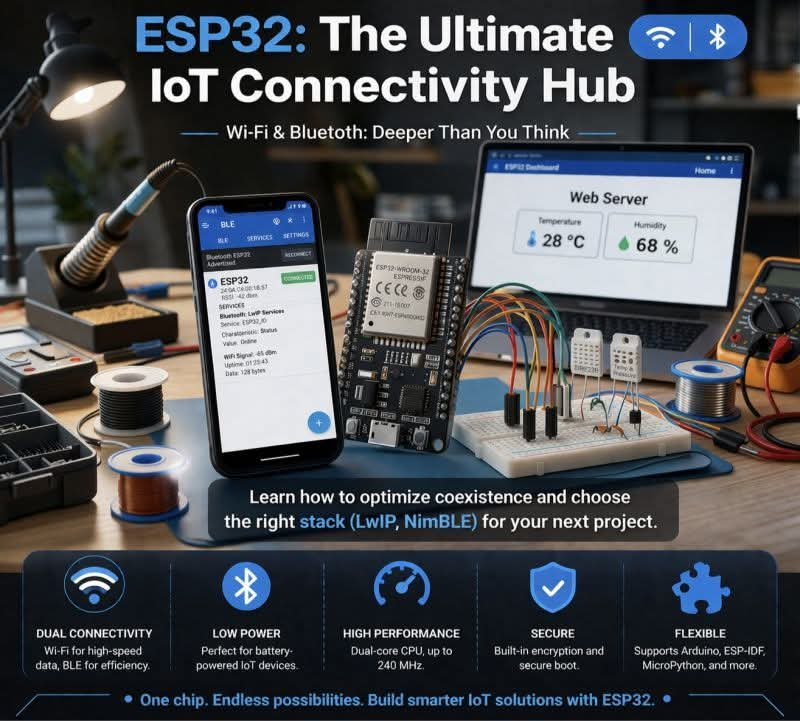
Mastering Wi-Fi and Bluetooth Architectures on ESP Microcontrollers 📶📡
Espressif’s ESP boards didn’t just make IoT accessible; they fundamentally shifted how we design embedded network stacks. But when you move past simple tutorials and start deploying at scale, the nuances of how these chips handle wireless protocols become critical.
🌐 The Wi-Fi Stack: Beyond WiFi.begin()
While the API makes it look simple, the underlying Wi-Fi implementation on ESP chips is an industrial-grade networking powerhouse, built largely on top of the LwIP (Lightweight IP) stack.
Operating Modes: ESPs don't just connect to networks; they route them. You can leverage STA (Station) to connect to a router, AP (Access Point) to broadcast a network, or AP+STA (SoftAP) simultaneously. SoftAP is the industry standard for headless device provisioning.
Power Optimization: Wi-Fi is notoriously power-hungry. To mitigate this, ESPs utilize DTIM (Delivery Traffic Indication Message) sleeping. By entering Modem Sleep between beacon intervals, the RF radio powers down while the CPU stays active, dropping consumption from ~240mA to ~20mA without dropping the connection.
The Next Gen (Wi-Fi 6): The newer ESP32-C6 introduces 802.11ax (Wi-Fi 6). This brings Target Wake Time (TWT) and OFDMA to the embedded level, drastically reducing latency and power consumption in dense IoT networks.
🔵 The Bluetooth Stack: Classic vs. BLE
Bluetooth on the ESP32 is a tale of two protocols, often utilizing either the heavier Bluedroid stack or the highly optimized NimBLE stack (highly recommended for SRAM-constrained projects).
Bluetooth Classic (BR/EDR): Supported primarily on the original ESP32. It’s essential for continuous data streams like audio (A2DP) or legacy serial profiles (SPP).
Bluetooth Low Energy (BLE): The backbone of modern sensor networks. ESPs can handle complex GATT Server/Client architectures.
BLE Mesh: ESP boards natively support Bluetooth Mesh profiles, allowing you to bypass the traditional star topology. You can daisy-chain hundreds of ESP32s or battery-powered sensor nodes across a massive physical footprint.
🔀 The Secret Sauce: RF Coexistence
How does an ESP32 run Wi-Fi and Bluetooth simultaneously when it only has one physical 2.4 GHz antenna?
Through a highly complex mechanism called Time Division Multiplexing (TDM) and Packet Traffic Arbitration (PTA).
The baseband hardware rapidly switches the antenna between the Wi-Fi MAC and the Bluetooth MAC. However, this is a zero-sum game. If you stream heavy Wi-Fi data while scanning for BLE packets, you will experience packet collisions and latency.
📕 https://t.co/yUaVkQgeBz
#EmbeddedEngineering #ESP32 #IoTArchitecture #Firmware #WiFi6 #BluetoothLowEnergy #Espressif #HardwareDesign #Microcontrollers #TechDeepDive
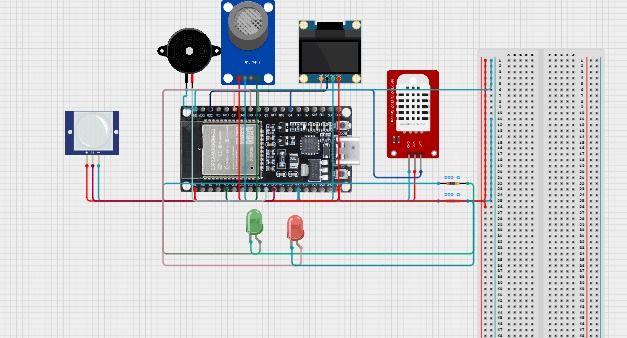
🚀 Excited to share my latest embedded systems project — an RTOS-Based Smart Monitoring System built using ESP32 and FreeRTOS.
The system is designed to perform real-time environmental monitoring by handling multiple tasks simultaneously with efficient scheduling and responsiveness. By leveraging FreeRTOS, the project demonstrates how multitasking can be implemented effectively in embedded applications.
🔧 Key Highlights:
• Real-time task management using FreeRTOS
• ESP32-based high-performance embedded platform
• Temperature & humidity monitoring
• Gas/smoke detection with alert mechanism
• OLED display for live system status monitoring
• Buzzer and LED indicators for safety notifications
• Optimized multitasking and resource management
📚 Technologies & Concepts Applied:
Embedded C | ESP32 | FreeRTOS | Sensor Interfacing | IoT | Real-Time Systems
This project helped me strengthen my understanding of RTOS concepts, task scheduling, inter-device communication, and embedded system design for smart automation applications.
Looking forward to building more advanced real-time and IoT-based solutions. 🚀
📕 https://t.co/yUaVkQfGM1
#EmbeddedSystems #ESP32 #FreeRTOS #IoT #RealTimeSystems #EmbeddedEngineering #Electronics #Microcontroller #SmartSystems #Automation #EngineeringStudent #ECE #TechInnovation #LearningJourney
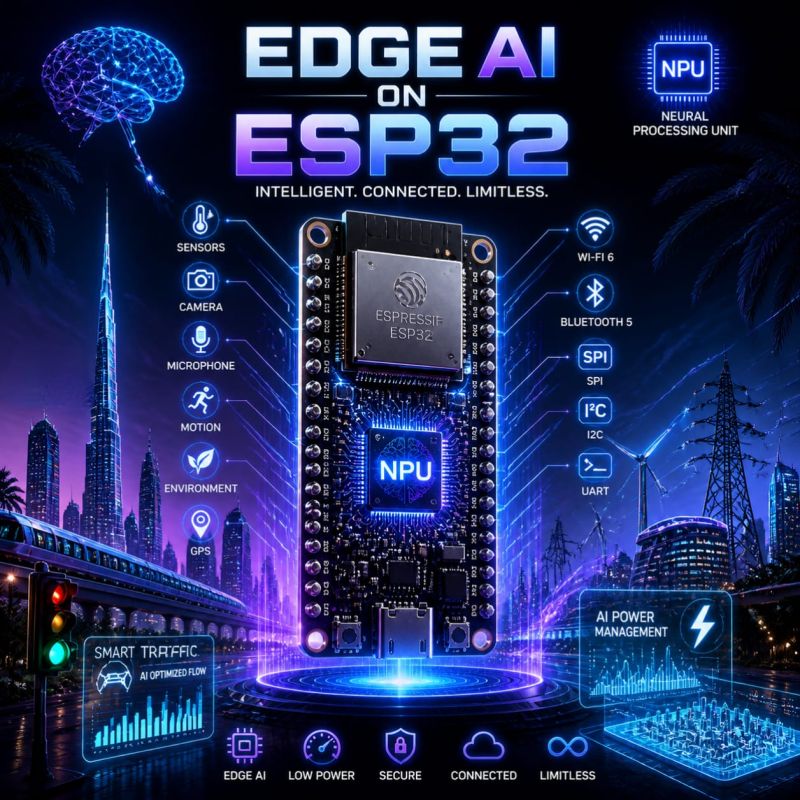
Nobody told me that learning ESP32 would put me at the intersection of one of the biggest tech shifts of 2026.
Here's what I mean:
IoT Analytics just confirmed that 2026 is the inflection year — when edge AI moves from pilots into full-scale deployment across billions of connected devices.
And the backbone of all of it? Embedded engineers.
Not cloud architects. Not app developers.
Engineers who understand how silicon thinks.
I'm early in my embedded journey — working with ESP32 and STM32, learning how microcontrollers communicate with the real world through UART, SPI, I2C. Writing firmware that runs in kilobytes of memory.
But here's what excites me about where this is heading:
→ New IoT SoCs now ship with on-device Neural Processing Units (NPUs)
→ FreeRTOS and Zephyr are the fastest-growing RTOS platforms globally
→ Dubai's IoT device market is projected to hit USD 2.5 trillion by 2033
→ Dubai 2040 Urban Master Plan is turning the city into a giant embedded system — smart traffic, smart energy, smart buildings
Every sensor node in that city needs a firmware engineer who understands low-power design, real-time constraints, and wireless protocols.
That's the role I'm building toward.
If you're a recruiter or engineer in the UAE working on IoT or embedded systems — I'd love to connect. Let's talk about where this field is headed.
What skill do you think is most underrated in embedded engineering right now?
📕 https://t.co/yUaVkQfGM1
#EmbeddedSystems #IoT #ESP32 #FirmwareEngineering #SmartCity #Dubai #UAE #EdgeAI #FreeRTOS #EmbeddedEngineer
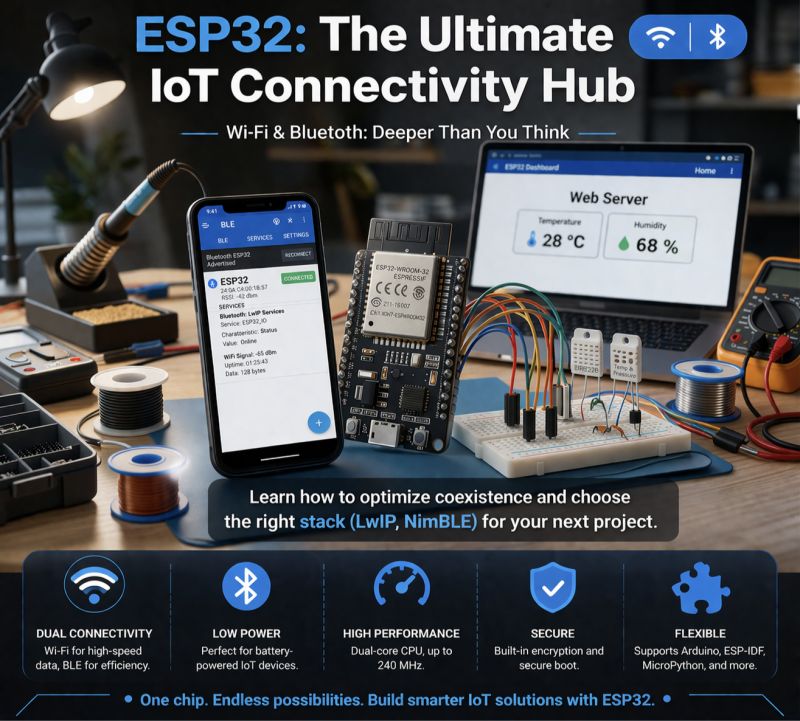
Mastering Wi-Fi and Bluetooth Architectures on ESP Microcontrollers 📶📡
Espressif’s ESP boards didn’t just make IoT accessible; they fundamentally shifted how we design embedded network stacks. But when you move past simple tutorials and start deploying at scale, the nuances of how these chips handle wireless protocols become critical.
🌐 The Wi-Fi Stack: Beyond WiFi.begin()
While the API makes it look simple, the underlying Wi-Fi implementation on ESP chips is an industrial-grade networking powerhouse, built largely on top of the LwIP (Lightweight IP) stack.
Operating Modes: ESPs don't just connect to networks; they route them. You can leverage STA (Station) to connect to a router, AP (Access Point) to broadcast a network, or AP+STA (SoftAP) simultaneously. SoftAP is the industry standard for headless device provisioning.
Power Optimization: Wi-Fi is notoriously power-hungry. To mitigate this, ESPs utilize DTIM (Delivery Traffic Indication Message) sleeping. By entering Modem Sleep between beacon intervals, the RF radio powers down while the CPU stays active, dropping consumption from ~240mA to ~20mA without dropping the connection.
The Next Gen (Wi-Fi 6): The newer ESP32-C6 introduces 802.11ax (Wi-Fi 6). This brings Target Wake Time (TWT) and OFDMA to the embedded level, drastically reducing latency and power consumption in dense IoT networks.
🔵 The Bluetooth Stack: Classic vs. BLE
Bluetooth on the ESP32 is a tale of two protocols, often utilizing either the heavier Bluedroid stack or the highly optimized NimBLE stack (highly recommended for SRAM-constrained projects).
Bluetooth Classic (BR/EDR): Supported primarily on the original ESP32. It’s essential for continuous data streams like audio (A2DP) or legacy serial profiles (SPP).
Bluetooth Low Energy (BLE): The backbone of modern sensor networks. ESPs can handle complex GATT Server/Client architectures.
BLE Mesh: ESP boards natively support Bluetooth Mesh profiles, allowing you to bypass the traditional star topology. You can daisy-chain hundreds of ESP32s or battery-powered sensor nodes across a massive physical footprint.
🔀 The Secret Sauce: RF Coexistence
How does an ESP32 run Wi-Fi and Bluetooth simultaneously when it only has one physical 2.4 GHz antenna?
Through a highly complex mechanism called Time Division Multiplexing (TDM) and Packet Traffic Arbitration (PTA).
The baseband hardware rapidly switches the antenna between the Wi-Fi MAC and the Bluetooth MAC. However, this is a zero-sum game. If you stream heavy Wi-Fi data while scanning for BLE packets, you will experience packet collisions and latency.
📕 https://t.co/yUaVkQfGM1
#EmbeddedEngineering #ESP32 #IoTArchitecture #Firmware #WiFi6 #BluetoothLowEnergy #Espressif #HardwareDesign #Microcontrollers #TechDeepDive
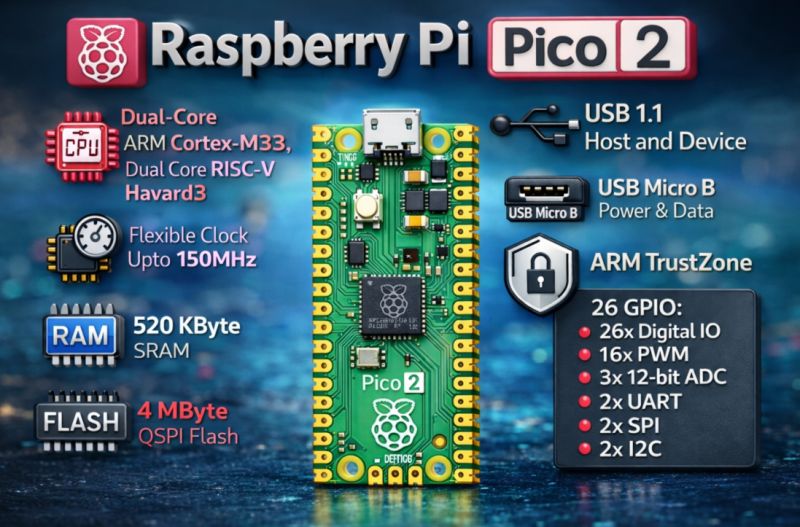
🚀 Exploring the Power of Raspberry Pi Pico 2 in Embedded & IoT Development
Excited to share this quick overview of the Raspberry Pi Pico 2, a powerful microcontroller designed for modern embedded systems and IoT innovation.
🔧 Key Highlights:
• 🧠 Dual-Core ARM Cortex-M33 architecture
• ⚡ Flexible clock speed up to 150 MHz
• 💾 520 KB SRAM for efficient processing
• 📦 4 MB QSPI Flash for program storage
• 🔌 USB 1.1 Host & Device support
• 🔐 ARM TrustZone for enhanced security
• 🔗 26 GPIO pins supporting Digital I/O, PWM, ADC, UART, SPI, and I2C
This compact board enables developers to build smart automation systems, robotics solutions, IoT devices, and real-time embedded applications.
As someone passionate about AI, Robotics, IoT, and hardware innovation, exploring platforms like the Pico 2 helps in creating smarter solutions that can solve real-world problems.
Looking forward to building more embedded hardware and IoT projects with this powerful microcontroller. 💡
🔥 Raspberry Pi Projects, Guides and Tutorials
https://t.co/LeR94swk4Q
#RaspberryPi #RaspberryPiPico #Pico2 #EmbeddedSystems #EmbeddedEngineering #Microcontroller #IoT #InternetOfThings #Electronics #HardwareDevelopment #Robotics #Automation #TechInnovation #Engineering #TechCommunity #STEM #AI #RoboticsEngineering #HardwareProjects #DIYElectronics #Innovation #FutureTechnology #TechLearning #Programming #Developers
🚀 Exploring ESP-IDF – Hands-on with ADC & Sensor Interfacing
Recently, I’ve been working with ESP-IDF to strengthen my expertise in low-level embedded development using Espressif Systems controllers.
As part of my ongoing learning process, I implemented ADC–LDR interfacing to measure ambient light intensity and process real-time analog sensor data using ESP-IDF.
This hands-on implementation helped me better understand:
✔️ Peripheral configuration at register/driver level
✔️ ESP-IDF project structure and build system
✔️ Real-time sensor data handling
✔️ Embedded debugging and optimization
Sharing a short demo video of the working prototype below.
I’m continuously building practical embedded and IoT solutions using microcontrollers, sensors, and real-time firmware development.
For further details, check on: https://t.co/oByZzmCNal
🔥 ESP32 Projects, Guides and Tutorials
https://t.co/gxrULjgUrQ
#ESP32 #ESPIDF #EmbeddedSystems #IoT #FirmwareDevelopment #CProgramming #ADC #Microcontrollers #EmbeddedEngineer #LearningJourney #UART #SPI #I2C #GPIO
🔧 ESP32-Based Servo Motor Control Using Potentiometer | Mini Project
I recently worked on an ESP32 project where I controlled a servo motor using an analog potentiometer. The ESP32 reads variable analog input values (0–4095) from the potentiometer and maps them to a corresponding servo angle (0–180°). As the knob rotates, the servo moves smoothly in real time.
✔ Key Features
Used ESP32 ADC to read analog values from GPIO 34
Implemented ADC attenuation (11 dB) for improved input range
Mapped 12-bit ADC values (0–4095) to servo angle (0–180°)
Controlled servo motor using the ESP32Servo library
Real-time monitoring via Serial Monitor
🧩 Applications
Robotics
Automation
Angle/position control
Interactive hardware prototypes
💡 Skills Used
ESP32 | Servo Control | ADC | Embedded C++ | Hardware Interfacing | IoT Development
🔥 Top 6 ESP32 eBooks for $20
https://t.co/Kyt8ZzFBCY
#ESP32
#Arduino
#IoT
#EmbeddedSystems
#Microcontroller
#ElectronicsProjects
#ServoMotor
#HardwareDevelopment
#Robotics
#MakerProject
#Innovation
#EmbeddedEngineering
#TechProjects
#Coding
#STEM
🚰 Smart Water Tank Level Indicator using ESP32 💡
Built a water level monitoring system using ESP32, Ultrasonic Sensor (HC-SR04), I2C LCD, and LEDs to display real-time water level inside a tank.
🔹 Ultrasonic sensor measures distance to water surface
🔹 LCD shows distance & tank level (LOW / MID / HIGH)
🔹 LEDs indicate water level visually
🔹 ESP32 ensures fast processing & future IoT scalability
This project is useful for home automation, water management, and smart infrastructure and can be extended with buzzer alerts, mobile apps, or cloud monitoring.
📌 Learning highlights:
✔ Sensor interfacing
✔ ESP32 GPIO & timing
✔ LCD I2C communication
✔ Embedded logic for real-world systems
🔥 Top 6 ESP32 eBooks for $20
https://t.co/Kyt8ZzFBCY
#ESP32 #IoT #EmbeddedSystems #WaterTank #Automation
#Electronics #Microcontroller #SmartHome
#EngineeringProjects #Arduino #Sensors
#EmbeddedEngineering #STEM #TechInnovation
#LearningByDoing
Last Seen Hashtags on Sotwe
Most Popular Users

Elon Musk 
@elonmusk
240M followers

Barack Obama
@barackobama
118.6M followers

Cristiano Ronaldo
@cristiano
114.4M followers

Donald J. Trump
@realdonaldtrump
111.7M followers

Narendra Modi
@narendramodi
106.9M followers

Rihanna
@rihanna
98.6M followers

NASA
@nasa
92.1M followers

Justin Bieber
@justinbieber
91.7M followers

KATY PERRY
@katyperry
89.9M followers

Taylor Swift
@taylorswift13
83.9M followers

Lady Gaga
@ladygaga
75.4M followers

Virat Kohli
@imvkohli
73.3M followers

Kim Kardashian
@kimkardashian
70.8M followers

YouTube
@youtube
68.6M followers

Neymar Jr
@neymarjr
66.3M followers

Bill Gates
@billgates
65.2M followers

Selena Gomez
@selenagomez
63M followers

The Ellen Show
@theellenshow
62.1M followers

CNN
@cnn
61.7M followers

X
@x
60.6M followers