

Top Tweets for #explainability

@emonuxui Explainability is important indeed

@litsababalis The explainability layer is what separates a tool people trust from one they use once. Most builders skip it.

The caveat is in the numbers: the full model scored 0.9337, the CNN alone scored 0.9333, within baseline confidence intervals and within run to run variability. Explainability improved the ability to inspect the model, it did not meaningfully raise accuracy, and prospective cardiologist validation is still required.

@LogicalSG I’ll have some serious topics to discuss, particularly around sequence model explainability. How we can map encodings to explainable reason codes

Can AI make stroke care smarter, safer and fairer?
A 2026 review in Stroke highlights AI’s potential in stroke detection and outcome prediction, while emphasising explainability, fairness and reliability for responsible clinical use.
🔗 https://t.co/iKc5yHk8AA
#AIinHealthcare

Quick distinction: a sandbox is a regulatory method for safe testing. A black box is a technical problem, AI whose reasoning even its builders can't explain. Black boxes make informed consent hard, which is why explainability keeps coming up.

@AletheiaLayer Agree. An agent's done claim is unverified input. I check the artifact, not the report. Explainability without a real pause switch is still a wish.

How do we build trustworthy AI in healthcare? New white paper and insights from @SmartCHANGE_eu, @aiprognosis, @TRUSTroke_EU and @UMBRELLA_IHI
on explainability, privacy, and user-centred design.
Read 🔗https://t.co/LvJao5z4oQ
#TrustworthyAI #DigitalHealth


labels. That bug, and fixing it, is why I trust these numbers now).
6/
In the video: the top-risk wallet table, a single wallet's SHAP explanation, and the transaction graph around it.
Why explainability matters as a solution, not a bonus:


Fair...that's the sharper question.
2026 regulation is already moving there: RBI's June MRM draft (reinforced by the governor's Aug 12 speech) now demands a full AI/ML inventory, owner, purpose, explainability, board sign-off, not just data residency. The EU AI Act's Aug 2 deadline requires the same per-system inventory for banks.
so the paper trail is heading toward exactly what you're describing. Whether procurement is actually asking for it at the deal table is a different timeline than what the regulator just wrote down.
Are you seeing it show up in RFPs yet, or is it still mostly the residency checkbox?

Building AI lending products for production requires more than just AI. This article explores credit risk, compliance, explainability, and operational controls needed to build reliable AI-powered lending systems.
https://t.co/ufSQL8d3NG
1/
Shipped: ChurnOps AI : customer churn prediction with XGBoost + SHAP explainability 🧵
Sometimes the best debugging story isn't fixing the model. It's realizing the model was never the problem.
1/
Shipped: ChurnOps AI — customer churn prediction with XGBoost + SHAP explainability
Sometimes the best debugging story isn't fixing the model. It's realizing the model was never the problem.

Master visual explainability in #YOLOv5! 🚀
Learn how EigenCAM generates class-agnostic heatmaps using PCA in OpenCV & PyTorch.
Code & Walkthrough: https://t.co/nlMeKQ17Bj
Free AI Newsletter: https://t.co/Evn9fMn3zZ
#ComputerVision


- ⚖️ Sensitive Data Exposure and Severity Risk quantification
- 📝Explainability with provenance and audit trails
- 🤖 Policy-driven smart de-identification
- 🎯 Utility-aware optimization and measurement
- ⚙️ Extensible and Configurable Entities Support with YAMLs
- ⚖️ Sensitive Data Exposure and Severity Risk quantification
- 📝 Explainability with provenance and audit trails
- 🤖 Policy-driven de-identification
- 🎯 Utility-aware optimization and measurement
- ⚙️ Extensible and Configurable Entities Support with YAMLs

@TheEddyEth I hadn’t thought about how explainability will shape AI’s next phase.

Explainability and verifiability aren't the same thing, but AI keeps treating them like they are.
Explainability is why the model decided this.
Verifiability is proof this output actually came from this model, untouched.

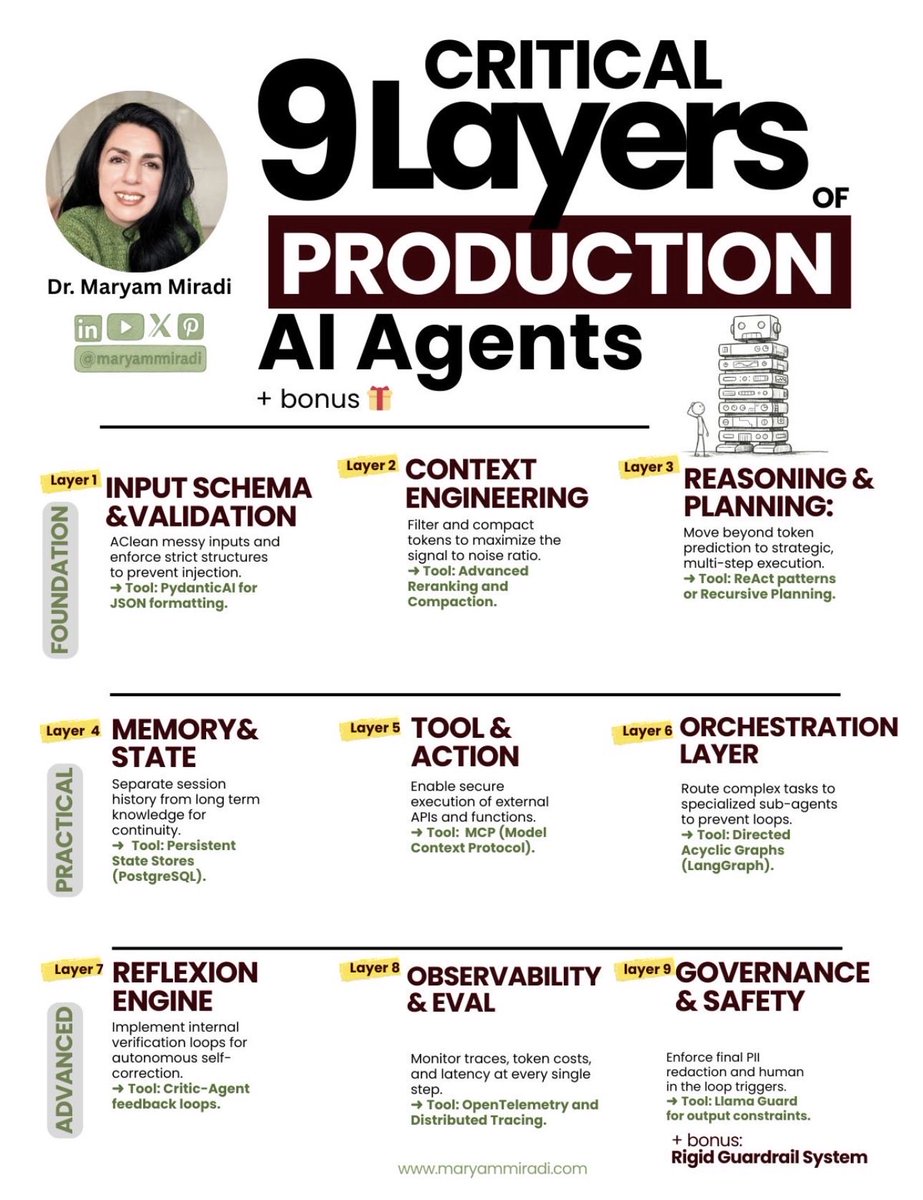
Don’t Build AI Agents with Thin Architecture.
This 9-Layer Stack is Critical for Production AI Agents ⬇
After building 400+ enterprise AI Agents, this is my blueprint:
𝟭. 𝗦𝘁𝗿𝗶𝗰𝘁 𝗜𝗻𝗽𝘂𝘁 𝗦𝗰𝗵𝗲𝗺𝗮𝘀 & 𝗩𝗮𝗹𝗶𝗱𝗮𝘁𝗶𝗼𝗻 𝗟𝗮𝘆𝗲𝗿
➝ Context window is not a raw data dump.
Never let raw user text hit the model directly.
➝ Clean messy inputs and enforces strict schemas to prevent injection.
➝ Use PydanticAI models to force the agent to return data in a strict JSON format.
Pro tip: you need an input classifier
𝟮. 𝗖𝗼𝗻𝘁𝗲𝘅𝘁 𝗘𝗻𝗴𝗶𝗻𝗲𝗲𝗿𝗶𝗻𝗴 𝗟𝗮𝘆𝗲𝗿
Most builders drown the model in tokens.
➝ use layered context and compaction to keep the window lean and relevant.
𝟯. 𝗥𝗲𝗮𝘀𝗼𝗻𝗶𝗻𝗴 & 𝗣𝗹𝗮𝗻𝗻𝗶𝗻𝗴 𝗟𝗮𝘆𝗲𝗿
This is where we move beyond simple completion.
➝ Use one of the 17 existing algorithms
Pro tip: Use recursive planning (langchain) or directed acyclic graphs (langgraph).
𝟰. 𝗠𝗲𝗺𝗼𝗿𝘆 & 𝗦𝘁𝗮𝘁𝗲 𝗟𝗮𝘆𝗲𝗿
Agents must remember to improve themselves.
➝ Separate session memory from long-term knowledge using persistent state stores.
𝟱. 𝗧𝗼𝗼𝗹 & 𝗔𝗰𝘁𝗶𝗼𝗻 𝗟𝗮𝘆𝗲𝗿
An agent without function calling is just a storyteller.
➝ Use typed interfaces and MCP to give the agent secure hands in the real world.
Pro tip: The execution layer must handle API failures, timeouts, and rate limits (e.g. OpenAI, Claude)
𝟲. 𝗢𝗿𝗰𝗵𝗲𝘀𝘁𝗿𝗮𝘁𝗶𝗼𝗻 𝗟𝗮𝘆𝗲𝗿
Don’t assume the Agent would "figure out" the steps.
In the lab, I’ve seen this lead to infinite loops.
➝ Build multi-agent routers to hand off tasks to specialized sub-agents.
Pro tip: Use a directed acyclic graph to define the logic flow (langgraph)
𝟳. 𝗥𝗲𝗳𝗹𝗲𝘅𝗶𝗼𝗻 𝗘𝗻𝗴𝗶𝗻𝗲
True Reliability comes from self-correction.
➝ Build a verification loop where a second process reviews the agent's work.
Pro tip: Check if the logic aligns with the original goal before the task is marked as complete.
𝟴. 𝗢𝗯𝘀𝗲𝗿𝘃𝗮𝗯𝗶𝗹𝗶𝘁𝗶𝘆 & 𝗘𝘃𝗮𝗹 𝗟𝗮𝘆𝗲𝗿
You cannot fix what you cannot see.
➝ Track traces, token costs, and latency at every single step of the chain.
🎥 AI Agent Explainability for Medical Scans: https://t.co/4aGtLTPFGN
𝟵. 𝗚𝗼𝘃𝗲𝗿𝗻𝗮𝗻𝗰𝗲 & 𝗦𝗮𝗳𝗲𝘁𝘆 𝗟𝗮𝘆𝗲𝗿
Do the final check before anything happens.
➝ Implement PII redaction and Human-in-the-loop triggers for high-stakes decisions.
+ 𝗥𝗶𝗴𝗶𝗱 𝗚𝘂𝗮𝗿𝗱𝗿𝗮𝗶𝗹 𝗦𝘆𝘀𝘁𝗲𝗺: If the model’s response doesn't follow your constraints, it never reaches the end user.
--
📥 Skip the trial-and-error of building production AI agents.
Watch my free 30-min training + get 88 pages of production guides.
Join 46,000+ AI engineers, architects, and directors.
👉 https://t.co/t9xyLtyvG1

Control Plane Auditability: Making Every Automated Decision Explainable Later @RialoHQ
A control plane becomes powerful when it can change state.
It can restrict a partner.
It can trigger a playbook.
It can merge conflicting responses.
It can start probation.
It can require re-entry evidence.
It can record a business override.
It can preserve exits while blocking new risk.
But power creates a new obligation:
Every state change must be explainable later.
Not vaguely. Not through memory. Not by asking the person who happened to be online.
A good audit trail should answer:
what happened
why it happened
what evidence existed
who approved it
what changed for users
what remained available
what playbook applied
what re-entry criteria were set
whether the system followed its own rules
Auditability is what turns automation from “black box control” into trustworthy governance.
1) Auditability is not just logging
Logs say:
“An event occurred.”
Auditability says:
“Here is the decision, the reason, the evidence, the authority, the impact, and the path back.”
That difference matters.
A raw log might show:
partner_state_changed: Level 2 → Level 5
Useful, but incomplete.
An audit-ready record says:
“Partner moved from Remediation Required to Exits-Only because parity monitoring detected partner-only allow outcomes on borrow-open under policy epoch 14. Playbook ENF-001 triggered. Safe exits remained available. New-risk actions were blocked. Policy owner and engineering owner approved scope expansion. Re-entry requires parity suite pass, root cause package, and 30-day probation.”
That is governance.
2) The audit record should center on state change
Every meaningful change in the control plane should create a state-change record.
Examples:
partner moves to advisory
partner moves to feature restricted
partner enters exits-only
partner receives throttled posture
partner begins re-entry
partner enters probation
partner exits probation
deprecation date changes
override request is approved or denied
playbook is enabled, disabled, or modified
automated restriction is rolled back
The state change is the unit of accountability.
If the system changes what a partner can do, the audit record should explain why.
3) Minimum fields for every state-change record
A useful audit record should include:
partner
previous state
new state
timestamp
triggering event
failure class
playbook version
restriction level
affected flows
preserved safe actions
user impact summary
evidence snapshot
automatic actions taken
human approvals required
approvers
partner notification status
re-entry criteria
probation rule, if any
rollback path
review date
This sounds like a lot, but most of it can be generated automatically.
The point is not to create paperwork.
The point is to prevent critical decisions from becoming folklore.
4) Capture the evidence snapshot, not just a link
A common audit failure is relying on links to dashboards.
Six months later:
dashboard queries changed
retention expired
metrics were backfilled
thresholds moved
screenshots were lost
the person who knew the context left
So every audit record should include an evidence snapshot.
For example:
metric value at trigger time
threshold breached
sample request IDs
decision diff summary
reason-code mismatch summary
traffic window
posture state
policy epoch
client version
affected action class
support ticket sample references
Do not store more sensitive data than necessary. But store enough to reconstruct the decision.
A link is helpful. A snapshot is durable.
5) Record what remained available
Audit trails often focus only on what was blocked.
That is incomplete.
For trust-governed systems, the audit record should also say what remained available:
repay
close
de-risk
view account
safe withdrawal, where policy allows
status visibility
remediation path
This matters because later reviews will ask:
“Did the restriction trap users?”
A good audit record can answer:
“No. Borrow-open and leverage increase were blocked. Repay, close, reduce exposure, and account visibility remained available. Partner UI was required to show exits-first state.”
This is how the doctrine shows up in audit form.
6) Audit automatic actions separately from human decisions
A self-healing control plane usually does two things:
automatic containment
human-reviewed scope decisions
Keep them separate.
Example:
Automatic action
playbook triggered
affected flow restricted
exits preserved
owner assigned
partner notice drafted
retest created
Human decision
expand restriction to all high-risk flows
approve exits-only mode
approve user-facing message
approve re-entry
approve probation exit
Why separate them?
Because automatic containment should be judged differently from human approval.
If automation acted correctly but a human expanded the scope, the audit trail should show that.
If automation over-triggered and a human rolled it back, the audit trail should show that too.
7) Track playbook version and conflict rule version
This is critical.
A partner restriction may depend on:
a playbook
a detection rule
a response rule
a conflict-resolution rule
a restriction bundle definition
All of these can change over time.
The audit record should include:
playbook ID and version
detection rule version
restriction bundle version
conflict rule version, if multiple playbooks fired
policy version or epoch where relevant
Otherwise, future reviewers will apply today’s logic to yesterday’s decision and misunderstand what happened.
Good auditability preserves the decision context as it existed at the time.
8) Business overrides need special audit treatment
Business overrides are not always wrong.
But they are always sensitive.
If commercial pressure changes a control decision, the audit record should be explicit.
Record:
requested override
requesting party
business rationale
control owner position
risk owner position
affected users or flows
expiration date
compensating controls
approver
re-review date
Never allow a business override to appear as a normal state transition.
It should be visible as a special class of governance decision.
The standard is not “business can never influence decisions.”
The standard is:
Business influence must never be hidden.
9) Audit rejected requests too
Do not record only approvals.
Rejected requests matter.
Examples:
partner requested deprecation extension, denied
partner requested risk-expanding override, denied
support requested manual unlock path, denied
business requested faster re-entry, denied
engineering requested rollback of restriction, denied
Why record denials?
Because they show that governance held.
They also prevent repeated pressure from looking like new requests each time.
A denial record should include:
request
reason for denial
applicable rule
alternative path offered
next review condition
This creates institutional memory.
10) Make re-entry audit-heavy by design
Re-entry is one of the highest-risk governance moments.
The audit record should show:
original failure class
original restriction
remediation package
tests passed
unresolved issues, if any
staged reopening plan
probation duration
relapse triggers
approval chain
partner notification
first review date
Do not let re-entry be summarized as:
“Partner fixed issue, access restored.”
That is not enough.
A good record says:
“Borrow-open reopened at reduced limits after parity suite pass, support script approval, and old-client compatibility check. Partner entered 30-day probation. Relapse trigger set for any partner-only allow or deprecated proof authorization.”
That gives future teams something to inspect.
11) Audit probation decisions explicitly
Probation should end with one of four decisions:
return to normal monitoring
extend probation
keep partial restriction
move back down the ladder
Each decision needs evidence.
Record:
probation window
original failure
monitored metrics
relapse triggers
whether triggers fired
support sample results
parity monitoring results
decision
approver
next review cadence
A silent probation expiration is an audit failure.
Probation is not time passing. It is evidence gathering.
12) Audit rollbacks without hiding mistakes
Sometimes automation will be wrong.
A trigger may false-positive.
A restriction may apply too broadly.
A partner state may be updated from stale data.
A playbook may be too aggressive.
Rollback is healthy if it is honest.
The rollback record should include:
original trigger
action taken
rollback reason
who approved rollback
user impact during activation
partner impact
whether trigger logic changed
whether playbook was paused
whether affected partner notice was updated
Do not delete the original action.
Mark it as rolled back.
Audit trails should show learning, not pretend the system was perfect.
13) Build an audit timeline view
A partner’s governance history should be readable as a timeline.
Example:
Jun 01: partner enters remediation required due to reason-code mismatch
Jun 04: tabletop finding added for posture display gap
Jun 07: partner passes reason-code retest
Jun 09: duplicate refresh spike triggers throttled posture
Jun 09: automatic throttling applied, exits preserved
Jun 10: partner notification sent
Jun 12: retry suppression test passed
Jun 13: staged re-entry approved
Jun 13 to Jun 27: 14-day probation
Jun 20: Day 7 review healthy
Jun 27: probation exited, normal monitoring restored
This lets a reviewer understand the partner’s operational history without reading dozens of disconnected records.
A timeline also reveals patterns:
repeated drift
recurring late migrations
frequent override pressure
fragile re-entry
chronic support mismatch
Auditability is not only for compliance. It is for pattern recognition.
14) Keep audit logs tamper-resistant
If audit records can be edited casually, they lose value.
Use controls:
append-only records where possible
corrections recorded as new entries
role-based edit permissions
required reason for changes
immutable evidence snapshots
approval signatures for high-impact decisions
retention policy
The point is simple:
You should not be able to clean up governance history after the fact.
Mistakes can be corrected.
They should not disappear.
15) Separate sensitive evidence from audit summaries
Audit records need evidence, but they should not become data leakage surfaces.
Use two layers:
Audit summary
Accessible to relevant operations teams.
Contains:
failure class
trigger summary
affected flows
state change
high-level evidence
approvals
re-entry criteria
Sensitive evidence vault
Restricted access.
Contains:
raw request samples
sensitive risk signals
vendor details
user-level evidence
security investigation material
The audit summary should reference sensitive evidence without exposing it broadly.
This keeps governance explainable without widening the privacy surface.
16) Make audits queryable by failure class
The system should answer questions like:
How many posture failures happened this quarter?
Which partners had partner-only allow outcomes?
How often did business overrides occur?
Which playbooks false-positived?
Which partners relapsed during probation?
Which deprecations required extensions?
Which restriction level was used most often?
How often were exits-only states activated?
Which support disclosure issues repeated?
If audit records are not structured, these questions become manual research.
Structured audit data turns history into operational intelligence.
17) Tie audit records to learning loops
Auditability should not be passive.
A good system uses audit history to improve:
playbooks
parity tests
SDK components
partner contracts
support scripts
deprecation planning
tabletop scenarios
restriction thresholds
Example:
If audit records show that three partners failed posture display during incident simulations, that is not three partner issues.
That is likely an SDK or integration design issue.
If audit records show repeated business override requests near hard deprecation dates, that is not just partner resistance.
That is a migration planning issue.
The audit trail should feed the roadmap.
18) Prepare for external review without overexposing internals
Sometimes audit records may need to support:
partner disputes
compliance review
internal risk review
board reporting
legal analysis
incident postmortems
Design the audit system so it can produce scoped reports:
partner-level timeline
incident-level decision record
playbook activation report
re-entry evidence package
override history
deprecation enforcement summary
user-impact summary
Each report should disclose only what is needed.
Auditability is about explainability, not maximal exposure.
19) The audit checklist for any partner restriction
Before a restriction is considered properly recorded, confirm:
trigger captured
evidence snapshot saved
playbook version recorded
restriction bundle recorded
affected flows listed
safe actions preserved
user impact summarized
owner assigned
partner notice status recorded
re-entry criteria defined
rollback path defined
review date set
approver recorded if human approval occurred
If any of these are missing, the restriction may be operationally valid but audit-weak.
That weakness will matter later.
The real standard
A control plane is auditable when a future reviewer can reconstruct the decision without relying on memory.
They should be able to see:
what failed
what rule applied
what the system did automatically
what humans approved
what users could still do
what the partner was told
what evidence was required for re-entry
whether probation succeeded
whether any override changed the outcome
whether the system followed its own governance rules
That is the standard.
Not perfect decisions.
Explainable decisions.
Because in complex partner systems, mistakes will happen.
Restrictions will sometimes be too broad.
Playbooks will need tuning.
Partners will dispute decisions.
Business teams will push for exceptions.
Auditability is what keeps all of that from becoming politics.
It gives the system memory.
And a system with memory can learn.

Playbook Conflict Resolution: What Happens When Multiple Self-Healing Rules Fire at Once? @RialoHQ
A mature control plane will eventually face overlapping failures.
A partner retry storm appears during restricted posture.
A deprecated proof is used in the same flow where support is leaking unsafe language.
A partner-only allow appears while a deprecation migration is already failing.
A posture compliance failure happens during probation.
This is normal.
Real incidents do not respect clean categories.
That is why a self-healing playbook library needs conflict resolution.
Without it, the system becomes chaotic:
two playbooks apply different restriction levels
owners disagree on severity
partner messages conflict
one playbook says “throttle”
another says “exits-only”
support receives two scripts
re-entry criteria become unclear
A self-healing system must know not only how to respond to one failure, but how to combine responses when failures overlap.
1) The first rule: protect invariants before optimizing flow
When playbooks conflict, invariants win.
The highest-priority invariants are:
safe exits remain available
partner-only allow on high-risk actions must stop
deprecated paths cannot authorize new risk after hard enforcement
posture must be respected during incident state
sensitive evidence must not be disclosed
retries must not create duplicate state or pressure loops
These are not equal to ordinary UX or partner convenience issues.
If an invariant fails, the system should prioritize containment even if another playbook suggests a softer response.
Example:
If a retry storm playbook suggests throttling, but the same partner also has partner-only allow on high-risk actions, the response should not stop at throttling.
The higher-priority response is feature restriction or exits-only for affected risk flows.
2) Use precedence tiers
A simple precedence model prevents debate.
Tier 1: Exit invariant failures
Examples:
repay blocked
close hidden
de-risk path unavailable
exits gated by unnecessary refresh
Response:
critical incident
exits-first correction
block conflicting risky flows
partner remains restricted until exit invariant passes
This tier overrides everything.
If users cannot safely reduce exposure, that becomes the first problem.
Tier 2: High-risk enforcement failures
Examples:
partner-only allow on borrow/open
deprecated proof authorizes new risk
issuer-removed proof still accepted
leverage increase succeeds during restricted posture
Response:
block affected high-risk action
consider exits-only
require parity retest
formal re-entry review
This tier takes priority over retry, comms, and remediation issues.
A partner cannot remain open for new risk while enforcement parity is broken.
Tier 3: Posture compliance failures
Examples:
partner UI does not show incident posture
paused actions appear available
partner ignores restricted mode
partner support tells users to retry during posture
Response:
restrict or disable affected new-risk flows
preserve exits
require posture simulation retest
apply probation after re-entry
Posture failures become Tier 2 if they allow high-risk execution.
Tier 4: Retry, refresh, and operational pressure
Examples:
duplicate refresh jobs
retry storms
queue bypass
cooldown violations
traffic spikes during degradation
Response:
throttle noncritical workloads
enforce dedup and rate limits
reduce queue priority
require retry suppression retest
Operational pressure is serious, but it usually does not override direct enforcement failures.
Tier 5: Disclosure and support hygiene
Examples:
unsafe support script
evidence leakage
override implication
unsupported user promises
Response:
restrict support tooling if needed
require script review
ticket sampling
support probation
Disclosure can move up to Tier 2 or Tier 3 if it enables abuse or creates policy bypass pressure.
Tier 6: Remediation and UX mapping failures
Examples:
reason codes collapse into generic errors
stale proof routes to support instead of refresh
cap exceeded routes to appeal
unknown code says “try again”
Response:
freeze rollout of affected flow if high-risk
require reason-code mapping retest
update SDK or UI component
These issues create drift over time. They usually become urgent when combined with another failure.
3) Use the “highest restriction wins” rule, with preservation of safe actions
When multiple playbooks fire, the system should apply the most protective relevant restriction.
But this must be precise.
“Highest restriction wins” does not mean “shut everything down.”
It means:
apply the strongest restriction needed for affected risky flows
preserve safe exits
preserve read-only access where possible
preserve remediation if it is safe and not part of the failure
Example:
A partner has:
retry storm in refresh flow
posture failure in borrow-open
support script issue
Combined response:
block borrow-open through partner
throttle refresh initiation and enforce dedup
preserve repay and close
keep account visibility
require support script update
require posture retest and retry suppression retest
The answer is not “suspend partner.”
The answer is “merge the restrictions by affected surface.”
4) Merge actions by surface area
Conflicting playbooks become easier when you classify by surface.
User action surface
What can users do?
view account
refresh
open new risk
increase risk
repay
close
withdraw
appeal
contact support
System resource surface
What capacity can partner consume?
refresh queue
issuer calls
API calls
appeal review
support escalation
risk evaluation
Information surface
What can partner or support see?
procedural status
reason-code family
raw evidence
hidden risk signals
vendor details
Governance surface
What decisions are allowed?
override requests
deprecation extensions
re-entry approval
probation exit
restriction rollback
Each playbook changes one or more surfaces.
Conflict resolution means merging surface-level changes without contradiction.
5) Example conflict: retry storm + posture failure
Scenario:
issuer is degraded
partner keeps retrying refresh
restricted posture is active
partner UI still shows borrow-open as available
Triggered playbooks:
retry storm
posture compliance failure
Naive response:
engineering throttles refresh
product asks partner to fix UI
partner keeps users clicking borrow-open
Better merged response:
backend blocks borrow-open for partner
refresh requests attach to existing jobs
noncritical refresh traffic is throttled
partner UI must show restricted posture
exits remain visible
posture simulation and retry suppression retest required
partner enters 14-day probation after re-entry
Priority:
Posture failure determines action restriction.
Retry storm determines capacity restriction.
Both apply.
6) Example conflict: disclosure issue + partner-only allow
Scenario:
partner support disclosed sensitive vendor rationale
monitoring detects partner-only allow on a high-risk action
Triggered playbooks:
unsafe disclosure
enforcement parity failure
Naive response:
support team updates scripts
engineering investigates parity
Better merged response:
immediately block affected high-risk action
restrict partner support access to sensitive fields
create critical incident
require parity retest
require support script and dashboard review
re-entry requires both enforcement fix and disclosure fix
probation length follows the higher severity, likely 30 days
Priority:
Partner-only allow is the top operational risk.
Disclosure control must also be contained because it may enable repeated abuse.
Both must be fixed before re-entry.
7) Example conflict: deprecation failure + business override request
Scenario:
hard date passed
partner still sends deprecated proofs for borrow-open
partner asks for a commercial extension
Triggered playbooks:
deprecated proof used for new risk
override pressure breach
Correct response:
deprecated proofs cannot authorize new risk
exits-only compatibility may remain if safe
business extension request is logged, not silently granted
any timeline change requires formal approval and compensating controls
partner must provide migration evidence
re-entry requires deprecation readiness test
Priority:
Hard-date enforcement wins over commercial pressure.
The partner may receive support.
They do not receive a private trust model.
8) Example conflict: probation relapse + active migration
Scenario:
partner is in probation after retry storm
during migration, legacy proof usage spikes
retry rate also rises again
Triggered playbooks:
probation relapse
deprecation failure
retry storm
Correct response:
move partner back down the restriction ladder
block legacy proof authorization for new risk
throttle refresh or migration-related retries
extend or reset probation after remediation
require both migration and retry tests before re-entry
Priority:
Probation makes thresholds stricter.
During probation, recurrence should not be treated as a fresh minor issue. It is evidence that re-entry was premature or the fix was incomplete.
The matrix does not need to cover every possible combination at first.
Start with the dangerous overlaps:
enforcement + posture
enforcement + deprecation
posture + retry
disclosure + appeal
retry + issuer degradation
probation + any repeat failure
business override + any invariant failure
10) Avoid contradictory partner notices
Multiple playbooks can generate multiple partner messages.
That is risky.
A partner should not receive:
“please fix retry behavior”
“your borrow flow is restricted”
“support scripts need review”
“you are entering probation”
as four disconnected messages.
The control plane should merge notices into one coherent partner update.
A good merged notice includes:
primary failure
secondary failures
current restriction state
allowed safe actions
required fixes
required tests
review timeline
re-entry criteria
Example:
“Your integration is currently restricted for high-risk borrow actions due to enforcement parity mismatch. We also detected elevated duplicate refresh attempts during the same window. Repay, close, and account visibility remain available. Re-entry requires the borrow parity suite and retry suppression test to pass, followed by a 30-day probation window.”
One message. Clear hierarchy.
11) Merge re-entry requirements, do not average them
When multiple playbooks fire, re-entry should require all relevant critical fixes.
Do not average severity.
If one issue requires:
parity test
30-day probation
and another requires:
support script review
14-day probation
the merged re-entry plan should require:
parity test
support script review
any other affected retests
probation length based on highest severity
Re-entry should not be easier because there were more issues.
It should be clearer.
12) Define human escalation points
Conflict resolution can be automated up to a point.
But certain combinations should trigger human review.
Automatic escalation should occur when:
Tier 1 failure appears
two or more Tier 2 failures appear
commercial override request conflicts with enforcement rule
partner is already in probation and relapse occurs
user impact exceeds threshold
partner suspension is being considered
public communication may be required
The control plane should still perform safe containment first.
Human review should decide broader scope, not delay initial protection.
13) Use severity escalation for repeated low-tier conflicts
Two low-tier failures can become high-risk together.
Example:
reason-code collapse
support escalation spike
override pressure breach
Individually, each may look manageable.
Together, they show a pattern:
users are confused, support is escalating, and partner pressure is increasing.
That is not just UX friction. That is drift forming.
Conflict rule:
Repeated or correlated Tier 5 and Tier 6 issues should escalate to remediation required or feature restriction if they affect high-risk actions.
The system should detect patterns, not only isolated failures.
14) Preserve audit clarity
When multiple playbooks fire, audit logs can become messy.
The control plane should record:
all triggered playbooks
primary playbook
secondary playbooks
precedence rule applied
combined restriction state
affected flows
safe actions preserved
merged re-entry criteria
approvers if escalation occurred
partner notice sent
rollback logic
This matters because later, people will ask:
“Why did we move this partner to exits-only?”
The answer should not be “a bunch of alerts fired.”
It should be:
“Partner-only allow on borrow-open was the primary Tier 2 trigger, combined with deprecated proof usage after hard date. Precedence rule E2 applied. Exits-only was activated for high-risk flows while repay and close remained available.”
That is governance.
15) Keep conflict rules simple enough to operate
Do not design a legalistic maze.
The best conflict system has a few memorable rules:
Exit failures override everything.
High-risk partner-only allow stops new risk immediately.
Hard deprecation dates cannot be softened privately.
Posture failures block affected paused actions.
Retry storms restrict capacity, not exits.
Disclosure failures restrict information access.
Probation relapse escalates faster.
Highest severity determines re-entry burden.
Safe actions stay available wherever possible.
Every merge must produce one partner state and one notice.
That is enough to start.
Complexity can grow later, but the first version should be usable under pressure.
The real standard
A playbook library is mature when overlapping failures do not create overlapping chaos.
When multiple playbooks fire, the system should know:
which failure is primary
which restrictions merge
which actions remain safe
which owners are assigned
which notice goes out
which tests are required
which probation rule applies
which audit trail explains the decision
That is the difference between automation and governance.
Automation fires rules.
Governance resolves rules into coherent action.
A self-healing control plane needs both.
Because real incidents are messy.
And the whole point of the system is to stay disciplined when the mess arrives.


Day 12 of exploring community-built dApps on @ritualnet .
Today I tested Ritual Oracle, built by @tutubearrr
🔗 Try it yourself:
https://t.co/W4YGoSunMs
According to the community directory, Ritual Oracle is designed as an On-Chain AI Signal Bot, providing crypto market signals powered by AI inference on Ritual.
This is exactly the type of application I expect to see in the Ritual ecosystem.
Instead of simply displaying blockchain data, the project attempts to transform information into insights.
And that's where things get interesting.
Most users don't want more charts.
They want better decisions.
What I liked:
🔮 Strong AI-native concept
🔮 Clear alignment with Ritual's vision
🔮 Useful use case for traders and researchers
🔮 Easy to understand value proposition
🔮 Good foundation for AI-powered market intelligence
🔮 One of the projects with potential utility beyond the Ritual community
The idea of combining AI inference with market analysis is compelling because it moves beyond raw data and into interpretation.
However, after exploring the project, I also identified several opportunities for improvement.
Current limitations:
⚠️ Signal explanations could be more transparent
⚠️ Users may not understand why a signal was generated
⚠️ Historical signal performance is difficult to evaluate
⚠️ Limited educational guidance for new users
⚠️ No confidence scoring system
⚠️ Missing portfolio-level insights
⚠️ Limited community feedback mechanisms
Features I'd love to see:
✨ AI confidence ratings for each signal
✨ Historical accuracy tracking
✨ Bullish/Bearish sentiment breakdowns
✨ Narrative analysis for market trends
✨ Personalized watchlists
✨ Risk assessment metrics
✨ Community prediction comparisons
✨ AI-generated market summaries
The biggest opportunity is explainability.
Many AI tools tell users what to do.
The best AI tools explain why.
Imagine receiving a signal that says:
"ETH sentiment is improving due to increasing social discussion and positive market structure."
Or:
"Confidence: 78% based on similar historical conditions."
That would immediately make the platform more trustworthy and useful.
Another feature I'd love to see is a personal AI analyst.
Instead of generic signals, the Oracle could learn what assets you follow and generate custom insights based on your interests.
Overall:
Concept: 9/10
Innovation: 8.5/10
Current User Experience: 7.5/10
Practical Utility: 8/10
Future Potential: 9.5/10
Huge respect to @tutubearrr for building a project that embraces one of Ritual's most exciting opportunities:
Using AI not just to process information, but to help people make sense of it.
The foundation is there.
Now the next step is improving transparency, accuracy tracking, and personalization.
If you're exploring community-built projects on Ritual, give it a try:
🔗 https://t.co/W4YGoSunMs
@ritualfnd

Day 11 of exploring community-built dApps on @ritualnet .
Today I tested Ritual Encrypted Research, built by @Cripson01
🔗 Try it yourself:
https://t.co/KXr4I2wK9A
This is one of the most ambitious projects I've explored in the Ritual ecosystem so far.
While many community dApps focus on gaming, engagement, or analytics, Ritual Encrypted Research tackles a much bigger challenge:
How can researchers collaborate with sensitive information without sacrificing privacy?
The concept immediately caught my attention because privacy and AI are becoming increasingly connected.
As AI systems consume more data, protecting research, intellectual property, and confidential information becomes more important than ever.
That's where this project feels particularly relevant.
What I liked:
🔐 Clear focus on privacy-first research
🔐 Strong alignment with Ritual's AI vision
🔐 Addresses a real problem rather than creating engagement for engagement's sake
🔐 Potential use cases extend beyond crypto
🔐 Creates a foundation for secure collaboration
🔐 One of the more serious and practical applications in the ecosystem
What stood out most was the idea itself.
Many builders create tools for existing users.
This project has the potential to attract entirely new audiences such as researchers, AI developers, analysts, and academic communities.
However, after exploring the platform, I also identified several opportunities for improvement.
Current limitations:
⚠️ The onboarding process could explain the use case more clearly
⚠️ New users may not immediately understand the value proposition
⚠️ Limited visualization of how encryption and privacy protections work
⚠️ Collaboration workflows could be easier to discover
⚠️ Missing trust indicators that help users understand data security
⚠️ User retention mechanisms are still limited
⚠️ Advanced users may want deeper controls and permissions management
Features I'd love to see:
✨ AI-generated research summaries
✨ Permission-based collaboration layers
✨ Team workspaces
✨ Research contribution tracking
✨ Version history and audit trails
✨ Encrypted knowledge repositories
✨ Reputation systems for contributors
✨ AI-powered discovery of related research topics
The biggest opportunity lies in combining encryption with intelligence.
Imagine uploading research data and receiving:
"Three related studies were found."
"Potential contradictions detected."
"Emerging research trends identified."
All while preserving privacy.
That would be incredibly powerful.
In my opinion, the future of AI isn't just smarter models.
It's smarter models working with protected information.
And that's exactly where projects like this could shine.
Overall:
Concept: 9.5/10
Innovation: 9/10
Current User Experience: 7/10
Accessibility: 7/10
Future Potential: 10/10
Huge respect to @Cripson01 for building one of the most intellectually interesting projects I've encountered during this Ritual ecosystem exploration.
Most applications focus on engagement.
This one focuses on knowledge.
And knowledge may become one of the most valuable assets in the AI era.
If you're exploring community-built projects on Ritual, give it a try:
🔗 https://t.co/KXr4I2wK9A
@ritualfnd

@R0se2o77 explainability is the real upgrade here
Don’t Build AI Agents with Thin Architecture.
This 9-Layer Stack is Critical for Production AI Agents ⬇
After building 400+ enterprise AI Agents, this is my blueprint:
𝟭. 𝗦𝘁𝗿𝗶𝗰𝘁 𝗜𝗻𝗽𝘂𝘁 𝗦𝗰𝗵𝗲𝗺𝗮𝘀 & 𝗩𝗮𝗹𝗶𝗱𝗮𝘁𝗶𝗼𝗻 𝗟𝗮𝘆𝗲𝗿
➝ Context window is not a raw data dump.
Never let raw user text hit the model directly.
➝ Clean messy inputs and enforces strict schemas to prevent injection.
➝ Use PydanticAI models to force the agent to return data in a strict JSON format.
Pro tip: you need an input classifier
𝟮. 𝗖𝗼𝗻𝘁𝗲𝘅𝘁 𝗘𝗻𝗴𝗶𝗻𝗲𝗲𝗿𝗶𝗻𝗴 𝗟𝗮𝘆𝗲𝗿
Most builders drown the model in tokens.
➝ use layered context and compaction to keep the window lean and relevant.
𝟯. 𝗥𝗲𝗮𝘀𝗼𝗻𝗶𝗻𝗴 & 𝗣𝗹𝗮𝗻𝗻𝗶𝗻𝗴 𝗟𝗮𝘆𝗲𝗿
This is where we move beyond simple completion.
🎥Use one of these 17 algorithms in Building Production AI Agents: https://t.co/ZjQ26De2mI
Pro tip: Use recursive planning (langchain) or directed acyclic graphs (langgraph).
𝟰. 𝗠𝗲𝗺𝗼𝗿𝘆 & 𝗦𝘁𝗮𝘁𝗲 𝗟𝗮𝘆𝗲𝗿
Agents must remember to improve themselves.
➝ Separate session memory from long-term knowledge using persistent state stores.
𝟱. 𝗧𝗼𝗼𝗹 & 𝗔𝗰𝘁𝗶𝗼𝗻 𝗟𝗮𝘆𝗲𝗿
An agent without function calling is just a storyteller.
➝ Use typed interfaces and MCP to give the agent secure hands in the real world.
Pro tip: The execution layer must handle API failures, timeouts, and rate limits (e.g. OpenAI, Claude)
𝟲. 𝗢𝗿𝗰𝗵𝗲𝘀𝘁𝗿𝗮𝘁𝗶𝗼𝗻 𝗟𝗮𝘆𝗲𝗿
Don’t assume the Agent would "figure out" the steps.
In the lab, I’ve seen this lead to infinite loops.
➝ Build multi-agent routers to hand off tasks to specialized sub-agents.
Pro tip: Use a directed acyclic graph to define the logic flow (langgraph)
𝟳. 𝗥𝗲𝗳𝗹𝗲𝘅𝗶𝗼𝗻 𝗘𝗻𝗴𝗶𝗻𝗲
True Reliability comes from self-correction.
➝ Build a verification loop where a second process reviews the agent's work.
Pro tip: Check if the logic aligns with the original goal before the task is marked as complete.
𝟴. 𝗢𝗯𝘀𝗲𝗿𝘃𝗮𝗯𝗶𝗹𝗶𝘁𝗶𝘆 & 𝗘𝘃𝗮𝗹 𝗟𝗮𝘆𝗲𝗿
You cannot fix what you cannot see.
➝ Track traces, token costs, and latency at every single step of the chain.
🎥 AI Agent Explainability for Medical Scans:
https://t.co/J9s8oTvKP8
𝟵. 𝗚𝗼𝘃𝗲𝗿𝗻𝗮𝗻𝗰𝗲 & 𝗦𝗮𝗳𝗲𝘁𝘆 𝗟𝗮𝘆𝗲𝗿
Do the final check before anything happens.
➝ Implement PII redaction and Human-in-the-loop triggers for high-stakes decisions.
+ 𝗥𝗶𝗴𝗶𝗱 𝗚𝘂𝗮𝗿𝗱𝗿𝗮𝗶𝗹 𝗦𝘆𝘀𝘁𝗲𝗺: If the model’s response doesn't follow your constraints, it never reaches the end user.
--
📥 Skip the trial-and-error of building production AI agents.
Watch my free 30-min training + get 88 pages of production guides.
Join 46,000+ AI engineers, architects, and directors.
👉 https://t.co/t9xyLtyvG1


I’ve seen simple models beat complex ensembles when explainability, deployment, and business impact matter.
The best model isn’t the most powerful—it’s the most useful. 🚀
#NaijaDataProfessor #DataScience #MachineLearning

AEO changes content incentives dramatically.
Explainability now matters more than volume.
That’s a major shift.
Last Seen Hashtags on Sotwe
Trends for you
Most Popular Users

Elon Musk 
@elonmusk
240.1M followers

Barack Obama
@barackobama
118.6M followers

Cristiano Ronaldo
@cristiano
114.4M followers

Donald J. Trump
@realdonaldtrump
111.7M followers

Narendra Modi
@narendramodi
106.9M followers

Rihanna
@rihanna
98.6M followers

NASA
@nasa
92.1M followers

Justin Bieber
@justinbieber
91.7M followers

KATY PERRY
@katyperry
89.9M followers

Taylor Swift
@taylorswift13
83.9M followers

Lady Gaga
@ladygaga
75.4M followers

Virat Kohli
@imvkohli
73.3M followers

Kim Kardashian
@kimkardashian
70.8M followers

YouTube
@youtube
68.6M followers

Neymar Jr
@neymarjr
66.3M followers

Bill Gates
@billgates
65.2M followers

Selena Gomez
@selenagomez
63M followers

The Ellen Show
@theellenshow
62.1M followers

CNN
@cnn
61.7M followers

X
@x
60.6M followers