

Top Tweets for #explainableAI

Grad-CAM struggling with object detection? 💡
EigenCAM extracts principal components from convolutional activations—no target class selection needed.
Full Tutorial: https://t.co/nlMeKQ17Bj
Join CV Community: https://t.co/Evn9fMn3zZ
#ExplainableAI #PyTorch


Graph neural network based hierarchy-aware embeddings of knowledge graphs: Applications to yeast phenotype prediction
1. Kronström et al. introduce Hierarchy-aware GNNs: a framework that couples GNN message passing on heterogeneous KGs with box embeddings constrained by ontology class hierarchies via a semantic loss, so learned representations better respect domain semantics.
2. Key idea: treat each GNN layer’s node output as latent variables that parameterise axis-aligned boxes; then enforce ontology constraints (e.g., subClassOf as geometric containment, and optional disjointness as non-overlap) using semantic losses during end-to-end training.
3. The KG is built for Saccharomyces cerevisiae by integrating curated resources (SGD, GO, APO, ChEBI, INO, MI, RO, BioCyc) and rewriting ABox facts into a TBox-style form, enabling a uniform representation of individuals/classes and relations as axioms usable for both GNN computation and semantic constraints.
4. The model targets quantitative phenotype prediction: predicting fitness (cell growth) for double gene deletions (digenic knockouts) as an edge-level regression problem over gene nodes, trained on 10,085,183 gene-pair measurements (standard condition 30°C), with careful removal of overlapping interaction edges from the KG to avoid leakage.
5. Architecture details: a heterogeneous GraphSAGE-style GNN (relation-specific modules per source-edge-target type) produces gene embeddings; deleted gene pairs are combined with a symmetric operator (best: element-wise product) and passed to an MLP regressor. Domains are embedded separately (8 ontology-aligned domains) to improve stability and efficiency.
6. Main performance result (10-fold CV, split by genes to prevent overlap between train/validation genes): a task-only GNN reaches mean R2=0.348; adding subClassOf links directly to the KG yields R2=0.350; using pretrained box embeddings as priors improves to R2=0.360; adding semantic loss improves further to R2=0.368 (overlap loss) and best R2=0.377 (distance-based loss).
7. Baselines: LightGBM on sparse phenotype instantiations achieves R2=0.211; LightGBM on a 64-dim ComplEx KG embedding achieves R2=0.191. This supports the claim that end-to-end heterogeneous GNN embeddings, especially with hierarchy-aware constraints, extract more predictive signal from the KG than these feature/embedding baselines.
8. Generalisation test: models trained on digenic deletions are evaluated on trigenic deletion fitness (15,095 triples). Using a 3-way element-wise product, performance reaches R2=0.380 with box priors, and R2=0.415 with distance-based semantic loss, indicating transfer beyond the original pairwise setting.
9. Interpretability-to-experiment loop: using gradient-based attribution over KG-linked traits, they score co-occurring relations important for predictions, generating hypotheses about interacting phenotypes. A selected, lab-feasible hypothesis linked inositol utilisation with NaCl (osmotic) stress resistance; an automated-lab perturbation experiment found a significant interaction, with inositol supplementation rescuing growth under salt stress.
10. Additional contributions: (i) shows how to learn low-dimensional GNN-driven box embeddings without a prediction task (pure semantic training), comparing distance vs overlap losses and visualising 2D molecular-function embeddings; (ii) explores using embedding changes under proposed edge additions as a way to rank KG revisions, finding some relation types show distinguishable rank distributions versus random edges, though effects can be small and variable.
📜Paper: https://t.co/SzDrahlftO
#KnowledgeGraphs #GraphNeuralNetworks #Ontology #RepresentationLearning #BoxEmbeddings #ComputationalBiology #SystemsBiology #Yeast #PhenotypePrediction #ExplainableAI


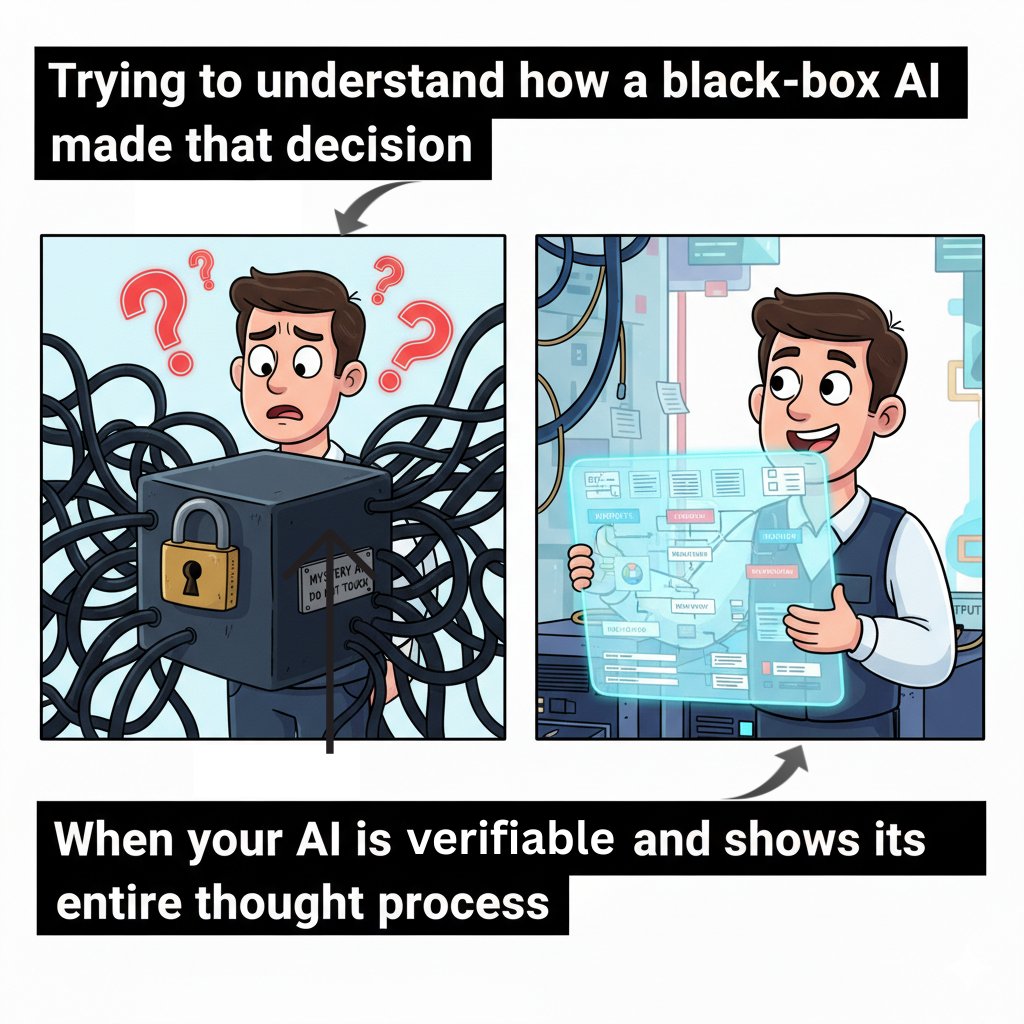
Finally, an AI that doesn't make me feel like I'm solving a Rubik's Cube blindfolded! #VerifiableAI #ExplainableAI

I’m building explainable AI infrastructure for crypto & on-chain funds not another black-box “AI bot
https://t.co/OMpN8IIunb
What we’re shipping
• Transparent AI lenses (narrative, flows, TA, macro)
• On-chain execution that can be audited
• Clear thesis → decision → execution trail
Why this matters:
Most AI tools give signals.
We show why the signal exists reducing blind risk and improving trust.
This is an early but real step toward glass-box AI fund agents.
@TryNoahAI
@Plena
#AI #CryptoAI #DeFi #BuildInPublic #ExplainableAI

Explainability methods from machine learning detect important drugs' atoms in drug-target interactions
1. A new study explores the use of explainable artificial intelligence (XAI) methods to identify crucial atoms in drug-target interactions using graph neural networks (GNNs). The research benchmarks four XAI attribution methods on GNN models trained for kinase and GPCR targets, revealing insights into the interpretability of these models.
2. The study finds that while consistency across different XAI methods is modest, consensus attributions highlight atoms directly contacting the binding pocket with high enrichment—up to 76% within 2Å in kinase-inhibitor complexes. This suggests that despite disagreements, XAI methods can pinpoint chemically meaningful ligand features.
3. Researchers used two benchmark datasets: KIBA for kinase inhibitors and GLASS for GPCR ligands. The GIN-based GNN model outperformed other architectures across both datasets, achieving an MSE of 0.1741 on KIBA and 0.4766 on GLASS with random splitting, demonstrating robust performance.
4. The study introduces a novel framework for evaluating the consistency and biological plausibility of GNN explanations in drug-target interactions. It employs intersection-over-union (IoU) to quantify explanation agreement and validates biological relevance by mapping attributed atoms to known binding site residues in 3D protein-ligand structures.
5. Cross-dataset fine-tuning experiments showed that models fine-tuned on different datasets underperformed the original task-specific models, highlighting the challenges in generalizing across diverse protein families. This finding underscores the need for protein family-specific models for accurate predictions.
📜Paper: https://t.co/Oof6Ht2Hz5
#MachineLearning #DrugDiscovery #GraphNeuralNetworks #ExplainableAI #GPCR #KinaseInhibitors


Every decision on BToken is backed by a logical fingerprint.
A future where no AI output is uncertain — only verified.
🔗 https://t.co/Dicit2AweF
#BToken #AI #Blockchain #ExplainableAI #Web3


@VivienMahe Yes i have made an initial version of it which basically uses ExplainableAI to provide reasons to biases in sentences and apart from that i’m using FastAPI, AssemblyAI for audio to text and Mongo for storing results. I can see months of work ahead of me right now !

3/ It offers transparent context flow, making the AI's reasoning trackable and easier to debug. Plus, it's modular—plug in any agent, model, or tool you need. #OpenSourceAI #ExplainableAI

Discover how AI-Powered Diagnostics improve accuracy, cut errors, and transform healthcare with diagnostic AI and automation. https://t.co/zwHWYzCA2x
#AIinHealthcare #EthicalAI #ClinicalAI #HumanCenteredAI #ExplainableAI #AITraining #DiagnosticInnovation #FutureOfHealthTech

🚀 Specialized Data = Smarter AI
The era of one-size-fits-all AI is fading. The future lies in specialized AI models powered by domain-specific, high-quality datasets.
Here’s why specialized data is a game-changer:
🔹 Accuracy that Matters – AI trained on precise data delivers context-aware, bias-free results.
🔹 Trust & Transparency – Specialized data makes AI models easier to interpret and explain.
🔹 Efficiency at Scale – Optimized training saves energy, time, and costs.
🔹 A Sustainable Data Economy – Decentralized contributions fuel continuous innovation.
These specialized datasets are the foundation for AI models that are transparent, verifiable, and built to solve real-world problems.
The shift has already begun. Are you ready for specialized AI?
#AI #SpecializedData #FutureOfAI #DataInnovation #ExplainableAI

🔑 The Power of Specialized Data in AI in @VeloraDEX
General-purpose AI models are impressive, but the future belongs to specialized models built on domain-specific data. Why? Because specialized data transforms how AI learns, interprets, and operates.
✨ Precision First – Targeted datasets reduce bias and deliver higher accuracy.
✨ Clarity & Trust – Explainable insights make AI outputs more reliable.
✨ Efficiency – Optimized data reduces overhead, saving time and cost.
✨ Sustainability – Community-driven contributions create a decentralized, thriving AI data economy.
With specialized data as the backbone, we can fine-tune models that are not just smarter, but also transparent, verifiable, and explainable empowering the next wave of specialized AI agents.
#AI #DataDriven #SpecializedAI #ExplainableAI #FutureOfAI #DataEconomy

🌐 Why Specialized Data Matters in AI
As AI continues to evolve, the demand is shifting from broad general-purpose models to specialized AI systems that excel in specific domains. The foundation of these systems is specialized, high-quality data.
🔹 High Model Accuracy
Domain-specific datasets minimize bias and sharpen precision, enabling AI to make smarter, context-aware decisions.
🔹 Explainability & Interpretability
Specialized data ensures that AI outputs are transparent and relevant, making insights more trustworthy.
🔹 Cost-Effectiveness
With optimized, high-fidelity data, models run more efficiently reducing computational costs and resource strain.
🔹 Sustainability
Specialized data collection fosters decentralized participation, creating a self-sustaining AI economy where contributors and users benefit.
👉 The result? Fine-tuned models that are specialized, transparent, verifiable, and explainable forming the intelligent core of next-generation specialized agents.
#AI #SpecializedData #MachineLearning #AIModels #ExplainableAI #DataEconomy


AI powers 38% of cybersecurity tools and 70%+ of enterprise workflows, but relying on opaque black-box systems is a risk we can't ignore.
We need explainable AI, open audits, and clear decision-making processes to ensure security and trust. Who's leading the charge for #AITransparency in cybersecurity?
@kaspersky
@cybersecmeg
@CrowdStrike
@DarkReading
@schneierblog
#Cybersecurity #ExplainableAI #TechEthics #AIAccountability

AI today is powerful—but often opaque.
It outputs results without showing the path it took.
@TheoriqAI changes this by making reasoning a shared, onchain resource—transparent, modular, and reusable.
At its heart are Theory Primitives—foundational cognitive blocks like contradiction, consensus, revision, and persistent memory.
They let agents:
– Map their reasoning
– Update beliefs as evidence changes
– Detect and resolve logical conflicts
– Collaborate across networks with shared memory
– Prove their conclusions
This transforms AI from isolated black boxes into interoperable reasoning agents.
In governance, it means every decision has an auditable logic trail.
In research, it means every hypothesis is testable and evolvable.
In learning, it means AI tutors that can explain their thought process.
In multi-agent systems, it means collaboration that scales with trust.
Theoriq doesn’t aim to be the smartest model—it’s the best collaborator.
It gives intelligence the structure to grow collectively.
Think of it as Git for reasoning:
– Fork ideas
– Merge perspectives
– Track the evolution of thought
Because in the age of autonomous agents, intelligence alone isn’t enough.
We need reasoning we can see, verify, and build on.
@TheoriqAI is creating the protocol for that future.
#kaito #Theoriq #ModularReasoning #OnchainAI #ExplainableAI #AgentOS #LogicInfrastructure


Almanak is changing the game with fully auditable, explainable AI strategies. No black boxes here! 🛠️ #ExplainableAI #bb27 #ドラマ40までに #srchafreen #PerthSanta #RevengedLoveEP20 #BBNaija #BBNaijaS10
Most AI answers sound confident.
Few can prove they’re right.
@TheoriqAI is building the layer where every conclusion comes with a reasoning trail you can inspect, share, and improve.
Its core is made of Theory Primitives—modular logic units like contradiction detection, belief revision, consensus building, and persistent memory.
With these, agents can:
– Explain why they think something
– Show the steps they took to decide
– Revise their stance with new evidence
– Store and share reasoning onchain
– Collaborate on decisions without losing traceability
This transforms AI from a “black box” into an open reasoning network.
For governance, that means auditable votes with transparent logic.
For research, it means experiments where every assumption is recorded.
For learning, it means tutors that show how they know.
For agent ecosystems, it means decisions that can be replayed and improved.
Theoriq doesn’t compete with LLMs—it complements them.
It gives intelligence structure.
Just like Git revolutionized code collaboration, Theoriq enables reasoning collaboration—forkable, mergeable, and verifiable.
Because in an era where agents will act on our behalf, trust isn’t optional.
It’s built on logic we can see.
@TheoriqAI is making that logic public.
#kaito #Theoriq #ExplainableAI #OnchainReasoning #ModularAI

AI can generate.
But can it explain, revise, or align?
@TheoriqAI says it should—so it builds the protocol to make it real.
Rather than scaling models, Theoriq scales structured reasoning.
It does this through a system of Theory Primitives—logic-based units like contradiction, agreement, revision, memory, and consensus.
These aren’t outputs.
They’re cognitive tools—modular, auditable, and forkable.
With them, Theoriq enables agents to:
– Debate and converge logically
– Store reasoning histories
– Share memory across networks
– Justify claims with structured proof
– Update beliefs in real-time
It’s the difference between guesswork and thought you can verify.
As AI becomes increasingly agentic, we don’t need more data—we need better thinking infrastructure.
That’s what Theoriq is:
A base layer where cognition is collaborative.
A protocol where ideas evolve like code.
A system where agents build trust through transparent reasoning, not just performance.
From DAO governance to DeSci research, from autonomous tutors to multi-agent simulations—anywhere intelligence must align, Theoriq becomes the logic substrate for meaningful cooperation.
We’re entering the era of reasoning networks, not just neural nets.
And @TheoriqAI is building the bridge.
Because intelligence without structure leads to noise.
Theoriq turns it into symphony.
#kaito #Theoriq #ModularReasoning #ExplainableAI #CognitiveProtocol #AgentCoordination #OnchainLogic #AIInfrastructure

Most agents today are like isolated thinkers.
They react, but don’t reason together.
@TheoriqAI changes that.
It introduces a shared reasoning infrastructure—where agents don’t just generate answers, but co-develop logic, memory, and structured thought.
At its core is a system of Theory Primitives—modular components like contradiction, revision, consensus, and memory. These form the building blocks of cognition that can be combined, forked, and audited.
With Theoriq, agents can:
– Justify every output
– Track belief changes over time
– Detect logical conflict
– Collaborate through structured logic graphs
– Store long-term memory onchain
This makes reasoning verifiable, reusable, and composable—across teams, agents, and protocols.
Want governance with explainable decisions?
Education that grows from feedback loops?
Research where hypotheses evolve and debate is trackable?
Theoriq makes that possible—not through monolithic AI, but through composable logic infrastructure that any agent can plug into.
And it’s already live—powering pilots in modular AI labs, collective research groups, and open agent coordination experiments.
This is AI that doesn’t hide behind output.
It reveals why it thinks, how it updates, and where reasoning can improve.
Because in a world of rapid agent deployment, we don’t just need smarter AI.
We need thinking systems we can build on—together.
@TheoriqAI is the protocol for that.
#kaito #Theoriq #ModularAI #OnchainReasoning #ExplainableAI #AgentOS #LogicLayer #CognitiveInfrastructure

If AI is the new compute, then reasoning is the new consensus.
And @TheoriqAI is building the reasoning layer—onchain.
Most agents today operate in isolation: stateless, unverifiable, and ephemeral.
Theoriq flips that model.
It treats cognition as a persistent, modular process—made of composable logic units: contradiction, revision, agreement, and memory. These “Theory Primitives” allow agents to reason in public, with history.
Every conclusion, belief, and change of mind is linked to a traceable logic graph.
Each claim is versioned like code.
Each debate is recordable and forkable.
Each memory evolves transparently—onchain.
This transforms AI from a black-box oracle into a collaborative thinking system.
With Theoriq:
– DAOs can reason through proposals, not just vote
– DeSci labs can test models that explain themselves
– Builders can compose AI logic the same way they compose smart contracts
– Agents can align and diverge—with proof
Theoriq isn’t a chatbot. It’s logic coordination for agent ecosystems.
And in a world where AI scales faster than trust, we need logic we can see, verify, and improve together.
@TheoriqAI is turning cognition into public infrastructure.
Because intelligence alone isn’t enough.
We need reasoning we can trust.
#kaito #Theoriq #OnchainReasoning #AgentCoordination #ModularAI #ExplainableAI

Last Seen Hashtags on Sotwe
Most Popular Users

Elon Musk 
@elonmusk
240.1M followers

Barack Obama
@barackobama
118.6M followers

Cristiano Ronaldo
@cristiano
114.4M followers

Donald J. Trump
@realdonaldtrump
111.7M followers

Narendra Modi
@narendramodi
106.9M followers

Rihanna
@rihanna
98.6M followers

NASA
@nasa
92.1M followers

Justin Bieber
@justinbieber
91.7M followers

KATY PERRY
@katyperry
89.9M followers

Taylor Swift
@taylorswift13
83.9M followers

Lady Gaga
@ladygaga
75.4M followers

Virat Kohli
@imvkohli
73.3M followers

Kim Kardashian
@kimkardashian
70.8M followers

YouTube
@youtube
68.6M followers

Neymar Jr
@neymarjr
66.3M followers

Bill Gates
@billgates
65.2M followers

Selena Gomez
@selenagomez
63M followers

The Ellen Show
@theellenshow
62.1M followers

CNN
@cnn
61.7M followers

X
@x
60.6M followers