

Top Tweets for #fcuk3d

@DKJATT898 @iraqiamerican11 @PiruzMollazadeh وعليكم السلام أخي @DKJATT898
💡First DEFINE Ummah, ie Nation
⚠️What Nation are iYuri speaking off ?
🎯The Ummah has been HiJ #fcuk3D and
SOLD to the Highest St iJ0GE 🤡
https://t.co/MwrJTdoH10
@surevesuimitpes
@Uziiiie
@nunya969696
@firstmuslim
#AG3ND421
#fcuk3ry
💡QR963: Krypto 4 SH33PAi 🐑s
Krypto Tech is the digitization and Encryption of Assets Tokens
👉Ledger: Block-Chain
👉Network: Decentralized
👉Timestamp: Unix Epoch
BTC: Open Source
Domain: PUBLIC
CBDC: Proprietary Source
Domain: PRIVATE
Example: XRP, IJ0GE
#613solar
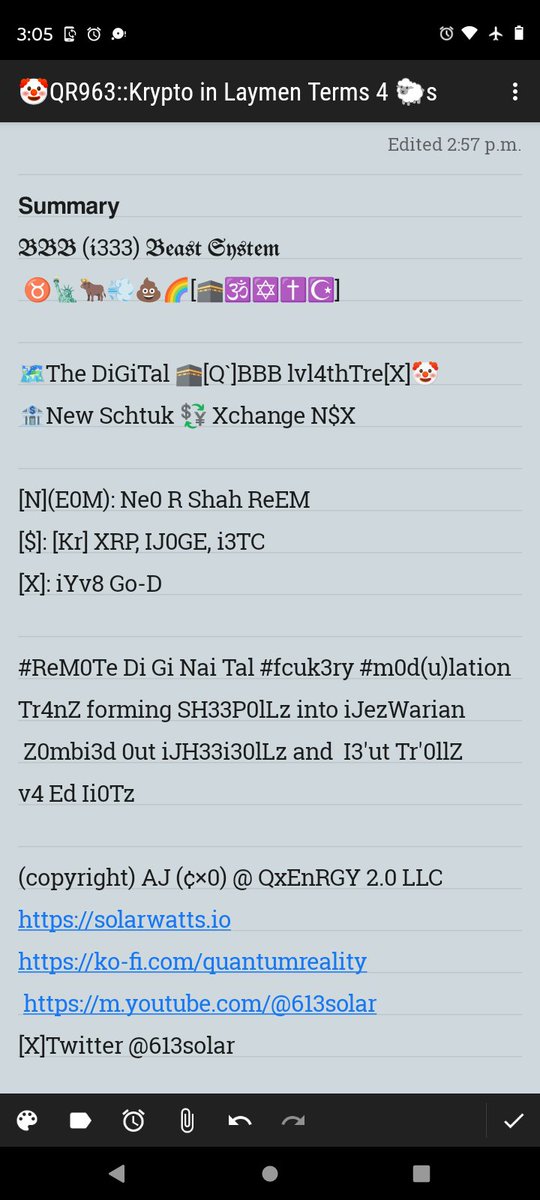



QR963: x🕋Luci TrAnZ 🌈iJ3HeVv(e)lvlanizZlvl
You couldn't make this 🐂💨💩 up
R' iJ3vV I3rain #fcuk3D enough?
🐑SH33P0lLz be SH33P0lLz
🤡iQ ¢Tr'0llz i33i ¢iJ0GE
🦧🍿idi0ts i33 Z4 🆔×iIoTzZ
https://t.co/ANw5hQAhqB
@__An6el__
@dawnsol71605592
@Trivium4tw
@KirkR95908


NANOLUC, BRET, QUANTUM DOTS and the RED-SHIFT!!!
📃 Semisynthetic, multicolor probes for bioluminescence imaging
NanoLuc is one of the brightest and most widely used luciferase enzymes, however, the native blue emission of NanoLuc limits its applications due to poor sample penetration. NanoBiT, a split luciferase reporter derived from NanoLuc, consists of two subunits: LgBiT and HiBiT. Herein, we take advantage of bioluminescence resonance energy transfer (BRET) to RED-SHIFT the emission of NanoBiT by chemically labeling the N-terminus of HiBiT with fluorescent probes.
Upon association of HiBiT and LgBiT, the appended fluorophores emit RED-SHIFTED LIGHT. When LgBiT is genetically encoded on the surface of mammalian cells, each probe produces unique emission profiles that can be distinguished by spectral phasor analysis microscopy. Moreover, by conjugating HiBiT peptides to fluorescent quantum dots, we extended BRET emission into the near-infrared. This modular system allows easy synthesis, rapid color switching, and tunable emission across the visible to near-infrared spectrum, providing a versatile platform for multicolor bioluminescence imaging across biological scales.
https://t.co/JwXgpianKg
📃 An Engineered Amber-Emitting Nano Luciferase and Its Use for Immunobioluminescence Imaging in Vivo
Here, we present the development of an NLuc mutant, QLuc, which catalyzes the oxidation of a synthetic QTZ luciferin for bright and RED-SHIFTED emission peaking at ∼ 585 nm. This amber-light-emitting luciferase-luciferin pair exhibited improved performance for imaging deep-tissue targets in live mice. Leveraging this novel bioluminescent reporter, we further pursued in vivo immunobioluminescence imaging (immunoBLI), which used a fusion protein of a single-chain variable antibody fragment (scFv) and QLuc for molecular imaging of tumor-associated antigens in a xenograft mouse model. As one of the MOST RED-SHIFTED NLuc variants, we expect QLuc to find broad applications in NONINVASIVE IMAGING IN MAMMALS.
The activity of QLuc is independent of ATP, and thus, it remains functional in the extracellular space where ATP concentrations are low. Because of its bright and red-shifted emission and excellent photon penetration in mammalian tissue, we envisaged that QLuc could be used to tag antibodies or antibody fragments for imaging specific cell-surface markers in vivo.
https://t.co/U62Dor2QEN
PROMEGA CORP
Functionalized nanoluc inhibitors
EP3562823A1
[0092] If the luminescent enzyme is one that occurs naturally or is a recombinant or mutant luminescent enzyme, e.g. one which retains activity in a luciferase-coelenterazine or luciferase-luciferin reaction of a naturally occurring luminescent enzyme, it can be obtained readily from a culture of bacteria, yeast, mammalian cells, insect cells, plant cells, or the like, transformed to express a nucleic acid encoding the luminescent enzyme. Further, the recombinant or mutant luminescent enzyme can be derived from an in vitro cell-free system using a nucleic acid encoding the luciferase.
https://t.co/Uu5YAhzPnO
![Ryansikorski10's tweet photo. NANOLUC, BRET, QUANTUM DOTS and the RED-SHIFT!!!
📃 Semisynthetic, multicolor probes for bioluminescence imaging
NanoLuc is one of the brightest and most widely used luciferase enzymes, however, the native blue emission of NanoLuc limits its applications due to poor sample penetration. NanoBiT, a split luciferase reporter derived from NanoLuc, consists of two subunits: LgBiT and HiBiT. Herein, we take advantage of bioluminescence resonance energy transfer (BRET) to RED-SHIFT the emission of NanoBiT by chemically labeling the N-terminus of HiBiT with fluorescent probes.
Upon association of HiBiT and LgBiT, the appended fluorophores emit RED-SHIFTED LIGHT. When LgBiT is genetically encoded on the surface of mammalian cells, each probe produces unique emission profiles that can be distinguished by spectral phasor analysis microscopy. Moreover, by conjugating HiBiT peptides to fluorescent quantum dots, we extended BRET emission into the near-infrared. This modular system allows easy synthesis, rapid color switching, and tunable emission across the visible to near-infrared spectrum, providing a versatile platform for multicolor bioluminescence imaging across biological scales.
https://t.co/JwXgpianKg
📃 An Engineered Amber-Emitting Nano Luciferase and Its Use for Immunobioluminescence Imaging in Vivo
Here, we present the development of an NLuc mutant, QLuc, which catalyzes the oxidation of a synthetic QTZ luciferin for bright and RED-SHIFTED emission peaking at ∼ 585 nm. This amber-light-emitting luciferase-luciferin pair exhibited improved performance for imaging deep-tissue targets in live mice. Leveraging this novel bioluminescent reporter, we further pursued in vivo immunobioluminescence imaging (immunoBLI), which used a fusion protein of a single-chain variable antibody fragment (scFv) and QLuc for molecular imaging of tumor-associated antigens in a xenograft mouse model. As one of the MOST RED-SHIFTED NLuc variants, we expect QLuc to find broad applications in NONINVASIVE IMAGING IN MAMMALS.
The activity of QLuc is independent of ATP, and thus, it remains functional in the extracellular space where ATP concentrations are low. Because of its bright and red-shifted emission and excellent photon penetration in mammalian tissue, we envisaged that QLuc could be used to tag antibodies or antibody fragments for imaging specific cell-surface markers in vivo.
https://t.co/U62Dor2QEN
PROMEGA CORP
Functionalized nanoluc inhibitors
EP3562823A1
[0092] If the luminescent enzyme is one that occurs naturally or is a recombinant or mutant luminescent enzyme, e.g. one which retains activity in a luciferase-coelenterazine or luciferase-luciferin reaction of a naturally occurring luminescent enzyme, it can be obtained readily from a culture of bacteria, yeast, mammalian cells, insect cells, plant cells, or the like, transformed to express a nucleic acid encoding the luminescent enzyme. Further, the recombinant or mutant luminescent enzyme can be derived from an in vitro cell-free system using a nucleic acid encoding the luciferase.
https://t.co/Uu5YAhzPnO](https://pbs.twimg.com/media/GxnzZbEXsAAXcti.jpg)
![Ryansikorski10's tweet photo. NANOLUC, BRET, QUANTUM DOTS and the RED-SHIFT!!!
📃 Semisynthetic, multicolor probes for bioluminescence imaging
NanoLuc is one of the brightest and most widely used luciferase enzymes, however, the native blue emission of NanoLuc limits its applications due to poor sample penetration. NanoBiT, a split luciferase reporter derived from NanoLuc, consists of two subunits: LgBiT and HiBiT. Herein, we take advantage of bioluminescence resonance energy transfer (BRET) to RED-SHIFT the emission of NanoBiT by chemically labeling the N-terminus of HiBiT with fluorescent probes.
Upon association of HiBiT and LgBiT, the appended fluorophores emit RED-SHIFTED LIGHT. When LgBiT is genetically encoded on the surface of mammalian cells, each probe produces unique emission profiles that can be distinguished by spectral phasor analysis microscopy. Moreover, by conjugating HiBiT peptides to fluorescent quantum dots, we extended BRET emission into the near-infrared. This modular system allows easy synthesis, rapid color switching, and tunable emission across the visible to near-infrared spectrum, providing a versatile platform for multicolor bioluminescence imaging across biological scales.
https://t.co/JwXgpianKg
📃 An Engineered Amber-Emitting Nano Luciferase and Its Use for Immunobioluminescence Imaging in Vivo
Here, we present the development of an NLuc mutant, QLuc, which catalyzes the oxidation of a synthetic QTZ luciferin for bright and RED-SHIFTED emission peaking at ∼ 585 nm. This amber-light-emitting luciferase-luciferin pair exhibited improved performance for imaging deep-tissue targets in live mice. Leveraging this novel bioluminescent reporter, we further pursued in vivo immunobioluminescence imaging (immunoBLI), which used a fusion protein of a single-chain variable antibody fragment (scFv) and QLuc for molecular imaging of tumor-associated antigens in a xenograft mouse model. As one of the MOST RED-SHIFTED NLuc variants, we expect QLuc to find broad applications in NONINVASIVE IMAGING IN MAMMALS.
The activity of QLuc is independent of ATP, and thus, it remains functional in the extracellular space where ATP concentrations are low. Because of its bright and red-shifted emission and excellent photon penetration in mammalian tissue, we envisaged that QLuc could be used to tag antibodies or antibody fragments for imaging specific cell-surface markers in vivo.
https://t.co/U62Dor2QEN
PROMEGA CORP
Functionalized nanoluc inhibitors
EP3562823A1
[0092] If the luminescent enzyme is one that occurs naturally or is a recombinant or mutant luminescent enzyme, e.g. one which retains activity in a luciferase-coelenterazine or luciferase-luciferin reaction of a naturally occurring luminescent enzyme, it can be obtained readily from a culture of bacteria, yeast, mammalian cells, insect cells, plant cells, or the like, transformed to express a nucleic acid encoding the luminescent enzyme. Further, the recombinant or mutant luminescent enzyme can be derived from an in vitro cell-free system using a nucleic acid encoding the luciferase.
https://t.co/Uu5YAhzPnO](https://pbs.twimg.com/media/GxnzZWxWcAAUYGo.jpg)
Last Seen Hashtags on Sotwe
Trends for you
Most Popular Users

Elon Musk 
@elonmusk
241.8M followers

Barack Obama
@barackobama
119M followers

Cristiano Ronaldo
@cristiano
114.6M followers

Donald J. Trump
@realdonaldtrump
111.9M followers

Narendra Modi
@narendramodi
107.2M followers

Rihanna
@rihanna
98.7M followers

NASA
@nasa
92.4M followers

Justin Bieber
@justinbieber
91.8M followers

KATY PERRY
@katyperry
90.1M followers

Taylor Swift
@taylorswift13
84M followers

Lady Gaga
@ladygaga
75.5M followers

Virat Kohli
@imvkohli
73.5M followers

Kim Kardashian
@kimkardashian
70.9M followers

YouTube
@youtube
68.8M followers

Neymar Jr
@neymarjr
66.5M followers

Bill Gates
@billgates
65.3M followers

Selena Gomez
@selenagomez
63.1M followers

The Ellen Show
@theellenshow
62.3M followers

CNN
@cnn
61.8M followers

X
@x
60.7M followers