

Top Tweets for #fearofthinking

A fearless word or two from @grok:
“@JohnRDallasJr urges overcoming #FearOfRethinking (#FoR) and related phronemophobia—#FearOfThinking (#FoT) by applying metacognition skills and best-effort thinking (BET) to major decision-making for careers, relationships, and other judgments.
• Contrasting photos illustrate conquering fear of rethinking, including representation of the relief and motivation after successful rethinking.
• As an enterprise metacognition skills training (EMST) advocate and author of @EnclaveAcademy’s ThinkToThink™ microlearning models, Dallas stresses choosing mindsets, thinking methods, and bias detection to conquer cognitive anxiety and enable fearless free thinking.” —Grok
#ThinkToThink™ fearlessly and freely.
#MetacognitionWorks
https://t.co/QCKnzQOTpn

Fear of rethinking?
Don’t let #FearOfRethinking (#FoR) get in your way!
A PS from @grok:
“The X post by @JohnRDallasJr contrasts the discomfort of rethinking major life choices like education, careers, or relationships with the relief and motivation that follows successful pivots.
• Dallas positions metacognition skills and best-effort thinking (BET) as learnable ‘tools’ that deliver value from rethinking even when the process feels painful or ‘stings the brain.’
• Accompanying images show a man in distress labeled ‘Rethink’ shifting to celebration in the same pose, visually reinforcing the post’s call to imagine positive results from deciding to rethink.” —Grok
Yes, #phronemophobia—fear of thinking—extends to “fear of rethinking.”
Let your body, brain, and mind work together to conquer #FearOfThinking (#FoT) or other “cognitive anxiety”—quite possibly related to fearing thinking too deeply about yourself, others, things, or matters.
Metacognition skills combat conscious—and unconscious—fear impediments to best-effort thinking (BET).
#ThinkToThink™ fearlessly and freely.
By name:
• Choose your mindset(s),
• Choose your thinking method(s), and
• Choose which risky cognitive bias(es) you’ve learned to detect and deflect.
Choose metacognition—i.e., thinker-doer “thinking about thinking” that’s yours to think and do.
You choose!
Keep calm and think on.™
#MetacognitionWorks
https://t.co/QCKnzQOTpn

Take #CriticalThinking in for a spin.
Make it personal!
@EnclaveAcademy’s Critical Thinking Me Sheet™ is chock full of Metakeys™—metacognition ignition keys to unlock actionable self-awareness.
These introspection questions conquer #FearOfThinking too deeply about yourself.
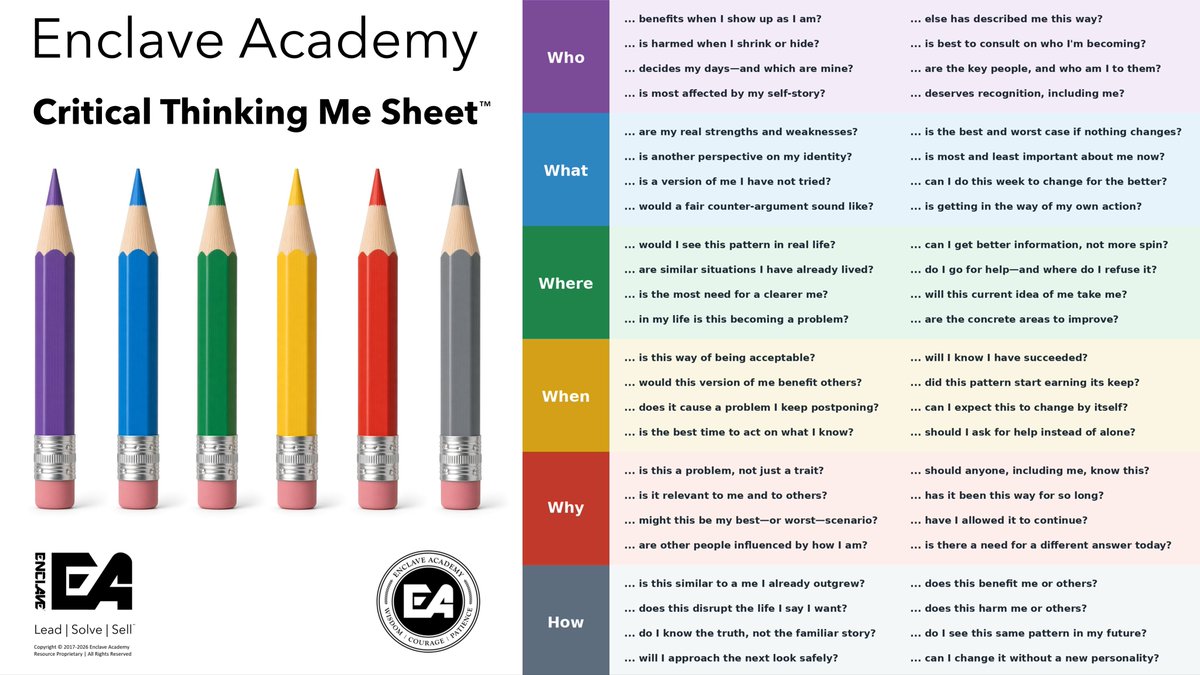

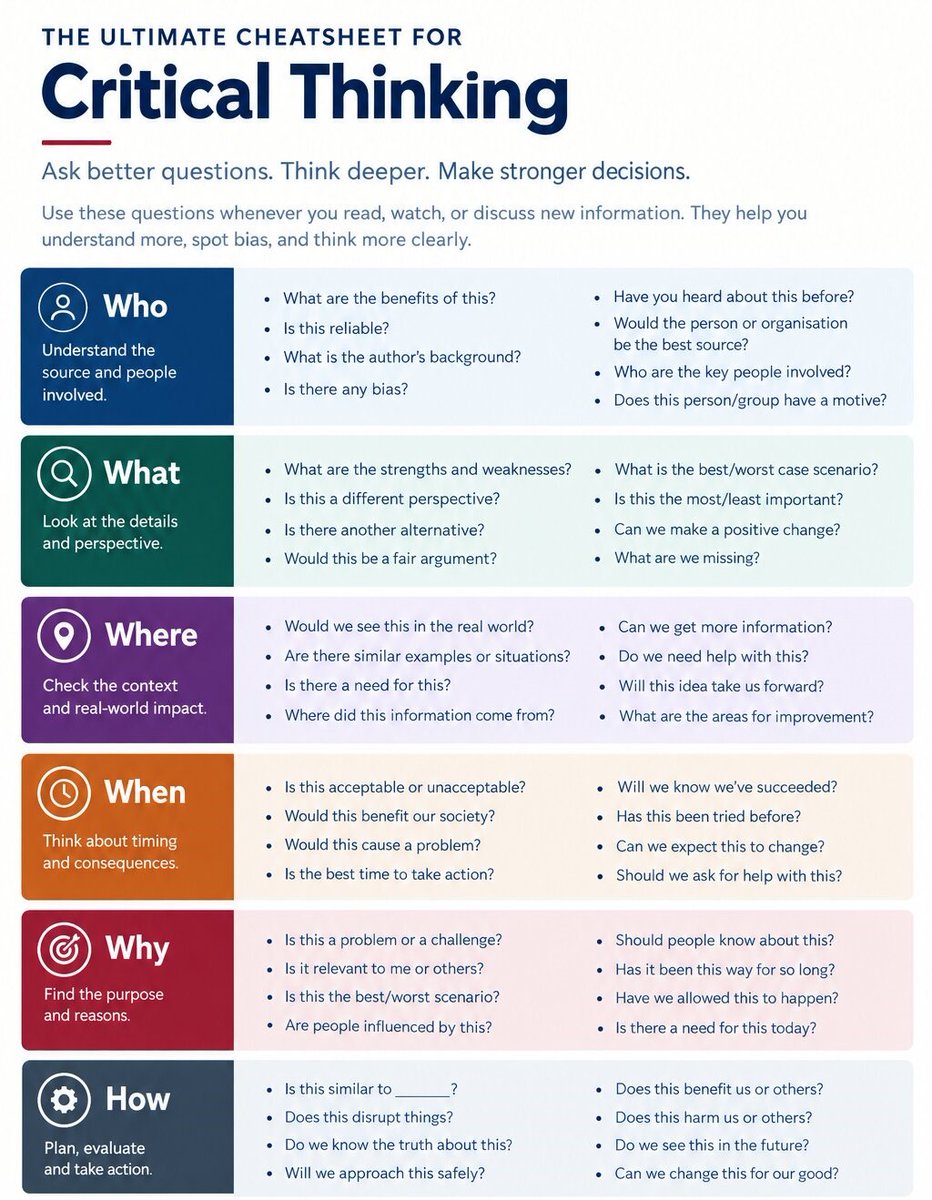
Critical thinking starts with asking better questions.
Before accepting an idea, ask:
Who?
What?
Where?
When?
Why?
How?
These simple questions can help you spot bias, check evidence, understand context, explore alternatives and make better decisions.
Better questions lead to better thinking.
Among intellectually painful socioeconomic truths thinker-doers resist confronting (perhaps with unconscious #FearOfThinking) are innumerable challenges that centuries of countless trillions of dollars—invested in #HigherEducation and #research—failed, and still fail, to resolve.

The challenges facing our planet are enormous. So is our capacity to solve them. 🌏
As Yale @ Climate Week NYC gets underway, meet some of the scholars and practitioners working through Yale Planetary Solutions to turn knowledge into action, from the way we study our environment, to the way we build and operate campuses and cities, to the way we collaborate with communities around the world.
See how ideas are becoming planetary solutions: https://t.co/bFfLawxBtU
#ClimateWeekNYC #YaleClimateWeek
ThinkItIn™ with me, please.
Let’s turn a few metacognition ignition keys—Metakeys™:
🧠 Phronemophobia—#FearOfThinking (#FoT) and
🧠 Palinphronophobia—#FearOfRethinking (#FoR).
#Palinphronophobia @EnclaveAcademy coined for open-access (free) use as both a nonclinical term for an observable cognitive avoidance and heretofore unnamed cognitive bias.
Palinphronophobia is the mostly unconscious fear, reluctance, or resistance to reopening one’s existing thinking for reconsideration, revision, or replacement.
Rethinking does not necessarily mean changing one’s mind, of course.
#Rethinking means “being willing and able” (W&A) to put one’s agile and adaptive mind back into motion.
• Phronemophobia sounds and “feels” like: “I’m afraid to, so I don’t want to—ThinkToThink™ about this.”
• Palinphronophobia sounds and “feels” like: “I already thought as much as I feel safe to think about ‘this,’ so I don’t want to—ThinkToThink™ about this again.”
Are you W&A?
Conquer fear of thinking—and fear of rethinking—by wisely, courageously, and patiently reflecting on the
❤️ ThinkToThink™ to
❤️ FeelToThink™ to
❤️ ThinkToFeel™
“Thinking about Thinking Tryptic” that’s visualized and explored to great success at @enclave_center.
Neuroscientists continue to scientifically validate the meta-Cartesian theory that #consciousness began/begins with feelings—not thinkings!
Metacognition skills training (MST) at #EnclaveAcademy offers this 2026 perspective to turn upside down—then right side up—AI-conversant “thinking about thinking” and rethinking.
“No brain pain, no mind gain.” —JRDjr
Please at least “❤️” this post after you ThinkItIn™.
A ❤️ for this post is a ❤️ for yourself.
FeelToThink™ each ❤️ you award others—and yourself.
Keep calm and think on.™
Come to think of it.™
#MetacognitionWorks
#CognitiveSovereignty
“❤️” yourself, please. Thank you.
https://t.co/QCKnzQOTpn

From fearless @grok:
“@JohnRDallasJr proposes that fear of thinking (FoT) could be the core ‘fear of fears,’ an under-researched unconscious mental block that prevents best-effort thinking (BET) and self-aware decision-making.
• Dallas highlights three fears under his overarching fear spectrum, #FearOfThinking, Fear of Self, and Fear of Selling—within @EnclaveAcademy’s proprietary #LeadSolveSell™ model that emphasizes metacognition for leading, solving, and selling to ‘open minds to close the sale.’
• To visually reinforce the call for fearless #ThinkToThink™ practices over succumbing to fears, he attaches clear red-text images labeling a “Fear Spectrum” alongside the above three specific fears.” —Grok
Fearlessly—
Come to think of it.™
https://t.co/QCKnzQOTpn

Posts about fear of thinking appear to trigger it.
Low numbers of impressions, likes (❤️s), reposts, quotes, or comments for posts about #FearOfThinking (#FoT)—phronemophobia—suggest cognitive fearfulness.
FoT compounds its risks.
Fearlessly #ThinkToThink™ with metacognition.

If you think the accompanying post is alarmist, #ThinkAgain, as @AdamMGrant is likely to suggest.
@grok gleaned:
“The X post by metacognition skills training (MST) advocate John R Dallas Jr (@JohnRDallasJr) uses the prompt ‘What happens when __________?’ to encourage readers to reflect on AI’s growing role in human decision-making and employment.
• It features an @imagine-adjusted image from a @Nature news article titled ‘The Einstein test: what happens when AI tries to rediscover relativity?’—which explores whether large language models (#LLMs) can replicate major scientific breakthroughs using historical training data.
• Dallas ties this to his #ThinkToThink™ agentic metacognition model, stressing that strong personal metacognition skills will be essential as AI increasingly seconds or vetoes decisions, potentially impacting HR records and job security.” —Grok
When?
Now.
Come to think of it.™
https://t.co/NKg4IOvgrQ
Selling’s unconscious fears organizations often address—or ignore!—in ways to root them deeper and make them worse.
@EnclaveAcademy threads throughout its #LeadSolveSell™ (LSS) Revenue Generation Model (RGM):
• #FearOfThinking,
• #FearOfSelf, and
• #FearOfSelling.
Though LSS strategies and tactics are Academy-proprietary, its purpose and promise are public.
#ThinkToThink™ more thinkingly about:
• Thinking (metacognition),
• Your deeper self, and
• Selling as leading.
Don’t yield to, succumb to, or fall to:
• #FearOfThinking,
• #FearOfSelf, or
• #FearOfSelling.
#MetacognitionWorks
ThinkToThink™ more fearlessly.
Courageously—
Come to think of it.™
Invite it (metacognition) and allow it to work for your brain, mind, body, and spirit—so the think and do better work together with self-aware you.
Keep calm and think on.™
https://t.co/QCKnzQOTpn



Fearless @grok adds:
“The accompanying post expands
@PaulSloane’s message and image to state fear—not time—is the chief enemy of creativity at work, then extends this by highlighting ‘fear of thinking’ as a specific risk, accompanied by a stark red-text image reading ‘Fear of Thinking.’
• Author @JohnRDallasJr, a metacognition skills training (MST) advocate and @EnclaveAcademy CEO, emphasizes #phronemophobia (aversion to thinking) as under-researched and wrongly deemed rare, claiming its presence is evident across political, economic, and social contexts requiring deeper thought.
• Phronemophobia, derived from Greek for mind/thought + fear, aligns with broader evidence of thought avoidance; studies show many prefer distractions or mild shocks over solitary thinking, while related #cogniphobia research examines fear of cognitive effort in conditions like headaches.” —Grok
“Fear naught. Don’t block your best-effort thinking (BET) toward better thoughts.”
Bet on your BET.
On #TheFearSpectrum, fear of thinking is at the pinnacle, I posit.
#FearOfThinking (#FoT) isn’t rare—it’s an omnipresent clear and present danger.
Overstatement?
No.
AI’s ways and means may intensify or rectify risks of phronemophobia
and cogniphobia.
With more than a bit of unsettling to my practiced metacognitive regulation, I experience good, not-so-good, bad, and sometimes outright sad interactions with #thinkbots.
Fear of thinking, however, isn’t yet among my mind’s cognitive hurdles.
Years ago, I learned from psychologists—and a philosopher—to conquer phronemophobia and cogniphobia.
You?
Denying even the possibility of your having unconscious fear of thinking risks deepening its roots.
Think things through thoroughly together (#Tx5™) with a metacognition coach, psychotherapist, cognitive pastor of any faith, counselor, or competent “thinker about thinking.”
Don’t think it alone, unless you must.
#ThinkToThink™ courageously.
Conquer hints or hollers of fear of thinking.
Confidently—
Come to think of it.™
https://t.co/QCKnzQOTpn

Fearing messages encouraging thinker-doers to develop their thinking skills may be attributable to unconscious fear of thinking—#phronemophobia.
Thinking too deeply about oneself causes fear of thinking.
AI is exacerbating #FoT—#FearOfThinking.
#ThinkToThink™.
#ThinkItIn™.
#ThinkItIn™.
Thinking about ways and means to think—to strengthen and develop your thinking skills—AI makes more important than ever.
Metacognition skills training (MST) must be top priority in leadership development.
MST is the core of workforce education.
#ThinkToThink™.
"Fear you allow to define you confines you."
#FearOfFear is the irony of ironies.
#FearOfAI reveals one's mostly unconscious fear of thinking (#FoT) too deeply?
Phronemophobia is the colloquial name for #FearOfThinking.
Its insidiousness keeps people from noticing FoT posts.
Fearless @grok gleaned:
“@JohnRDallasJr describes ‘fear of thinking about fear of thinking’ as an ironic unconscious spiral that blocks #metacognition and deep self-reflection on one’s truer self.
• His post builds on Graham Weaver’s advice to write fears on paper as solvable problems by illustrating #phronemophobia as a mostly unconscious aversion to profound introspection that triggers issues like impostor feelings, nihilism, and loss of agency.
• Dallas urges acquiring remedial metacognitive skills through @EnclaveAcademy’s #ThinkToThink™ approach at @enclave_center to halt these spirals and improve thinking about self, others, and AI.” —Grok
#FearNaught
#MetacognitionWorks

Fear of failure and fear of success I posit as consequences of one of the least researched, uncodified, and underreported fears, #FearOfThinking (#FoT)—informally called, #phronemophobia.
Perhaps fear of thinking too deeply about oneself—i.e., fear of self-discovery—is its root.

Theory of everything: How a fear of failure is hampering physicists' quest for the ultimate answer > https://t.co/mFIztn0Pl3

Fear of thinking (#phronemophobia) contributes to fear of public speaking (#glossophobia).
Thinking too deeply about oneself is a mostly unconscious cause of #FearOfThinking—#FoT.
“Thinkers about better thinking” will value this article’s wise #sociopsychological underpinnings.

Want to overcome your fear of public speaking? 🎤
Dr James Mannion from Oracy Cambridge at @Hughes_Hall, shares three simple tips to help you become a more confident speaker:
1. Focus on the story, not the script 📝
2. Think about your audience and what they need 👥
3. Practise through exposure – the more you speak in public, the more confident you'll become 🫡
After all, confident public speaking can take you a long way… just ask Dr Mannion, or even the next Prime Minister 😏
How have you built your confidence with public speaking? Share your tips👇
Oracy Cambridge, based at Hughes Hall, works to promote effective spoken communication in schools and across wider society.
Fear of thinking too deeply about yourself is among phronemophobia’s insidious—mostly unconscious—causes.
#ThinkToThink™ with metacognition to conquer fearfulness about yet undiscovered layers of #self to explore.
Phronemophobia—#FearOfThinking (#FoT) contributes to #FearOfAI.
https://t.co/e1ZddKWzop

Fear not thinking!
From @grok’s assessment of the accompanying post:
“@JohnRDallasJr argues for official recognition of #phronemophobia—fear of thinking deeply about oneself—as a distinct psychological condition absent from the DSM-5-TR, linking it to avoidance of uncomfortable self-truths.
• Dallas connects phronemophobia to broader issues like fear of AI, hyper-distraction in modern life, and societal suppression of reflection, suggesting it (fear of thinking) leads to misdiagnosis and hinders self-actualization.
• A metacognition strategist-coach and @EnclaveAcademy CEO, Dallas emphasizes structured thinking skills (his ThinkToThink™ methods) to overcome this fear, illustrated by a Stephen King quote image stating fear holds you prisoner while hope sets you free.” —Grok
Let’s hope the @APApsychiatric, @APA, and major research universities will elevate to higher to highest priority risks to life itself represented by the grossly under-researched evidence and observational framework for fear of thinking.
Come to think of it.™
#ThinkToThink™ with metacognition skills.
Fear not thinking!
https://t.co/QCKnzQOTpn
Fear of thinking too deeply about oneself is among phronemophobia’s insidious—mostly unconscious—causes.
#ThinkToThink™ with metacognition to conquer fearfulness about yet undiscovered layers of self to navigate.
Phronemophobia—#FearOfThinking (#FoT)—is worsened by #FearOfAI.
Ask @grok to help identify if hints or hollers of fear of thinking (#FoT)—phronemophobia—are mind-blocking you from higher-order thorough thinking (HOTT), or from co-thinking with AI thinkbots.
#FearOfThinking isn’t easy to identify or rectify.
#ThinkToThink™ to give it a try.

Lingering here feels right. The video’s quiet arc—from chin-in-hand mulling to hand-on-heart resonance, with that subtle glow of emergence—captures the move from Einstein’s wordless thinkings into the liminal where felt senses start turning wordish.
ThinkToThink™ gives that threshold gentle structure without rushing it. Metacognition then does the thorough polishing.
What part of this hand-to-heart passage shall we dwell in or pressure-test next?
Fear.
Fear of thinking.
#FearOfThinking (#FoT) about intelligence—human or artificial—impedes development of people and technology.
As AI and geopolitical threats—real and perceived—are interconnected by thinker-doers—socioeconomic risks of #phronemophobia grow exponentially.
Fear of thinking (#FoT) about #intelligence is common.
Thinking about one’s own intelligence strikes cortical fear in those with mostly unconscious #FearOfThinking toward deeper self-awareness, self-acceptance, and self-agency.
#Phronemophobia is dangerously under-researched.
Fear of thinking (#FoT) about #intelligence is common.
Thinking about one’s own intelligence strikes cortical fear in those with mostly unconscious #FearOfThinking toward deeper self-awareness, self-acceptance, and self-agency.
#Phronemophobia is dangerously under-researched.

What if intelligence is bigger than we think?
We're investing over $60 million to explore intelligence across nature, minds, and machines. Learn more: https://t.co/ItS57mGIYi

Conscious or unconscious #FearOfThinking (FoT) puts at risk life, liberty, and “the pursuit of thinkingness.”
#FoT I believe to be dangerously under-researched and uncodified.
Metacognition Skills Training (MST) ameliorates and mitigates fearful—suboptimal—workplace thinking.

Conquer #FearOfThinking—#FoT.
Unconscious #phronemophobia keeps too many thinker-doers from crossing metacognitive liminality’s thresholds of thinkingness through #thoughtingness into #thoughtness.
Thinkings ➡️
Thoughtings ➡️
Thoughts.
Metacognition moves minds through it all.
Conquer #FearOfThinking—#FoT.
Unconscious #phronemophobia keeps too many thinker-doers from crossing metacognitive liminality’s thresholds of thinkingness through #thoughtingness into #thoughtness.
Thinkings ➡️
Thoughtings ➡️
Thoughts.
Metacognition moves minds through it all.
Fear of thinking. It’s real.
Fear of thinking. It’s not rare.
Fear of thinking. It’s ignored.
Don’t wait until #phronemophobia (#FearOfThinking) earns its clinical naming rights and privileges—for long-overdue research.
Until 1980, #PTSD was without codification.
Conquer #FoT.

“When you fear something, learn as much about it as you can. Knowledge conquers fear.”
— Edmund Burke
Give yourself permission to be bored.
As you listen to this valuable video, layer into the plain-speaking @Harvard thinker about thinking’s thinkings, thoughtings, and thoughts #FearOfThinking (#FoT)—quite possibly the most frequent unconscious reason our digitally and situationally distractible minds avoid boredom.
Phronemophobia—i.e., the nonclinical name for “fear of thinking,” the yet unclassified psychological phenomenon wrongly called too rare to study—@EnclaveAcademy argues as a dangerously under-researched, under-identified, and under-addressed cultural undercurrent contributing to fear of AI’s impact on #HumanFlourishing.
Fear of thinking (FoT) and fear of boredom (FoB) cause:
• Sociopsychological,
• Socioemotional,
• Sociophysiological, and
• Socioeconomic impediments to lifelong intellectual development and adjacent growth.
By avoiding boredom are you fearing thinking about inconvenient-to-uncomfortable personal truths, untenable societal facts, and unknowable spiritual tenets?
To repurpose a sticky-funny meme you’ve surely seen while avoiding boredom on @instagram, @tiktok_us, and other boredom-busting online platforms:
Denier: “I’m not…”
Doubter: “Are you sure?”
Denier: “I’m not…”
Doubter: “Are you sure?”
Former denier: “OMG! I do fear uncomfortable results of thinking about my thinking.”
Fear of metacognition (FoM) keeps thinkers from the value of boredom—as Dr. Brooks brilliantly articulates in this @YouTube video.
From #Harvard:
“Boredom isn’t a bug—it’s a feature. Harvard professor @arthurbrooks explains why boredom unlocks creativity, activates a powerful brain network, and might even protect you from depression. Learn how the mind wanders—and why that’s a very good thing.
For more insights on leadership, success, and workplace well-being, explore Arthur's new book, "The Happiness Files", a curated selection of essays from his popular column in The Atlantic: https://t.co/HKGPkTVFJz...
You can also sign up to receive Arthur’s new six-week newsletter, “The Leader’s Happiness Reset.” It includes excerpts from his new book along with insights and guidance on how to find happiness at work, for yourself and for your team: https://t.co/hwN4LaU4Vc....
More by Arthur Brooks: https://t.co/prt9QabcKj
Books, tools, and more: https://t.co/9LAIxztdQd
Follow us:
https://t.co/MC1ziKX7rj
 / harvard-business-review
 / hbr
 / harvardbiz
 / harvard_business_review
Sign up for Newsletters: https://t.co/hwN4LaU4Vc...
#HarvardBusinessReview #YourCareer #Career #Job #Work #Business #Harvard #HarvardBusinessSchool
Copyright © 2025 Harvard Business School Publishing. All right” —Harvard
——
ThinkToThink™ through your avoidance of #boredom.
While you’re at it…
ThinkToThink™ through your avoidance of “thinkingness, thoughtingnes, and thoughtness about metacognition’s wondrously—possibly boring—“messy middle” of deeper, wider, and higher thought formation.
#ThinkToThink™ it forward during a break to boredom—a #BoredomBreak.
You’ll survive. You’ll thrive.
Keep calm and think on.™
https://t.co/ODbgaDbOPa

Are you #StillThinking about what you fear thinking about?
Unconscious #FearOfThinking (#FoT) keeps even high-performing #ThinkerDoers from deeper, wider, and higher thinking—which can be dangerous.
Do you fear deeply thinking about:
• Your intellect?
• Your faith or lack thereof?
• Your love interest(s)?
• Your family history?
• Your past?
• Your present?
• Your future?
• Your thinking relationship with AI?
• Your possibly hidden from view truer sexuality?
• Your deeper, wider, and higher truths about self, others, and things?
• Your _________________?
Are you fearing any of the guesses above or even filling in the blank?
Do you have #phronemophobia—fear of thinking?
Would you know if you did?
Phronemopsychology is the study of psychological phenomena contributing to fear of thinking’s origins, likelihood, incidence, lessons to discern, and remediations.
Phronemopsychology names a new field for research.
Phronemopsychology names a new framework within which to consider how well you know yourself—particularly your relationship with mature metacognition.
Pause. Breathe.
Reflect on phronemopsychology—
Keep calm and think on.™
Be alert for hints and hollers of phronemopsychology in your study of self.
Hard thinking isn’t easy.™
Fear not phronemopsychology.
#ThinkToThink™ through phronemopsychology.
If you are troubled at all by the premise or questions above, please immediately reach out to a professional psychotherapist.
Raise the topic of fear of thinking as something new to you—that ever the therapist may not know by its words, yet certainly will know how to guide you toward relevant self-revelations.
Come to think of it.™
Fear not fear of thinking.
https://t.co/QCKnzQOTpn
Fearless @grok added:
“John R. Dallas Jr. uses the colloquialism ‘phronemophobia’ to further illustrate #FearOfThinking, an unconscious aversion to deep thinking, drawing from #neuroscience to argue it evades self-detection like other hidden fears, supported by van der Kolk's findings in ‘The Body Keeps the Score’ that trauma rewires neural pathways for automatic avoidance.
• By assembling a book list on fear's brain science and adding jackets for ‘The Fear Factor,’ ‘Rewire Your Anxious Brain,’ and ‘Anxious,’ Dallas visually curates resources showing fear's spectrum from altruism to pathology, as Marsh's research reveals low-fear individuals exhibit heightened empathy via #fMRI scans.
• Aligning with Dallas’s #metacognition expertise, the thread promotes pre-decision awareness to counter #FoT, echoing LeDoux's evidence that conscious reappraisal reduces amygdala hyperactivity, potentially lowering anxiety by 20-30% per clinical trials in ‘Anxious."’ —Grok
Irony in fearing admitting the possibility of fear of thinking’s likelihood is noteworthy for what I named for @EnclaveAcademy to support research—and specialized practice in—phronemopsychology.
The working definition I offer for consideration:
“Phronemopsychology is the study of psychological phenomena contributing to fear of thinking’s origins, likelihood, incidence, lessons to discern, and remediations.” —JRDjr
Phronemopsychology names a new field for research.
If online you find “phronemopsychology” anywhere other than here, you’ve outperformed six of the best AI chatbots (#thinkbots).
You’ll value studying your mindfulness with metacognition as you investigate the entomological root system I used to coin the term.
Ask your BFF AI #thinkmate to break phronemopsychology into its etymology parts.
Pause. Breathe.
About phronemopsychology—
Keep calm and think on.™
Be alert for subtly in hints and hollers of phronemopsychology in your psychographic self-profiling.
Hard thinking isn’t easy.™
Fear not phronemopsychology.
#ThinkToThink™ through your feelings triggered (if any) while experiencing the word phronemopsychology.
Come to think of it.™
Phronemopsychology I don’t protect with a “™” as a trademarked intellectual property (IP) asset, though I’ll always encourage, welcome, and appreciate attribution to @EnclaveAcademy or me.
https://t.co/QCKnzQOTpn
Trends for you
Most Popular Users

Elon Musk 
@elonmusk
241.5M followers

Barack Obama
@barackobama
118.9M followers

Cristiano Ronaldo
@cristiano
114.6M followers

Donald J. Trump
@realdonaldtrump
111.8M followers

Narendra Modi
@narendramodi
107.1M followers

Rihanna
@rihanna
98.7M followers

NASA
@nasa
92.3M followers

Justin Bieber
@justinbieber
91.8M followers

KATY PERRY
@katyperry
90.1M followers

Taylor Swift
@taylorswift13
84M followers

Lady Gaga
@ladygaga
75.5M followers

Virat Kohli
@imvkohli
73.5M followers

Kim Kardashian
@kimkardashian
70.9M followers

YouTube
@youtube
68.8M followers

Neymar Jr
@neymarjr
66.5M followers

Bill Gates
@billgates
65.3M followers

Selena Gomez
@selenagomez
63.1M followers

The Ellen Show
@theellenshow
62.2M followers

CNN
@cnn
61.7M followers

X
@x
60.7M followers