

Top Tweets for #hyperconnected


I spent yesterday bringing one of my personal concepts to life.
A personal project exploring themes of isolation, identity, and the feeling of becoming invisible in a hyperconnected world.
Made for creative exploration and my portfolio.

Deep Learning Predicts Dissimilar DNA-DNA Binding and Engineers Hyperconnected Networks
1. The paper argues for engineering beyond “orthogonality”: instead of avoiding weak/off-target DNA–DNA interactions, it aims to predict and deliberately use them to build scalable, multivalent molecular systems that must operate amid high background sequence diversity.
2. The core contribution is BINND (Binding and Interaction Neural Network for DNA), trained on a ground-truth experimental dataset spanning far-from-complementary 20mer DNA pairs, where traditional heuristics (Hamming/Levenshtein/GC/Tm) and thermodynamic tools degrade in accuracy.
3. A key enabling innovation is an ultra-high-throughput NGS-based pulldown platform that measures millions of DNA–DNA interactions per bait: randomized 20mer ssDNA “prey” appended to a barcoded dsDNA region enables pooled, multiplexed sequencing across conditions, while biotinylated 20mer “baits” and streptavidin beads enrich binders.
4. Robustness checks show strong selectivity: <0.2% of input prey mass is recovered as bound, and only ~0.07% of bound sequences appear in more than one bait dataset—supporting low non-specific carryover across highly dissimilar baits.
5. BINND uses a CNN classifier (not a Transformer) with an interleaved encoding that preserves putative base-pair proximity: [S1,1, S2,20, S1,2, S2,19, …]. The model is trained on ~144.6 million balanced bound/unbound pairs (8:1:1 split), reflecting extreme sparsity typical of randomer libraries.
6. Performance highlights: BINND reaches AUC = 0.88 and ~83% accuracy on experimental test data, and it cleanly separates bound vs unbound for most of sequence space where ΔG and edit-distance distributions heavily overlap. It also scores 100% on 1M perfectly complementary pairs that were not present in training data.
7. Benchmarking against NUPACK, Primer3, and Levenshtein distance shows BINND improves classification accuracy by ≥10% and accelerates inference substantially (GPU: ~54x faster than NUPACK and ~7x faster than Primer3), with comparable memory use. A compact BINND-Lite variant trades a small accuracy drop for faster training/inference.
8. Data-efficient generalization is explicitly tested: training on increasing numbers of bait datasets shows AUC rises quickly and plateaus around ~0.8 by ~11 baits when predicting binding for held-out unseen baits, suggesting BINND learns transferable binding rules rather than memorizing bait-specific patterns.
9. BINND also generalizes across assay environments: models trained at one salt condition (0.05M, 0.5M, or 4M KCl) retain strong AUC when evaluated across other salt conditions, indicating robustness to ionic-strength shifts.
10. A compelling demonstration is engineering a hyperconnected DNA interaction network: 26 baits (A–Z) represent “attributes” and 96 designed prey represent “storybook characters,” where each prey is designed to bind multiple mutually dissimilar baits in overlapping patterns. Wet-lab pulldowns recapitulate much of the predicted zigzag connectivity, and BINND’s predicted probabilities correlate monotonically with enrichment; BINND outperforms Primer3 especially in this dense, network-level setting.
💻Code: https://t.co/OwMjt2edob ; https://t.co/w1FVS5D4Ov
📜Paper: https://t.co/BoU5pymE7W
#DeepLearning #ComputationalBiology #SyntheticBiology #DNAHybridization #NGS #MachineLearning #DNANanotechnology #DNAComputing #DNAStorage #Bioengineering


Data Line Traveler published with ARMY{OG} STUDIO.
Captures a moment between destinations — where augmented humans travel through the digital arteries of a hyperconnected world.
@XRParmy_pog https://t.co/0e6n6tAKpT


In 2026, tech is defined by a key shift: AI moves from experiment to widespread use. This fuels the rise of autonomous agents and robotics, is powered by more efficient specialized hardware, and demands a major focus on cybersecurity and data governance in a hyperconnected world.

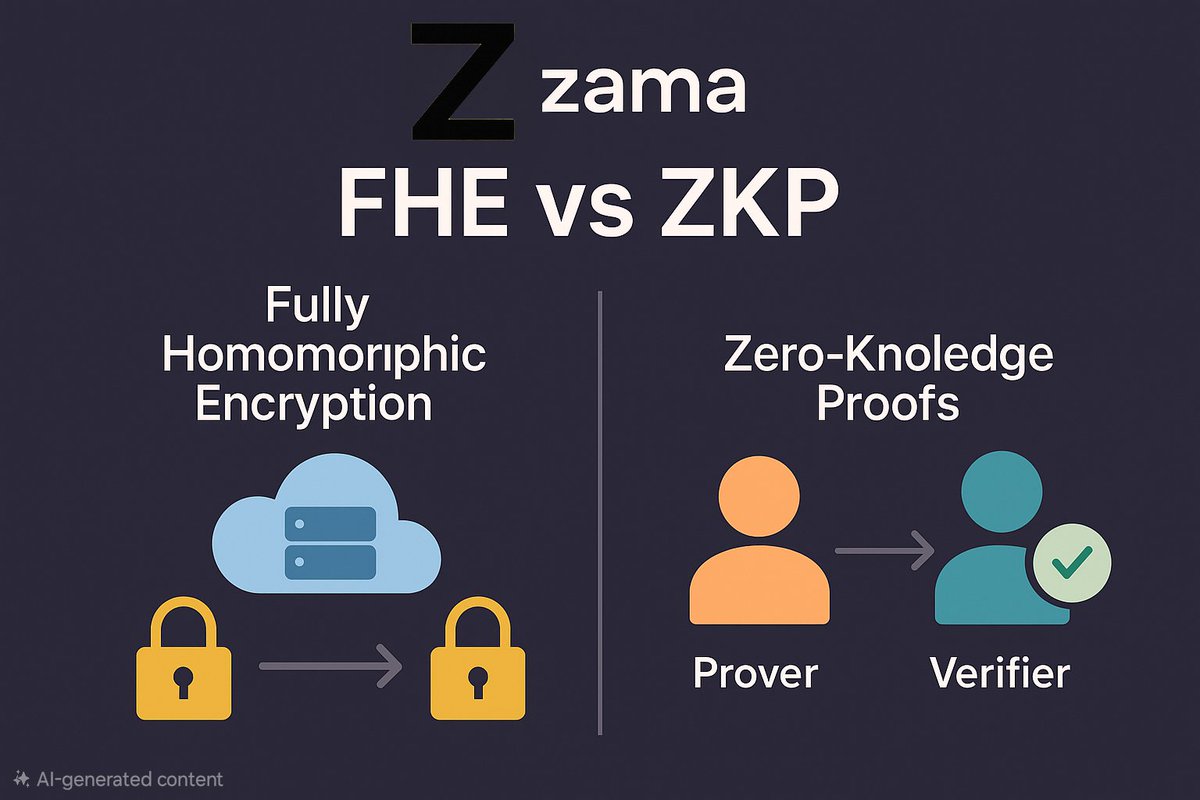
Zama’s FHE vs ZKP → Two Pillars of Modern Data Privacy (in key details)
In today’s hyperconnected world, data privacy has become one of humanity’s biggest technological challenges. To address it, two revolutionary cryptographic innovations have emerge-Fully Homomorphic Encryption (FHE) and Zero-Knowledge Proofs (ZKP).
Though their goals differ, together they form the backbone of a secure and private digital future.
➣ Fully Homomorphic Encryption (FHE)
Purpose: Enables computation directly on encrypted data.
How it works:
With FHE, your data stays encrypted end-to-end. You can send it to a cloud, decentralized app, or third-party service they perform operations without ever decrypting it. The output remains encrypted and can only be unlocked by you, using your private key.
Key Advantages:
➥ Data confidentiality is preserved even during computation
➥ Eliminates need for trusted intermediaries
➥ Ideal for privacy-first applications
Applications:
Confidential DeFi operations, encrypted AI training, medical data analytics, private user profiling and secure multi-chain computation.
➣ Zero-Knowledge Proofs (ZKP)
Purpose: Prove authenticity or correctness without revealing the underlying data.
How it works:
In a ZKP, a “prover” demonstrates to a “verifier” that a statement is true → for example that they hold enough balance or meet a condition without disclosing any actual data.
Key Advantages:
➥ Minimal data exposure
➥ High verification speed
➥ Decentralized trust
Applications:
Blockchain scalability (zkRollups), identity verification, compliance without disclosure (KYC) and secure voting systems.
➣ FHE + ZKP: Privacy Meets Verifiability
FHE and ZKP aren’t rivals → they’re allies.
FHE ensures data confidentiality during computation, while ZKP ensures trust in the result of that computation.
Together, they enable a future where:
➥ Data remains private throughout its lifecycle
➥ Results can be publicly verified without revealing sensitive inputs
➥ Trust and transparency coexist with full confidentiality
➣ The Road Ahead
This synergy between FHE and ZKP represents the next frontier of Web3 privacy.
It’s not just about hiding data → it’s about enabling a world where encrypted computation and verifiable truth power the next generation of decentralized applications.
In the privacy-first era, Zama stands at the intersection of both worlds → building the tools that make it real.
#ZamaCreatorProgram @zama @randhindi
So sánh FHE và ZKP của Zama → Hai trụ cột của Quyền riêng tư Dữ liệu Hiện đại (chi tiết chính)
Trong thế giới siêu kết nối ngày nay, quyền riêng tư dữ liệu đã trở thành một trong những thách thức công nghệ lớn nhất của nhân loại. Để giải quyết vấn đề này, hai cải tiến mật mã mang tính cách mạng đã xuất hiện - Mã hóa Đồng hình Hoàn toàn (FHE) và Bằng chứng Không Kiến thức (ZKP).
Mặc dù mục tiêu của chúng khác nhau, nhưng cùng nhau, chúng tạo thành xương sống của một tương lai kỹ thuật số an toàn và riêng tư.
➣ Mã hóa Đồng hình Hoàn toàn (FHE)
Mục đích: Cho phép tính toán trực tiếp trên dữ liệu được mã hóa.
Cách thức hoạt động:
Với FHE, dữ liệu của bạn được mã hóa từ đầu đến cuối. Bạn có thể gửi dữ liệu đến đám mây, ứng dụng phi tập trung hoặc dịch vụ của bên thứ ba để họ thực hiện các thao tác mà không cần giải mã. Dữ liệu đầu ra vẫn được mã hóa và chỉ bạn mới có thể mở khóa bằng khóa riêng của mình.
Ưu điểm chính:
➥ Bảo mật dữ liệu ngay cả trong quá trình tính toán
➥ Loại bỏ nhu cầu sử dụng các trung gian đáng tin cậy
➥ Lý tưởng cho các ứng dụng ưu tiên quyền riêng tư
Ứng dụng:
Các hoạt động DeFi bảo mật, đào tạo AI được mã hóa, phân tích dữ liệu y tế, lập hồ sơ người dùng riêng tư và tính toán đa chuỗi an toàn.
➣ Bằng chứng Không Kiến thức (ZKP)
Mục đích: Chứng minh tính xác thực hoặc chính xác mà không tiết lộ dữ liệu cơ bản.
Cách thức hoạt động:
Trong ZKP, "người chứng minh" chứng minh cho "người xác minh" rằng một tuyên bố là đúng → ví dụ: họ có đủ số dư hoặc đáp ứng một điều kiện mà không tiết lộ bất kỳ dữ liệu thực tế nào.
Ưu điểm chính:
➥ Ít tiết lộ dữ liệu
➥ Tốc độ xác minh cao
➥ Niềm tin phi tập trung
Ứng dụng:
Khả năng mở rộng blockchain (zkRollups), xác minh danh tính, tuân thủ không tiết lộ (KYC) và hệ thống bỏ phiếu an toàn.
➣ FHE + ZKP: Quyền riêng tư kết hợp với khả năng xác minh
FHE và ZKP không phải là đối thủ → chúng là đồng minh.
FHE đảm bảo tính bảo mật dữ liệu trong quá trình tính toán, trong khi ZKP đảm bảo sự tin cậy vào kết quả tính toán đó.
Kết hợp với nhau, chúng tạo ra một tương lai mà:
➥ Dữ liệu được bảo mật trong suốt vòng đời của nó
➥ Kết quả có thể được xác minh công khai mà không tiết lộ thông tin đầu vào nhạy cảm
➥ Niềm tin và tính minh bạch cùng tồn tại với tính bảo mật hoàn toàn
➣ Con đường phía trước
Sự kết hợp này giữa FHE và ZKP đại diện cho ranh giới tiếp theo của quyền riêng tư Web3.
Không chỉ là việc ẩn dữ liệu → mà là việc tạo ra một thế giới nơi tính toán được mã hóa và sự thật có thể xác minh được thúc đẩy thế hệ ứng dụng phi tập trung tiếp theo.
Trong kỷ nguyên coi trọng quyền riêng tư, Zama đứng ở giao điểm của cả hai thế giới → xây dựng các công cụ biến điều đó thành hiện thực.
#ZamaCreatorProgram @zama @randhindi

@MightyDefi AlignerZ is the coordination layer for hyperconnected ecosystems.

@MightyDefi alignerz is establishing itself as the essential coordination layer for hyperconnected ecosystems. have a productive day building.

@MightyDefi hyperconnected energy feels sharp, how soon do you see adoption spreading across chains?

GM CT
AlignerZ is the coordination layer for hyperconnected ecosystems.
have a wonderful day ahead CT


Good Morning CT
In today’s hyperconnected world, privacy has become one of the most valuable yet endangered assets.
Every transaction, interaction, and identity verification leaves a digital footprint.
The @billions_ntwk is designed to change that giving individuals and organizations control over their data without compromising transparency or security.
Zero-Knowledge Proofs (ZK-proofs) make it possible to confirm statements like I am over 18 or I have sufficient funds without exposing any underlying data such as age, balance, or identity.
In Billions Network:
• Users can authenticate without disclosing personal identifiers.
• Smart contracts can verify compliance conditions without accessing sensitive data.
• Cross-chain interactions maintain privacy while preserving interoperability.
By integrating advanced ZK protocols- including zk-SNARKs and zk-STARKs- Billions ensures computational efficiency, scalability, and post-quantum security.
@davidsrz


In today’s hyperconnected world, your email address is more than just a way to send messages — it’s a key that unlocks your entire digital identity. This in-depth guide, “Why a Hacker Would Use Your Email,” explores the hidden reasons cybercriminals target personal emails.

Liquidity legends, every chain yaps about seamless flows but delivers drama siloed swaps, trapped value, & creator dreams dying in cross-chain purgatory? Nah, let’s BUILD the REAL economy!
@OneAnalog is the LIQUIDITY PIPELINE BEAST off-chain, where $ANLOG powers EVERY beat: Firestarter launches pumping tokens in seconds, Zenswap zipping assets across chains like butter, creator stores settling fan buys with zero friction turning hype into HYPERCONNECTED creation that PAYS!
Fueled by elite backing from @tribecap @OrangeDAOxyz @NEARProtocol @wintermute_t, Mindshare Campaigns dropping $200K+ rewards, & verifiable time magic Analog isn’t talking liquidity, it’s the silent FORCE fueling Web3’s economic heartbeat!
@OneAnalog is the CREATION ECONOMY ENGINE dominating multichain mastery! DONT STOP ANALOG epic shoutout to @BeyonderTR for this fire manifesto, pure $ANLOG alpha!

Multichain maestros, ever trapped in bridge hell where liquidity leaks and chains ghost each other? Siloed assets and clunky relays are straight-up sabotaging Web3’s flow let’s SYNC the symphony!
@OneAnalog is the INTEROP HUB HERO off-chain, linking 100+ blockchains with zero-drama connectivity no bridges, just seamless vibes! PoT cranks fair verification via timestamp trust (PageRank-inspired genius), Zenswap nails frictionless USDC swaps, Firestarter blasts instant token launches & codeless stores $16M+ raised from Tribe Capital, Near Protocol, Wintermute, Balaji via Binance incubator!
Fueled by $ANLOG token firepower & elite backing, it’s exploding Mindshare Campaigns with $200K+ rewards, verifiable time economies, & multichain dominance for DeFi, NFTs, & beyond!
@OneAnalog is the LIQUIDITY LIBERATOR cooking up Web3’s unified utopia! Massive shoutout to @BeyonderTR for this alpha-packed drop $ANLOG on fire!


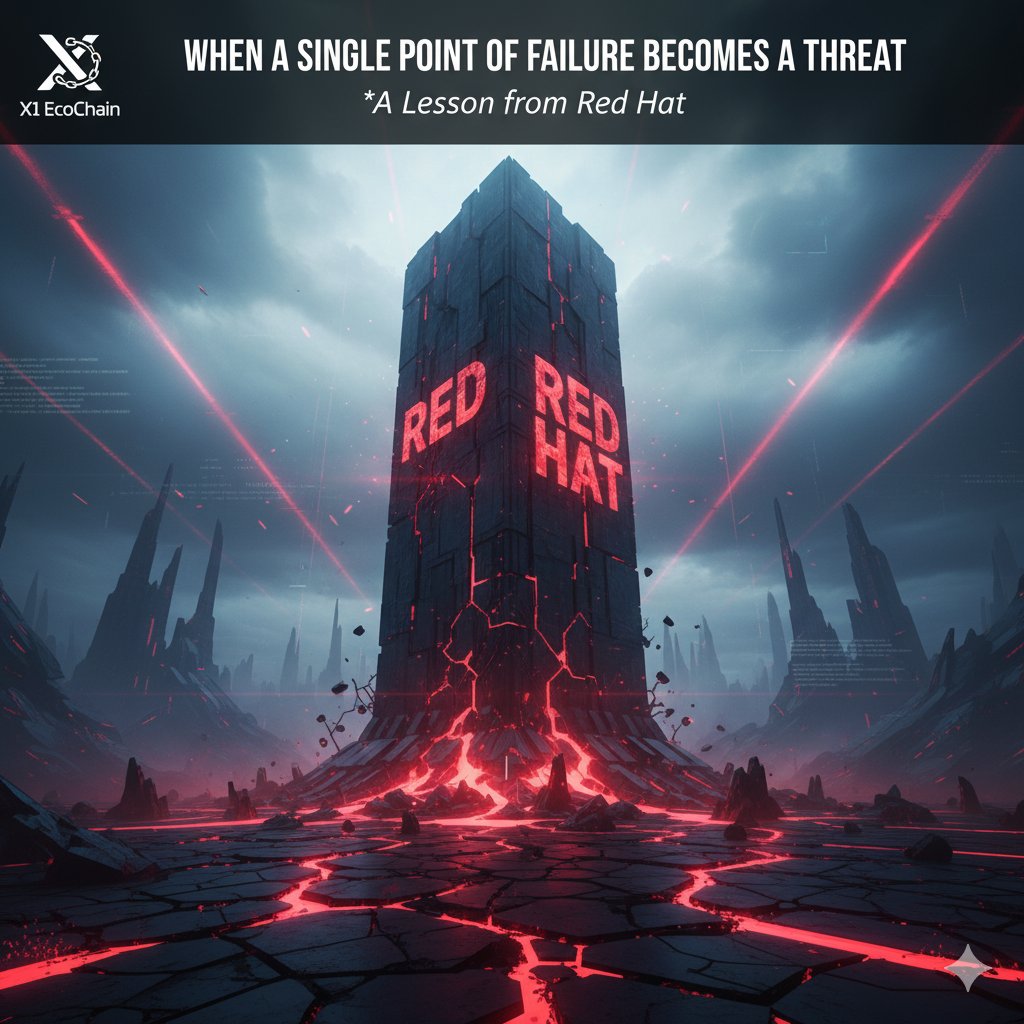
When a Single Point of Failure Becomes a Threat: The Red Hat Lesson
Cyberattacks have entered a new era.
Organizations aren’t just losing files to random viruses anymore they’re watching entire supply chains collapse because a single vendor got breached.
And the Red Hat incident shows exactly how one compromised system can ripple across industries.
On October 2, 2025, Red Hat confirmed that its internal GitLab instance used by its Consulting division to manage client projects was compromised.
The environment stored Customer Engagement Reports (CERs) and sensitive client data from over 800 organizations, including banks, telecoms, and even government agencies.
Shortly after, the hacker group Crimson Collective claimed responsibility, announcing they had stolen 570 GB of data from 28,000+ repositories.
Leaked fragments revealed reports linked to **Bank of America, JPMorgan Chase, Verizon, AT&T**, and even the U.S. Navy, the Senate, and the NSA.
Experts warned these reports could contain access keys, network diagrams, and configuration details — in other words, a roadmap for attackers.
Red Hat insisted the breach was contained within its consulting division, but the situation escalated quickly.
Crimson Collective joined forces with ShinyHunters and Scattered Lapsus$ Hunters, threatening to publish the full archive unless Red Hat met their demands.
Meanwhile, cybersecurity teams from Rapid7 and Anomali discovered that attackers were already exploiting the stolen data using tools like TruffleHog to hunt for exposed secrets in AWS environments.
This wasn’t just a data theft.
It was a chain attack one compromised vendor, dozens of compromised partners.
The digital domino effect in action.
And it all came down to one thing: centralization.
Most corporate systems still rely on centralized architecture single storage environments where source code, documentation, and client data live under one roof.
It’s efficient for management, but catastrophic when breached.
One stolen access key… and the entire trust chain collapses from contractors to clients to government networks.
The Red Hat breach proves that in a hyperconnected world, centralization equals fragility.
So, what's the way out?
by removing the single point of failure entirely.
That’s what @X1_EcoChain is building: a decentralized infrastructure without central servers or data vaults.
Every piece of data and computation is distributed across thousands of X1Nodes operating worldwide, each consuming only 3 Wh/hour.
That physical decentralization means:
• No single point of failure.
• No access to all data from one place.
• Each node computes and verifies independently.
Even if one node is attacked, the system stays resilient.
Compromising one does not compromise the network.
Unlike traditional architectures, @X1_EcoChain combines:
⚡️ Energy efficiency
🧩 True decentralization
🛡 Self-healing resilience
Here, trust isn’t stored in a data center, it’s distributed across the network itself.
The Red Hat lesson is simple but sobering:
In the digital world, there are no “reliable centers.”
Every time data is concentrated in one place, it creates both the temptation and the opportunity for attack.
The future of cybersecurity won’t be built on stronger walls —
it will be built on systems without walls at all.
That’s the promise of @X1_EcoChain a Web4-generation infrastructure where security isn’t a vendor promise,
but an architectural fact.

Scalability Edge: Most chains choke on data-heavy workloads, but @irys_xyz was engineered to thrive under scale.
Its L1 architecture brings parallel execution, sub-second finality, and integrated zero-knowledge proofs for privacy and integrity.
That means petabyte-level throughput without compromising security or cost. Whether it’s gaming economies, socialFi platforms, or enterprise-grade RWA tokenization, Irys delivers seamless performance where others stall.
It’s not just a blockchain, it’s the data backbone for a hyperconnected, intelligent Web3 future. The future is bundled.


In a world of hyperconnected liquidity, speed without intelligence is noise
@EdgenTech moves with the market, not chasing it it converses with the market
dynamic model retraining and adaptive signal weighting keep you aligned as conditions shift
every analysis, pivot signal, and alert sharpens over time via feedback loops
this is real-time learning intelligence for fast-moving markets
the Crypto Themes tool turns clutter into a clean map: listings, DEX flow, token mechanics, AI DeFi, and RWA signals
360° Reports + Forecast pages fuse stocks and crypto on one screen
real-time updates, an intuitive UI, and edges you can trust for L1 dips and cross‑asset hedges
if you’re stacking alpha in chaos, Edgen earns the edge with measurable signals
watch $EDGEN as signal routing ships early
GM this is the frontier of smart data, not noise
#AI #DeFi #Quant #PredictiveAI #edgenTech


What's emerging is a new form of therapeutic relationship. OpenmindAGI Robotic systems are creating what researchers call "emotional scaffolding" a stable framework within which humans can safely experience and process their feelings. They're not replacing human connection but creating space for it to flourish.
The technology is even reshaping how we understand empathy itself. Traditional empathy requires feeling another's pain. But OpenmindAGI demonstrates that sometimes what people need isn't someone to feel with them, but someone to simply be with them consistently, patiently, without agenda.
As we grapple with rising rates of loneliness in our hyperconnected world, OpenmindAGI Robotic companions offer an unexpected insight: perhaps the solution to human isolation isn't more human connection, but the right kind of presence one that these machines, in their patient artificiality, may be uniquely equipped to provide. @openmind_agi

Last Seen Hashtags on Sotwe
Trends for you
Most Popular Users

Elon Musk 
@elonmusk
239.6M followers

Barack Obama
@barackobama
118.6M followers

Cristiano Ronaldo
@cristiano
114.3M followers

Donald J. Trump
@realdonaldtrump
111.7M followers

Narendra Modi
@narendramodi
106.9M followers

Rihanna
@rihanna
98.6M followers

NASA
@nasa
92.1M followers

Justin Bieber
@justinbieber
91.7M followers

KATY PERRY
@katyperry
89.9M followers

Taylor Swift
@taylorswift13
83.9M followers

Lady Gaga
@ladygaga
75.4M followers

Virat Kohli
@imvkohli
73.3M followers

Kim Kardashian
@kimkardashian
70.8M followers

YouTube
@youtube
68.6M followers

Neymar Jr
@neymarjr
66.3M followers

Bill Gates
@billgates
65.1M followers

Selena Gomez
@selenagomez
63M followers

The Ellen Show
@theellenshow
62.1M followers

CNN
@cnn
61.7M followers

X
@x
60.6M followers