

Top Tweets for #microlearningphp

99/100: 🚀 Congratulations! You've learned the basics of PHP programming, from setting up a shared hosting environment to working with databases. Continue practicing and exploring PHP documentation to expand your skills. #KeepLearning #MicroLearningPHP #NetiServer
98/100: 🌐 Close the MySQL database connection using the mysqli_close() function. Save the file.
#CloseMySQLConnection #MicroLearningPHP #NetiServer
97/100: 🌐 Refresh your browser to see the result of modifying the MySQL database records. The changes should be reflected in the displayed records.
#DatabaseModificationResult #MicroLearningPHP #NetiServer
96/100: 🌐 Practice inserting, updating, and deleting records in the MySQL database using PHP. Write SQL queries and use the mysqli_query() function to execute them. Save the file.
#ModifyDatabaseRecords #MicroLearningPHP #NetiServer
95/100: 🌐 Refresh your browser to see the result of querying the MySQL database. The records from the table should be displayed.
#MySQLQueryResult #MicroLearningPHP #NetiServer
94/100: 🌐 Use a while loop and the mysqli_fetch_assoc() function to iterate through the query result and display the records. Save the file.
#FetchQueryResults #MicroLearningPHP #NetiServer
93/100: 🌐 Write a simple SQL query to select all records from the table you created earlier. Use the mysqli_query() function to execute the query and store the result in a variable. Save the file.
#MySQLSelectQuery #MicroLearningPHP #NetiServer
92/100: 🌐 In your PHP script, practice connecting to the MySQL database using mysqli_connect(). Make sure to replace the function's arguments with the correct database credentials. Save the file.
#ConnectToMySQL #MicroLearningPHP #NetiServer
89/100: 🌐 Learn about working with databases in PHP. One popular database management system is MySQL. PHP can interact with MySQL databases to store, retrieve, and modify data.
#PHPMySQL #MicroLearningPHP #NetiServer
https://t.co/DizSL5bCVS
88/100: 🌐 Refresh your browser to see the result of sending an email with PHP. Check the recipient's inbox to confirm the email was sent. Note that sending emails may not work on some shared hosting environments due to server restrictions.
#MailFunctionResult #MicroLearningPHP
87/100: 📧 Practice sending a simple email using the mail() function. Be sure to replace $to with a valid email address. Save the file.
#MailFunctionExample #MicroLearningPHP #NetiServer
86/100: 📧 Study the syntax for the mail() function:
mail($to, $subject, $message, $headers);
$to is the recipient's email address, $subject is the email subject, $message is the email body, and $headers are optional email headers
#MailFunctionSyntax #MicroLearningPHP #NetiServer
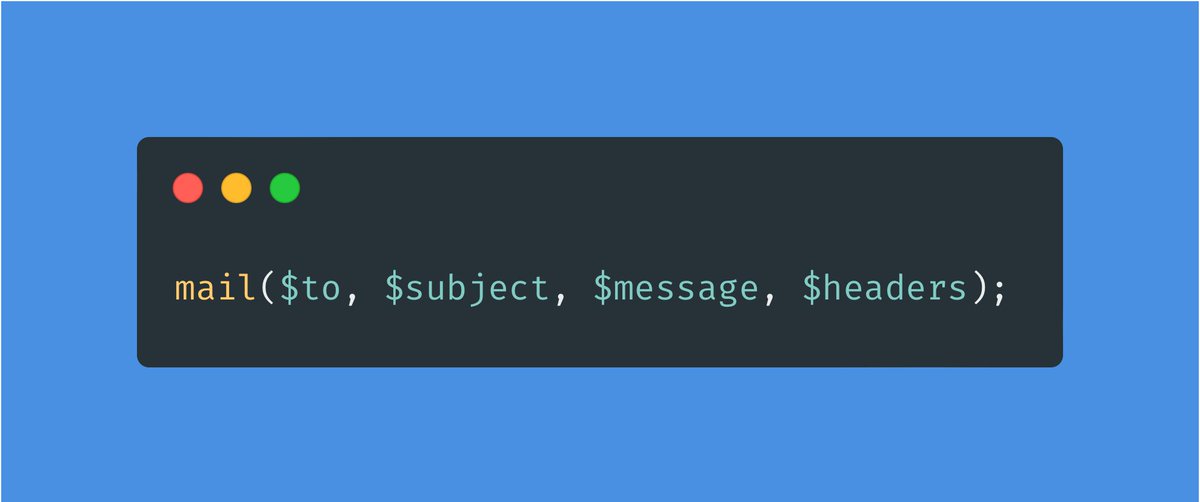
85/100: 📧 Learn about sending emails with PHP using the mail() function. This function allows you to send emails directly from your PHP script.
#PHPEmail #MicroLearningPHP #NetiServer
https://t.co/7peZlwZC26
84/100: 🌐 Refresh your browser to see the result of working with the file functions. Check the server to ensure example.txt has been created and contains the string you wrote.
#FileFunctionsResult #MicroLearningPHP #NetiServer
83/100: 💾 Create a new text file named example.txt on the server. In your PHP script, practice opening the file, writing a string to it, and closing the file using the fopen(), fwrite(), and fclose() functions. Save the file.
#FileFunctionsExample #MicroLearningPHP #NetiServer
82/100: 💾 Explore some common file functions: fopen(), fclose(), fwrite(), fgets(), file_exists(), and unlink().
#CommonFileFunctions #MicroLearningPHP #NetiServer
81/100: 💾 Learn about working with files in PHP using file functions. PHP allows you to read, write, and modify files on the server.
#PHPFileFunctions #MicroLearningPHP #NetiServer
https://t.co/hXLf2yhFmT
80/100: 🌐 Refresh your browser to see the result of applying the array functions to the $numbers array. The manipulated array should be displayed.
#ArrayFunctionsResult #MicroLearningPHP #NetiServer
79/100: 🗂️ Practice using some of the array functions on the $numbers array created earlier. For example, use count() to find the length of the array and array_push() to add a new element. Save the file.
#ArrayFunctionsExample #MicroLearningPHP #NetiServer
78/100: 🗂️ Explore some common array functions: count(), in_array(), array_push(), array_pop(), array_shift(), array_unshift(), sort(), and implode().
#CommonArrayFunctions #MicroLearningPHP #NetiServer
Most Popular Users

Elon Musk 
@elonmusk
240.1M followers

Barack Obama
@barackobama
119.3M followers

Donald J. Trump
@realdonaldtrump
111.6M followers

Cristiano Ronaldo
@cristiano
108.8M followers

Narendra Modi
@narendramodi
106.9M followers

Rihanna
@rihanna
97.2M followers

NASA
@nasa
92.1M followers

Justin Bieber
@justinbieber
90.5M followers

KATY PERRY
@katyperry
86.7M followers

Taylor Swift
@taylorswift13
80.5M followers

Lady Gaga
@ladygaga
72.1M followers

Kim Kardashian
@kimkardashian
69.3M followers

YouTube
@youtube
68.6M followers

Virat Kohli
@imvkohli
68.4M followers

Bill Gates
@billgates
63.4M followers

The Ellen Show
@theellenshow
62.5M followers

CNN
@cnn
61.9M followers

Neymar Jr
@neymarjr
60.9M followers

X
@x
60.9M followers

CNN Breaking News
@cnnbrk
59.9M followers