

Top Tweets for #microsoftcloud

Most teams treat Azure Policy like a compliance report.
That misses the bigger value.
Azure Policy is one of the few controls in Azure that can influence what gets deployed, not just report on what already exists.
That matters more than most teams realize.
When people, pipelines, or templates create or update resources, Azure Policy evaluates those resources against the rules you define. Depending on the effect, it can audit, deny, append, modify, or even deploy missing configuration.
That is not just reporting.
That is platform behavior.
This is why Azure Policy matters so much in a real landing zone.
You can require tags.
You can restrict regions.
You can enforce configuration standards.
You can automatically apply or remediate settings in the right scenarios.
Not through a standards document.
Through the platform itself.
That changes the operating model.
Without policy, governance depends on people remembering the rules.
With policy, the platform helps enforce the rules consistently.
But there is a tradeoff.
If you go too hard with deny too early, you create friction and slow teams down.
If you stay too passive with audit-only forever, nothing really changes.
Microsoft’s guidance points toward a better pattern:
start with visibility, understand the impact, then move toward stronger enforcement where it makes sense.
That is the real design decision.
Not whether Azure Policy matters.
It does.
The decision is how intentionally you use it.
Because once an Azure environment grows, retrofitting governance is a lot harder than building it in from the start.
Azure Policy is not just about compliance.
It is one of the clearest ways to turn governance standards into actual platform control.
#Azure #MicrosoftAzure #AzurePolicy #CloudGovernance #AzureArchitecture #CloudArchitecture #LandingZones #CloudSecurity #PlatformEngineering #MicrosoftCloud

🚀 Day 10 of 30 Days of Azure Well-Architected Framework – Performance Efficiency in action!
When we talk about the Performance Efficiency pillar, it’s all about making sure your workloads scale smoothly and deliver consistent user experiences—even under pressure. That’s where Azure Load Testing comes in.
Here’s the lowdown:
💡 No Infrastructure Fuss: Fully managed load generation. Just define your test and Azure spins up the firepower to simulate thousands of users. No VMs or test rigs for you to maintain 🤖🔥
💡 Realistic Scenarios: Use JMeter/Locust scripts to mimic real user flows – logins, checkouts, you name it. Or do a quick URL smash test. Custom or simple, your call 🎯
💡 Live Insights: While the test runs, watch live charts of response times, CPU, memory – all in one view! Identify bottlenecks during the test, not afterward. It’s like x-ray vision for your app’s performance under stress 📊👀
💡 Automate & Integrate: Fold load tests into your CI/CD pipeline. Set pass/fail criteria (e.g. fail deploy if latency >2s). Now each release gets a performance checkmark ✅ or a “back to dev” 🚫. No more guesswork on whether that new build can handle the heat.
💡 Peak Prep & Confidence: Plan for Black Friday or viral spikes with data. By testing different loads, you’ll know how far you can scale or where to tweak. Sleep better at night knowing your architecture can handle the storm 😌🌩️
Takeaway: Azure Load Testing turns “I hope it holds” into “I know it will”. It’s about proactive performance tuning and delivering great UX even at 10x users. Don’t launch untested – load test and launch with confidence! 🚀💪
#Azure #WellArchitected #LoadTesting #AzureDevOps #Performance #Scalability #AzureTips #MicrosoftAzure #MVPBuzz #MicrosoftCloud #AzureWAF
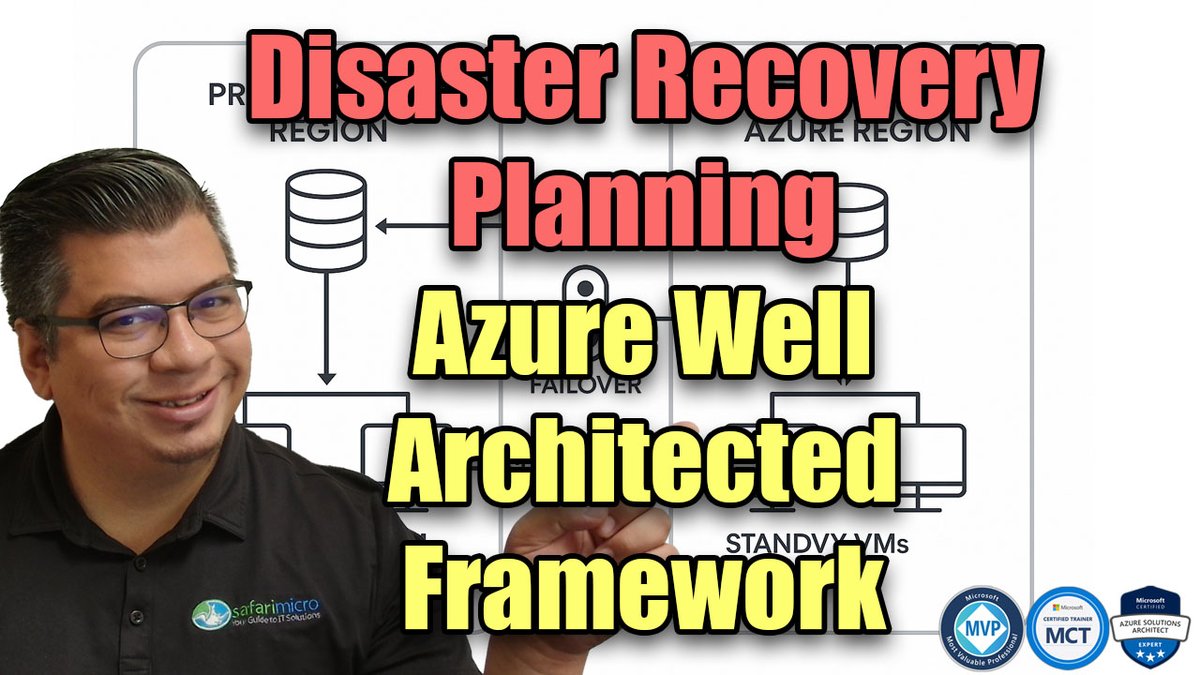
👉 Why Disaster Recovery Planning Matters in Azure #WellArchitectedFramework🤷♂️
Disaster Recovery (DR) isn’t just a checkbox—it’s a critical part of your cloud reliability strategy. Even with highly available architecture, region-wide outages or critical failures can happen. A strong DR plan ensures your business can bounce back quickly and minimize impact.
Here’s how to build an effective DR strategy in Azure:
✅ Define RTO and RPO
Start with Recovery Time Objective (RTO) and Recovery Point Objective (RPO). These metrics define how fast you need to recover and how much data loss is acceptable. For example, an e-commerce platform may require an RTO of 1 hour and RPO of 15 minutes.
✅ Use Azure Site Recovery (ASR)
ASR replicates virtual machines (VMs) across regions for quick failover. It also supports replication from on-premises or Azure VMware Solution environments to the cloud.
✅ Leverage Geo-Redundancy
Enable geo-replication for storage (e.g., GRS for Blob Storage, active geo-replication for Azure SQL). Consider deploying standby application instances in a secondary region—passive until needed.
✅ Automate Failover
Document your failover steps and automate where possible. ASR enables one-click failover. For custom setups, use runbooks and scripts to update DNS or reroute traffic.
✅ Test Your DR Plan
A DR plan is only as good as its test results. Use Azure’s test failover capabilities to simulate outages and measure your actual RTO. Regular testing builds confidence and reveals gaps.
Azure’s Well-Architected Framework recommends designing with recovery in mind—because when disaster strikes, readiness makes all the difference.
🔁 Don't just back up—be ready to bounce back.
#Azure #DisasterRecovery #CloudResilience #AzureSiteRecovery #HighAvailability #CloudStrategy #BusinessContinuity #AzureWellArchitected #ITLeadership #CloudArchitecture #MicrosoftAzure #MicrosoftCloud

AI agents shouldn’t make decisions in the dark—especially in healthcare.
We’ve developed a Chainlit-style reasoning pane using enterprise-friendly tech: .NET, Node.js, and React.
#EnterpriseAI #MicrosoftCloud #MSCloudHealth #HealthcareEngineering #AIArchitecture #HCLDR

🔥Azure Private DNS Zones can be used for secure, internal name resolution within Azure when you create a Private Endpoint.🔥
🎞️ This is a clip from my full video on Private Endpoints 🔗: https://t.co/usTRQwgUaP
When you create a private endpoint for an Azure service like Storage, Azure automatically creates an 'A record' in a private DNS zone. This record ensures your Azure resources resolve service names directly to private IPs, facilitating secure, internal communication without traversing the public internet. 🔒
Key Points:
🔹 Private DNS zones automatically link DNS records to your private endpoints.
🔹 You can connect a single private DNS zone to multiple virtual networks.
🔹 Custom DNS servers can leverage private DNS zones as secondary DNS for robust resolution.
🔹 Private DNS zones are Azure-internal only, requiring additional configuration for hybrid/on-premises environments.
Whether you're dealing with Azure Storage, SQL databases, or other PaaS services, mastering Private Endpoints is key to ensuring secure and efficient connectivity within your virtual networks. 🔐🌐
Check out the full video on Private Endpoints!
Full video 🔗: https://t.co/usTRQwgUaP
#Azure #AzureNetworking #PrivateEndpoints #CloudSecurity #MicrosoftAzure #MsCloudBros #AzureMVP #CloudArchitecture #TechTutorial #DNSConfiguration #AzureTips #Microsoft #MicrosoftCloud #PrivateDNSZone
🔥 🎥 New Video Alert! 📢 Azure Private Endpoints 🔥
Full video 🔗: https://t.co/usTRQwgUaP
Ever wondered what Azure Private Endpoints are, or struggled with DNS when configuring them? 🤔
In my latest video, we dive deep into:
🔹 What Azure Private Endpoints are.
🔹 Why you’d want to use them.
🔹 How to configure them correctly in the Azure Portal.
🔹 Mastering DNS resolution challenges with Private Endpoints.
Whether you're dealing with Azure Storage, SQL databases, or other PaaS services, mastering Private Endpoints is key to ensuring secure and efficient connectivity within your virtual networks. 🔐🌐
Check out the video!
Full video 🔗: https://t.co/usTRQwgUaP
📌 Like, Subscribe, and hit the 🔔 to stay updated on all things Azure and Microsoft Cloud!
#Azure #AzureNetworking #PrivateEndpoints #CloudSecurity #MicrosoftAzure #MsCloudBros #AzureMVP #CloudArchitecture #TechTutorial #DNSConfiguration #AzureTips #Microsoft #MicrosoftCloud

#MicrosoftCloud for Healthcare is transforming patient care and clinician experience. 🩺
By harnessing the power of Azure Health Data Services, clinical teams can make data-driven decisions, enhancing care quality. Plus, less time on admin means more time for patients.
A true win-win! 🙌https://t.co/BKbzTlEO1R
#HealthcareInnovation #MicrosoftAzure #MSCloudHealth #MC4H

Trends for you
Most Popular Users

Elon Musk 
@elonmusk
240.1M followers

Barack Obama
@barackobama
118.6M followers

Cristiano Ronaldo
@cristiano
114.4M followers

Donald J. Trump
@realdonaldtrump
111.7M followers

Narendra Modi
@narendramodi
106.9M followers

Rihanna
@rihanna
98.6M followers

NASA
@nasa
92.1M followers

Justin Bieber
@justinbieber
91.7M followers

KATY PERRY
@katyperry
89.9M followers

Taylor Swift
@taylorswift13
83.9M followers

Lady Gaga
@ladygaga
75.4M followers

Virat Kohli
@imvkohli
73.3M followers

Kim Kardashian
@kimkardashian
70.8M followers

YouTube
@youtube
68.6M followers

Neymar Jr
@neymarjr
66.3M followers

Bill Gates
@billgates
65.2M followers

Selena Gomez
@selenagomez
63M followers

The Ellen Show
@theellenshow
62.1M followers

CNN
@cnn
61.7M followers

X
@x
60.6M followers