

Top Tweets for #openbind

The first OpenBind release: An open experimental structure–affinity dataset and benchmark for structure-based AI
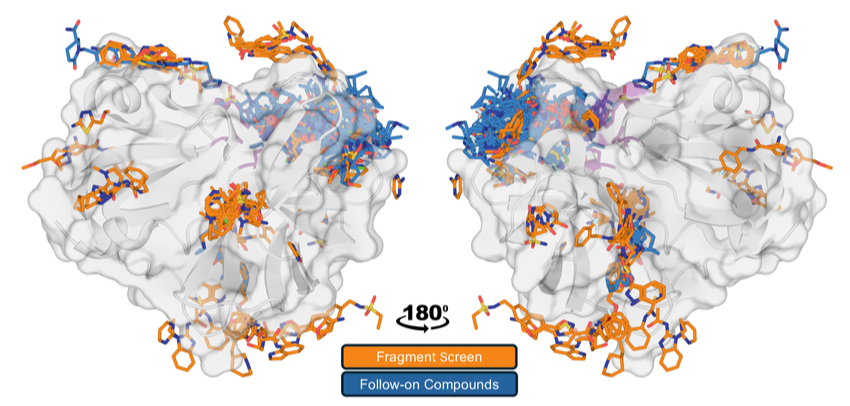
1 OpenBind is introduced as an open-science effort to generate experimentally coherent structure–affinity datasets for structure-based AI. This first public release targets enteroviral 2A protease and is positioned as the largest public single-target experimental structure–affinity dataset to date.
2 Dataset scale and composition: 925 crystallographic binding events from 699 compounds, with grating-coupled interferometry (GCI; waveRAPID) affinity measurements for 601 compounds. After curation, 881 binding events remain for structural benchmarking (79 fragments, 802 follow-ons), and a QC-filtered affinity benchmark contains 490 compounds.
3 A key design choice is “campaign coherence”: structures come from an initial crystallographic fragment screen followed by follow-on soaking, and affinities are measured in a consistent biophysical setup. This reduces heterogeneity typical of retrospective datasets aggregated across assays, conditions, and curation standards.
4 The release is intended to test generalization beyond near-neighbor leakage. Using the Runs N’ Poses ligand–pocket similarity metric against PLINDER structures up to 30 Sep 2021 (AlphaFold3 cutoff), curated complexes show only moderate similarity (median ~40; most <50), a regime where prior work observed substantial cofolding performance drops.
5 Docking benchmarks show receptor-state selection dominates outcomes. With cognate holo receptors (redocking), GNINA reaches ~85% Top-25 success, but cross-docking into apo-like receptors (experimental apo 8POA or AF2 apo model) collapses due to a loop near the pocket adopting a partially occluding conformation.
6 Fragment-informed cross-docking partially rescues performance: selecting a receptor from the most chemically similar fragment-bound complex improves pose recovery (e.g., GNINA Top-25 RMSD-valid ~38%), but stringent interaction recovery remains low (Success ~14%), highlighting that fragments may not fully encode the pocket geometry needed for larger follow-ons.
7 Cofolding methods (AlphaFold3, Boltz-1/2, OpenFold3-p2, Protenix-v1, RosettaFold3) mitigate rigid receptor mismatch by allowing pocket adaptation, improving over apo cross-docking. However, Top-1 performance is much lower than Top-25, indicating that generating a correct pose and ranking it first are still distinct bottlenecks; an oracle ensemble across methods suggests complementary failure modes and room for better ranking/selection strategies.
8 Target-specific adaptation is a central takeaway: fine-tuning OpenFold3-p2 on just the curated fragment-bound structures (n=79) substantially improves follow-on pose prediction and virtual screening, with the biggest gains under stricter criteria that require both RMSD accuracy and protein–ligand interaction recovery (LDDT-PLI).
9 Affinity prediction remains difficult even with experimental structures. Across 490 QC-filtered compounds, structure-based methods (e.g., Boltz-2, GNINA, smina, AEV-PLIG, AQAffinity) show only modest correlation overall, and simple baselines are competitive (molecular weight gives the highest Spearman; mean pKD yields the lowest RMSE). The authors emphasize this as a reminder to benchmark against physicochemical baselines in coherent medicinal-chemistry series.
10 Virtual screening benchmark: 2,084 follow-on compounds (566 crystallographic binders; 1,518 “suspected non-binders” defined by no observed binding in technically successful soaks). Docking gives moderate discrimination (smina ROC-AUC 0.624; GNINA CNN VS 0.665). Base OpenFold3-p2 pair ipTM ranking is near-random (ROC-AUC ~0.53), but fragment-fine-tuned OpenFold3-p2 reaches ROC-AUC 0.76, suggesting fragment-derived structural data can make model confidence more informative for hit prioritization on related chemistry.
💻Code: https://t.co/btphfneKHO
📜Paper: https://t.co/H6vFYjpvGa
#OpenBind #StructuralBiology #DrugDiscovery #ProteinLigand #Cofolding #Docking #VirtualScreening #BindingAffinity #OpenScience #Benchmarking

We absolutely need something similar here in the US. It seems the UK will lead in AI-based drug discovery with this effort:
Announced today, the UK’s ‘OpenBind’ consortium will use breakthrough experimental technology to generate the world’s largest collection of data on how drugs interact with proteins, the building blocks of the body. This will be twenty times greater than anything collected over the last fifty years – cementing the UK’s position as a global hub for AI-driven drug discovery.
This will support the training of new AImodels that can identify promising new drugs, giving researchers an unparalleled ability to open up new fronts in the fight against disease- slashing development costs by up to £100 billion and sparking the innovation and economic growth which underpins the government’s Plan for Change.

We're excited to partner with the UK Government on OpenBind, an effort to create the largest open dataset of drug-protein interactions in history.
More data → smarter AI models → better medicines
https://t.co/2xNdXOCq7i


영국의 'OpenBind' 컨소시엄은 약물이 신체의 구성 요소인 단백질과 어떻게 상호 작용하는지에 대한 세계 최대의 데이터 컬렉션을 생성할 것입니다.
이는 지난 50년 동안 수집된 어떤 것보다 20배 더 클 것

More here: https://t.co/wpjncRiNff
Trends for you
Most Popular Users

Elon Musk 
@elonmusk
240.1M followers

Barack Obama
@barackobama
118.6M followers

Cristiano Ronaldo
@cristiano
114.4M followers

Donald J. Trump
@realdonaldtrump
111.7M followers

Narendra Modi
@narendramodi
106.9M followers

Rihanna
@rihanna
98.6M followers

NASA
@nasa
92.1M followers

Justin Bieber
@justinbieber
91.7M followers

KATY PERRY
@katyperry
89.9M followers

Taylor Swift
@taylorswift13
83.9M followers

Lady Gaga
@ladygaga
75.4M followers

Virat Kohli
@imvkohli
73.3M followers

Kim Kardashian
@kimkardashian
70.8M followers

YouTube
@youtube
68.6M followers

Neymar Jr
@neymarjr
66.3M followers

Bill Gates
@billgates
65.2M followers

Selena Gomez
@selenagomez
63M followers

The Ellen Show
@theellenshow
62.1M followers

CNN
@cnn
61.7M followers

X
@x
60.6M followers